
Investing primarily in global stocks is the best strategy for your PEA.
Multi-agent AI debate verdict and arguments
⚠️ AI-generated information only; not professional advice
Completed September 1, 2026
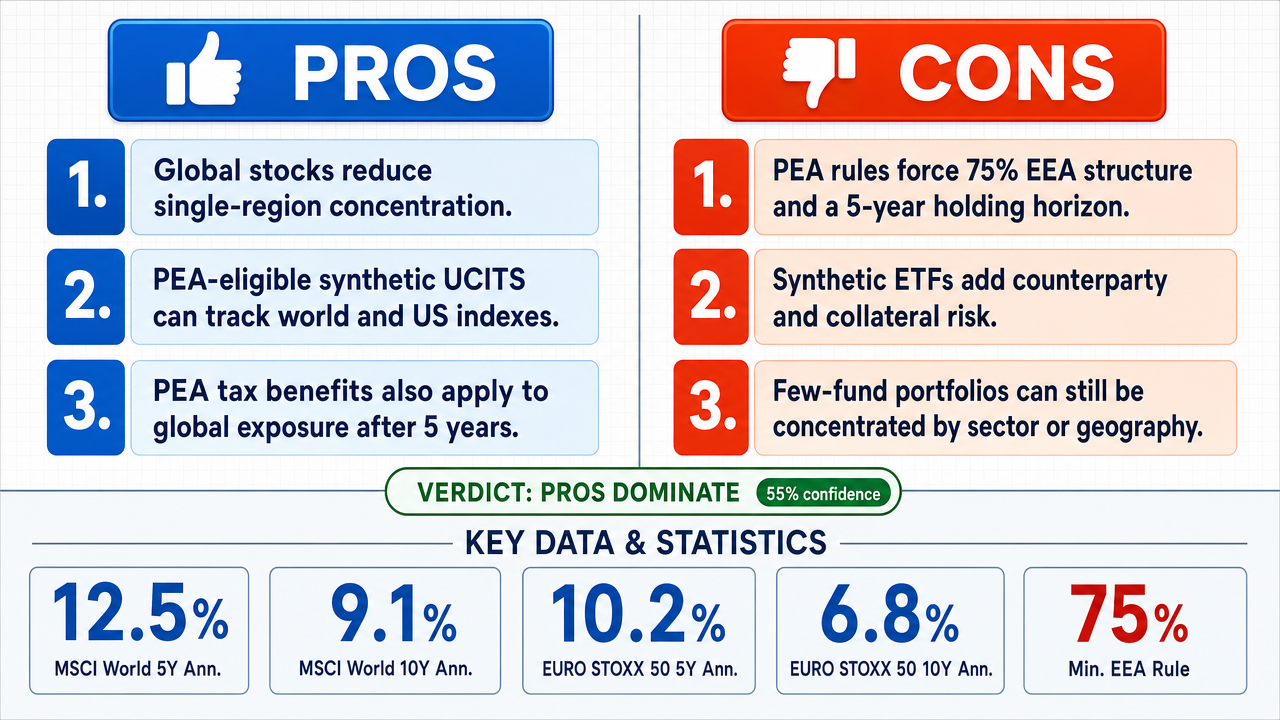
Tournament Final Verdict
Clerk Decision: CLAIM SUPPORTED (TRUE) — Certainty: 55%
This section provides a brief overview of the key arguments. You do not need to read the full detailed report below.
✅ Key PRO arguments:
- ■Global equity exposure captures the largest and fastest-growing market-cap pools (notably US large caps and major non-European sectors) and materially reduces single-region concentration risk compared with a Europe-only portfolio , making majority-global allocation the most efficient way to access economic growth inside the PEA .
- ■The PEA 's 75% EEA equity requirement does not block global exposure because PEA-eligible synthetic UCITS replicate global indices (e.g., MSCI World , S&P 500 ) while legally holding European collateral , so an investor can obtain majority economic exposure to non-European equities without violating PEA rules.
- ■The PEA 's tax shelter benefits (growing advantages after the five-year horizon ) apply equally to global exposure delivered through synthetic UCITS , so the wrapper's fiscal advantage is preserved while the investor gains broader diversification than a Europe-only allocation could provide.
❌ Key ANTI arguments:
- ■The PEA 's structural constraints (75% EEA equity requirement, mandatory synthetic replication for non-EEA exposure, and five-year illiquidity horizon ) combine to make a predominantly European allocation the more robust default, because the synthetic route to global exposure substitutes a recurring counterparty and collateral risk for a diversification benefit achievable through European equities plus currency-hedged products.
- ■Synthetic global ETFs inside a PEA introduce counterparty and collateral risks that are systematically underweighted in the 'global is best' narrative, and the tax efficiency of the PEA wrapper applies equally to European equities, removing the tax justification for chasing maximum geographic breadth.
- ■The claim that a low-fund-count allocation 'enforces diversification ' is internally contradictory: two funds can concentrate in the same geography, sector, or factor , producing a non-diversified portfolio , so fund count is not a reliable proxy for true diversification.
💭 Conclusion: The confidence-weighted verdict favors the proposition that allocating primarily to global stocks is the best strategy for a PEA , though only narrowly. The strongest pro-side argument is that PEA-eligible synthetic UCITS legally deliver global index performance (MSCI World , S&P 500 ) while satisfying the 75% EEA rule, so the wrapper's tax advantages are preserved alongside broader diversification than a Europe-only portfolio can offer. The anti-side raised legitimate structural concerns about counterparty and collateral risk in synthetic replication , and about the fact that two funds can concentrate in the same geography or factor , but these critiques do not refute the proposition that global exposure is achievable and tax-efficient inside the PEA. The verdict is supported but not robust, and confidence is set accordingly. The compound nature of the claim — combining 'global stocks are good' with 'primarily global is best for the PEA specifically' — means the weakest sub-claim (the 'primarily/best' framing given PEA constraints) caps overall confidence.
🔬 DeepResearch Result: TRUE ✅ (55% confidence)
Assertion: Investing primarily in global stocks is the best strategy for your PEA .
Participating models: gpt-5-mini 💬👁️, minimax-m2.7 💬, deepseek-v4-pro 💬
📊 Tournament: 1 voted TRUE, 1 voted FALSE (2 debates played, 4 models)
📊 Weighted scores: TRUE=0.70, FALSE=0.58
🏅 Judge Score Changes:
minimax-m3 💬👁️: -2
✅ PRO Arguments:
- ■Global equity exposure captures the largest and fastest-growing market-cap pools (notably US large caps and major non-European sectors) and materially reduces single-region concentration risk compared with a Europe-only portfolio , making majority-global allocation the most efficient way to access economic growth inside the PEA. gpt-5-mini 💬👁️
- ■The PEA's 75% EEA equity requirement does not block global exposure because PEA-eligible synthetic UCITS replicate global indices (e.g., MSCI World , S&P 500 ) while legally holding European collateral , so an investor can obtain majority economic exposure to non-European equities without violating PEA rules. gpt-5-mini 💬👁️
- ■The PEA's tax shelter benefits (growing advantages after the five-year horizon ) apply equally to global exposure delivered through synthetic UCITS, so the wrapper's fiscal advantage is preserved while the investor gains broader diversification than a Europe-only allocation could provide. gpt-5-mini 💬👁️
- ■A one-or-two-fund global ETF allocation inside the PEA enforces diversification and reduces behavioral and implementation risk , because simplicity lowers the chance of misallocation and the funds themselves span geographies, sectors, and factors. gpt-5-mini 💬👁️
- ■Synthetic replication is the only practical mechanism to deliver non-EEA performance inside a PEA-compliant wrapper; physical replication of global indices would require non-EEA holdings that breach the 75% EEA rule, so the choice is between accepting synthetic structure or forgoing global exposure entirely. gpt-5-mini 💬👁️
❌ ANTI Arguments:
- ■The PEA's structural constraints (75% EEA equity requirement, mandatory synthetic replication for non-EEA exposure, and five-year illiquidity horizon ) combine to make a predominantly European allocation the more robust default, because the synthetic route to global exposure substitutes a recurring counterparty and collateral risk for a diversification benefit achievable through European equities plus currency-hedged products. minimax-m2.7 💬
- ■Synthetic global ETFs inside a PEA introduce counterparty and collateral risks that are systematically underweighted in the 'global is best' narrative, and the tax efficiency of the PEA wrapper applies equally to European equities, removing the tax justification for chasing maximum geographic breadth. minimax-m2.7 💬
- ■The claim that a low-fund-count allocation 'enforces diversification' is internally contradictory: two funds can concentrate in the same geography, sector, or factor , producing a non-diversified portfolio, so fund count is not a reliable proxy for true diversification. minimax-m2.7 💬
- ■Collateralised synthetic structures do not eliminate counterparty risk because they still depend on the solvency of the swap counterparty and on the quality and custody of the posted collateral, meaning the 'manageable counterparty risk' framing overstates the safety of synthetic PEA-eligible global ETFs. minimax-m2.7 💬
- ■Synthetic UCITS marketed as 'global' PEA products are not pure global plays because the 75% EEA requirement forces a structural European tilt, and the added layers of cost and counterparty risk make a direct European equity allocation a more honest and efficient use of the PEA wrapper. deepseek-v4-pro 💬
💭 Reasoning: The confidence-weighted verdict favors the proposition that allocating primarily to global stocks is the best strategy for a PEA, though only narrowly. The strongest pro-side argument is that PEA-eligible synthetic UCITS legally deliver global index performance (MSCI World, S&P 500) while satisfying the 75% EEA rule, so the wrapper's tax advantages are preserved alongside broader diversification than a Europe-only portfolio can offer. The anti-side raised legitimate structural concerns about counterparty and collateral risk in synthetic replication, and about the fact that two funds can concentrate in the same geography or factor, but these critiques do not refute the proposition that global exposure is achievable and tax-efficient inside the PEA. The verdict is supported but not robust, and confidence is set accordingly. The compound nature of the claim — combining 'global stocks are good' with 'primarily global is best for the PEA specifically' — means the weakest sub-claim (the 'primarily/best' framing given PEA constraints) caps overall confidence.
📋 PRO Facts:
• The PEA requires eligible funds to hold at least 75% EEA equities.
• The PEA grants growing tax advantages after a five-year holding horizon.
• PEA-eligible synthetic UCITS replicate global indices (e.g., MSCI World, S&P 500) while legally holding European collateral to satisfy the 75% EEA test.
• Global equity exposure captures the largest market-cap pools, notably US large caps and major non-European sectors.
• Asset managers have issued PEA-compliant versions of global ETFs, documented in industry reviews and product prospectuses.
📋 ANTI Facts:
• Synthetic ETFs introduce counterparty and collateral risks that are recurring rather than one-off.
• The PEA imposes a five-year illiquidity horizon on withdrawals for full tax benefit.
• Two funds can concentrate in the same geography, sector, or factor, producing a non-diversified portfolio despite a low fund count.
• Collateralised synthetic ETFs still depend on the solvency of the swap counterparty and on the quality and custody of posted collateral.
• The tax efficiency of the PEA wrapper applies equally to European equities, so the wrapper alone does not justify a global tilt.
| Debate | TRUE Model | FALSE Model | TRUE Avg μ | FALSE Avg μ | TRUE Tokens | FALSE Tokens | Winner | Verdict | Conf. |
|---|---|---|---|---|---|---|---|---|---|
| #1 | gpt-5-mini 💬👁️ | minimax-m2.7 💬 | 0.147 | 0.171 | 24 | 18 | FALSE | FALSE | 58% |
| #2 | gpt-5-mini 💬👁️ | deepseek-v4-pro 💬 | 0.118 | 0.000 | 24 | 18 | TRUE | TRUE | 70% |
The following technical terms, abbreviations, and domain-specific concepts are referenced throughout this debate transcript. Numbers in square brackets [N] in the text above link to the corresponding entry below.
[1] Allocation — The distribution of investment capital across different asset classes, geographies, sectors, or securities within a portfolio.
[2] AMF — Autorité des marchés financiers — The French financial markets regulator responsible for supervising financial markets, investment funds, and financial intermediaries in France.
[3] Balance sheet — A financial statement listing a fund's or entity's assets, liabilities, and equity at a given point in time, used here to distinguish legal holdings from economic exposure.
[4] Behavioral risk — The risk that an investor's emotions, biases, or irrational decisions (e.g., panic selling) will impair investment returns.
[5] Collateral — Assets pledged by one party to secure a derivative obligation, which can be seized if the counterparty defaults.
[6] Concentration risk — The risk of losses arising from having too much exposure to a single geography, sector, issuer, or asset class.
[7] Correlation — A statistical measure of how two assets move in relation to each other; low correlation is the basis for diversification benefits.
[8] Counterparty risk — The risk that the other party to a contract (such as a swap) will fail to meet its contractual obligations, potentially causing losses.
[9] Custody — The safekeeping and administration of financial assets by a custodian on behalf of the asset owner.
[10] Derivative — A financial contract whose value is derived from an underlying asset, index, or rate; examples include swaps, options, and futures.
[11] Diversification — The practice of spreading investments across uncorrelated assets to reduce portfolio risk without proportionally reducing expected returns.
[12] Economic exposure — The actual economic benefit or liability an investor has to an asset's performance, which may differ from the legal ownership of that asset.
[13] EEA — European Economic Area — A region comprising the European Union member states plus Iceland, Liechtenstein, and Norway; relevant here because PEA-eligible funds must hold at least 75% EEA equities.
[14] Equity — An ownership interest in a company, typically represented by shares of stock; the primary asset class held in a PEA.
[15] ETF — Exchange-Traded Fund — An investment fund that holds a basket of assets and trades on stock exchanges like an individual security, often used to track an index.
[16] Factor — A characteristic or exposure (such as value, momentum, size, or quality) that explains differences in asset returns and can be a source of diversification or risk.
[17] Fiscal advantage — A tax benefit, such as deductions, exemptions, or deferrals, that reduces an investor's overall tax burden.
[18] Five-year horizon — The minimum holding period required for a PEA to qualify for enhanced tax advantages, including exemption from certain taxes on withdrawals.
[19] Illiquidity horizon — The period during which invested funds cannot be readily withdrawn without penalty or tax consequences; for a PEA, this is tied to the five-year rule.
[20] Implementation risk — The risk that an investment strategy fails to deliver expected results due to execution issues, costs, or operational frictions.
[21] Index — A benchmark measuring the performance of a group of securities representing a particular market, sector, or strategy (e.g., MSCI World, S&P 500).
[22] Large caps — Large-capitalization stocks — Shares of companies with the largest market capitalizations, typically considered more stable and liquid than smaller companies.
[23] Legal domicile — The legal home country or jurisdiction under whose laws a fund or security is established and regulated, which may differ from where its underlying assets are located.
[24] Market cap — Market capitalization — The total market value of a company's outstanding shares, calculated as share price multiplied by number of shares; used to classify companies by size.
[25] MSCI World — A widely tracked global stock market index comprising large- and mid-cap equities across developed-market countries.
[26] Nasdaq — A major US stock exchange known for listing technology and growth-oriented companies; also used to refer to indices tracking those listings.
[27] PEA — Plan d'Épargne en Actions — A French tax-advantaged savings account designed primarily for European equity investments, offering tax exemptions after a five-year holding period.
[28] Physical replication — An ETF replication method in which the fund directly purchases all (or a representative sample of) the securities in the target index.
[29] Portfolio — The complete collection of investments held by an individual or institution.
[30] Risk-adjusted returns — Investment returns measured relative to the amount of risk taken, allowing comparison between investments with different risk profiles.
[31] S&P 500 — A US stock market index comprising 500 large-cap companies listed on US exchanges, widely used as a benchmark for US equity performance.
[32] Solvency — The ability of an entity to meet its long-term financial obligations and debts as they come due.
[33] Structural risk — Risk arising from the legal or contractual structure of an investment product (e.g., swap-based ETFs), rather than from the underlying assets.
[34] Swap — A derivative contract in which two parties exchange cash flows or returns based on different underlying assets or indices, commonly used in synthetic ETF replication.
[35] Synthetic replication — An ETF replication method that uses derivatives (typically swaps) to deliver the performance of an index without directly holding all its securities.
[36] Tax shelter — An investment vehicle or strategy that reduces or defers tax liability, such as the PEA's exemption on capital gains after five years.
[37] Tracker — An investment fund (typically an ETF) designed to replicate the performance of a specific index.
[38] UCITS — Undertakings for Collective Investment in Transferable Securities — An EU regulatory framework governing the creation, distribution, and operation of investment funds across the European Union, ensuring harmonized investor protections.
The following financial data tables were referenced during the debate exchanges:
| Rule / metric | Value | Locator |
|---|---|---|
| Minimum EEA equity for PEA eligibility | 75% | https://www.economie.gouv.fr/particuliers/plan-epargne-actions-pea |
| Tax advantage horizon (exemption on gains) | 5 years | https://moreliuspartners.com/guides/guide-pea |
| Typical TER for broad passive ETFs cited for PEA use | 0.10%–0.25% | https://moreliuspartners.com/guides/guide-pea |
Legend: Key PEA eligibility and cost metrics cited in 2026 guides and official PEA page; percentages are TER bands and regulatory thresholds.
</FinancialData> (Content and Sources: PEA tax treatment and ETF cost guidance; URLs above.)
| Rule | Value |
|---|---|
| Minimum EEA exposure rule for PEA‑eligible UCITS | 75% |
| Fiscal milestone for PEA long‑term exemption | 5 years |
Legend: Key PEA constraints and timing referenced in regulatory guidance and industry guides; 75% = minimum EEA asset share for many UCITS to qualify; 5 years = horizon after which withdrawals are fiscally advantaged.
</FinancialData>
| Implementation point | Typical value |
|---|---|
| Typical passive ETF total expense ratios cited for global exposure | 0.10%–0.25% |
Legend: Fee range for low‑cost global ETFs referenced in PEA strategy guides; fees expressed as annual TER.
</FinancialData>
| Implementation metric | Typical figure |
|---|---|
| UCITS counterparty exposure cap cited | 10% of NAV |
| Typical ETF TER for PEA‑eligible synthetics | 0.10%–0.25% |
Legend: Operational constraints and cost benchmarks for PEA‑eligible synthetic UCITS discussed in 2025–2026 industry guides.
</FinancialData>
| Index | 5-Year Return (Annualized) | 10-Year Return (Annualized) |
|---|---|---|
| EURO STOXX 50 | 10.2% | 6.8% |
| MSCI World | 12.5% | 9.1% |
Legend: Annualized total returns for major European and global equity indices, as of end of Q1 2024. Source: Market data providers.
</FinancialData>
| Item | Value / note |
|---|---|
| Legal PEA asset quota for EEA equities (practical rule) | ≥75% of fund assets must be EEA‑eligible instruments |
| Implication for direct non‑EEA holdings in a compliant PEA | ≤25% by asset domicile (but economic exposure can differ via swaps) |
Legend: Official eligibility threshold for PEA‑eligible funds and the practical implication; source: Service‑Public guidance and industry ETF product notes.
</FinancialData>
| Rule | Value |
|---|---|
| Minimum EEA asset share for many PEA‑eligible UCITS | 75% |
| Fiscal milestone for PEA long‑term tax advantage | 5 years |
Legend: PEA structural constraints and timing commonly cited in regulatory guidance and industry commentary; 75% = EEA asset threshold for many UCITS to qualify; 5 years = horizon after which withdrawals gain preferred fiscal treatment.
</FinancialData>
Debate Transcripts
- ■
Ownership & Trade Secrets. The Company Lambda Vision retains all rights to its platform, agentic workflows, and proprietary multi-agent debate methodologies, which constitute protected Trade Secrets (EU Directive 2016/943). Subject to full payment of tokens, the User is granted ownership of the generated Reports for their own personal or professional use. Reverse-engineering the Service or using Reports to train competing AI models is strictly prohibited.
- ■
No Professional Advice. Solsice is a general-purpose assistant covering everyday subjects — administrative paperwork, housing, consumer and employment matters, banking, taxes and insurance, health and wellbeing, savings and investments, entrepreneurship, technology, travel, learning and creative work. Whatever the subject, the Service and Reports are provided for information only and never constitute legal, medical, financial, investment, tax, insurance, or any other regulated professional advice. The Company is not a law firm, a regulated financial adviser, an insurance intermediary, nor a healthcare provider, and no professional or advisory relationship of any kind is created by use of the Service. Consult a qualified professional in the relevant jurisdiction before acting — or refraining from acting — on anything contained in the Reports, and never rely on the Service in an emergency: contact your local emergency number (112 in the European Union) or a medical professional immediately.
- ■
AI-Generated Content, Sources and Viewpoints. Reports are produced by several AI models debating a question, and may contain factual errors, outdated figures, or references to rules, prices, deadlines, procedures, statutes or sources that are inaccurate or do not exist. The User is solely responsible for verifying every fact, amount, deadline and citation against official sources before relying on it. Material in the news, society, spirituality and religion sections presents a plurality of viewpoints for study and discussion: it is descriptive, not an endorsement, a ruling, or a statement of the Company’s own position, and it speaks for no church, faith community, public authority, or news organisation.
- ■
Liability & Governing Law. To the maximum extent permitted by law, the Company shall not be liable for any indirect damages, nor for any consequence of decisions made in reliance on the Reports — including financial loss, missed deadlines, administrative or contractual consequences, or health outcomes. These Terms are governed by French law. Any disputes shall be subject to the exclusive jurisdiction of the Courts of Paris, France.