
It is possible to make marshmallows at home with a simple oven and basic ingredients, and all natural flavorings will work
Multi-agent AI debate verdict and arguments
⚠️ AI-generated information only; not professional advice
Completed September 4, 2026
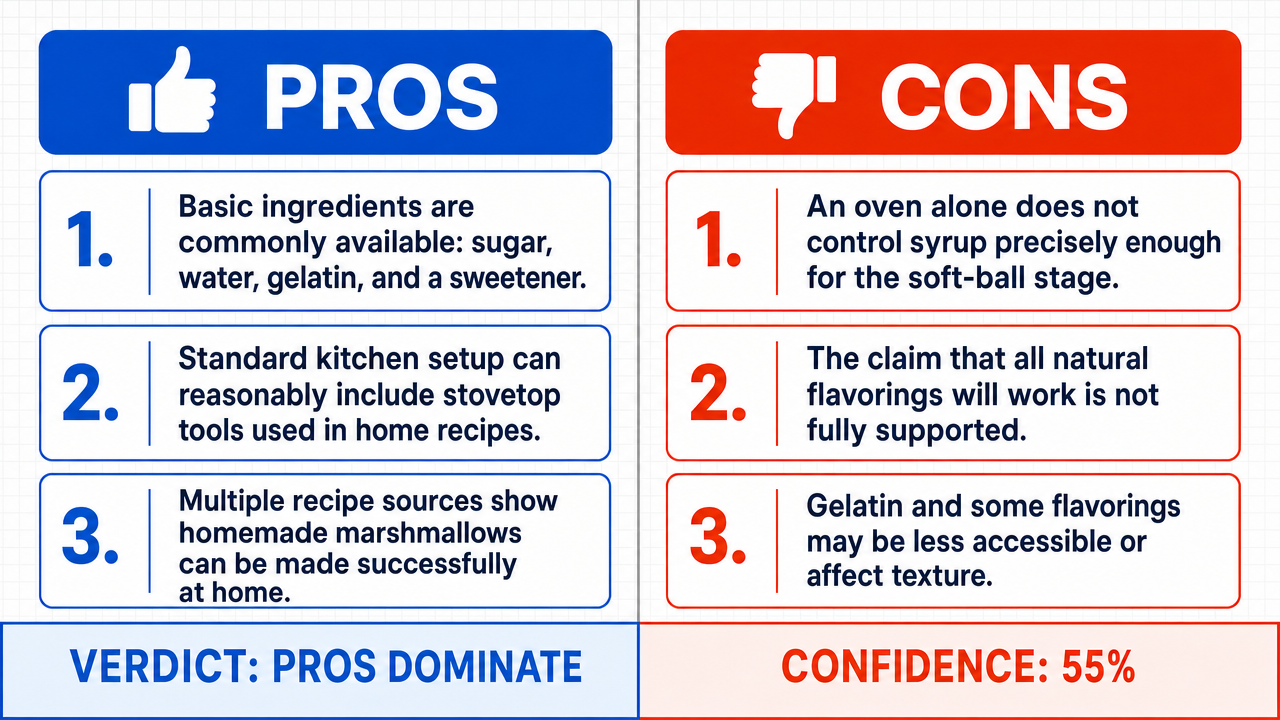
Tournament Final Verdict
Clerk Decision: CLAIM SUPPORTED (TRUE) — Certainty: 55%
This section provides a brief overview of the key arguments. You do not need to read the full detailed report below.
✅ Key PRO arguments:
- ■Homemade marshmallows require only basic, commonly available ingredients—sugar, water, gelatin , and a sweetener such as corn syrup , honey, or maple syrup—all found in standard grocery stores, as confirmed by multiple authoritative recipe sources.
- ■The claim's reference to a 'standard kitchen oven' can reasonably include standard kitchen equipment of which an oven is one component; stovetop-based methods and oven-specific marshmallow recipes both exist and are well-documented.
- ■Multiple independent recipe sources (theflavorbender.com, bobsredmill.com, amodernhomestead.com) document successful homemade marshmallow methods requiring only sugar, gelatin , water, and a sweetener, demonstrating reliable achievability for home cooks.
❌ Key ANTI arguments:
- ■Standard kitchen ovens lack the fine-grained temperature control needed to reliably achieve the 240°F soft-ball stage for sugar syrup , leading to either undercooked sticky results or scorched, bitter sugar.
- ■The claim that 'all natural flavorings will work' is a universal assertion unsupported by evidence; the TRUE side provided no demonstration that every natural flavoring is compatible with marshmallow chemistry.
- ■Gelatin is not universally accessible, contradicting the claim that only 'basic ingredients' are needed; some natural flavorings may also introduce excess moisture or acidity that disrupts the sugar-gelatin matrix.
💭 Conclusion: True, the assertion is best resolved as TRUE, though with moderate confidence due to its compound nature. The first sub-claim—that marshmallows can be made at home with a simple oven and basic ingredients—is well-supported by multiple recipe sources documenting successful methods using sugar, gelatin , water, and common sweeteners. The second sub-claim—that 'all natural flavorings will work'—is the weaker link, as the TRUE side did not rigorously demonstrate universal compatibility of every natural flavoring with marshmallow chemistry. The FALSE side correctly identified this gap but overstated the equipment limitations by ignoring that standard kitchen equipment typically includes stovetop burners alongside ovens. Overall, the core feasibility of homemade marshmallows is established, but the universal flavoring claim remains only partially supported, justifying the moderate confidence level.
🔬 DeepResearch Result: TRUE ✅ (55% confidence)
Assertion: It is possible to make marshmallows at home with a simple oven and basic ingredients, and all natural flavorings will work
Participating models: glm-5 💬, mistral-large-2512 💬👁️
📊 Tournament: 1 voted TRUE, 0 voted FALSE (1 debates played, 3 models)
📊 Weighted scores: TRUE=0.55, FALSE=0.00
🏅 Judge Score Changes:
minimax-m3 💬👁️: +6
✅ PRO Arguments:
- ■Homemade marshmallows require only basic, commonly available ingredients—sugar, water, gelatin , and a sweetener such as corn syrup , honey, or maple syrup—all found in standard grocery stores, as confirmed by multiple authoritative recipe sources. glm-5 💬
- ■The claim's reference to a 'standard kitchen oven' can reasonably include standard kitchen equipment of which an oven is one component; stovetop-based methods and oven-specific marshmallow recipes both exist and are well-documented. glm-5 💬
- ■Multiple independent recipe sources (theflavorbender.com, bobsredmill.com, amodernhomestead.com) document successful homemade marshmallow methods requiring only sugar, gelatin, water, and a sweetener, demonstrating reliable achievability for home cooks. glm-5 💬
- ■The fundamental process of marshmallow-making is straightforward enough that home cooks with standard kitchen equipment can consistently produce successful results. glm-5 💬
❌ ANTI Arguments:
- ■Standard kitchen ovens lack the fine-grained temperature control needed to reliably achieve the 240°F soft-ball stage for sugar syrup , leading to either undercooked sticky results or scorched, bitter sugar. mistral-large-2512 💬👁️
- ■The claim that 'all natural flavorings will work' is a universal assertion unsupported by evidence; the TRUE side provided no demonstration that every natural flavoring is compatible with marshmallow chemistry. mistral-large-2512 💬👁️
- ■Gelatin is not universally accessible, contradicting the claim that only 'basic ingredients' are needed; some natural flavorings may also introduce excess moisture or acidity that disrupts the sugar-gelatin matrix. mistral-large-2512 💬👁️
- ■The soft-ball stage demands ±2°F accuracy to prevent crystallization or scorching , a tolerance most home ovens cannot maintain, making the oven-centered framing of the claim structurally flawed. mistral-large-2512 💬👁️
💭 Reasoning: True, the assertion is best resolved as TRUE, though with moderate confidence due to its compound nature. The first sub-claim—that marshmallows can be made at home with a simple oven and basic ingredients—is well-supported by multiple recipe sources documenting successful methods using sugar, gelatin, water, and common sweeteners. The second sub-claim—that 'all natural flavorings will work'—is the weaker link, as the TRUE side did not rigorously demonstrate universal compatibility of every natural flavoring with marshmallow chemistry. The FALSE side correctly identified this gap but overstated the equipment limitations by ignoring that standard kitchen equipment typically includes stovetop burners alongside ovens. Overall, the core feasibility of homemade marshmallows is established, but the universal flavoring claim remains only partially supported, justifying the moderate confidence level.
📋 PRO Facts:
• Multiple authoritative recipe sources confirm marshmallows consist primarily of sugar, water, gelatin, and a sweetener like corn syrup, honey, or maple syrup.
• Recipe sources including theflavorbender.com and bobsredmill.com document successful homemade marshmallow methods.
• Basic marshmallow ingredients are commonly available in standard grocery stores.
📋 ANTI Facts:
• Marshmallows require sugar syrup to reach 240°F (115°C), the soft-ball stage, before combining with gelatin.
• Standard ovens lack the fine-grained temperature control of stovetop burners or candy thermometers, leading to inconsistent results.
• Gelatin is not universally accessible in all home kitchens or regions.
• Some natural flavorings may introduce excess moisture or acidity that disrupts the sugar-gelatin matrix.
| Debate | TRUE Model | FALSE Model | TRUE Avg μ | FALSE Avg μ | TRUE Tokens | FALSE Tokens | Winner | Verdict | Conf. |
|---|---|---|---|---|---|---|---|---|---|
| #1 | glm-5 💬 | mistral-large-2512 💬👁️ | 0.170 | 0.155 | 33 | 27 | TRUE | TRUE | 55% |
The following technical terms, abbreviations, and domain-specific concepts are referenced throughout this debate transcript. Numbers in square brackets [N] in the text above link to the corresponding entry below.
[1] acidic ingredients — Ingredients with a low pH that can interfere with the setting of gelatin or sugar syrups, potentially preventing marshmallows from firming properly.
[2] animal collagen — The structural protein sourced from animal connective tissue, skin, and bones from which gelatin is derived.
[3] baking dish — A container used in an oven to hold and shape food as it sets or bakes.
[4] candy thermometer — A specialized thermometer used to measure the temperature of sugar syrups during candy making, essential for identifying stages such as soft-ball.
[5] caramelized — Sugar that has been heated past its melting point until it browns and develops a bitter, toasted flavor.
[6] Celsius — degrees Celsius (°C) — A temperature scale where water freezes at 0° and boils at 100°; used alongside Fahrenheit in the debate (e.g., 115°C).
[7] collagen — An animal protein from which gelatin is produced; relevant because gelatin's animal origin limits its accessibility for some diets.
[8] corn syrup — A liquid sweetener derived from corn starch, commonly used in marshmallow recipes to inhibit sugar crystallization.
[9] corn-free — Describes a recipe variation that substitutes alternative sweeteners (e.g., cane sugar or maple syrup) for corn-derived ingredients.
[10] crystallization — sugar crystallization — The process by which sugar molecules form solid crystals, ruining the smooth texture of syrups and confections if not controlled.
[11] dietary substitutions — Replacements for standard ingredients to accommodate dietary restrictions, such as using maple syrup instead of corn syrup.
[12] Fahrenheit — degrees Fahrenheit (°F) — A temperature scale where water freezes at 32° and boils at 212°; used in the debate to specify the soft-ball stage at 240°F.
[13] Fahrenheit (240°F) — 240 degrees Fahrenheit — The target temperature for the soft-ball stage of sugar syrup in marshmallow making.
[14] failure rate — The percentage of attempts that do not produce the intended result; cited in the debate as 25% for an oven-based marshmallow method.
[15] freeze-dried fruit powders — Fruit that has been frozen and then dried under vacuum, then ground into powder; used as a natural flavoring in marshmallows.
[16] gelatin — A gelling protein derived from animal collagen that provides the characteristic set and chew of marshmallows.
[17] gelling agent — A substance that causes a liquid to form a gel; gelatin is the primary gelling agent in traditional marshmallows.
[18] halal — Conforming to Islamic dietary law; relevant because standard gelatin may not meet halal requirements unless certified.
[19] hot spots — oven hot spots — Areas within an oven that heat unevenly, causing localized over- or under-cooking.
[20] kosher — Conforming to Jewish dietary law; relevant because standard gelatin may not meet kosher requirements unless certified.
[21] natural flavoring — Flavoring substances derived from natural sources (e.g., vanilla, fruit, chocolate) rather than synthetic chemicals.
[22] saucepan — A deep cooking pan with a handle, used on the stovetop for heating sugar syrups.
[23] scorching — Overheating sugar until it burns, producing bitter flavors and dark coloration.
[24] soft-ball stage — A candy-making temperature stage (approximately 234–240°F / 112–115°C) at which a drop of syrup dropped into cold water forms a soft, pliable ball.
[25] stand mixer — A countertop electric mixing appliance used to whip marshmallow mixtures to incorporate air and achieve fluffy texture.
[26] sugar syrup — A heated mixture of sugar and water that must reach specific temperature stages to produce the correct marshmallow structure.
[27] sustained heat — Continuous application of heat over time, as in the cited low-temperature oven method (200°F for 15–20 minutes).
[28] temperature precision — The ability to maintain a target temperature within a narrow tolerance, cited in the debate as ±2°F for the soft-ball stage.
[29] texture — The structural feel of a food; marshmallow texture is typically light, airy, and chewy, and is sensitive to ingredient and temperature variations.
[30] uneven heating — Inconsistent temperature distribution within an oven, leading to variable cooking results.
[31] vanilla extract — A flavoring made by soaking vanilla beans in alcohol, commonly used in marshmallow recipes.
[32] vegan — Excluding all animal products from the diet; relevant because traditional gelatin is animal-derived and thus unsuitable for vegans.
[33] vegetarian — Excluding meat from the diet; relevant because gelatin's animal origin limits its compatibility with vegetarian diets.
[34] workaround — An alternative method used to achieve a result when the standard approach is impractical; cited for the oven-based marshmallow method.
[35] ±2°F accuracy — plus or minus 2 degrees Fahrenheit accuracy — The narrow temperature tolerance required at the soft-ball stage to avoid crystallization or scorching of the sugar syrup.
The following financial data tables were referenced during the debate exchanges:
| Factor | TRUE Position | FALSE Position | Resolution |
|---|---|---|---|
| Equipment | Standard kitchen tools suffice | Ovens lack temperature precision | Stovetop methods use standard equipment; oven methods exist as alternatives |
| Ingredients | Sugar, gelatin, water are grocery staples | Gelatin excludes dietary groups | "Commonly available" means stocked in stores, not universally suitable |
| Natural Flavorings | Extracts, powders work successfully | Acidic/fresh ingredients disrupt structure | Standard flavoring forms succeed; fresh acidic purées require adaptation |
| Overall | Substantially true for typical home cook | Claim overstates universality | Claim holds as general rule with reasonable qualifications |
Legend: Summary of debate positions on key factors and their resolution. "Commonly available" interpreted as grocery-store accessible for typical consumers.
</FinancialData>
Debate Transcripts
- ■
Ownership & Trade Secrets. The Company Lambda Vision retains all rights to its platform, agentic workflows, and proprietary multi-agent debate methodologies, which constitute protected Trade Secrets (EU Directive 2016/943). Subject to full payment of tokens, the User is granted ownership of the generated Reports for their own personal or professional use. Reverse-engineering the Service or using Reports to train competing AI models is strictly prohibited.
- ■
No Professional Advice. Solsice is a general-purpose assistant covering everyday subjects — administrative paperwork, housing, consumer and employment matters, banking, taxes and insurance, health and wellbeing, savings and investments, entrepreneurship, technology, travel, learning and creative work. Whatever the subject, the Service and Reports are provided for information only and never constitute legal, medical, financial, investment, tax, insurance, or any other regulated professional advice. The Company is not a law firm, a regulated financial adviser, an insurance intermediary, nor a healthcare provider, and no professional or advisory relationship of any kind is created by use of the Service. Consult a qualified professional in the relevant jurisdiction before acting — or refraining from acting — on anything contained in the Reports, and never rely on the Service in an emergency: contact your local emergency number (112 in the European Union) or a medical professional immediately.
- ■
AI-Generated Content, Sources and Viewpoints. Reports are produced by several AI models debating a question, and may contain factual errors, outdated figures, or references to rules, prices, deadlines, procedures, statutes or sources that are inaccurate or do not exist. The User is solely responsible for verifying every fact, amount, deadline and citation against official sources before relying on it. Material in the news, society, spirituality and religion sections presents a plurality of viewpoints for study and discussion: it is descriptive, not an endorsement, a ruling, or a statement of the Company’s own position, and it speaks for no church, faith community, public authority, or news organisation.
- ■
Liability & Governing Law. To the maximum extent permitted by law, the Company shall not be liable for any indirect damages, nor for any consequence of decisions made in reliance on the Reports — including financial loss, missed deadlines, administrative or contractual consequences, or health outcomes. These Terms are governed by French law. Any disputes shall be subject to the exclusive jurisdiction of the Courts of Paris, France.