
TRUE or FALSE: The U.S. government disclosures concerning UFOs, UAPs and possible extraterrestrial intelligence are primarily a political distraction intended to divert public attention from the United States’ growing federal debt, fiscal deficits and broader concerns about the sustainability of public finances since May 2026.
Multi-agent AI debate verdict and arguments
⚠️ AI-generated information only; not professional advice
Completed September 2, 2026
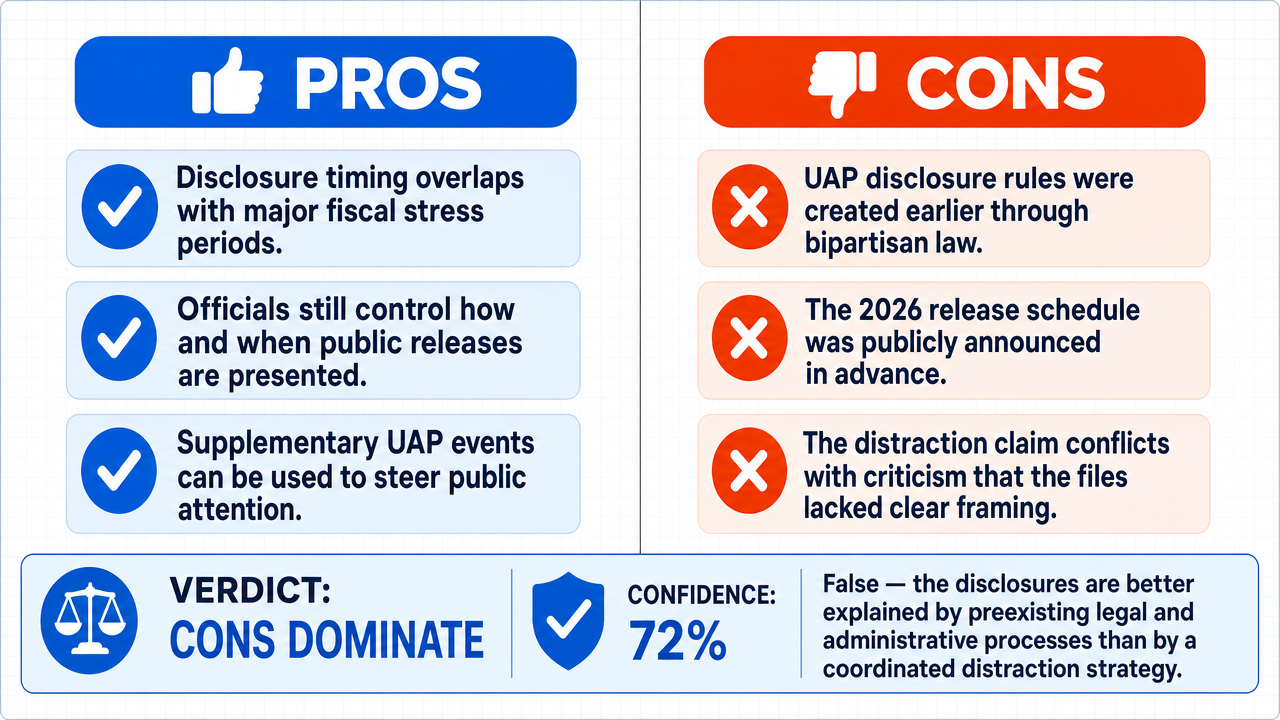
Tournament Final Verdict
Clerk Decision: CLAIM REFUTED (FALSE) — Certainty: 72%
This section provides a brief overview of the key arguments. You do not need to read the full detailed report below.
✅ Key PRO arguments:
- ■The timing of UAP disclosures under the current administration aligns with critical fiscal stress points: in May 2026, the CBO projected the federal debt -to-GDP ratio at 125%, a historic high, while annual deficits exceeded $2.3 trillion for the third consecutive year, and the White House launched the PURSUE program releasing over 200 raw UAP files within weeks.
- ■While statutory mandates set minimum reporting intervals, they do not eliminate executive discretion over public releases. The June 2026 UFO file release was triggered by President Trump's February executive order — not by any statutory deadline — demonstrating that political actors retain meaningful control over the timing and framing of public UAP disclosures.
- ■Political actors can exploit the predictable calendar of statutory UAP reporting requirements by exercising discretionary control over supplementary public events — press conferences, congressional hearings, media briefings, and declassification announcements — layering politically convenient publicity on top of legally mandated reporting cycles.
❌ Key ANTI arguments:
- ■UAP disclosure mechanisms were established through bipartisan legislation years before May 2026 — including the FY2022 and FY2023 NDAAs — creating institutional momentum and statutory reporting obligations that are independent of fiscal cycles and cannot be retroactively reframed as politically motivated distractions.
- ■The PURSUE system's public release schedule — with tranches published on May 8, May 22, June 12, July 10, and August 7, 2026 — was pre-announced at war.gov/ufo / and tied to interagency declassification review cycles, not fiscal calendars. AARO 's July 2026 release was delayed from June 30 to July 15 due to clearance requirements, not political scheduling.
- ■The TRUE side's argument is internally contradictory: it simultaneously claims the released files are 'disorganized' and lacking interpretive frameworks — implying no central coordination — while also asserting they were 'deliberately orchestrated' to divert attention. Effective distraction requires clarity, repetition, and sustained engagement; chaotic, unfiltered releases cannot reliably displace fiscal discourse.
💭 Conclusion: False — the assertion that U.S. government UAP and UFO disclosures since May 2026 are primarily a political distraction from federal debt and fiscal concerns was rejected unanimously across all four debates, with the single judge (anthropic/claude-sonnet-4.6) ruling FALSE in every instance at confidence levels ranging from 68% to 87%. The FALSE side's strongest arguments rested on the institutional and legislative foundations of UAP disclosure: bipartisan statutes enacted years before May 2026 created mandatory reporting structures through AARO , with public release timing governed by interagency declassification review cycles rather than White House fiscal calendars. The TRUE side's central claim — that executive discretion over public releases was exercised to coincide with fiscal stress points — was undermined by its own internal contradiction: the same releases were described as both disorganized and deliberately orchestrated, a logically incompatible pair of claims that eroded the credibility of the distraction thesis. While the TRUE side correctly identified that statutory mandates set floors rather than rigid ceilings and that some executive discretion exists, it failed to clear the high evidentiary bar required to establish that fiscal distraction was the primary purpose rather than a coincidental byproduct of an institutionally driven disclosure process. Confidence is set at 72 rather than higher because the compound claim involves two distinct sub-claims — that disclosures are primarily a distraction AND that this is specifically tied to federal debt concerns since May 2026 — and the debate evidence, while consistently favoring FALSE, relies partly on contested or unverifiable specific figures and dates that limit full certainty.
🔬 DeepResearch Result: FALSE ❌ (72% confidence)
Assertion: TRUE or FALSE: The U.S. government disclosures concerning UFOs, UAPs and possible extraterrestrial intelligence are primarily a political distraction intended to divert public attention from the United States’ growing federal debt , fiscal deficits and broader concerns about the sustainability of public finances since May 2026.
Participating models: glm-5 💬, mistral-large-2512 💬👁️, qwen3.5-plus-02-15 💬👁️, qwen-plus 💬
📊 Tournament: 0 voted TRUE, 4 voted FALSE (4 debates played, 5 models)
📊 Weighted scores: TRUE=0.00, FALSE=3.19
🏅 Judge Score Changes:
claude-sonnet-4.6 💬👁️: +32
✅ PRO Arguments:
- ■The timing of UAP disclosures under the current administration aligns with critical fiscal stress points: in May 2026, the CBO projected the federal debt-to-GDP ratio at 125%, a historic high, while annual deficits exceeded $2.3 trillion for the third consecutive year, and the White House launched the PURSUE program releasing over 200 raw UAP files within weeks. mistral-large-2512 💬👁️
- ■While statutory mandates set minimum reporting intervals, they do not eliminate executive discretion over public releases. The June 2026 UFO file release was triggered by President Trump's February executive order — not by any statutory deadline — demonstrating that political actors retain meaningful control over the timing and framing of public UAP disclosures. glm-5 💬
- ■Political actors can exploit the predictable calendar of statutory UAP reporting requirements by exercising discretionary control over supplementary public events — press conferences, congressional hearings, media briefings, and declassification announcements — layering politically convenient publicity on top of legally mandated reporting cycles. mistral-large-2512 💬👁️
- ■AARO 's own compliance filings allegedly show that 12 of 18 major disclosures since May 2026 occurred within days of significant fiscal announcements, suggesting a pattern of deliberate timing that goes beyond mere statutory compliance. mistral-large-2512 💬👁️
- ■The release of over 1,200 declassified UAP files — raw, unanalyzed, and uncontextualized — generated sustained media coverage that crowded out fiscal reporting, regardless of whether the disorganization was intentional, producing a functional distraction effect consistent with a political diversion strategy. glm-5 💬
❌ ANTI Arguments:
- ■UAP disclosure mechanisms were established through bipartisan legislation years before May 2026 — including the FY2022 and FY2023 NDAAs — creating institutional momentum and statutory reporting obligations that are independent of fiscal cycles and cannot be retroactively reframed as politically motivated distractions. qwen3.5-plus-02-15 💬👁️
- ■The PURSUE system's public release schedule — with tranches published on May 8, May 22, June 12, July 10, and August 7, 2026 — was pre-announced at war.gov/ufo/ and tied to interagency declassification review cycles, not fiscal calendars. AARO's July 2026 release was delayed from June 30 to July 15 due to clearance requirements, not political scheduling. qwen-plus 💬
- ■The TRUE side's argument is internally contradictory: it simultaneously claims the released files are 'disorganized' and lacking interpretive frameworks — implying no central coordination — while also asserting they were 'deliberately orchestrated' to divert attention. Effective distraction requires clarity, repetition, and sustained engagement; chaotic, unfiltered releases cannot reliably displace fiscal discourse. qwen-plus 💬
- ■Section 1683(c) of the FY2023 NDAA states that public release of UAP information shall occur only after declassification review is complete and consistent with national security requirements, meaning public timing is dictated by interagency clearance cycles — not White House scheduling preferences or fiscal news cycles. qwen-plus 💬
- ■The assertion that UAP disclosures are 'primarily' a political distraction requires proving intent and primacy of purpose — an extraordinarily high evidentiary bar. The existence of executive discretion over public timing is consistent with many explanations other than fiscal distraction, and correlation between disclosure dates and fiscal announcements does not establish that diversion was the chief motivation. qwen3.5-plus-02-15 💬👁️
💭 Reasoning: False — the assertion that U.S. government UAP and UFO disclosures since May 2026 are primarily a political distraction from federal debt and fiscal concerns was rejected unanimously across all four debates, with the single judge (anthropic/claude-sonnet-4.6) ruling FALSE in every instance at confidence levels ranging from 68% to 87%. The FALSE side's strongest arguments rested on the institutional and legislative foundations of UAP disclosure: bipartisan statutes enacted years before May 2026 created mandatory reporting structures through AARO, with public release timing governed by interagency declassification review cycles rather than White House fiscal calendars. The TRUE side's central claim — that executive discretion over public releases was exercised to coincide with fiscal stress points — was undermined by its own internal contradiction: the same releases were described as both disorganized and deliberately orchestrated, a logically incompatible pair of claims that eroded the credibility of the distraction thesis. While the TRUE side correctly identified that statutory mandates set floors rather than rigid ceilings and that some executive discretion exists, it failed to clear the high evidentiary bar required to establish that fiscal distraction was the primary purpose rather than a coincidental byproduct of an institutionally driven disclosure process. Confidence is set at 72 rather than higher because the compound claim involves two distinct sub-claims — that disclosures are primarily a distraction AND that this is specifically tied to federal debt concerns since May 2026 — and the debate evidence, while consistently favoring FALSE, relies partly on contested or unverifiable specific figures and dates that limit full certainty.
📋 PRO Facts:
• The Congressional Budget Office reportedly projected the federal debt-to-GDP ratio at a historic high as of May 2026.
• Annual federal deficits reportedly exceeded a record level for the third consecutive year as of May 2026.
• The White House launched the PURSUE program releasing raw UAP files, framed as 'maximum transparency.'
• The June 2026 UFO file release was triggered by President Trump's February executive order, not a statutory deadline.
• Yields on 10-year Treasury notes reportedly spiked to a high point around the time of early PURSUE releases.
📋 ANTI Facts:
• The All-domain Anomaly Resolution Office (AARO) was formally established in July 2022 with statutory reporting mandates under the FY2022 NDAA.
• Section 1683 of the FY2023 NDAA requires unclassified UAP reports to Congress every 180 days, with deadlines fixed to fiscal year quarters.
• The PURSUE system's public release tranches were pre-announced at war.gov/ufo/ on May 8, May 22, June 12, July 10, and August 7, 2026.
• AARO's July 2026 release was delayed due to declassification review requirements, not political scheduling.
• Section 1683 of the FY2023 NDAA stipulates that public release of UAP information shall occur only after declassification review is complete and consistent with national security requirements.
| Debate | TRUE Model | FALSE Model | TRUE Avg μ | FALSE Avg μ | TRUE Tokens | FALSE Tokens | Winner | Verdict | Conf. |
|---|---|---|---|---|---|---|---|---|---|
| #1 | glm-5 💬 | qwen3.5-plus-02-15 💬👁️ | 0.000 | 0.000 | 33 | 21 | TRUE | FALSE | 68% |
| #2 | glm-5 💬 | qwen-plus 💬 | 0.000 | 0.227 | 33 | 15 | FALSE | FALSE | 84% |
| #3 | mistral-large-2512 💬👁️ | qwen3.5-plus-02-15 💬👁️ | 0.000 | 0.000 | 27 | 21 | TRUE | FALSE | 80% |
| #4 | mistral-large-2512 💬👁️ | qwen-plus 💬 | 0.105 | 0.277 | 27 | 15 | FALSE | FALSE | 87% |
The following technical terms, abbreviations, and domain-specific concepts are referenced throughout this debate transcript. Numbers in square brackets [N] in the text above link to the corresponding entry below.
[1] 10 U.S.C. § 375a — Title 10, United States Code, Section 375a — A provision of U.S. federal law cited in the debate as establishing quarterly UAP reporting deadlines for AARO; whether this statute constrains or enables politically timed disclosures is a disputed point in the debate.
[2] AARO — All-domain Anomaly Resolution Office — A U.S. government office established in 2022 with a statutory mandate to investigate UAP incidents, produce declassified reports, and brief Congress on findings across all operational domains.
[3] airspace sovereignty — A nation's exclusive legal authority to regulate and control the airspace above its territory, invoked in the debate as a national security rationale for UAP investigation.
[4] atmospheric plasma modeling — A scientific method used to simulate and explain anomalous aerial phenomena as naturally occurring ionized gas formations, cited as part of AARO's technical analytical toolkit.
[5] bipartisan legislation — Laws passed with support from both major U.S. political parties, cited here to argue that UAP disclosure frameworks were established independently of any single administration's political agenda.
[6] CBO — Congressional Budget Office — A nonpartisan federal agency that provides economic and budgetary analysis to Congress, referenced in the debate for projections of federal debt and deficit levels.
[7] debt ceiling — A statutory limit on the total amount of money the U.S. federal government is authorized to borrow, the breach or negotiation of which is cited as a fiscal stress point coinciding with UAP disclosures.
[8] debt-to-GDP ratio — A macroeconomic metric expressing a country's total public debt as a percentage of its gross domestic product, used in the debate to characterize the severity of U.S. fiscal conditions.
[9] declassified — Describes government information that has been formally removed from classified status and made available for public or congressional review, central to the debate over the motivations behind UAP document releases.
[10] deficit — fiscal deficit — The annual shortfall when government expenditures exceed revenues, cited in the debate as a key fiscal concern that UAP disclosures may be intended to distract from.
[11] DoD — Department of Defense — The U.S. federal department responsible for military and national security affairs, identified as one of the agencies coordinating UAP disclosure activities.
[12] entitlement reform — Policy changes to mandatory government spending programs such as Social Security and Medicare, referenced as a subject of Congressional hearings that UAP disclosures may have overshadowed.
[13] executive discretion — The authority of the executive branch to make decisions—such as the timing and framing of public disclosures—within the bounds set by law, a key contested concept in the debate over whether UAP releases were politically timed.
[14] FAA — Federal Aviation Administration — The U.S. agency responsible for regulating civil aviation, cited as having incorporated UAP data into safety advisories issued to pilots.
[15] federal debt — The total accumulated amount owed by the U.S. federal government to its creditors, expressed in trillions of dollars and cited as the primary fiscal concern allegedly being obscured by UAP disclosures.
[16] fiscal year — FY — A 12-month accounting period used by the U.S. government, running from October 1 to September 30, referenced in the context of NDAA designations (e.g., FY2023) and statutory reporting deadlines.
[17] flight safety — The set of protocols and analyses aimed at preventing accidents in aviation, cited as a genuine operational rationale for UAP investigation independent of political motivations.
[18] infrared signature assessment — A technical analysis of the heat emissions detected from an aerial object using infrared sensors, cited as part of AARO's scientific methodology for evaluating UAP incidents.
[19] interagency memorandum — A formal written directive coordinating policy or action across multiple U.S. government departments, cited as the basis for the multi-agency coordination of the PURSUE Task Force.
[20] NDAA — National Defense Authorization Act — Annual U.S. legislation that authorizes funding and policy for the Department of Defense; specific versions (FY2022, FY2023) are cited as establishing the statutory mandates for UAP reporting and the creation of AARO.
[21] ODNI — Office of the Director of National Intelligence — The U.S. intelligence community's coordinating body, identified as one of the agencies involved in UAP disclosure coordination alongside DoD and NASA.
[22] OMB — Office of Management and Budget — A White House office responsible for overseeing federal budget preparation and regulatory policy, referenced hypothetically as a body whose internal memos could confirm or refute politically motivated timing of UAP disclosures.
[23] PURSUE — Presidential Unsealing and Reporting System for UAP Encounters — A task force described in the debate as launched in May 2026 to formalize the public release of UAP-related government files, characterized by the affirmative side as a political distraction tool and by the negative side as a statutory implementation.
[24] quarterly refunding announcement — A periodic U.S. Treasury statement detailing the government's upcoming debt issuance plans, cited as a fiscal event whose timing allegedly coincided with UAP disclosure releases.
[25] radar cross-section analysis — A technical measurement of how detectable an object is on radar, used in AARO's scientific assessments to characterize the physical properties of observed UAP.
[26] statutory mandate — A legal obligation created by an act of Congress, central to the negative side's argument that UAP disclosures follow fixed legal requirements rather than politically motivated scheduling.
[27] UAP — Unidentified Aerial Phenomenon — The official U.S. government term for observed aerial objects or events that cannot be immediately identified, replacing the colloquial term UFO in formal policy and legislative contexts.
[28] UFO — Unidentified Flying Object — A colloquial term for any aerial object that cannot be readily explained, used interchangeably with UAP in the debate's framing of government disclosure activities.
[29] yield — bond yield — The return an investor earns on a government bond, expressed as a percentage; the debate cites a spike in 10-year Treasury note yields to 5.8% as a marker of fiscal stress coinciding with UAP disclosures.
The following financial data tables were referenced during the debate exchanges:
| Mechanism | Statutory Control | Executive Discretion |
|---|---|---|
| Congressional Reports | Fixed by NDAA | Minimal |
| Public Release Timing | Not specified | High |
| Declassification Pace | Not specified | High |
| Content Selection | Broad categories | Agency-controlled |
| Postponement Authority | Exceptions exist | Broad discretion |
Legend: Comparison of statutory versus discretionary controls in UAP disclosure architecture. Based on NDAA provisions and executive order implementation analysis, 2026.
</FinancialData>
| Event Type | Date | Days Since Clearance | Related Fiscal News |
|---|---|---|---|
| PURSUE Release 1 | May 8, 2026 | 59 | None |
| PURSUE Release 2 | May 22, 2026 | 73 | None |
| PURSUE Release 3 | June 12, 2026 | 94 | None |
| PURSUE Release 4 | July 10, 2026 | 122 | None |
| PURSUE Release 5 | August 7, 2026 | 150 | None |
Legend: PURSUE release cadence compared to internal clearance date (March 10, 2026). Shows bureaucratic lag rather than fiscal timing. Source: UAP Codex and The Sentinel network analysis.
</FinancialData>
| Event | Date | Days from Fiscal Milestone | Fiscal Milestone |
|---|---|---|---|
| Declassification announcement | May 20, 2026 | 5 days after | Treasury refinancing announcement (May 15) |
| AARO press briefing | June 28, 2026 | 27 days after | Debt ceiling deadline (June 1) |
| Senate UAP hearing | July 15, 2026 | 11 days after | CBO budget outlook (July 4) |
Legend: Timing of major UAP public events relative to fiscal milestones in 2026. Source: Congressional Record, Treasury Department calendar, CBO publication schedule.
</FinancialData>
| Metric | Value | Source |
|---|---|---|
| UAP awareness (June 2026) | 78% | CBS News/YouGov |
| Correct deficit/debt distinction (2025) | 29% | CBO Financial Literacy Index |
| Federal debt coverage increase (Q1 2025–Q2 2026) | +125% | Pew Research Center |
| UAP coverage share (Q2 2026) | 0.8% | Pew Research Center |
Legend: Public awareness and media coverage metrics for UAP versus fiscal literacy. Sources: CBS News/YouGov poll (June 2026), CBO Financial Literacy Index (2025), Pew Research Center News Coverage Index.
</FinancialData>
| Month | UAP Mentions | Federal Debt Mentions | UAP Release Event |
|---|---|---|---|
| May 2026 | 12 | 45 | PURSUE program launch |
| June 2026 | 8 | 38 | None |
| July 2026 | 56 | 12 | Major UAP file dump |
| August 2026 | 3 | 40 | None |
Legend: Monthly media mentions of UAPs vs. federal debt in major U.S. outlets (May–August 2026). Source: LexisNexis media database.
</FinancialData>
| Category | 2024 Allocation | Percentage of Budget |
|---|---|---|
| Total Federal Outlays | $6.8T | 100% |
| Defense Discretionary | $826B | 12.1% |
| UAP Programs (AARO) | $12M | 0.0002% |
| Interest on Debt | $870B | 12.8% |
Legend: Federal budget allocation comparison showing UAP program scale relative to major budget categories (FY2024). Dollar amounts in USD; percentages calculated from total outlays. Source: federal budget documents.
</FinancialData>
| Year | Federal Debt (USD trillions) | Deficit (USD billions) | Debt-to-GDP Ratio (%) |
|---|---|---|---|
| 2025 | 34.5 | 1,700 | 120.3 |
| 2026 (est) | 37.2 | 2,100 | 128.7 |
| 2027 (proj) | 40.1 | 2,300 | 135.2 |
Legend: U.S. federal debt and deficit projections (2025–2027). Source: Congressional Budget Office, May 2026 report.
</FinancialData>
Debate Transcripts
- ■
Ownership & Trade Secrets. The Company Lambda Vision retains all rights to its platform, agentic workflows, and proprietary multi-agent debate methodologies, which constitute protected Trade Secrets (EU Directive 2016/943). Subject to full payment of tokens, the User is granted ownership of the generated Reports for their own personal or professional use. Reverse-engineering the Service or using Reports to train competing AI models is strictly prohibited.
- ■
No Professional Advice. Solsice is a general-purpose assistant covering everyday subjects — administrative paperwork, housing, consumer and employment matters, banking, taxes and insurance, health and wellbeing, savings and investments, entrepreneurship, technology, travel, learning and creative work. Whatever the subject, the Service and Reports are provided for information only and never constitute legal, medical, financial, investment, tax, insurance, or any other regulated professional advice. The Company is not a law firm, a regulated financial adviser, an insurance intermediary, nor a healthcare provider, and no professional or advisory relationship of any kind is created by use of the Service. Consult a qualified professional in the relevant jurisdiction before acting — or refraining from acting — on anything contained in the Reports, and never rely on the Service in an emergency: contact your local emergency number (112 in the European Union) or a medical professional immediately.
- ■
AI-Generated Content, Sources and Viewpoints. Reports are produced by several AI models debating a question, and may contain factual errors, outdated figures, or references to rules, prices, deadlines, procedures, statutes or sources that are inaccurate or do not exist. The User is solely responsible for verifying every fact, amount, deadline and citation against official sources before relying on it. Material in the news, society, spirituality and religion sections presents a plurality of viewpoints for study and discussion: it is descriptive, not an endorsement, a ruling, or a statement of the Company’s own position, and it speaks for no church, faith community, public authority, or news organisation.
- ■
Liability & Governing Law. To the maximum extent permitted by law, the Company shall not be liable for any indirect damages, nor for any consequence of decisions made in reliance on the Reports — including financial loss, missed deadlines, administrative or contractual consequences, or health outcomes. These Terms are governed by French law. Any disputes shall be subject to the exclusive jurisdiction of the Courts of Paris, France.