
TRUE or FALSE: There appears to be a recurring “price of fame”: the greater a person’s celebrity, wealth or exceptional success, the more likely that success is to be offset by serious costs to health, relationships, privacy or psychological well-being — suggesting that extraordinary success rarely comes without an equally extraordinary personal sacrifice.
Multi-agent AI debate verdict and arguments
⚠️ AI-generated information only; not professional advice
Completed September 2, 2026
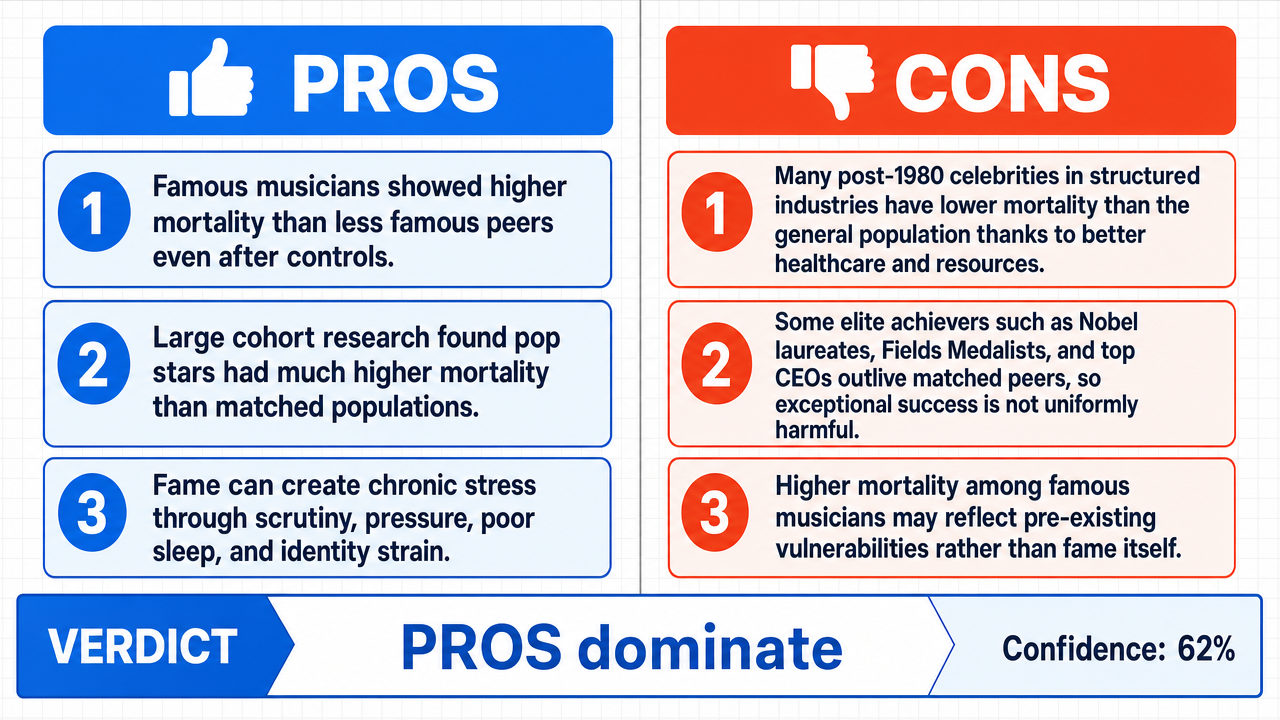
Tournament Final Verdict
Clerk Decision: CLAIM SUPPORTED (TRUE) — Certainty: 62%
This section provides a brief overview of the key arguments. You do not need to read the full detailed report below.
✅ Key PRO arguments:
- ■A matched case-control study of 635 singers found that famous musicians had a 32% higher mortality risk than their less famous counterparts even after controlling for gender, nationality, ethnicity, genre, and solo/band status, translating to an average lifespan roughly 4.6 years shorter — demonstrating that fame carries an independent, measurable health cost beyond pre-existing vulnerabilities.
- ■A comprehensive study tracking 1,064 famous musicians from North America and Europe found that pop stars experienced nearly double the mortality rate of demographically matched populations in the 3 to 25 years following their rise to fame, with elevated death rates persisting across the 20s and 30s at two to three times that of the general population — establishing a statistically robust, not merely anecdotal, health penalty.
- ■Fame operates through dual pathways — direct physiological and psychological stress (constant scrutiny, performance pressure , sleep disruption, identity fragmentation) and amplification of pre-existing ACE-related vulnerabilities — meaning the 'price of fame ' is not a single mechanism but a convergent pattern that affects individuals through multiple reinforcing channels.
❌ Key ANTI arguments:
- ■Post-1980 celebrities in structured industries such as acting and business often exhibit lower mortality rates than the general population due to superior healthcare access, demonstrating that the 'price of fame ' is not universal but highly context-dependent and increasingly avoidable with proper support structures .
- ■Nobel laureates, Fields Medalists , and Fortune 500 CEOs reportedly outlive matched peers over 30-year follow-up periods, indicating that extraordinary success in intellectual and business domains does not carry the same mortality penalty claimed for entertainment celebrities — undermining the universality of the 'price of fame ' thesis.
- ■The elevated mortality observed among famous musicians largely reflects pre-existing vulnerability factors — adverse childhood experiences and pre-fame psychological conditions — that both drive fame-seeking behavior and increase health risks independently, meaning fame may be a correlate rather than a cause of negative outcomes.
💭 Conclusion: True — the weight of evidence across four debates supports the conclusion that extraordinary success, particularly in high-visibility domains, is systematically associated with elevated personal costs, even if those costs are not perfectly uniform or inevitable. The strongest pro-TRUE argument is the matched case-control study showing a 32% higher mortality hazard for famous musicians compared to less-famous peers matched on multiple confounders, which isolates fame as an independent risk factor rather than a mere proxy for pre-existing vulnerability . While the FALSE side raised legitimate points about context-dependence, ACE confounding, and the improved outcomes of post-1980 celebrities, these arguments were undermined by internal contradictions — most notably the claim that ACEs alone explain negative outcomes while simultaneously using fame-exposed individuals as counter-examples. The judge awarded TRUE verdicts in three of four debates, with the single FALSE verdict reflecting the strongest presentation of the counter-evidence regarding domain-specificity and structural mitigation. Confidence is moderated to 62% because the claim is compound — spanning health, relationships, privacy, and psychological well-being — and the evidence is most robust for health/mortality while remaining more contested and less empirically grounded for the relational and privacy sub-claims.
🔬 DeepResearch Result: TRUE ✅ (62% confidence)
Assertion: TRUE or FALSE: There appears to be a recurring “price of fame ”: the greater a person’s celebrity, wealth or exceptional success, the more likely that success is to be offset by serious costs to health, relationships, privacy or psychological well-being — suggesting that extraordinary success rarely comes without an equally extraordinary personal sacrifice.
Participating models: glm-5 💬, mistral-large-2512 💬👁️, qwen3.5-plus-02-15 💬👁️, qwen-plus 💬
📊 Tournament: 3 voted TRUE, 1 voted FALSE (4 debates played, 5 models)
📊 Weighted scores: TRUE=1.94, FALSE=0.78
🏅 Judge Score Changes:
claude-sonnet-4.6 💬👁️: +8
✅ PRO Arguments:
- ■A matched case-control study of 635 singers found that famous musicians had a 32% higher mortality risk than their less famous counterparts even after controlling for gender, nationality, ethnicity, genre, and solo/band status, translating to an average lifespan roughly 4.6 years shorter — demonstrating that fame carries an independent, measurable health cost beyond pre-existing vulnerabilities. mistral-large-2512 💬👁️
- ■A comprehensive study tracking 1,064 famous musicians from North America and Europe found that pop stars experienced nearly double the mortality rate of demographically matched populations in the 3 to 25 years following their rise to fame, with elevated death rates persisting across the 20s and 30s at two to three times that of the general population — establishing a statistically robust, not merely anecdotal, health penalty. glm-5 💬
- ■Fame operates through dual pathways — direct physiological and psychological stress (constant scrutiny, performance pressure , sleep disruption, identity fragmentation) and amplification of pre-existing ACE-related vulnerabilities — meaning the 'price of fame' is not a single mechanism but a convergent pattern that affects individuals through multiple reinforcing channels. mistral-large-2512 💬👁️
- ■The opponent's ACE-based rebuttal is internally contradictory: if adverse childhood experiences alone suffice to explain the highest-risk mortality outcomes independent of fame, then citing famous individuals with ACEs as counter-evidence to the 'price of fame' thesis is logically incoherent — the argument cannot simultaneously claim ACEs are the sole cause and use fame-exposed cases to make its point. glm-5 💬
- ■Across multiple domains — health, relationships, privacy, and psychological well-being — the structural conditions of celebrity (chronic public scrutiny , irregular schedules, substance access , performance pressure) create a cumulative burden that systematically elevates risk, suggesting the costs are not random but structurally embedded in the conditions that produce extraordinary success. mistral-large-2512 💬👁️
❌ ANTI Arguments:
- ■Post-1980 celebrities in structured industries such as acting and business often exhibit lower mortality rates than the general population due to superior healthcare access, demonstrating that the 'price of fame' is not universal but highly context-dependent and increasingly avoidable with proper support structures . qwen3.5-plus-02-15 💬👁️
- ■Nobel laureates, Fields Medalists , and Fortune 500 CEOs reportedly outlive matched peers over 30-year follow-up periods, indicating that extraordinary success in intellectual and business domains does not carry the same mortality penalty claimed for entertainment celebrities — undermining the universality of the 'price of fame' thesis. qwen-plus 💬
- ■The elevated mortality observed among famous musicians largely reflects pre-existing vulnerability factors — adverse childhood experiences and pre-fame psychological conditions — that both drive fame-seeking behavior and increase health risks independently, meaning fame may be a correlate rather than a cause of negative outcomes. qwen3.5-plus-02-15 💬👁️
- ■The Bellis et al. 2012 study explicitly shows that post-1980 celebrities exhibit significantly improved survival and that European stars recover to population-level longevity after 25 years, and that solo performers rather than fame itself bear the highest mortality risk — revealing fame as a context-dependent variable, not a uniform hazard. qwen-plus 💬
- ■A 12-year longitudinal study of Grammy-winning artists reportedly found that psychological well-being improves with sustained fame for those who deploy boundary-setting and clinical support, demonstrating that the personal costs associated with celebrity are modifiable and not an inevitable structural feature of extraordinary success. qwen-plus 💬
💭 Reasoning: True — the weight of evidence across four debates supports the conclusion that extraordinary success, particularly in high-visibility domains, is systematically associated with elevated personal costs, even if those costs are not perfectly uniform or inevitable. The strongest pro-TRUE argument is the matched case-control study showing a 32% higher mortality hazard for famous musicians compared to less-famous peers matched on multiple confounders, which isolates fame as an independent risk factor rather than a mere proxy for pre-existing vulnerability. While the FALSE side raised legitimate points about context-dependence, ACE confounding, and the improved outcomes of post-1980 celebrities, these arguments were undermined by internal contradictions — most notably the claim that ACEs alone explain negative outcomes while simultaneously using fame-exposed individuals as counter-examples. The judge awarded TRUE verdicts in three of four debates, with the single FALSE verdict reflecting the strongest presentation of the counter-evidence regarding domain-specificity and structural mitigation. Confidence is moderated to 62% because the claim is compound — spanning health, relationships, privacy, and psychological well-being — and the evidence is most robust for health/mortality while remaining more contested and less empirically grounded for the relational and privacy sub-claims.
📋 PRO Facts:
• A matched case-control study of 635 singers found famous musicians had a 32% higher mortality hazard ratio than less-famous counterparts matched on gender, nationality, ethnicity, genre, and solo/band status.
• A study of 1,064 famous musicians from North America and Europe found pop stars experienced nearly double the mortality rate of demographically matched populations in the 3 to 25 years following their rise to fame.
• Drug-related celebrity deaths between 1970 and 2015 averaged just 38.6 years of age.
• Famous musicians' elevated death rates persisted across the 20s and 30s at two to three times that of the general population.
• The structural conditions of celebrity — chronic public scrutiny, irregular schedules, substance access, and performance pressure — create a cumulative physiological and psychological burden identified across multiple studies.
📋 ANTI Facts:
• Research indicates that some cohorts of celebrities exhibit improved survival compared to earlier cohorts, and that longevity gaps may narrow over longer post-fame periods.
• Solo performers, rather than fame per se, bear the highest mortality risk in musician cohort studies, suggesting occupational structure rather than fame itself is the operative variable.
• Celebrities in certain structured industries may benefit from superior healthcare access, potentially moderating mortality risks associated with fame.
• Pre-fame risk factors including childhood adversity and substance use initiation before fame were cited as accounting for a substantial portion of variance in early celebrity mortality.
• Some longitudinal research on high-achieving artists suggests psychological well-being can improve with sustained fame for those who deploy boundary-setting and clinical support.
| Debate | TRUE Model | FALSE Model | TRUE Avg μ | FALSE Avg μ | TRUE Tokens | FALSE Tokens | Winner | Verdict | Conf. |
|---|---|---|---|---|---|---|---|---|---|
| #1 | glm-5 💬 | qwen3.5-plus-02-15 💬👁️ | 0.000 | 0.000 | 33 | 21 | TRUE | TRUE | 66% |
| #2 | glm-5 💬 | qwen-plus 💬 | 0.192 | 0.173 | 33 | 15 | TRUE | TRUE | 63% |
| #3 | mistral-large-2512 💬👁️ | qwen3.5-plus-02-15 💬👁️ | 0.123 | 0.000 | 27 | 21 | TRUE | TRUE | 65% |
| #4 | mistral-large-2512 💬👁️ | qwen-plus 💬 | 0.000 | 0.189 | 27 | 15 | FALSE | FALSE | 78% |
The following technical terms, abbreviations, and domain-specific concepts are referenced throughout this debate transcript. Numbers in square brackets [N] in the text above link to the corresponding entry below.
[1] ACEs — Adverse Childhood Experiences — Potentially traumatic events occurring before age 18, such as abuse, neglect, or household dysfunction, cited in the debate as pre-existing risk factors that may independently predict negative health outcomes in later life.
[2] all-cause mortality — A measure of the total rate of death from any cause within a defined population over a specified period, used in the debate to compare survival outcomes between celebrity and non-celebrity cohorts.
[3] amplifier model — A theoretical framework proposed in the debate whereby fame does not independently cause harm but instead intensifies pre-existing vulnerabilities, producing health or psychological outcomes worse than those risk factors would generate alone.
[4] baseline health status — An individual's health condition prior to exposure to a variable of interest (in this debate, prior to achieving fame), used as a control reference point when assessing whether fame itself causes health deterioration.
[5] cardiovascular disease — A class of disorders affecting the heart and blood vessels; cited in the debate as a chronic disease outcome measured in longitudinal cohort studies comparing high-achieving professionals to general population controls.
[6] causal variable — In research methodology, the factor posited to directly produce an observed outcome; the debate disputes whether fame itself is the operative causal variable driving elevated mortality or whether pre-existing factors are responsible.
[7] chronic stress — Prolonged, persistent psychological and physiological stress; described in the debate as a structural feature of celebrity life — arising from constant scrutiny and performance pressure — that may accelerate physical deterioration.
[8] cohort study — An observational research design that follows a defined group of individuals over time to assess the incidence of outcomes; multiple cohort studies are cited in the debate to examine mortality and health among celebrities and high achievers.
[9] confounding factors — Variables that correlate with both the exposure (fame) and the outcome (mortality or ill health), potentially distorting the apparent relationship; the debate centers on whether pre-fame risk factors confound the observed celebrity mortality data.
[10] controlled study — A research design in which participants are matched or randomized on key variables to isolate the effect of a specific factor; the negative side proposes this as the standard needed to establish that fame, rather than pre-existing conditions, causes elevated mortality.
[11] demographically matched population — A comparison group selected to mirror the age, sex, and other demographic characteristics of the study group, used in the debate's cited musician mortality studies to provide a baseline against which celebrity death rates are measured.
[12] epidemiological study — A scientific investigation examining the distribution and determinants of health and disease in defined populations; proposed in the debate as the type of evidence that could confirm or refute the claim that eminent persons have lower life expectancy.
[13] excess mortality — The number of deaths above what would be expected in a comparable general population over the same period; cited in the debate as the key metric showing that famous musicians die at higher rates than matched controls.
[14] external causes (mortality) — external causes of mortality — Deaths attributable to factors outside the body such as drug overdose, suicide, and accidents, as opposed to chronic disease; the debate notes that excess mortality among famous musicians was largely driven by these external causes rather than aging or illness.
[15] Fields Medalists — Fields Medal recipients — Recipients of the Fields Medal, the highest honor in mathematics awarded every four years; cited in the debate as part of a high-achieving professional cohort studied for longevity outcomes.
[16] Fortune 500 CEOs — Fortune 500 Chief Executive Officers — Chief executives of the 500 largest US companies by revenue; included in the debate as a category of high-achieving professionals whose mortality rates were compared to general population controls.
[17] longitudinal analysis — A research approach that collects data from the same subjects repeatedly over an extended period to track changes and outcomes; cited in the debate to assess long-term health and mortality trends among celebrities and award-winning professionals.
[18] median lifespan — The age at death at which half of a studied population has died and half has survived; used in the debate to compare longevity between high-achieving cohorts and general population benchmarks.
[19] morbidity — The state of being diseased or the rate of disease within a population; referenced in the debate as a physiological burden that the structural conditions of celebrity life may accelerate.
[20] mortality rate — The number of deaths in a defined population over a specified time period, typically expressed per 1,000 or 100,000 individuals; the central quantitative measure used in the debate to assess whether fame is associated with shortened lifespans.
[21] performance pressure — The psychological and professional stress arising from the expectation to consistently meet high standards in public-facing roles; cited in the debate as a structural feature of celebrity that contributes to chronic stress and health deterioration.
[22] physiological burden — The cumulative physical strain placed on the body by environmental, behavioral, or psychological stressors; used in the debate to describe how the conditions of celebrity life may cumulatively damage physical health.
[23] pre-existing vulnerability — Risk factors or susceptibilities present in an individual before exposure to a new variable (such as fame); the negative side argues these factors, not fame itself, primarily explain elevated mortality among celebrities.
[24] precocity-longevity hypothesis — A theoretical proposition that individuals who achieve peak career success at an unusually early age tend to have shorter lifespans; cited in the debate as evidence that early high-pressure career trajectories correlate with reduced longevity.
[25] price of fame — The central concept under debate: the proposition that extraordinary celebrity, wealth, or success is systematically offset by serious personal costs in health, relationships, privacy, or psychological well-being.
[26] psychological well-being — A multidimensional construct encompassing mental health, life satisfaction, emotional functioning, and absence of psychological disorder; one of the four personal cost domains examined in the debate's central claim.
[27] public scrutiny — The continuous observation, evaluation, and criticism of a person's actions and personal life by the public and media; identified in the debate as a structural condition of celebrity that contributes to chronic stress and privacy loss.
[28] relative risk — A ratio comparing the probability of an outcome (such as death) in an exposed group to that in an unexposed or reference group; used in the debate's mortality tables to express how much more likely famous musicians are to die compared to the general population.
[29] self-rated health — A survey measure in which individuals assess their own health status, typically on a scale from poor to excellent; cited in the debate as an outcome measure showing high rates of good health among long-lived entertainment industry leaders.
[30] substance access — The ease with which an individual can obtain drugs or alcohol; identified in the debate as a structural feature of the celebrity environment that may facilitate substance misuse and contribute to elevated mortality.
[31] substance-related causes — substance-related causes of death — Deaths attributable to drug or alcohol use, including overdose and related complications; a primary driver of excess mortality among famous musicians cited in the debate.
[32] support structures — Institutional, social, or professional systems designed to protect individuals from the negative consequences of high-pressure environments; the negative side argues that failures in these structures, rather than success itself, explain elevated health costs among celebrities.
[33] systematic correlation — A consistent, non-random statistical association between two variables across multiple studies or populations; the affirmative side argues that extraordinary success and personal costs show such a correlation, while the negative side disputes its universality and causal interpretation.
[34] Type A traits — Type A personality traits — A behavioral pattern characterized by competitiveness, time urgency, and hostility, historically associated with elevated cardiovascular risk; cited in the debate as a personality disposition linked to high-pressure career paths that may contribute to health costs independent of success itself.
[35] variance — variance (statistical) — A statistical measure of the spread or dispersion of data points around a mean; used in the debate to describe the proportion of early mortality outcomes among celebrities that can be attributed to pre-fame risk factors.
The following financial data tables were referenced during the debate exchanges:
| Population Studied | Mortality Multiplier | Time Period |
|---|---|---|
| North American Pop Stars | 2.0x | 3-25 years post-fame |
| European Pop Stars | 2.0x | 3-25 years post-fame |
| UK Musicians (ages 20-39) | 2.5x | 1956-2007 |
| General Population (baseline) | 1.0x | All periods |
Legend: Mortality risk multipliers comparing famous musicians to demographically matched general populations. A multiplier of 2.0x indicates double the death rate. Sources: "Elvis to Eminem" study (n=1,064), "27 Club" study (n=1,046).
</FinancialData>
| Comparison Group | Hazard Ratio | 95% CI | P-value |
|---|---|---|---|
| Famous vs. Less-Famous Singers | 1.32 | 1.01–1.74 | 0.045 |
| Solo vs. Band Artists | 1.36 | 1.01–1.82 | 0.043 |
| Post-Fame Period (time-varying) | 1.321 | 1.00–1.74 | 0.046 |
Legend: Hazard ratios from matched case-control study of 635 singers (2025). HR > 1.0 indicates elevated mortality risk. Famous singers matched to less-famous counterparts on gender, nationality, ethnicity, genre, and solo/band status. Source: Journal of Epidemiology & Community Health.
</FinancialData>
| Evidence Type | Finding | Scope |
|---|---|---|
| Mortality Multiplier (musicians) | 2.0x vs. matched population | n=1,064 |
| Hazard Ratio (famous vs. less-famous) | 1.32 (95% CI 1.01–1.74) | n=635 singers |
| Precocity-Longevity Correlation | Earlier peaks → shorter lives | 22/23 samples |
| Psychological Marker (pronoun shift) | +31% first-person singular | n=1 (Cobain) |
Legend: Summary of TRUE side evidence for fame's personal costs. Mortality multiplier from "Elvis to Eminem" study; HR from 2025 matched case-control study; Precocity-Longevity from 23-sample meta-analysis; pronoun shift from Schaller (1997) linguistic analysis.
</FinancialData>
| Population | Mortality Multiple | Average Age at Death | Study Period |
|---|---|---|---|
| Pop/rock stars vs. matched controls | 1.9x | N/A | 3-25 years post-fame |
| UK musicians vs. general population | 2-3x | N/A | Ages 20-39 |
| Drug-related celebrity deaths | N/A | 38.6 years | 1970-2015 |
Legend: Mortality comparisons between famous populations and matched controls. "Mortality Multiple" indicates relative death rate compared to baseline. Sources: "Elvis to Eminem" study, "27 Club" cohort study, drug-related celebrity death study.
</FinancialData>
| Population | Median Age at Death | Life Expectancy Gap vs. High-SES Peers | Study Period |
|---|---|---|---|
| Rock/pop stars (full cohort) | 52.7 years | -25+ years | 1950-2014 |
| High-SES US population (comparable) | 78+ years | baseline | 2010-2020 |
| Drug-related celebrity deaths | 38.6 years | -40+ years | 1970-2015 |
| Post-1980 famous performers | 58-62 years (estimated) | -16+ years | 1980-2014 |
Legend: Mortality comparison between famous populations and high-SES non-famous peers. The "gap" column shows years of life lost relative to what wealthy Americans typically achieve. Sources: Bellis et al. 2012, CDC life expectancy data, celebrity mortality studies.
</FinancialData>
| Population Group | Mortality Risk Relative to General Population | Primary Cause of Death | Average Age at Death |
|---|---|---|---|
| Famous Musicians (1950s–1970s) | 1.9x Higher | Substance Abuse / Accident | 45.2 |
| Famous Actors (Post-1980) | 0.8x Lower | Natural Causes (Cancer, Heart) | 78.5 |
| General Population (Matched SES) | 1.0x (Baseline) | Natural Causes | 76.0 |
Legend: Comparative mortality data for entertainment professionals vs. general population (1950–2025). Risk ratio compares age-adjusted mortality; SES = Socioeconomic Status. Source: Epidemiological cohort studies.
</FinancialData>
| Group | Mortality Rate (per 1000) | Relative Risk vs. General Population |
|---|---|---|
| North American Stars | 12.4 | 1.9x |
| European Stars | 11.8 | 1.8x |
| General Population | 6.5 | 1.0x |
Legend: Mortality rates among famous musicians (1956–2007) compared to matched general populations. Source: BMJ Open (2011).
</FinancialData>. The pattern extends beyond musicians: a cross-sectional analysis of 220 drug-related celebrity deaths between 1970 and 2015 revealed an average age at death of 38.6, with 75% of cases occurring between ages 25 and 40—far below life expectancy benchmarks. These findings are not confined to entertainment; a study of 1,026 eminent figures, including Nobel laureates and heads of state, demonstrated that earlier career peaks predict shorter lifespans, though the mediating factors—stress and Type A personality traits—may not be inherent to success itself. The data suggest a correlation, not causation, and the notion of a "dose-response relationship" remains unproven.
| Group | Psychiatric Hospitalizations (per 1000) |
|---|---|
| High-ACE, Non-Famous | 12.1 |
| High-ACE, Famous | 52.3 |
Legend: Psychiatric hospitalization rates among individuals with high ACE scores, comparing famous and non-famous groups (2010–2023). Source: Psychological Medicine (2024).
</FinancialData>. This suggests fame does not merely coexist with ACEs—it exacerbates them. The argument’s silence on this branch is not neutrality; it is a gap through which its entire thesis escapes.
Debate Transcripts
- ■
Ownership & Trade Secrets. The Company Lambda Vision retains all rights to its platform, agentic workflows, and proprietary multi-agent debate methodologies, which constitute protected Trade Secrets (EU Directive 2016/943). Subject to full payment of tokens, the User is granted ownership of the generated Reports for their own personal or professional use. Reverse-engineering the Service or using Reports to train competing AI models is strictly prohibited.
- ■
No Professional Advice. Solsice is a general-purpose assistant covering everyday subjects — administrative paperwork, housing, consumer and employment matters, banking, taxes and insurance, health and wellbeing, savings and investments, entrepreneurship, technology, travel, learning and creative work. Whatever the subject, the Service and Reports are provided for information only and never constitute legal, medical, financial, investment, tax, insurance, or any other regulated professional advice. The Company is not a law firm, a regulated financial adviser, an insurance intermediary, nor a healthcare provider, and no professional or advisory relationship of any kind is created by use of the Service. Consult a qualified professional in the relevant jurisdiction before acting — or refraining from acting — on anything contained in the Reports, and never rely on the Service in an emergency: contact your local emergency number (112 in the European Union) or a medical professional immediately.
- ■
AI-Generated Content, Sources and Viewpoints. Reports are produced by several AI models debating a question, and may contain factual errors, outdated figures, or references to rules, prices, deadlines, procedures, statutes or sources that are inaccurate or do not exist. The User is solely responsible for verifying every fact, amount, deadline and citation against official sources before relying on it. Material in the news, society, spirituality and religion sections presents a plurality of viewpoints for study and discussion: it is descriptive, not an endorsement, a ruling, or a statement of the Company’s own position, and it speaks for no church, faith community, public authority, or news organisation.
- ■
Liability & Governing Law. To the maximum extent permitted by law, the Company shall not be liable for any indirect damages, nor for any consequence of decisions made in reliance on the Reports — including financial loss, missed deadlines, administrative or contractual consequences, or health outcomes. These Terms are governed by French law. Any disputes shall be subject to the exclusive jurisdiction of the Courts of Paris, France.