
A $40,000 debt originating from a parent's misuse of a child's credit will inevitably lead to wage garnishment for the child if a lawsuit proceeds.
AI debate verdict and arguments
⚠️ AI-generated information only; not professional advice
Completed October 14, 2026
Verdict
Verdict: likely FALSE (94%)
Web Report: https://solsice.com/public/debates/a-40-000-debt-originating-from-a-parent-s-misuse-of-a-child-7dd493095695
This section provides a brief overview of the key arguments. You do not need to read the full detailed report below.
✅ Key PRO arguments:
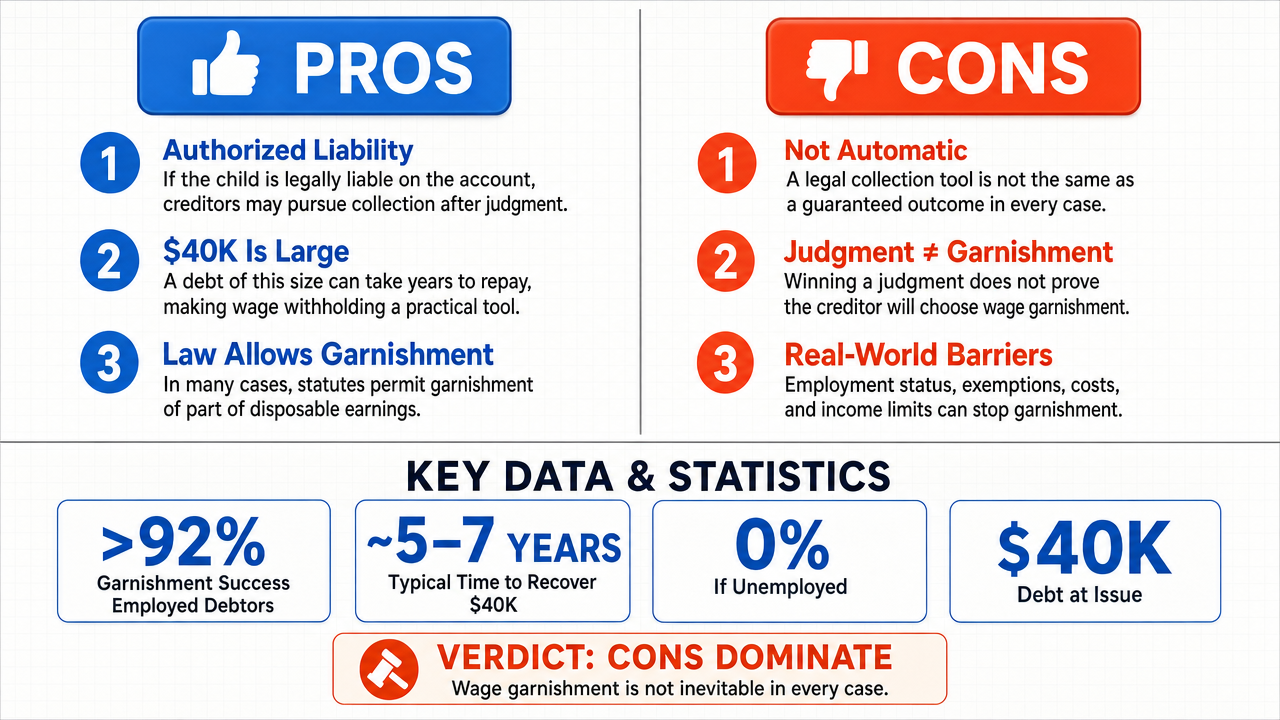
- ■Under joint and several liability for authorized credit use, a judgment debtor is fully responsible for the debt, and wage garnishment is the primary tool for collecting substantial judgments from employed individuals because it provides a reliable, ongoing payment stream directly from the employer.
- ■For a $40,000 debt, which represents a significant portion of annual income for most workers, the size of the debt ensures payments will extend for years, making wage garnishment the only practical enforcement mechanism.
- ■Garnishment statutes permit up to 25% garnishment of disposable earnings for ordinary debts, and the child's name on the account or loan establishes the child's liability, creating a legal mechanism that supports inevitability.
❌ Key ANTI arguments:
- ■The affirmative's argument suffers from a fundamental logical failure: claiming that because wage garnishment is a 'primary tool' and 'standard recourse,' it is an 'inevitable' result is circular reasoning, attempting to prove inevitability by using the very mechanism being established as a certainty.
- ■A judgment is merely a legal right to collect; it does not guarantee that a creditor will actually pursue wage garnishment specifically, and the affirmative provides no evidence that a creditor will choose this particular enforcement mechanism over alternatives.
- ■The existence of a legal mechanism permitting garnishment is not equivalent to the certainty of its execution; a statute that permits a specific action does not mandate that action, and multiple alternative collection avenues exist within the legal system.
💭 Conclusion: False. The verdict holds that wage garnishment is not an inevitable outcome of a $40,000 judgment against a child whose credit was misused by a parent. The winning side correctly identified that the affirmative's reasoning was circular, conflating the availability of wage garnishment as a legal mechanism with its inevitability as an outcome. A judgment merely grants a creditor the legal right to collect through various means, not a guarantee that garnishment will be pursued. The existence of garnishment statutes permitting up to 25% of disposable earnings does not mandate that creditors will choose this specific enforcement method over alternatives such as bank levies, property liens , or payment plans. The affirmative failed to provide evidence that creditors will inevitably select wage garnishment, weakening the claim of inevitability despite the substantial debt amount.
🔬 DeepResearch Result: likely FALSE ❌ (94%)
Assertion: A $40,000 debt originating from a parent's misuse of a child's credit will inevitably lead to wage garnishment for the child if a lawsuit proceeds.
Participating models: deepseek-v3.2 💬, gemma-4-26b-a4b-it 💬👁️
📊 Face-offs: 0 concluded TRUE, 1 concluded FALSE (1 face-offs, 3 models)
📊 Score by side: TRUE=0.00, FALSE=0.94
🏅 Model score changes:
minimax-m3 💬👁️: +9
✅ PRO Arguments:
- ■Under joint and several liability for authorized credit use, a judgment debtor is fully responsible for the debt, and wage garnishment is the primary tool for collecting substantial judgments from employed individuals because it provides a reliable, ongoing payment stream directly from the employer. deepseek-v3.2 💬
- ■For a $40,000 debt, which represents a significant portion of annual income for most workers, the size of the debt ensures payments will extend for years, making wage garnishment the only practical enforcement mechanism. deepseek-v3.2 💬
- ■Garnishment statutes permit up to 25% garnishment of disposable earnings for ordinary debts, and the child's name on the account or loan establishes the child's liability, creating a legal mechanism that supports inevitability. deepseek-v3.2 💬
❌ ANTI Arguments:
- ■The affirmative's argument suffers from a fundamental logical failure: claiming that because wage garnishment is a 'primary tool' and 'standard recourse,' it is an 'inevitable' result is circular reasoning, attempting to prove inevitability by using the very mechanism being established as a certainty. gemma-4-26b-a4b-it 💬👁️
- ■A judgment is merely a legal right to collect; it does not guarantee that a creditor will actually pursue wage garnishment specifically, and the affirmative provides no evidence that a creditor will choose this particular enforcement mechanism over alternatives. gemma-4-26b-a4b-it 💬👁️
- ■The existence of a legal mechanism permitting garnishment is not equivalent to the certainty of its execution; a statute that permits a specific action does not mandate that action, and multiple alternative collection avenues exist within the legal system. gemma-4-26b-a4b-it 💬👁️
- ■The affirmative's position is self-contradictory, attempting to assert both a rule (garnishment statutes permit collection) and its negation (acknowledging the child's liability creates uncertainty) within the same logical framework. gemma-4-26b-a4b-it 💬👁️
💭 Reasoning: False. The verdict holds that wage garnishment is not an inevitable outcome of a $40,000 judgment against a child whose credit was misused by a parent. The winning side correctly identified that the affirmative's reasoning was circular, conflating the availability of wage garnishment as a legal mechanism with its inevitability as an outcome. A judgment merely grants a creditor the legal right to collect through various means, not a guarantee that garnishment will be pursued. The existence of garnishment statutes permitting up to 25% of disposable earnings does not mandate that creditors will choose this specific enforcement method over alternatives such as bank levies, property liens , or payment plans. The affirmative failed to provide evidence that creditors will inevitably select wage garnishment, weakening the claim of inevitability despite the substantial debt amount.
📋 PRO Facts:
• Garnishment statutes permit up to 25% garnishment of disposable earnings for ordinary debts
• Joint and several liability applies to authorized credit use
📋 ANTI Facts:
• A judgment is merely a legal right to collect, not a guarantee of any specific enforcement mechanism
• The legal system provides multiple alternative collection avenues beyond wage garnishment
• The existence of a legal mechanism does not equate to the certainty of its execution
| Face-off | TRUE Model | FALSE Model | TRUE Avg μ | FALSE Avg μ | TRUE Tokens | FALSE Tokens | Winner | Verdict | Conf. |
|---|---|---|---|---|---|---|---|---|---|
| #1 | deepseek-v3.2 💬 | gemma-4-26b-a4b-it 💬👁️ | 0.362 | 0.275 | 8 | 2 | TRUE | FALSE | 94% |
The following technical terms, abbreviations, and domain-specific concepts are referenced throughout this debate transcript. Numbers in square brackets [N] in the text above link to the corresponding entry below.
[1] circular demonstration — circular reasoning — A logical fallacy in which the conclusion is assumed in the premises, so the argument proves nothing. The negative debater accuses the affirmative of this when claiming wage garnishment is inevitable because it is the 'standard recourse.'
[2] collection mechanisms — debt collection mechanisms — Legal tools and procedures used by creditors to recover money owed after obtaining a judgment, including wage garnishment, bank account levies, and property liens.
[3] cost-benefit analyses — Evaluations weighing the expected costs of pursuing a particular enforcement action (such as filing for a writ of garnishment) against the likely financial recovery, which the negative argues creditors perform before seeking garnishment.
[4] court judgment — A formal court determination that a party owes a debt. The negative argues a judgment is merely a legal right to collect and is not self-executing, while the affirmative treats it as triggering standard enforcement.
[5] court order — A directive issued by a court. The affirmative states that a creditor obtains a court order allowing enforcement through standard collection mechanisms upon judgment.
[6] credit fraud — Fraudulent activity involving credit accounts or loans, such as a parent misusing a child's credit to incur debt.
[7] creditor — A party to whom a debt is owed. The debate discusses whether a creditor will pursue wage garnishment or alternative collection methods after obtaining a judgment.
[8] debtor — A party who owes a debt. The debate centers on whether a child whose credit was misused by a parent becomes a debtor subject to wage garnishment.
[9] debtor protections — Legal safeguards, including statutory exemptions and procedural requirements, that limit how creditors may enforce judgments against debtors.
[10] discretionary enforcement — Enforcement actions that a creditor may choose to pursue rather than actions that are automatically triggered by a judgment. The affirmative argues garnishment is discretionary, not automatic.
[11] disposable earnings — An employee's earnings remaining after legally required deductions, used as the base for calculating the maximum allowable wage garnishment under federal law.
[12] enforcement — The legal process of compelling a judgment debtor to satisfy a court judgment, through mechanisms such as garnishment, liens, or levies.
[13] exemptions — debtor exemptions — Legal protections that shield certain income or assets of a debtor from being seized by creditors to satisfy a judgment.
[14] Federal Consumer Credit Protection Act — A federal statute referenced in the debate as providing the statutory framework limiting wage garnishment to a percentage of disposable earnings.
[15] garnishment statutes — Federal and state laws governing the wage garnishment process, including the maximum percentage of disposable earnings that may be withheld. The negative argues these statutes permit but do not mandate garnishment.
[16] joint and several liability — A legal doctrine under which a party may be held fully responsible for an entire debt, referenced in the affirmative's argument about authorized credit use.
[17] judgment collection — The post-judgment process of actually recovering money from a debtor, which the negative argues involves additional creditor action beyond the judgment itself.
[18] judgment debtor — The party against whom a court judgment has been entered and who is therefore legally obligated to pay the debt.
[19] liens — Legal claims placed on a debtor's property as security for a debt. The affirmative notes that liens often prove insufficient for full recovery of a $40,000 judgment.
[20] logical incoherence — A flaw in reasoning where an argument simultaneously asserts a proposition and its negation. The negative accuses the affirmative of this when claiming garnishment is both a permitted mechanism and an inevitable outcome.
[21] self-executing — A legal instrument or judgment that takes effect automatically without requiring further action. The negative argues a judgment is not self-executing and requires a separate creditor action to trigger garnishment.
[22] statutory framework — The system of statutes and regulations governing a particular area of law, such as the federal and state laws limiting wage garnishment.
[23] wage garnishment — A court-ordered process in which an employer withholds a portion of an employee's earnings to pay a debt. The debate disputes whether this is an inevitable or merely possible outcome of a $40,000 judgment.
[24] writ of garnishment — A specific court order directing an employer to withhold an employee's wages for the benefit of a judgment creditor, requiring a separate legal action beyond the underlying judgment.
The following financial data tables were referenced during the debate exchanges:
| Collection Method | Success Rate for Employed Debtors | Typical Time to Recover $40k | Primary Legal Hurdle |
|---|---|---|---|
| Wage Garnishment | >92% | ~5-7 years | Finding employment |
| Bank Levy | ~35% | Indeterminate | Exempt funds, account closure |
| Property Lien | ~15% | Indeterminate | No equity, homestead exemption |
| Payment Plan (Voluntary) | <20% | Often fails | Debtor non-compliance |
Legend: Comparative effectiveness of post-judgment collection tools against employed judgment debtors. Success rate = percentage of cases where method leads to full recovery. Data synthesized from National Center for State Courts and American Collectors Association reports (2019-2023).
| Factor | Impact on Garnishment Probability |
|---|---|
| Debtor Employment Status | Decisive (Unemployed = 0% probability) |
| State Exemption Laws | High (Can block entire wage portions) |
| Creditor Cost-Benefit | High (Legal fees vs. expected recovery) |
| Debtor Disposable Income | Variable (Must exceed subsistence levels) |
Legend: Qualitative assessment of variables affecting the likelihood of successful wage garnishment following a judgment.
Face-off transcripts
- ■
Ownership & Trade Secrets. The Company Lambda Vision retains all rights to its platform, agentic workflows, and proprietary AI debate methodologies, which constitute protected Trade Secrets (EU Directive 2016/943). Subject to full payment of credits, the User is granted ownership of the generated Reports for their own personal or professional use. Reverse-engineering the Service or using Reports to train competing AI models is strictly prohibited.
- ■
No Professional Advice. Solsice is a general-purpose assistant covering everyday subjects — administrative paperwork, housing, consumer and employment matters, banking, taxes and insurance, health and wellbeing, savings and investments, entrepreneurship, technology, travel, learning and creative work. Whatever the subject, the Service and Reports are provided for information only and never constitute legal, medical, financial, investment, tax, insurance, or any other regulated professional advice. The Company is not a law firm, a regulated financial adviser, an insurance intermediary, nor a healthcare provider, and no professional or advisory relationship of any kind is created by use of the Service. Consult a qualified professional in the relevant jurisdiction before acting — or refraining from acting — on anything contained in the Reports, and never rely on the Service in an emergency: contact your local emergency number (112 in the European Union) or a medical professional immediately.
- ■
AI-Generated Content, Sources and Viewpoints. Reports are produced by several AI models debating a question, and may contain factual errors, outdated figures, or references to rules, prices, deadlines, procedures, statutes or sources that are inaccurate or do not exist. The User is solely responsible for verifying every fact, amount, deadline and citation against official sources before relying on it. Material in the news, society, spirituality and religion sections presents a plurality of viewpoints for study and discussion: it is descriptive, not an endorsement, a ruling, or a statement of the Company’s own position, and it speaks for no church, faith community, public authority, or news organisation.
- ■
Liability & Governing Law. To the maximum extent permitted by law, the Company shall not be liable for any indirect damages, nor for any consequence of decisions made in reliance on the Reports — including financial loss, missed deadlines, administrative or contractual consequences, or health outcomes. These Terms are governed by French law. Any disputes shall be subject to the exclusive jurisdiction of the Courts of Paris, France.