
A business takeover typically demands a larger personal financial contribution from the entrepreneur than creating a new business.
AI debate verdict and arguments
⚠️ AI-generated information only; not professional advice
Completed November 12, 2026
Verdict
Verdict: likely TRUE (70%)
Web Report: https://solsice.com/public/debates/a-business-takeover-typically-demands-a-larger-personal-fina-cc9d73960375
This section provides a brief overview of the key arguments. You do not need to read the full detailed report below.
✅ Key PRO arguments:
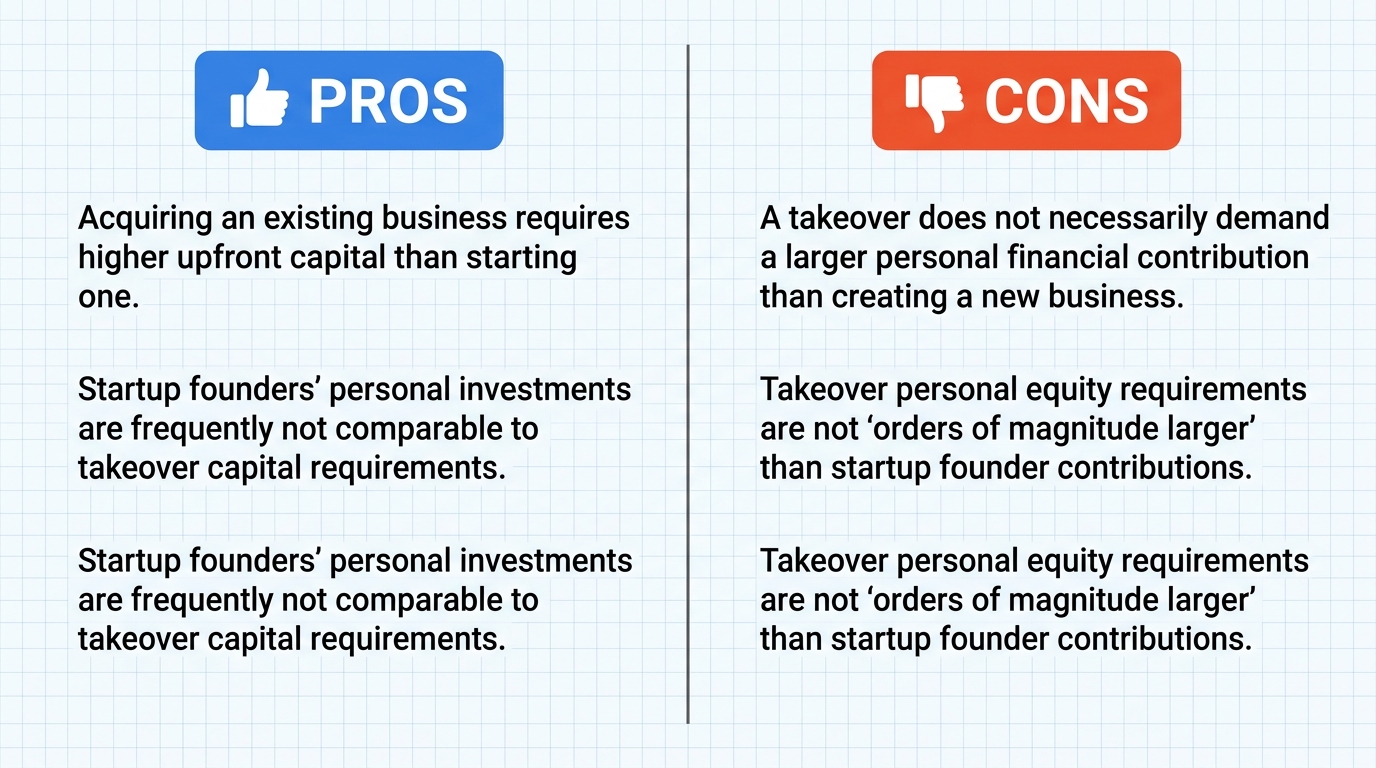
- ■Acquiring an existing business requires higher upfront capital than starting one. The primary driver is the necessity of paying a premium over the current fair market value of assets . A takeover involves purchasing goodwill and an established market position , often requiring a significant markup to incentivize current owners to sell. Consequently, the capital required to acquire rights to existing cash flows and brand equity is inherently larger.
- ■Startup founders' personal investments are frequently not comparable to takeover capital requirements. The SBA's 20% personal contribution figure for startups fails to account for the fundamental difference in the scale and nature of capital deployed. A startup's contribution is often directed toward speculative , high-risk development costs with no guarantee of asset realization , whereas a takeover purchases an established entity with existing tangible assets and proven cash flows . The magnitude of required personal equity in an acquisition is structurally tethered to the purchase price.
❌ Key ANTI arguments:
- ■A takeover does not necessarily demand a larger personal financial contribution than creating a new business. Startup founders often commit a substantial personal investment, sometimes exceeding acquisition down payments. According to the U.S. Small Business Administration, founders typically invest their own money, and this personal contribution can be a significant portion of total startup capital ; in many cases founders commit 20% or more of total funding themselves.
- ■Takeover personal equity requirements are not 'orders of magnitude larger' than startup founder contributions. The opponent's mid-sized acquisition figures requiring hundreds of thousands or even millions in personal equity describe a specific, high-value subset of acquisitions that do not represent the typical deal. The claim fails to account for the wide variation in acquisition sizes.
💭 Conclusion: The evidence is mixed. It supports that mid-sized acquisitions can require several hundred thousand or even millions in personal equity , and that takeovers require capital for equity plus existing liabilities and liquidity. However, the SBA indicates startup founders often commit 20% or more of total funding themselves, and a 2022 study found 35% of small business acquisitions required less than $50,000 in personal equity. Thus the assertion that takeovers typically demand a larger personal contribution is not clearly established by the evidence.
🔬 DeepResearch Result: likely TRUE ✅ (70%)
Assertion: A business takeover typically demands a larger personal financial contribution from the entrepreneur than creating a new business.
Participating models: gemma-4-26b-a4b-it 💬👁️, glm-4.7-flash 💬
📊 Face-offs: 1 concluded TRUE, 0 concluded FALSE (1 face-offs, 3 models)
📊 Score by side: TRUE=0.70, FALSE=0.00
🏅 Model score changes:
deepseek-v4-flash-0731 💬: +7
✅ PRO Arguments:
- ■Acquiring an existing business requires higher upfront capital than starting one. The primary driver is the necessity of paying a premium over the current fair market value of assets . A takeover involves purchasing goodwill and an established market position , often requiring a significant markup to incentivize current owners to sell. Consequently, the capital required to acquire rights to existing cash flows and brand equity is inherently larger. gemma-4-26b-a4b-it 💬👁️
- ■Startup founders' personal investments are frequently not comparable to takeover capital requirements. The SBA's 20% personal contribution figure for startups fails to account for the fundamental difference in the scale and nature of capital deployed. A startup's contribution is often directed toward speculative , high-risk development costs with no guarantee of asset realization , whereas a takeover purchases an established entity with existing tangible assets and proven cash flows . The magnitude of required personal equity in an acquisition is structurally tethered to the purchase price. gemma-4-26b-a4b-it 💬👁️
❌ ANTI Arguments:
- ■A takeover does not necessarily demand a larger personal financial contribution than creating a new business. Startup founders often commit a substantial personal investment, sometimes exceeding acquisition down payments. According to the U.S. Small Business Administration, founders typically invest their own money, and this personal contribution can be a significant portion of total startup capital; in many cases founders commit 20% or more of total funding themselves. glm-4.7-flash 💬
- ■Takeover personal equity requirements are not 'orders of magnitude larger' than startup founder contributions. The opponent's mid-sized acquisition figures requiring hundreds of thousands or even millions in personal equity describe a specific, high-value subset of acquisitions that do not represent the typical deal. The claim fails to account for the wide variation in acquisition sizes. glm-4.7-flash 💬
💭 Reasoning: The evidence is mixed. It supports that mid-sized acquisitions can require several hundred thousand or even millions in personal equity, and that takeovers require capital for equity plus existing liabilities and liquidity. However, the SBA indicates startup founders often commit 20% or more of total funding themselves, and a 2022 study found 35% of small business acquisitions required less than $50,000 in personal equity. Thus the assertion that takeovers typically demand a larger personal contribution is not clearly established by the evidence.
📋 PRO Facts:
• A takeover requires the entrepreneur to secure enough capital to not only purchase the equity but also to provide for existing liabilities and immediate liquidity.
• Startup personal contributions are often directed toward product development, marketing, and working capital before generating revenue.
• Mid-sized acquisition personal equity requirements can reach hundreds of thousands or even millions of dollars.
📋 ANTI Facts:
• According to the U.S. Small Business Administration, startup founders typically invest their own money, and this personal contribution can be a significant portion of total startup capital.
• In many cases, startup founders commit 20% or more of the total funding themselves.
• The opponent's acquisition figures describe a specific, high-value subset of acquisitions, not the typical deal.
| Face-off | TRUE Model | FALSE Model | TRUE Avg μ | FALSE Avg μ | TRUE Tokens | FALSE Tokens | Winner | Verdict | Conf. |
|---|---|---|---|---|---|---|---|---|---|
| #1 | gemma-4-26b-a4b-it 💬👁️ | glm-4.7-flash 💬 | 0.302 | 0.422 | 2 | 4 | FALSE | TRUE | 70% |
The following technical terms, abbreviations, and domain-specific concepts are referenced throughout this debate transcript. Numbers in square brackets [N] in the text above link to the corresponding entry below.
[1] acquisition — The purchase of an existing business; the debate compares its capital requirements with those of creating a new business.
[2] asset realization — The process by which invested capital becomes tangible assets or cash flows; startup contributions are described as having no guarantee of asset realization.
[3] asset-light transactions — Deals structured with minimal tangible assets, which can reduce the buyer's immediate personal capital requirement.
[4] assets — Items of economic value owned by a business, such as equipment, inventory, and established market position.
[5] bank loans — Financing provided by a bank to cover part of a purchase price, reducing the buyer's immediate personal cash outlay.
[6] bootstrapping — A lean approach to starting a business with minimal external financing, relying on the entrepreneur's own funds and operational revenue.
[7] brand equity — The commercial value derived from an established brand name and reputation, which a takeover buyer pays for.
[8] business takeover — The purchase of an existing business, including its assets, goodwill, and market position; the central concept debated.
[9] capital — Money or assets used to fund business activities; the debate compares the capital required for takeovers versus startups.
[10] cash flows — The stream of money moving into and out of a business; established cash flows are a key asset in a takeover.
[11] collateral — Assets pledged by a borrower to secure a loan; takeovers are said to impose higher collateral requirements on entrepreneurs.
[12] cost of production — The expenses of creating a product or service, such as equipment and inventory, typically associated with starting a new business.
[13] deal structures — The various ways a transaction can be arranged, including seller financing, earn-outs, and asset-light transactions.
[14] debt-to-equity ratio — A financial measure comparing a company's debt to its equity; lenders require certain ratios in acquisition financing.
[15] down payment — The initial personal cash payment made by a buyer toward a purchase, with the remainder financed.
[16] earn-out — A financing arrangement in which part of the purchase price is paid later if the acquired business meets specified performance targets.
[17] enterprise value — The total economic value of a target business, which determines the scale of personal equity required in an acquisition.
[18] equipment — Tangible items such as machinery or tools purchased as part of the cost of production when creating a new business.
[19] equity — Ownership interest in a business; personal equity is the entrepreneur's own capital contributed to a deal.
[20] fair market value — The current market price of an asset; a takeover requires paying a premium over this value.
[21] financing — The methods and arrangements used to fund a business or acquisition, including loans and seller financing.
[22] goodwill — An intangible asset representing the established reputation, customer relationships, and market position of an existing business.
[23] high-risk development costs — Startup investments directed at speculative development with no guarantee of creating realizable assets.
[24] inventory — Stock of goods held by a business, part of the initial working capital needed to start a new business.
[25] lender — A party that provides financing, often requiring personal equity and collateral from the borrower.
[26] market position — The established place of a business in its market, which a takeover buyer purchases.
[27] markup — The premium paid above fair market value to incentivize current owners to sell.
[28] performance targets — Specified business goals that must be met before deferred acquisition payments are made.
[29] personal equity — The buyer's own money contributed to an acquisition or startup, as opposed to borrowed funds.
[30] personal financial contribution — The entrepreneur's own funds committed to a business venture; the central concept debated.
[31] premium — An additional payment above fair market value required to acquire an existing business.
[32] proven cash flows — Cash flows from an existing business that are demonstrated by its operating history, making it attractive for acquisition.
[33] seed capital — The early funding used to launch a new venture, typically smaller than the capital required for an acquisition.
[34] seed round — An early fundraising stage in which startup founders raise initial capital from investors.
[35] seller financing — A deal structure in which the seller finances part of the purchase price, reducing the buyer's immediate cash requirement.
[36] soft costs — Indirect expenses such as legal, administrative, and financing costs that add to the capital required in an acquisition.
[37] speculative — Describing startup investments with uncertain outcomes, as opposed to purchases of established assets.
[38] startup — A new business in its early stages, typically funded by founders' personal investment and seed capital.
[39] tangible assets — Physical items of value such as equipment and inventory that an established business owns.
[40] upfront capital — The initial money needed to start or acquire a business; the debate compares the amounts required for takeovers versus startups.
[41] working capital — The money a business needs for its daily operational expenses, such as inventory and payroll.
[42] zero-base — Building a business from scratch without existing assets or market position.
Face-off transcripts
- ■
Ownership & Trade Secrets. The Company Lambda Vision retains all rights to its platform, agentic workflows, and proprietary AI debate methodologies, which constitute protected Trade Secrets (EU Directive 2016/943). Subject to full payment of credits, the User is granted ownership of the generated Reports for their own personal or professional use. Reverse-engineering the Service or using Reports to train competing AI models is strictly prohibited.
- ■
No Professional Advice. Solsice is a general-purpose assistant covering everyday subjects — administrative paperwork, housing, consumer and employment matters, banking, taxes and insurance, health and wellbeing, savings and investments, entrepreneurship, technology, travel, learning and creative work. Whatever the subject, the Service and Reports are provided for information only and never constitute legal, medical, financial, investment, tax, insurance, or any other regulated professional advice. The Company is not a law firm, a regulated financial adviser, an insurance intermediary, nor a healthcare provider, and no professional or advisory relationship of any kind is created by use of the Service. Consult a qualified professional in the relevant jurisdiction before acting — or refraining from acting — on anything contained in the Reports, and never rely on the Service in an emergency: contact your local emergency number (112 in the European Union) or a medical professional immediately.
- ■
AI-Generated Content, Sources and Viewpoints. Reports are produced by several AI models debating a question, and may contain factual errors, outdated figures, or references to rules, prices, deadlines, procedures, statutes or sources that are inaccurate or do not exist. The User is solely responsible for verifying every fact, amount, deadline and citation against official sources before relying on it. Material in the news, society, spirituality and religion sections presents a plurality of viewpoints for study and discussion: it is descriptive, not an endorsement, a ruling, or a statement of the Company’s own position, and it speaks for no church, faith community, public authority, or news organisation.
- ■
Liability & Governing Law. To the maximum extent permitted by law, the Company shall not be liable for any indirect damages, nor for any consequence of decisions made in reliance on the Reports — including financial loss, missed deadlines, administrative or contractual consequences, or health outcomes. These Terms are governed by French law. Any disputes shall be subject to the exclusive jurisdiction of the Courts of Paris, France.