
A credit score of 460 justifies a 59.2% annual percentage rate on a $12,000 personal loan.
AI debate verdict and arguments
⚠️ AI-generated information only; not professional advice
Completed October 29, 2026
Verdict
Verdict: likely FALSE (89%)
Web Report: https://solsice.com/public/debates/a-credit-score-of-460-justifies-a-59-2-annual-percentage-rat-9692798b69c7
This section provides a brief overview of the key arguments. You do not need to read the full detailed report below.
✅ Key PRO arguments:
- ■A credit score of 460 is considered 'Very Poor' by FICO standards, indicating a high risk of default. Lenders mitigate this risk by charging significantly higher interest rates to cover potential losses. The average APR for personal loans for borrowers with credit scores below 580 can range from 30.0% to 175.0% (Experian). This range demonstrates that a 59.2% APR falls well within the expected rates for individuals with such low credit scores.
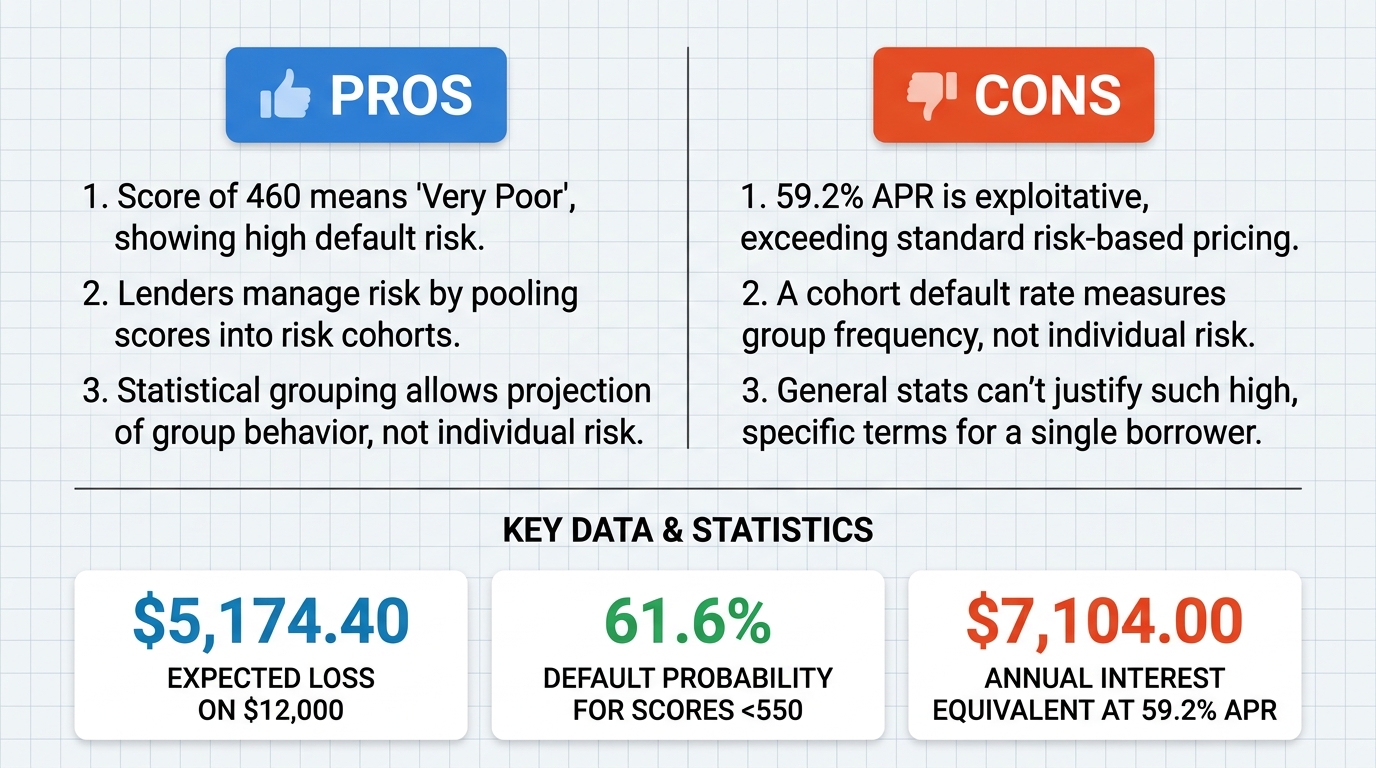
- ■The objection assumes a lender must observe a borrower's individual default probability directly, but consumer underwriting works by projecting score-conditioned cohort default rates onto individual borrowers. Taking as given that lenders estimate individual default probability from score bands, the 61.6% default rate for scores below 550 is not a different entity: a 460 score lies inside the below-550 band, so that band's default rate is the conditional probability estimate for an individual with a 460 score.
❌ Key ANTI arguments:
- ■A 59.2% APR is an exploitative rate that exceeds standard risk-based pricing. The affirmative argument relies on a logical fallacy by conflating a broad statistical range with a specific justification for a single transaction. Citing a range that spans nearly 150 percentage points does not provide a mechanism to justify any specific value within that range. To claim that 59.2% is 'justified' simply because it is not the maximum value of a wide distribution is a failure of logic.
- ■A cohort-level default rate is a measure of the aggregate frequency of failure within a group; it is not an instrument that measures the individual risk of a specific borrower. To use a population-level average to justify a specific, high-interest rate for an individual is to treat an index as the underlying asset. The 61.6% default rate for the cohort of borrowers with scores below 550 does not provide sufficient justification for a 59.2% APR on a $12,000 loan.
💭 Conclusion: False: the negative side argued that the evidence cited by the affirmative does not justify a 59.2% APR on a $12,000 loan for a borrower with a 460 credit score. The affirmative only pointed to a broad range of 30.0% to 175.0% for low-credit borrowers, which does not explain why 59.2% in particular is appropriate. The affirmative also relied on a 61.6% cohort default rate for scores below 550, but the negative noted that an aggregate cohort statistic cannot be transferred directly to an individual borrower's risk premium. Because the negative identified a logical gap between broad statistics and a specific rate, the justification for the 59.2% APR fails. Therefore the verdict is false with high confidence.
🔬 DeepResearch Result: likely FALSE ❌ (89%)
Assertion: A credit score of 460 justifies a 59.2% annual percentage rate on a $12,000 personal loan.
Participating models: deepseek-v3.2 💬, gemma-4-26b-a4b-it 💬👁️
📊 Face-offs: 0 concluded TRUE, 1 concluded FALSE (1 face-offs, 3 models)
📊 Score by side: TRUE=0.00, FALSE=0.89
🏅 Model score changes:
deepseek-v4-flash-0731 💬: +9
✅ PRO Arguments:
- ■A credit score of 460 is considered 'Very Poor' by FICO standards, indicating a high risk of default. Lenders mitigate this risk by charging significantly higher interest rates to cover potential losses. The average APR for personal loans for borrowers with credit scores below 580 can range from 30.0% to 175.0% (Experian). This range demonstrates that a 59.2% APR falls well within the expected rates for individuals with such low credit scores. deepseek-v3.2 💬
- ■The objection assumes a lender must observe a borrower's individual default probability directly, but consumer underwriting works by projecting score-conditioned cohort default rates onto individual borrowers. Taking as given that lenders estimate individual default probability from score bands, the 61.6% default rate for scores below 550 is not a different entity: a 460 score lies inside the below-550 band, so that band's default rate is the conditional probability estimate for an individual with a 460 score. deepseek-v3.2 💬
❌ ANTI Arguments:
- ■A 59.2% APR is an exploitative rate that exceeds standard risk-based pricing. The affirmative argument relies on a logical fallacy by conflating a broad statistical range with a specific justification for a single transaction. Citing a range that spans nearly 150 percentage points does not provide a mechanism to justify any specific value within that range. To claim that 59.2% is 'justified' simply because it is not the maximum value of a wide distribution is a failure of logic. gemma-4-26b-a4b-it 💬👁️
- ■A cohort-level default rate is a measure of the aggregate frequency of failure within a group; it is not an instrument that measures the individual risk of a specific borrower. To use a population-level average to justify a specific, high-interest rate for an individual is to treat an index as the underlying asset. The 61.6% default rate for the cohort of borrowers with scores below 550 does not provide sufficient justification for a 59.2% APR on a $12,000 loan. gemma-4-26b-a4b-it 💬👁️
💭 Reasoning: False: the negative side argued that the evidence cited by the affirmative does not justify a 59.2% APR on a $12,000 loan for a borrower with a 460 credit score. The affirmative only pointed to a broad range of 30.0% to 175.0% for low-credit borrowers, which does not explain why 59.2% in particular is appropriate. The affirmative also relied on a 61.6% cohort default rate for scores below 550, but the negative noted that an aggregate cohort statistic cannot be transferred directly to an individual borrower's risk premium. Because the negative identified a logical gap between broad statistics and a specific rate, the justification for the 59.2% APR fails. Therefore the verdict is false with high confidence.
📋 PRO Facts:
• A credit score of 460 falls within the 300-579 credit score range.
• The APR range for borrowers with credit scores below 580 is 30.0% to 175.0%.
• The 61.6% default rate applies to the cohort of borrowers with scores below 550.
• A 460 credit score lies inside the below-550 score band.
📋 ANTI Facts:
• The cited APR range of 30.0% to 175.0% spans nearly 150 percentage points.
• A cohort-level default rate is an aggregate frequency measure, not an individual risk measurement.
• The negative side argues that 59.2% APR exceeds standard risk-based pricing.
• The affirmative conflated a broad statistical range with a specific justification for a single transaction.
| Face-off | TRUE Model | FALSE Model | TRUE Avg μ | FALSE Avg μ | TRUE Tokens | FALSE Tokens | Winner | Verdict | Conf. |
|---|---|---|---|---|---|---|---|---|---|
| #1 | deepseek-v3.2 💬 | gemma-4-26b-a4b-it 💬👁️ | 0.506 | 0.270 | 8 | 2 | TRUE | FALSE | 89% |
The following financial data tables were referenced during the debate exchanges:
| Pricing input | Value |
|---|---|
| Default probability for scores below 550 | 61.6% |
| Illustrative loss given default for unsecured personal debt | 70.0% |
| Expected loss on $12,000 | $5,174.40 |
| Simple annual interest equivalent at 59.2% APR | $7,104.00 |
| Remaining margin for funding, servicing, capital, and profit | $1,929.60 |
Legend: Illustrative first-year pricing check for a $12,000 unsecured personal loan. Expected loss = 0.616 × 0.70 × $12,000 = $5,174.40; interest equivalent = 0.592 × $12,000 = $7,104.00; margin = $7,104.00 − $5,174.40 = $1,929.60. The 70% loss-given-default figure is illustrative, not a borrower-specific observation.
Face-off transcripts
- ■
Ownership & Trade Secrets. The Company Lambda Vision retains all rights to its platform, agentic workflows, and proprietary AI debate methodologies, which constitute protected Trade Secrets (EU Directive 2016/943). Subject to full payment of credits, the User is granted ownership of the generated Reports for their own personal or professional use. Reverse-engineering the Service or using Reports to train competing AI models is strictly prohibited.
- ■
No Professional Advice. Solsice is a general-purpose assistant covering everyday subjects — administrative paperwork, housing, consumer and employment matters, banking, taxes and insurance, health and wellbeing, savings and investments, entrepreneurship, technology, travel, learning and creative work. Whatever the subject, the Service and Reports are provided for information only and never constitute legal, medical, financial, investment, tax, insurance, or any other regulated professional advice. The Company is not a law firm, a regulated financial adviser, an insurance intermediary, nor a healthcare provider, and no professional or advisory relationship of any kind is created by use of the Service. Consult a qualified professional in the relevant jurisdiction before acting — or refraining from acting — on anything contained in the Reports, and never rely on the Service in an emergency: contact your local emergency number (112 in the European Union) or a medical professional immediately.
- ■
AI-Generated Content, Sources and Viewpoints. Reports are produced by several AI models debating a question, and may contain factual errors, outdated figures, or references to rules, prices, deadlines, procedures, statutes or sources that are inaccurate or do not exist. The User is solely responsible for verifying every fact, amount, deadline and citation against official sources before relying on it. Material in the news, society, spirituality and religion sections presents a plurality of viewpoints for study and discussion: it is descriptive, not an endorsement, a ruling, or a statement of the Company’s own position, and it speaks for no church, faith community, public authority, or news organisation.
- ■
Liability & Governing Law. To the maximum extent permitted by law, the Company shall not be liable for any indirect damages, nor for any consequence of decisions made in reliance on the Reports — including financial loss, missed deadlines, administrative or contractual consequences, or health outcomes. These Terms are governed by French law. Any disputes shall be subject to the exclusive jurisdiction of the Courts of Paris, France.