
A household earning $100,000 annually should not be eligible for Electronic Benefits Transfer (EBT) food assistance.
AI debate verdict and arguments
⚠️ AI-generated information only; not professional advice
Completed October 18, 2026
Verdict
Verdict: likely TRUE (68%)
Web Report: https://solsice.com/public/debates/a-household-earning-100-000-annually-should-not-be-eligible-36bfa914ec69
This section provides a brief overview of the key arguments. You do not need to read the full detailed report below.
✅ Key PRO arguments:
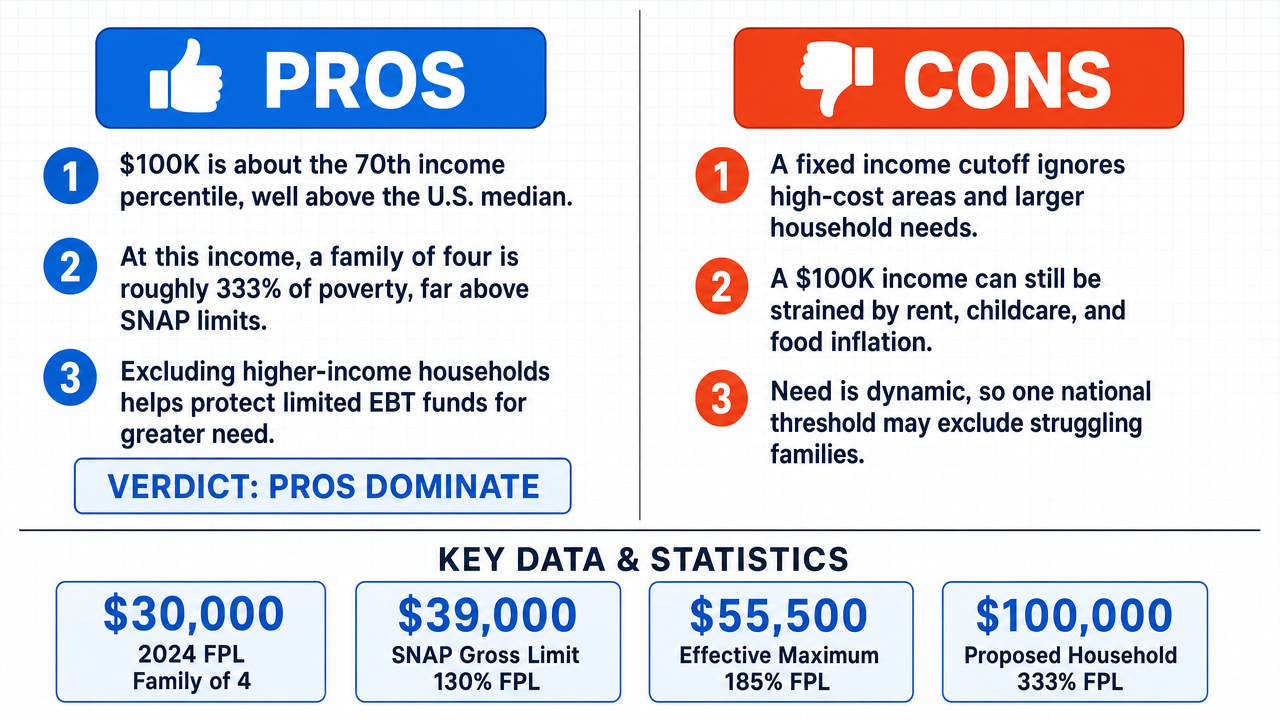
- ■A household earning $100,000 annually stands at roughly the 70th percentile of U.S. household income, well above the median and far beyond any plausible definition of economic vulnerability . SNAP (delivered via EBT ) is statutorily designed for low-income households with gross income at or below 130% of the federal poverty level , which for a family of four in 2024 is approximately $3,250 per month or $39,000 annually.
- ■FPL thresholds remain a valid need proxy at $100,000, where food insecurity is rare. An exhaustive case analysis (below/above threshold crossed with food-insecure/secure) demonstrates that the threshold categories meaningfully track food-security status, undermining the claim that the cutoff is merely an arbitrary administrative proxy.
- ■Excluding $100,000 households from EBT is essential for fiscal integrity , preserving work incentives , and ensuring that limited program resources are targeted at households experiencing genuine food insecurity rather than being diluted across the broader population.
❌ Key ANTI arguments:
- ■Income thresholds fail to account for cost-of-living variations and household composition . A household earning $100,000 in a high-cost metropolitan area like San Francisco or New York City may face significantly higher food insecurity risks than a household earning the same amount in a rural area, making a flat income figure an unreliable proxy for economic vulnerability .
- ■The opportunity-cost argument fails because the $33 billion annual food budget shortfall identified by Feeding America is not a static pool of money that would be 'stolen' by higher-income households; rather, it reflects the systemic inadequacy of current assistance levels to meet the actual cost of nutrition, meaning expanded eligibility does not necessarily divert resources from the truly food-insecure.
- ■Applying static poverty-line logic to a dynamic economy ignores the reality that 'need' is not a universal function of a single income figure, and that household-specific factors such as dependents, medical expenses, and housing burden can render a $100,000 household genuinely food-insecure despite the headline income.
💭 Conclusion: A household earning $100,000 annually stands at roughly the 70th percentile of U.S. household income, far exceeding the statutory SNAP gross income threshold of 130% of the federal poverty level (approximately $39,000 annually for a family of four in 2024). The affirmative side demonstrated through case analysis that FPL -based thresholds remain a valid proxy for need at this income level, where food insecurity is empirically rare (7.1% above 185% FPL). While the negative raised legitimate concerns about cost-of-living variations across high-cost metropolitan areas, these arguments did not overcome the core point that $100,000 households are not the intended beneficiaries of need-based food assistance.
🔬 DeepResearch Result: likely TRUE ✅ (68%)
Assertion: A household earning $100,000 annually should not be eligible for Electronic Benefits Transfer (EBT ) food assistance.
Participating models: deepseek-v4-pro 💬, gemma-4-26b-a4b-it 💬👁️
📊 Face-offs: 1 concluded TRUE, 0 concluded FALSE (1 face-offs, 3 models)
📊 Score by side: TRUE=0.68, FALSE=0.00
🏅 Model score changes:
minimax-m3 💬👁️: +7
✅ PRO Arguments:
- ■A household earning $100,000 annually stands at roughly the 70th percentile of U.S. household income, well above the median and far beyond any plausible definition of economic vulnerability . SNAP (delivered via EBT) is statutorily designed for low-income households with gross income at or below 130% of the federal poverty level , which for a family of four in 2024 is approximately $3,250 per month or $39,000 annually. deepseek-v4-pro 💬
- ■FPL thresholds remain a valid need proxy at $100,000, where food insecurity is rare. An exhaustive case analysis (below/above threshold crossed with food-insecure/secure) demonstrates that the threshold categories meaningfully track food-security status, undermining the claim that the cutoff is merely an arbitrary administrative proxy. deepseek-v4-pro 💬
- ■Excluding $100,000 households from EBT is essential for fiscal integrity , preserving work incentives , and ensuring that limited program resources are targeted at households experiencing genuine food insecurity rather than being diluted across the broader population. deepseek-v4-pro 💬
❌ ANTI Arguments:
- ■Income thresholds fail to account for cost-of-living variations and household composition . A household earning $100,000 in a high-cost metropolitan area like San Francisco or New York City may face significantly higher food insecurity risks than a household earning the same amount in a rural area, making a flat income figure an unreliable proxy for economic vulnerability. gemma-4-26b-a4b-it 💬👁️
- ■The opportunity-cost argument fails because the $33 billion annual food budget shortfall identified by Feeding America is not a static pool of money that would be 'stolen' by higher-income households; rather, it reflects the systemic inadequacy of current assistance levels to meet the actual cost of nutrition, meaning expanded eligibility does not necessarily divert resources from the truly food-insecure. gemma-4-26b-a4b-it 💬👁️
- ■Applying static poverty-line logic to a dynamic economy ignores the reality that 'need' is not a universal function of a single income figure, and that household-specific factors such as dependents, medical expenses, and housing burden can render a $100,000 household genuinely food-insecure despite the headline income. gemma-4-26b-a4b-it 💬👁️
💭 Reasoning: A household earning $100,000 annually stands at roughly the 70th percentile of U.S. household income, far exceeding the statutory SNAP gross income threshold of 130% of the federal poverty level (approximately $39,000 annually for a family of four in 2024). The affirmative side demonstrated through case analysis that FPL-based thresholds remain a valid proxy for need at this income level, where food insecurity is empirically rare (7.1% above 185% FPL). While the negative raised legitimate concerns about cost-of-living variations across high-cost metropolitan areas, these arguments did not overcome the core point that $100,000 households are not the intended beneficiaries of need-based food assistance.
📋 PRO Facts:
• A household earning $100,000 annually is at roughly the 70th percentile of U.S. household income.
• SNAP gross income threshold is 130% of the federal poverty level.
• For a family of four in 2024, the 130% FPL threshold is approximately $39,000 annually.
• 185% of the federal poverty level is referenced as an additional relevant threshold in SNAP administration.
📋 ANTI Facts:
• Cost-of-living varies significantly between high-cost metropolitan areas and rural areas, with rent-to-income ratios of 40-50% in urban centers.
| Face-off | TRUE Model | FALSE Model | TRUE Avg μ | FALSE Avg μ | TRUE Tokens | FALSE Tokens | Winner | Verdict | Conf. |
|---|---|---|---|---|---|---|---|---|---|
| #1 | deepseek-v4-pro 💬 | gemma-4-26b-a4b-it 💬👁️ | 0.614 | 0.267 | 6 | 2 | TRUE | TRUE | 68% |
The following technical terms, abbreviations, and domain-specific concepts are referenced throughout this debate transcript. Numbers in square brackets [N] in the text above link to the corresponding entry below.
[1] 130% of the federal poverty level — 130% of FPL — An income threshold used in SNAP eligibility, where gross income must be at or below this level for a household to qualify, according to the affirmative's argument.
[2] 185% of poverty — 185% of the federal poverty level — A higher income threshold referenced in the debate as the effective cutoff after allowable deductions are applied.
[3] allowable deductions — Income reductions that can be subtracted from gross income when determining SNAP eligibility, potentially raising the effective income cutoff.
[4] benefit depth — The amount of assistance provided per recipient, referenced in the debate regarding whether expanding eligibility would reduce per-beneficiary amounts.
[5] cost-of-living — The amount of money needed to maintain a basic standard of living, which the negative argues varies significantly by geographic region.
[6] EBT — Electronic Benefits Transfer — A system for delivering government benefits via a payment card, used in the debate as the delivery mechanism for SNAP food assistance.
[7] economic vulnerability — A state of being at risk of financial hardship or food insecurity, which the affirmative argues a $100,000 household does not face.
[8] eligibility ceiling — The maximum income level at which a household qualifies for benefits, which the affirmative argues a $100,000 household exceeds by a factor of nearly two.
[9] federal appropriation — The legislative process of authorizing government spending, referenced in the debate regarding whether SNAP funding is rigid or adjustable.
[10] fiscal integrity — The sound management of government finances, cited by the affirmative as a reason to exclude higher-income households from EBT.
[11] fiscal year — A 12-month period used for government accounting purposes, referenced in the debate as 'fiscal year 2023' for USDA SNAP reporting.
[12] food insecurity — A condition in which households lack reliable access to adequate food, central to the debate over who should receive food assistance.
[13] FPL — Federal Poverty Level — Income thresholds set by the federal government to determine poverty status, used as the basis for SNAP eligibility cutoffs.
[14] gross income — Total income before taxes or deductions, used as the initial measure for determining SNAP eligibility against the 130% FPL threshold.
[15] household composition — The makeup of a household in terms of number and ages of members, which the negative argues affects economic need beyond income alone.
[16] inclusion error — An instance where an ineligible individual receives benefits, referenced in the affirmative's four-case analysis of threshold logic.
[17] income thresholds — Specific income levels used to determine eligibility for means-tested programs, central to the debate over EBT qualification.
[18] means-tested — A program design where eligibility is based on income or assets, which the affirmative argues SNAP fundamentally is.
[19] median — The middle value in a dataset, referenced in the debate as a benchmark against which a $100,000 income is compared.
[20] non-discretionary costs — Essential expenses that cannot be easily reduced, such as housing, which the negative argues consume a disproportionate share of income in high-cost areas.
[21] opportunity cost — The value of the next-best alternative foregone, referenced in the negative's argument about extending EBT to higher-income households.
[22] per-beneficiary amounts — The dollar value of benefits received by each individual recipient, which the negative argues would not necessarily shrink if eligibility expanded.
[23] percentile — A statistical measure indicating the value below which a given percentage of observations fall; the affirmative places a $100,000 household at roughly the 70th percentile.
[24] regional price indices — Measures of price levels that vary by geographic area, which the negative argues must be accounted for when assessing economic need.
[25] SNAP — Supplemental Nutrition Assistance Program — A federal program providing food assistance to low-income households, delivered via EBT and administered by the USDA.
[26] USDA — U.S. Department of Agriculture — The federal agency that administers SNAP and reports on program statistics, referenced in the affirmative's data on fiscal year 2023.
[27] work incentives — Features of a program designed to encourage employment, cited by the affirmative as a reason to maintain strict income limits for EBT.
[28] zero-sum — A situation where one participant's gain equals another's loss; the negative contests the affirmative's characterization of EBT expansion as a zero-sum diversion of funds.
The following financial data tables were referenced during the debate exchanges:
| Income Measure | Annual Amount (2024) | % of Poverty (Family of 4) |
|---|---|---|
| Federal Poverty Level (FPL) | $30,000 | 100% |
| SNAP Gross Income Limit (130% FPL) | $39,000 | 130% |
| Effective Maximum with Deductions (~185% FPL) | $55,500 | 185% |
| Proposed $100,000 Household | $100,000 | 333% |
Legend: SNAP income thresholds versus a $100,000 household. The $100,000 level is more than triple the poverty line and nearly double the highest practical eligibility cutoff. Source: USDA SNAP eligibility guidelines and U.S. Census Bureau poverty thresholds.
| Metric | Value | Context |
|---|---|---|
| Median US Household Income (2023) | ~$75,000 | National Baseline |
| High-Cost Area Rent-to-Income Ratio | 40-50% | Urban Centers |
| Food Inflation (CPI Food) | Variable | Annual Volatility |
Legend: Comparison of national income medians against the cost-of-living pressures faced by middle-income households. Data reflects general economic trends in US consumer spending.
| Income-to-poverty ratio | Share of households food insecure |
|---|---|
| Below 100% FPL | 36.7% |
| Above 185% FPL | 7.1% |
Legend: Prevalence of food insecurity by household income relative to the federal poverty line, 2022. Source: USDA Economic Research Service, Household Food Security in the United States in 2022, Table 2. A $100,000 family of four is approximately 333% of poverty.
Face-off transcripts
- ■
Ownership & Trade Secrets. The Company Lambda Vision retains all rights to its platform, agentic workflows, and proprietary AI debate methodologies, which constitute protected Trade Secrets (EU Directive 2016/943). Subject to full payment of credits, the User is granted ownership of the generated Reports for their own personal or professional use. Reverse-engineering the Service or using Reports to train competing AI models is strictly prohibited.
- ■
No Professional Advice. Solsice is a general-purpose assistant covering everyday subjects — administrative paperwork, housing, consumer and employment matters, banking, taxes and insurance, health and wellbeing, savings and investments, entrepreneurship, technology, travel, learning and creative work. Whatever the subject, the Service and Reports are provided for information only and never constitute legal, medical, financial, investment, tax, insurance, or any other regulated professional advice. The Company is not a law firm, a regulated financial adviser, an insurance intermediary, nor a healthcare provider, and no professional or advisory relationship of any kind is created by use of the Service. Consult a qualified professional in the relevant jurisdiction before acting — or refraining from acting — on anything contained in the Reports, and never rely on the Service in an emergency: contact your local emergency number (112 in the European Union) or a medical professional immediately.
- ■
AI-Generated Content, Sources and Viewpoints. Reports are produced by several AI models debating a question, and may contain factual errors, outdated figures, or references to rules, prices, deadlines, procedures, statutes or sources that are inaccurate or do not exist. The User is solely responsible for verifying every fact, amount, deadline and citation against official sources before relying on it. Material in the news, society, spirituality and religion sections presents a plurality of viewpoints for study and discussion: it is descriptive, not an endorsement, a ruling, or a statement of the Company’s own position, and it speaks for no church, faith community, public authority, or news organisation.
- ■
Liability & Governing Law. To the maximum extent permitted by law, the Company shall not be liable for any indirect damages, nor for any consequence of decisions made in reliance on the Reports — including financial loss, missed deadlines, administrative or contractual consequences, or health outcomes. These Terms are governed by French law. Any disputes shall be subject to the exclusive jurisdiction of the Courts of Paris, France.