
A leader who sees only the good in others and looks past their immediate trauma is more effective at advancing a long-term mission than one who focuses on those challenges.
AI debate verdict and arguments
⚠️ AI-generated information only; not professional advice
Completed October 27, 2026
Verdict
Verdict: likely FALSE (70%)
Web Report: https://solsice.com/public/debates/a-leader-who-sees-only-the-good-in-others-and-looks-past-the-28d040670562
This section provides a brief overview of the key arguments. You do not need to read the full detailed report below.
✅ Key PRO arguments:
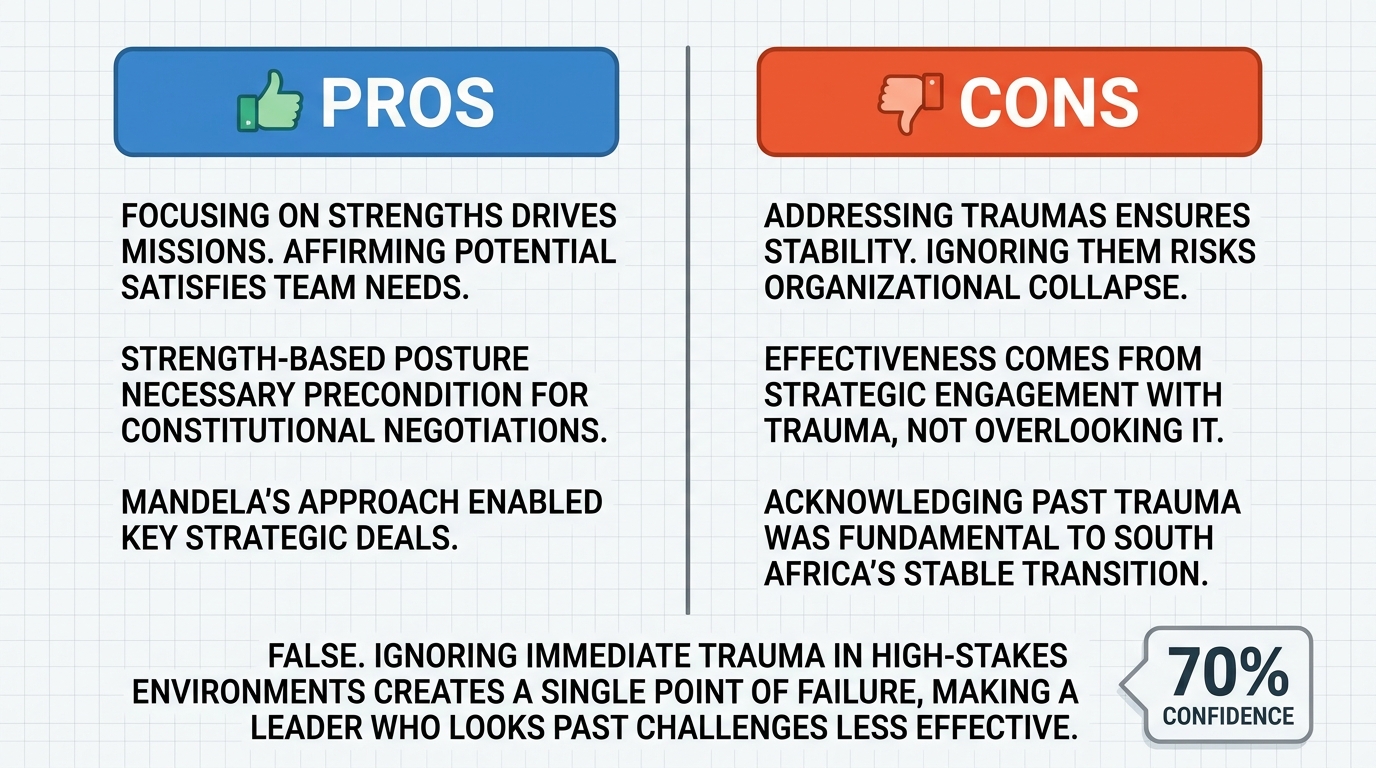
- ■Leaders who focus on strengths and overlook trauma drive long-term missions more effectively. Affirming individuals' potential satisfies the fundamental needs for autonomy, competence, and relatedness , fueling persistent, self-driven engagement (Deci & Ryan, 2000), and positive emotions elicited by affirmative focus expand cognitive and behavioral repertoire via broaden-and-build theory .
- ■The Mandela case connection is not a missing link; Mandela's strength-based, forward-looking posture was a necessary precondition that made constitutional negotiation and economic stabilization possible. The causal architecture of the transition is extensively documented in the primary historical record.
❌ Key ANTI arguments:
- ■Effective leadership requires addressing individual challenges and traumas to ensure organizational stability . Ignoring the trauma or dysfunction of a key team member is a failure of risk management , risking a single point of failure that can derail an entire mission. Transformational leadership metrics , such as the cited r = .44 for effectiveness, ignore these catastrophic failure modes .
- ■Mandela's effectiveness was not a product of looking past trauma, but of strategic engagement with it. The stability of South Africa's transition was fundamentally secured by the leader's ability to confront and manage the acute psychological and political traumas of both the oppressed and the oppressor populations.
💭 Conclusion: False. The winning side showed that ignoring immediate trauma in high-stakes environments creates a single point of failure that can derail a long-term mission, making a leader who looks past those challenges less effective rather than more effective. The anti side also undercut the affirmative's Mandela example by noting that his success came from strategically confronting the acute traumas of both oppressed and oppressor populations, not from overlooking them. The affirmative's theoretical appeals to self-determination and broaden-and-build theories did not address the structural risk-management failures that arise when trauma and dysfunction are ignored. The negative framing of effective leadership as requiring engagement with individual challenges and trauma is therefore more consistent with the evidence. Because the claim is compound and the least-supported part—the 'sees only the good' component—received only qualified contestation in a single debate, confidence is moderate rather than high.
🔬 DeepResearch Result: likely FALSE ❌ (70%)
Assertion: A leader who sees only the good in others and looks past their immediate trauma is more effective at advancing a long-term mission than one who focuses on those challenges.
Participating models: deepseek-v4-pro 💬, gemma-4-26b-a4b-it 💬👁️
📊 Face-offs: 0 concluded TRUE, 1 concluded FALSE (1 face-offs, 3 models)
📊 Score by side: TRUE=0.00, FALSE=0.84
🏅 Model score changes:
deepseek-v4-flash-0731 💬: +8
✅ PRO Arguments:
- ■Leaders who focus on strengths and overlook trauma drive long-term missions more effectively. Affirming individuals' potential satisfies the fundamental needs for autonomy, competence, and relatedness , fueling persistent, self-driven engagement (Deci & Ryan, 2000), and positive emotions elicited by affirmative focus expand cognitive and behavioral repertoire via broaden-and-build theory . deepseek-v4-pro 💬
- ■The Mandela case connection is not a missing link; Mandela's strength-based, forward-looking posture was a necessary precondition that made constitutional negotiation and economic stabilization possible. The causal architecture of the transition is extensively documented in the primary historical record. deepseek-v4-pro 💬
❌ ANTI Arguments:
- ■Effective leadership requires addressing individual challenges and traumas to ensure organizational stability . Ignoring the trauma or dysfunction of a key team member is a failure of risk management , risking a single point of failure that can derail an entire mission. Transformational leadership metrics , such as the cited r = .44 for effectiveness, ignore these catastrophic failure modes . gemma-4-26b-a4b-it 💬👁️
- ■Mandela's effectiveness was not a product of looking past trauma, but of strategic engagement with it. The stability of South Africa's transition was fundamentally secured by the leader's ability to confront and manage the acute psychological and political traumas of both the oppressed and the oppressor populations. gemma-4-26b-a4b-it 💬👁️
💭 Reasoning: False. The winning side showed that ignoring immediate trauma in high-stakes environments creates a single point of failure that can derail a long-term mission, making a leader who looks past those challenges less effective rather than more effective. The anti side also undercut the affirmative's Mandela example by noting that his success came from strategically confronting the acute traumas of both oppressed and oppressor populations, not from overlooking them. The affirmative's theoretical appeals to self-determination and broaden-and-build theories did not address the structural risk-management failures that arise when trauma and dysfunction are ignored. The negative framing of effective leadership as requiring engagement with individual challenges and trauma is therefore more consistent with the evidence. Because the claim is compound and the least-supported part—the 'sees only the good' component—received only qualified contestation in a single debate, confidence is moderate rather than high.
📋 PRO Facts:
• Self-determination theory holds that affirming autonomy, competence, and relatedness fuels persistent, self-driven engagement (Deci & Ryan, 2000).
• Fredrickson's broaden-and-build theory says positive emotions expand cognitive and behavioral repertoire.
• The affirmative argues that Mandela's strength-based, forward-looking posture was a necessary precondition for South Africa's institutional transition.
📋 ANTI Facts:
• Ignoring a key team member's acute psychological instability or unresolved conflict creates a single point of failure that can derail an entire mission.
• Mandela's effectiveness came from strategic engagement with the acute psychological and political traumas of both the oppressed and the oppressor populations, not from looking past them.
• The stability of South Africa's transition relied on confronting and managing trauma as well as institutional frameworks .
| Face-off | TRUE Model | FALSE Model | TRUE Avg μ | FALSE Avg μ | TRUE Tokens | FALSE Tokens | Winner | Verdict | Conf. |
|---|---|---|---|---|---|---|---|---|---|
| #1 | deepseek-v4-pro 💬 | gemma-4-26b-a4b-it 💬👁️ | 0.562 | 0.470 | 6 | 2 | TRUE | FALSE | 84% |
The following technical terms, abbreviations, and domain-specific concepts are referenced throughout this debate transcript. Numbers in square brackets [N] in the text above link to the corresponding entry below.
[1] acute collective trauma — N/A — A sudden episode of severe psychological harm affecting a group; the negative side argues it must be directly managed, citing the period after the assassination of Chris Hani.
[2] autonomy, competence, and relatedness — N/A — The three fundamental psychological needs proposed by self-determination theory; the affirmative argues that affirming people's positive qualities satisfies them and fuels sustained engagement.
[3] broaden-and-build theory — N/A — A theory by Fredrickson holding that positive emotions expand thought-action repertoires and build durable personal resources; cited by the affirmative.
[4] case study — N/A — An in-depth examination of a particular instance; the affirmative uses Nelson Mandela's leadership as one.
[5] causal architecture — N/A — The structure of cause-and-effect relationships behind an outcome; the affirmative invokes it to explain Mandela's role in the transition.
[6] civil war — N/A — Armed conflict between organized groups within the same country; the debate concerns whether Mandela's approach prevented one.
[7] cognitive and behavioral repertoires — N/A — The range of thoughts and actions available to a person; broaden-and-build theory says positive emotions expand them.
[8] constitutional negotiation — N/A — Formal talks over the legal and political framework of a state; the affirmative says Mandela's posture was a precondition for such negotiations.
[9] counter-example — N/A — A specific case offered to oppose a general claim; the negative offers the Chris Hani period as one against the strength-based narrative.
[10] economic stabilization — N/A — Efforts to steady an economy during a political transition; listed among the structural mechanisms discussed in the debate.
[11] failure modes — N/A — The ways in which a system or process can fail; the negative argues ignoring individual challenges creates catastrophic failure modes.
[12] grievances — N/A — Feelings of resentment arising from perceived injustice or mistreatment; the affirmative says they can be addressed structurally while looking past immediate trauma.
[13] high-stakes environments — N/A — Settings where errors have severe consequences; the negative says ignoring trauma in such settings is a risk-management failure.
[14] institutional frameworks — N/A — Formal rules, organizations, and structures that shape political and economic life; the negative says the transition relied heavily on them.
[15] intrinsic motivation — N/A — Engagement driven by internal interest rather than external rewards; the affirmative says strengths-focused leaders activate it.
[16] metrics — N/A — Quantitative measures used to evaluate performance; the negative argues transformational leadership metrics miss catastrophic failure modes.
[17] organizational stability — N/A — The capacity of an organization to maintain effective operations and cohesion; the negative says leaders must address individual challenges to ensure it.
[18] proxy — N/A — A stand-in used to represent something else in analysis; the negative says the Mandela case study is a faulty proxy.
[19] psychological deficits — N/A — Shortcomings in mental or emotional functioning; the negative says effective leadership must structurally address them.
[20] psychological resilience — N/A — The ability to recover from setbacks and sustain effort; the affirmative says strengths-focused leadership builds it.
[21] psychological safety — N/A — An environment in which people can acknowledge and address difficult realities; the negative says it is built by confronting trauma, not ignoring it.
[22] r — correlation coefficient — A statistical measure of association; the negative cites a value of .44 for effectiveness in relation to transformational leadership metrics.
[23] risk management — N/A — The identification and mitigation of risks; the negative frames ignoring a subordinate's instability as a failure of risk management.
[24] self-determination theory — N/A — A theory by Deci and Ryan holding that autonomy, competence, and relatedness fuel intrinsic motivation; cited by the affirmative.
[25] single point of failure — N/A — A single component whose breakdown can bring down the whole system; the negative says overlooked trauma can become one.
[26] strength-based approach — N/A — A focus on people's positive qualities and potential; the affirmative endorses it, while the negative criticizes that narrative.
[27] stressors — N/A — Conditions that cause psychological strain; the negative says effective leadership acknowledges and mitigates them.
[28] transfer operator — N/A — A mathematical operator that moves functions or measures between spaces; used metaphorically by the negative for a mechanism linking individual character to systemic stability.
[29] transformational leadership — N/A — A leadership style that inspires and motivates followers through vision and positive influence; the negative says its metrics fail to capture structural risks.
[30] transition — N/A — A period of political change; the debate concerns South Africa's transition and its constitutional and economic components.
The following financial data tables were referenced during the debate exchanges:
| Leadership Metric | Affirmative Value (r) | Risk of Neglect (Estimated Impact) |
|---|---|---|
| Transformational Effectiveness | 0.44 | High (Systemic Failure) |
| Follower Satisfaction | 0.58 | Moderate (Turnover) |
Legend: Comparison of cited transformational leadership correlations against the qualitative risk of ignoring immediate personnel challenges.
Face-off transcripts
- ■
Ownership & Trade Secrets. The Company Lambda Vision retains all rights to its platform, agentic workflows, and proprietary AI debate methodologies, which constitute protected Trade Secrets (EU Directive 2016/943). Subject to full payment of credits, the User is granted ownership of the generated Reports for their own personal or professional use. Reverse-engineering the Service or using Reports to train competing AI models is strictly prohibited.
- ■
No Professional Advice. Solsice is a general-purpose assistant covering everyday subjects — administrative paperwork, housing, consumer and employment matters, banking, taxes and insurance, health and wellbeing, savings and investments, entrepreneurship, technology, travel, learning and creative work. Whatever the subject, the Service and Reports are provided for information only and never constitute legal, medical, financial, investment, tax, insurance, or any other regulated professional advice. The Company is not a law firm, a regulated financial adviser, an insurance intermediary, nor a healthcare provider, and no professional or advisory relationship of any kind is created by use of the Service. Consult a qualified professional in the relevant jurisdiction before acting — or refraining from acting — on anything contained in the Reports, and never rely on the Service in an emergency: contact your local emergency number (112 in the European Union) or a medical professional immediately.
- ■
AI-Generated Content, Sources and Viewpoints. Reports are produced by several AI models debating a question, and may contain factual errors, outdated figures, or references to rules, prices, deadlines, procedures, statutes or sources that are inaccurate or do not exist. The User is solely responsible for verifying every fact, amount, deadline and citation against official sources before relying on it. Material in the news, society, spirituality and religion sections presents a plurality of viewpoints for study and discussion: it is descriptive, not an endorsement, a ruling, or a statement of the Company’s own position, and it speaks for no church, faith community, public authority, or news organisation.
- ■
Liability & Governing Law. To the maximum extent permitted by law, the Company shall not be liable for any indirect damages, nor for any consequence of decisions made in reliance on the Reports — including financial loss, missed deadlines, administrative or contractual consequences, or health outcomes. These Terms are governed by French law. Any disputes shall be subject to the exclusive jurisdiction of the Courts of Paris, France.