
A parent who uses their child's credit to finance a house in another country is solely responsible for any resulting debt and its consequences.
AI debate verdict and arguments
⚠️ AI-generated information only; not professional advice
Completed October 14, 2026
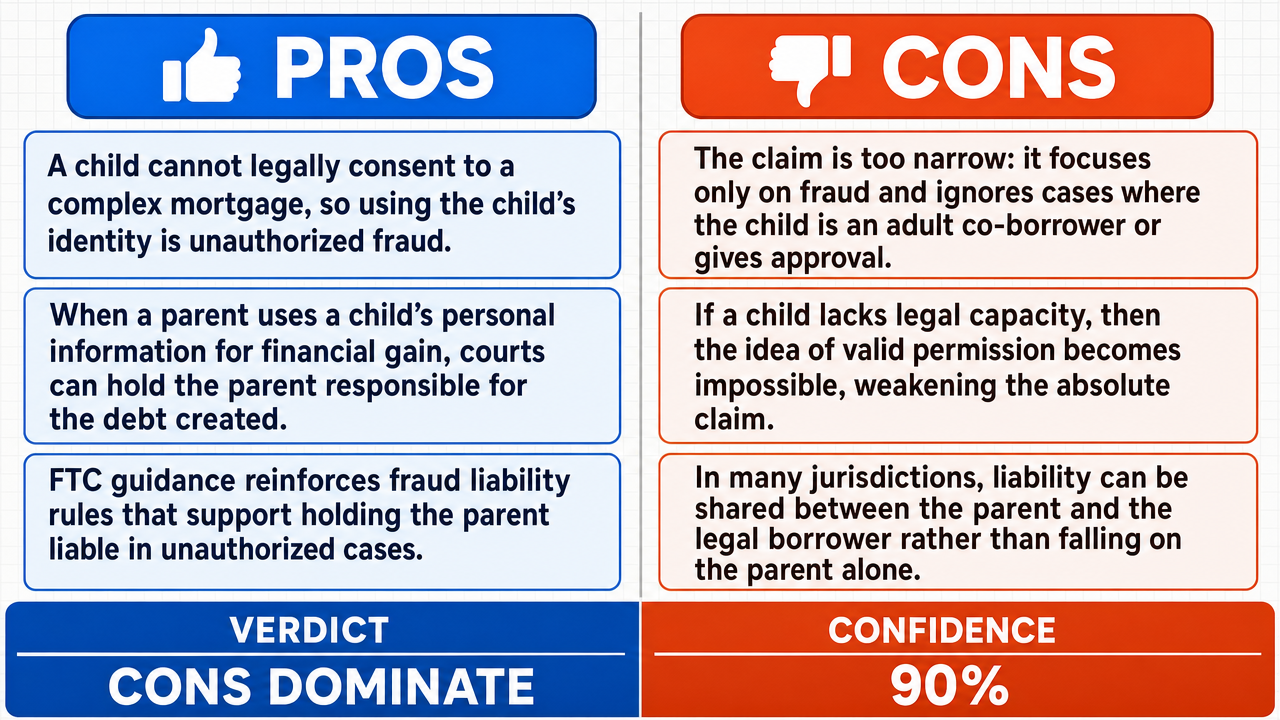
Verdict
Verdict: likely FALSE (90%)
Web Report: https://solsice.com/public/debates/a-parent-who-uses-their-child-s-credit-to-finance-a-house-in-32e712ddc60e
This section provides a brief overview of the key arguments. You do not need to read the full detailed report below.
✅ Key PRO arguments:
- ■A child cannot legally consent to a complex, cross-border mortgage contract, making the parent an unauthorized agent committing fraud if they use the child's identity without permission, and courts consistently hold the party who initiated and benefited from the fraudulent transaction liable for restitution and damages .
- ■U.S. case law establishes that a parent who misuses a child's personal information for financial gain is solely liable for the debts created, grounded in principles of agency and fiduciary duty .
- ■Consumer protection authorities like the FTC issue formal guidance that codifies liability principles courts enforce, especially in fraud cases, directly shaping and defining liability in cross-border mortgage scenarios.
❌ Key ANTI arguments:
- ■The affirmative commits a 'glissement de quantificateur ' by narrowing the claim to only fraudulent and unauthorized transactions, ignoring scenarios where the child is a co-signer , a consenting adult participant, or a beneficiary of the arrangement, in which liability would be shared.
- ■There is a logical contradiction in the affirmative's position: if a child truly lacks legal capacity to consent , then the concept of 'permission' is meaningless, undermining the universal rule of 'sole responsibility' the affirmative attempts to establish.
- ■Liability for credit-based debt is shared between the perpetrator and the legal borrower in many jurisdictions, particularly when the child is an adult co-applicant or has consented to the arrangement, meaning the parent is not 'solely' responsible in all cases.
💭 Conclusion: False. The verdict rejects the absolute claim of sole parental responsibility because the affirmative's argument relies on a narrowed scope that only addresses fraudulent, unauthorized use of a child's credit. The original assertion covers all scenarios in which a parent uses a child's credit to finance a house abroad, including cases where the child is a consenting adult, a co-signer , or a beneficiary of the arrangement. In such cases, liability is shared rather than resting solely with the parent. The affirmative's internal contradiction—claiming children cannot legally consent while simultaneously invoking the concept of 'permission'—further weakens the universal 'sole responsibility' framing. The judge found the negative side's broader, more logically consistent interpretation of liability more persuasive.
🔬 DeepResearch Result: likely FALSE ❌ (90%)
Assertion: A parent who uses their child's credit to finance a house in another country is solely responsible for any resulting debt and its consequences.
Participating models: deepseek-v3.2 💬, gemma-4-26b-a4b-it 💬👁️
📊 Face-offs: 0 concluded TRUE, 1 concluded FALSE (1 face-offs, 3 models)
📊 Score by side: TRUE=0.00, FALSE=0.90
🏅 Model score changes:
minimax-m3 💬👁️: +9
✅ PRO Arguments:
- ■A child cannot legally consent to a complex, cross-border mortgage contract, making the parent an unauthorized agent committing fraud if they use the child's identity without permission, and courts consistently hold the party who initiated and benefited from the fraudulent transaction liable for restitution and damages . deepseek-v3.2 💬
- ■U.S. case law establishes that a parent who misuses a child's personal information for financial gain is solely liable for the debts created, grounded in principles of agency and fiduciary duty . deepseek-v3.2 💬
- ■Consumer protection authorities like the FTC issue formal guidance that codifies liability principles courts enforce, especially in fraud cases, directly shaping and defining liability in cross-border mortgage scenarios. deepseek-v3.2 💬
❌ ANTI Arguments:
- ■The affirmative commits a 'glissement de quantificateur ' by narrowing the claim to only fraudulent and unauthorized transactions, ignoring scenarios where the child is a co-signer , a consenting adult participant, or a beneficiary of the arrangement, in which liability would be shared. gemma-4-26b-a4b-it 💬👁️
- ■There is a logical contradiction in the affirmative's position: if a child truly lacks legal capacity to consent, then the concept of 'permission' is meaningless, undermining the universal rule of 'sole responsibility' the affirmative attempts to establish. gemma-4-26b-a4b-it 💬👁️
- ■Liability for credit-based debt is shared between the perpetrator and the legal borrower in many jurisdictions, particularly when the child is an adult co-applicant or has consented to the arrangement, meaning the parent is not 'solely' responsible in all cases. gemma-4-26b-a4b-it 💬👁️
💭 Reasoning: False. The verdict rejects the absolute claim of sole parental responsibility because the affirmative's argument relies on a narrowed scope that only addresses fraudulent, unauthorized use of a child's credit. The original assertion covers all scenarios in which a parent uses a child's credit to finance a house abroad, including cases where the child is a consenting adult, a co-signer, or a beneficiary of the arrangement. In such cases, liability is shared rather than resting solely with the parent. The affirmative's internal contradiction—claiming children cannot legally consent while simultaneously invoking the concept of 'permission'—further weakens the universal 'sole responsibility' framing. The judge found the negative side's broader, more logically consistent interpretation of liability more persuasive.
📋 PRO Facts:
• Children generally lack legal capacity to consent to complex contracts such as cross-border mortgages.
• U.S. case law holds parents who misuse a child's personal information for financial gain liable for resulting debts.
• FTC consumer protection guidance codifies liability principles enforced by courts in fraud cases.
📋 ANTI Facts:
• The original claim encompasses scenarios beyond fraud, including cases where the child is a co-signer or consenting adult participant.
• If children lack legal capacity to consent, the concept of 'permission' becomes logically incoherent, undermining a universal sole-liability rule.
• Liability for credit-based debt is often shared between the perpetrator and the legal borrower across multiple jurisdictions.
| Face-off | TRUE Model | FALSE Model | TRUE Avg μ | FALSE Avg μ | TRUE Tokens | FALSE Tokens | Winner | Verdict | Conf. |
|---|---|---|---|---|---|---|---|---|---|
| #1 | deepseek-v3.2 💬 | gemma-4-26b-a4b-it 💬👁️ | 0.473 | 0.267 | 8 | 2 | TRUE | FALSE | 90% |
The following technical terms, abbreviations, and domain-specific concepts are referenced throughout this debate transcript. Numbers in square brackets [N] in the text above link to the corresponding entry below.
[1] agency — legal agency — A legal relationship in which one party (the agent) is authorized to act on behalf of another (the principal), creating legal obligations for the principal.
[2] bifurcated — bifurcated liability — In legal contexts, liability that is split or divided into separate categories, such as criminal culpability and civil obligation.
[3] borrowing capacity — The maximum amount of credit or debt a person is able to obtain based on their income, credit history, and other financial factors.
[4] civil liability — Legal responsibility for harm or wrongdoing enforceable through civil courts, typically resulting in monetary damages rather than criminal punishment.
[5] co-signer — A person who signs a loan or credit agreement alongside the primary borrower and assumes equal responsibility for repayment.
[6] consent — In legal contexts, voluntary agreement or permission that may affect the validity of a contract or transaction.
[7] consumer protection agencies — Government bodies that issue guidance and enforce laws to protect consumers from unfair, deceptive, or fraudulent business practices.
[8] contractual matter — An issue governed by the terms of a contract and the obligations established between the parties to that agreement.
[9] credit history — A record of a person's past borrowing and repayment behavior, used by lenders to assess creditworthiness.
[10] credit score — A numerical value derived from a person's credit history that represents their creditworthiness to potential lenders.
[11] criminal culpability — The degree to which a person is legally blameworthy for a criminal act, determining their liability for criminal penalties.
[12] criminal identity theft — The fraudulent use of another person's personal identifying information for financial gain, treated as a criminal offense.
[13] criminal penalties — Punishments imposed by courts for criminal offenses, which may include fines, restitution, or imprisonment.
[14] cross-border mortgage — A mortgage loan involving property, parties, or financing that spans the legal jurisdictions of more than one country.
[15] damages — Monetary compensation awarded by a court to a party who has suffered loss or injury due to another's wrongdoing.
[16] doctrine of unauthorized agency — A legal principle addressing situations where a person purports to act on behalf of another without proper authority, affecting liability for resulting transactions.
[17] fiduciary duty — A legal obligation requiring one party to act in the best interest of another, with loyalty and care, due to a position of trust.
[18] fraud — Intentional deception made for personal gain or to cause harm to another party, often involving misrepresentation of facts.
[19] Fraud Act 2006 — A statute referenced in the debate as part of the United Kingdom's legal framework addressing fraudulent conduct.
[20] FTC — Federal Trade Commission — A U.S. federal consumer protection agency referenced in the debate as issuing formal guidance on issues such as child identity theft.
[21] glissement de quantificateur — quantifier shift — A debate/logic term (used in French in the transcript) referring to a logical fallacy in which the scope of a universal claim is improperly narrowed or shifted.
[22] legal capacity — The legal ability of a person to enter into binding contracts or transactions, which may be limited for minors.
[23] lender — A party that provides funds to a borrower under the terms of a loan or credit agreement.
[24] misrepresentation — A false statement of fact made by one party that induces another to enter into a contract, potentially rendering the contract voidable.
[25] mortgage — A loan arrangement used to finance the purchase of real property, with the property serving as collateral for the debt.
[26] Personal Identifying Information — Personal Identifying Information (PII) — Data such as name, Social Security number, or financial account details that can be used to identify or impersonate an individual.
[27] restitution — A legal remedy requiring a party who has unjustly benefited to compensate the injured party, typically by returning money or property.
[28] statutes — Written laws enacted by a legislative body, which courts interpret and apply to specific cases.
[29] unauthorized agent — A person who acts on behalf of another without proper authority, potentially creating liability for the purported principal or for themselves.
[30] void — void contract — A contract that lacks legal force from the outset, typically because a party lacked capacity or consent was absent.
The following financial data tables were referenced during the debate exchanges:
| Jurisdiction | Legal Principle Applied | Typical Outcome for Parent |
|---|---|---|
| United States | Fraud, Unauthorized Use of Personal Identifying Information | Held liable for full debt, damages, and potential criminal penalties |
| United Kingdom | Fraud Act 2006, Misrepresentation | Civil liability for debt; criminal prosecution possible |
| Canada | Identity Fraud, Breach of Fiduciary Duty | Ordered to repay debt and compensate child for credit harm |
Legend: Comparative legal outcomes for parents committing credit fraud against children. Sources: U.S. FTC consumer alerts, UK Financial Conduct Authority guidance, Canadian consumer protection rulings.
| Liability Type | Primary Target | Secondary Target | Legal Basis |
|---|---|---|---|
| Criminal Liability | Perpetrator (Parent) | N/A | Fraud/Identity Theft Statutes |
| Contractual Debt | Named Borrower (Child) | Guarantor/Co-signer | Mortgage Contract/Promissory Note |
| Civil Damages | Perpetrator (Parent) | N/A | Tort Law/Restitution |
Legend: Distribution of responsibility in cases of credit misuse. "Primary Target" refers to the entity most directly pursued by the specific legal mechanism.
Face-off transcripts
- ■
Ownership & Trade Secrets. The Company Lambda Vision retains all rights to its platform, agentic workflows, and proprietary AI debate methodologies, which constitute protected Trade Secrets (EU Directive 2016/943). Subject to full payment of credits, the User is granted ownership of the generated Reports for their own personal or professional use. Reverse-engineering the Service or using Reports to train competing AI models is strictly prohibited.
- ■
No Professional Advice. Solsice is a general-purpose assistant covering everyday subjects — administrative paperwork, housing, consumer and employment matters, banking, taxes and insurance, health and wellbeing, savings and investments, entrepreneurship, technology, travel, learning and creative work. Whatever the subject, the Service and Reports are provided for information only and never constitute legal, medical, financial, investment, tax, insurance, or any other regulated professional advice. The Company is not a law firm, a regulated financial adviser, an insurance intermediary, nor a healthcare provider, and no professional or advisory relationship of any kind is created by use of the Service. Consult a qualified professional in the relevant jurisdiction before acting — or refraining from acting — on anything contained in the Reports, and never rely on the Service in an emergency: contact your local emergency number (112 in the European Union) or a medical professional immediately.
- ■
AI-Generated Content, Sources and Viewpoints. Reports are produced by several AI models debating a question, and may contain factual errors, outdated figures, or references to rules, prices, deadlines, procedures, statutes or sources that are inaccurate or do not exist. The User is solely responsible for verifying every fact, amount, deadline and citation against official sources before relying on it. Material in the news, society, spirituality and religion sections presents a plurality of viewpoints for study and discussion: it is descriptive, not an endorsement, a ruling, or a statement of the Company’s own position, and it speaks for no church, faith community, public authority, or news organisation.
- ■
Liability & Governing Law. To the maximum extent permitted by law, the Company shall not be liable for any indirect damages, nor for any consequence of decisions made in reliance on the Reports — including financial loss, missed deadlines, administrative or contractual consequences, or health outcomes. These Terms are governed by French law. Any disputes shall be subject to the exclusive jurisdiction of the Courts of Paris, France.