
A person always retains agency to refuse unwanted advances, even when feeling impulsive, if no physical assault occurs.
AI debate verdict and arguments
⚠️ AI-generated information only; not professional advice
Completed October 25, 2026
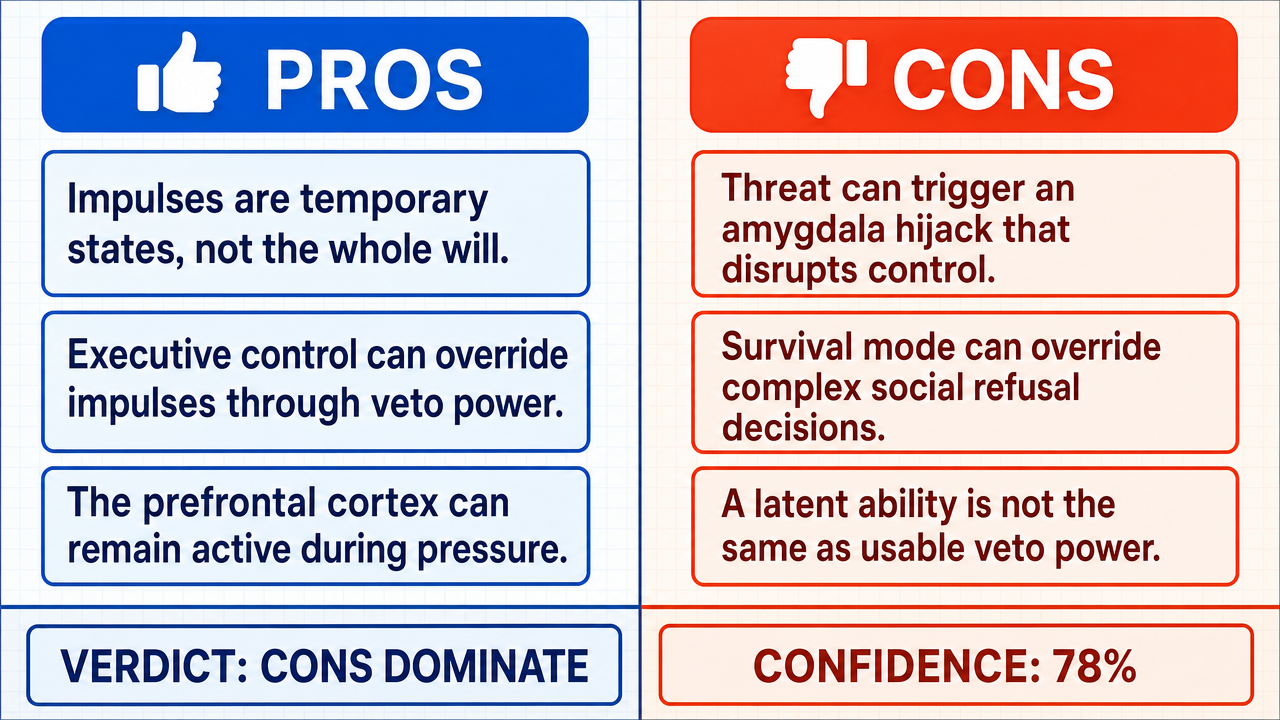
Verdict
Verdict: likely FALSE (78%)
Web Report: https://solsice.com/public/debates/a-person-always-retains-agency-to-refuse-unwanted-advances-e-e29d4f32ee3d
This section provides a brief overview of the key arguments. You do not need to read the full detailed report below.
✅ Key PRO arguments:
- ■Agency rests on the philosophical distinction between transient impulse and volition ; impulses are psychological states that do not constitute the totality of the self, and the cognitive capacity for executive function remains a latent faculty even under strong urges.
- ■Top-down regulation , a fundamental feature of human cognition, provides structural 'veto power ' over impulses, meaning the mechanism to refuse is preserved as a latent capacity regardless of momentary emotional arousal .
- ■The amygdala does not 'deactivate' the prefrontal cortex in a way that eliminates executive control; neuroscientific literature confirms the prefrontal cortex remains active and continues to exert inhibitory control even during periods of high emotional arousal .
❌ Key ANTI arguments:
- ■In social threat contexts , the prefrontal cortex —the seat of veto power —is functionally deactivated by the amygdala via an 'amygdala hijack ,' which physically prevents execution of the refusal mechanism, rendering agency inaccessible rather than merely difficult.
- ■Under threat, the brain prioritizes immediate survival over complex social decision-making , meaning the capacity to refuse is biologically unavailable in the moment of impulse , not merely suppressed.
- ■A 'latent' faculty that is not reliably deployable under strong-impulse conditions does not equate to preserved veto power , because 'latent' by definition implies it is not actively or consistently available when needed.
💭 Conclusion: False. The assertion that a person always retains agency to refuse unwanted advances in the absence of physical assault is not supported, because neurobiological evidence indicates that amygdala -driven threat responses can functionally deactivate the prefrontal cortex , rendering the executive 'veto' mechanism inaccessible rather than merely difficult to use. The affirmative's reliance on a 'latent' faculty of top-down regulation conflates structural capacity with operative availability, a distinction the negative effectively exploited. Acute stress and social threat contexts shift cognition toward survival-oriented, habitual responses , meaning refusal capacity is not reliably preserved in the moment of impulse . Therefore, the claim that agency is 'always' retained overstates the reliability of executive control under emotionally charged conditions.
🔬 DeepResearch Result: likely FALSE ❌ (78%)
Assertion: A person always retains agency to refuse unwanted advances, even when feeling impulsive, if no physical assault occurs.
Participating models: gemma-4-26b-a4b-it 💬👁️, glm-4.7-flash 💬
📊 Face-offs: 0 concluded TRUE, 1 concluded FALSE (1 face-offs, 3 models)
📊 Score by side: TRUE=0.00, FALSE=0.78
🏅 Model score changes:
minimax-m3 💬👁️: +8
✅ PRO Arguments:
- ■Agency rests on the philosophical distinction between transient impulse and volition ; impulses are psychological states that do not constitute the totality of the self, and the cognitive capacity for executive function remains a latent faculty even under strong urges. gemma-4-26b-a4b-it 💬👁️
- ■Top-down regulation , a fundamental feature of human cognition, provides structural 'veto power ' over impulses, meaning the mechanism to refuse is preserved as a latent capacity regardless of momentary emotional arousal . gemma-4-26b-a4b-it 💬👁️
- ■The amygdala does not 'deactivate' the prefrontal cortex in a way that eliminates executive control; neuroscientific literature confirms the prefrontal cortex remains active and continues to exert inhibitory control even during periods of high emotional arousal. gemma-4-26b-a4b-it 💬👁️
❌ ANTI Arguments:
- ■In social threat contexts , the prefrontal cortex—the seat of veto power—is functionally deactivated by the amygdala via an 'amygdala hijack ,' which physically prevents execution of the refusal mechanism, rendering agency inaccessible rather than merely difficult. glm-4.7-flash 💬
- ■Under threat, the brain prioritizes immediate survival over complex social decision-making , meaning the capacity to refuse is biologically unavailable in the moment of impulse, not merely suppressed. glm-4.7-flash 💬
- ■A 'latent' faculty that is not reliably deployable under strong-impulse conditions does not equate to preserved veto power, because 'latent' by definition implies it is not actively or consistently available when needed. glm-4.7-flash 💬
- ■Research on stress and decision-making demonstrates that acute stress , which often accompanies unwanted advances, significantly impairs prefrontal cortex function and shifts cognition toward habitual or reactive responses, undermining the affirmative's claim of preserved executive control. glm-4.7-flash 💬
💭 Reasoning: False. The assertion that a person always retains agency to refuse unwanted advances in the absence of physical assault is not supported, because neurobiological evidence indicates that amygdala-driven threat responses can functionally deactivate the prefrontal cortex, rendering the executive 'veto' mechanism inaccessible rather than merely difficult to use. The affirmative's reliance on a 'latent' faculty of top-down regulation conflates structural capacity with operative availability, a distinction the negative effectively exploited. Acute stress and social threat contexts shift cognition toward survival-oriented, habitual responses , meaning refusal capacity is not reliably preserved in the moment of impulse. Therefore, the claim that agency is 'always' retained overstates the reliability of executive control under emotionally charged conditions.
📋 PRO Facts:
• The prefrontal cortex remains active and continues to exert inhibitory control even during periods of high emotional arousal.
• Top-down regulation is described as a fundamental feature of human cognition providing structural veto power over impulses.
📋 ANTI Facts:
• In social threat contexts, the amygdala can functionally deactivate the prefrontal cortex, preventing execution of veto power.
• Acute stress significantly impairs prefrontal cortex function and shifts cognition toward habitual or reactive responses.
• Under threat, the brain prioritizes immediate survival over complex social decision-making, making refusal capacity biologically unavailable in the moment.
| Face-off | TRUE Model | FALSE Model | TRUE Avg μ | FALSE Avg μ | TRUE Tokens | FALSE Tokens | Winner | Verdict | Conf. |
|---|---|---|---|---|---|---|---|---|---|
| #1 | gemma-4-26b-a4b-it 💬👁️ | glm-4.7-flash 💬 | 0.381 | 0.508 | 4 | 4 | FALSE | FALSE | 78% |
The following technical terms, abbreviations, and domain-specific concepts are referenced throughout this debate transcript. Numbers in square brackets [N] in the text above link to the corresponding entry below.
[1] abuse of power — A form of coercion in which one party leverages a position of authority or influence to compel another to act against their will, recognized in legal frameworks as negating genuine consent.
[2] acute stress — A short-term physiological and psychological response to perceived threat, which research indicates can impair prefrontal cortex function and shift behavior toward habitual or impulsive responses.
[3] agency — The philosophical and psychological capacity of an individual to make intentional choices and exert control over their own actions, often distinguished from mere impulse.
[4] amygdala — A brain structure central to processing threat and emotional responses; in the debate, it is described as capable of overriding prefrontal activity during perceived threat.
[5] amygdala hijack — A neurobiological concept describing a rapid, overwhelming emotional response triggered by the amygdala that is said to bypass or suppress rational prefrontal processing.
[6] bottom-up processing — A mode of neural processing driven by sensory or emotional input rather than by deliberate, higher-order cognition; contrasted in the debate with top-down regulation.
[7] coercion — In legal contexts, the use of pressure, threats, or abuse of power to compel behavior; the debate notes that legal systems may define coercion to include non-physical pressures.
[8] coercive environment — A setting in which non-physical pressures (such as threats, power imbalances, or economic dependence) are argued to nullify the ability to refuse.
[9] cognitive capacity — The mental ability to perform tasks such as reasoning, inhibition, and decision-making; in the debate, treated as the substrate of agency.
[10] consent — A legal and ethical concept denoting voluntary agreement, predicated on the ability both to give and to withdraw permission.
[11] decision-making — The cognitive process of selecting a course of action; in the debate, contrasted between deliberate top-down control and stress-driven habitual responding.
[12] economic dependence — Reliance on another party for financial survival, cited in the debate as a non-physical pressure that can undermine the ability to refuse.
[13] emotional arousal — A state of heightened emotional activation; the affirmative argues that the prefrontal cortex continues to exert inhibitory control even during such states.
[14] executive function — A set of higher-order cognitive processes, including inhibitory control and planning, mediated primarily by the prefrontal cortex.
[15] functional availability — The degree to which a cognitive or neural capacity can actually be deployed in a given moment, as opposed to merely existing structurally.
[16] functional degradation — A reduction in the operational effectiveness of a neural or cognitive system, argued in the debate to occur under acute stress.
[17] habitual responses — Automatic, learned behaviors triggered without deliberate deliberation; cited as the default mode when prefrontal control is impaired.
[18] impulse — A transient psychological drive toward action, distinguished in the debate from volition and treated as potentially subject to veto.
[19] impulsive responses — Reactions driven by immediate impulse rather than deliberation, associated in the debate with stress-induced prefrontal impairment.
[20] inhibitory control — The cognitive ability to suppress or veto an impulse, attributed to prefrontal cortex function and central to the debate's conception of agency.
[21] latent faculty — A capacity that exists structurally but is not actively or reliably available; the negative argues this does not equate to operative veto power.
[22] legal frameworks — Structured systems of law and doctrine; in the debate, referenced regarding how consent and coercion are formally defined.
[23] neural pathways — The routes through which signals travel in the nervous system; the debate discusses shifts in the relative influence of different pathways under threat.
[24] non-physical pressures — Forms of influence short of physical force—such as threats, power abuse, or economic dependence—that legal systems may treat as coercive.
[25] power dynamics — The relational distribution of authority or influence between parties; cited as a factor that can nullify the ability to refuse.
[26] prefrontal cortex — The brain region associated with executive function, inhibitory control, and deliberate decision-making; central to the debate's neuroscience claims.
[27] social threat contexts — Interpersonal situations perceived as threatening, in which the debate argues amygdala activity can override prefrontal control.
[28] structural capacity — The mere existence of a neural or cognitive mechanism, distinguished in the debate from its functional availability under stress.
[29] top-down regulation — Cognitive control exerted by higher-order brain regions (notably the prefrontal cortex) over lower-level impulses and emotional responses.
[30] veto power — Used metaphorically in the debate to denote the capacity to negate or override an impulse, equated with inhibitory control.
[31] volition — The capacity for conscious, intentional willing, distinguished in the debate from transient impulse as the basis of genuine agency.
[32] withdrawal (of consent) — The act of revoking previously given consent; the affirmative argues that the legal capacity to consent presupposes the ability to withdraw it.
Face-off transcripts
- ■
Ownership & Trade Secrets. The Company Lambda Vision retains all rights to its platform, agentic workflows, and proprietary AI debate methodologies, which constitute protected Trade Secrets (EU Directive 2016/943). Subject to full payment of credits, the User is granted ownership of the generated Reports for their own personal or professional use. Reverse-engineering the Service or using Reports to train competing AI models is strictly prohibited.
- ■
No Professional Advice. Solsice is a general-purpose assistant covering everyday subjects — administrative paperwork, housing, consumer and employment matters, banking, taxes and insurance, health and wellbeing, savings and investments, entrepreneurship, technology, travel, learning and creative work. Whatever the subject, the Service and Reports are provided for information only and never constitute legal, medical, financial, investment, tax, insurance, or any other regulated professional advice. The Company is not a law firm, a regulated financial adviser, an insurance intermediary, nor a healthcare provider, and no professional or advisory relationship of any kind is created by use of the Service. Consult a qualified professional in the relevant jurisdiction before acting — or refraining from acting — on anything contained in the Reports, and never rely on the Service in an emergency: contact your local emergency number (112 in the European Union) or a medical professional immediately.
- ■
AI-Generated Content, Sources and Viewpoints. Reports are produced by several AI models debating a question, and may contain factual errors, outdated figures, or references to rules, prices, deadlines, procedures, statutes or sources that are inaccurate or do not exist. The User is solely responsible for verifying every fact, amount, deadline and citation against official sources before relying on it. Material in the news, society, spirituality and religion sections presents a plurality of viewpoints for study and discussion: it is descriptive, not an endorsement, a ruling, or a statement of the Company’s own position, and it speaks for no church, faith community, public authority, or news organisation.
- ■
Liability & Governing Law. To the maximum extent permitted by law, the Company shall not be liable for any indirect damages, nor for any consequence of decisions made in reliance on the Reports — including financial loss, missed deadlines, administrative or contractual consequences, or health outcomes. These Terms are governed by French law. Any disputes shall be subject to the exclusive jurisdiction of the Courts of Paris, France.