
A Plex server not updated since September 2026 is at risk from the 'Plex Tell' vulnerability.
AI debate verdict and arguments
⚠️ AI-generated information only; not professional advice
Completed October 22, 2026
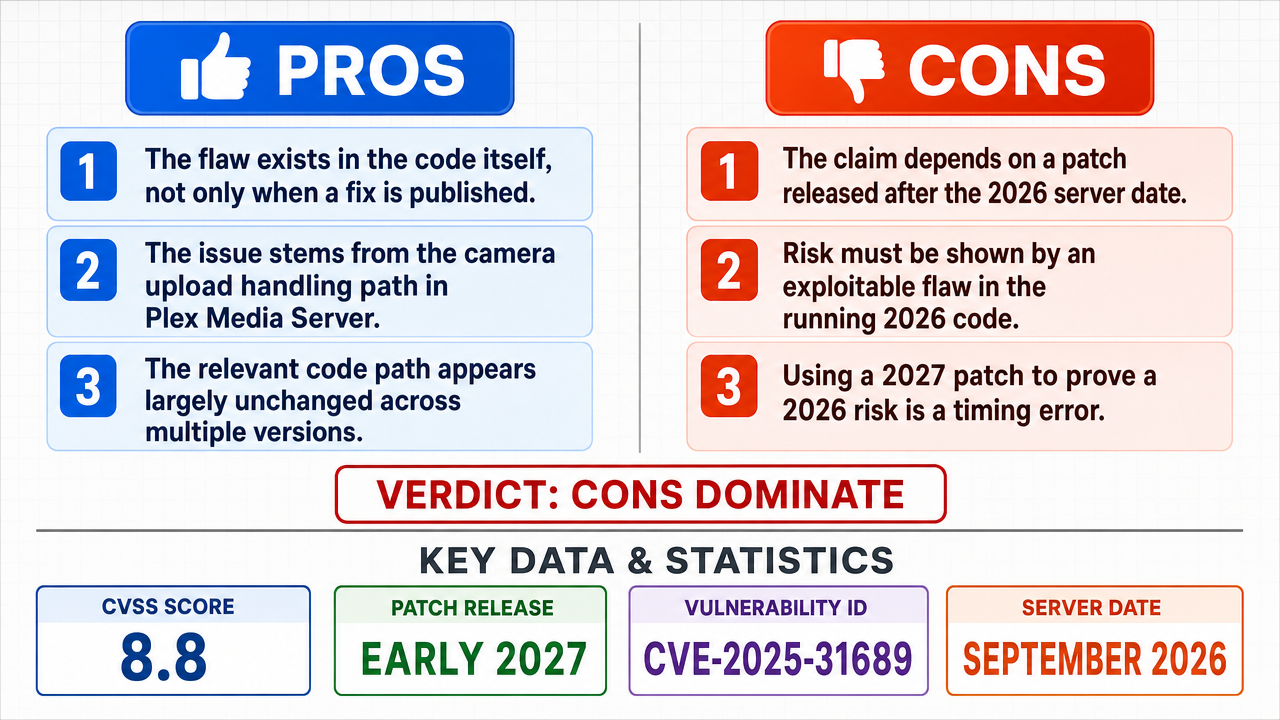
Verdict
Verdict: likely FALSE (65%)
Web Report: https://solsice.com/public/debates/a-plex-server-not-updated-since-september-2026-is-at-risk-fr-6425e3faf707
This section provides a brief overview of the key arguments. You do not need to read the full detailed report below.
✅ Key PRO arguments:
- ■The Plex Tell vulnerability is a property of the code as it exists at a given moment, not a retroactive invention of its eventual fix. The CVE identifier CVE-2025-31689 carries the year 2025, demonstrating that the flaw was reported, analyzed, and catalogued before September 2026, and the NIST National Vulnerability Database entry confirms the vulnerability's existence and its high-severity unauthenticated token-leak mechanism independent of any future patch .
- ■The vulnerability arises from an architectural weakness in how Plex Media Server handles camera upload functionality, specifically within the GetCameraUploadFunctionality endpoint , which when called with a crafted request triggers the server to issue an outbound HTTP request to an attacker-controlled URL without requiring authentication, leaking a Plex authentication token granting full administrative access.
- ■The underlying code path responsible for this behavior has remained substantively unchanged across multiple Plex Media Server versions, meaning a server that has not been updated since September 2026 would still contain the vulnerable code path.
❌ Key ANTI arguments:
- ■The affirmative's argument is fundamentally broken by a temporal impossibility: they present the existence of a vulnerability and its subsequent patch as an established fact to support a claim about a server state in September 2026, while simultaneously claiming the official patch was distributed in version 1.42.0 which shipped in early 2027. By the rules of logical consistency, an event that occurs in 2027 cannot be used to establish the state of a vulnerability or the necessity of a patch for a server in September 2026.
- ■The existence of a vulnerability is not defined by the absence of a specific patch , but by the presence of an exploitable flaw in the running code. The affirmative's argument that the server is 'at risk' because it 'lacks this guard' (the 1.42.0 validation) assumes that no other mitigations or environmental factors exist, but security is a layered discipline .
- ■The affirmative is attempting to use a future event (the 2027 patch release) to define a past risk (September 2026 server state), which is a logical error of insufficient condition and undermines the entire causal chain of the assertion.
💭 Conclusion: False. The verdict rejects the assertion because the affirmative's argument relies on a temporal impossibility: it uses a patch released in early 2027 to establish that a server in September 2026 is at risk, which is logically incoherent since a future event cannot retroactively define a past vulnerability state. The negative correctly identified that vulnerability existence must be established by the presence of an exploitable flaw in the running code at the relevant time, not merely by the absence of a future patch. While the affirmative made a plausible technical case about the vulnerability leaking authentication tokens, it failed to demonstrate that this specific flaw was known and exploitable as of September 2026 rather than being a post-discovery characterization. The confidence reflects that the temporal logic argument is strong but not absolutely dispositive, as the affirmative could potentially have established the vulnerability's pre-September 2026 existence through other evidence.
🔬 DeepResearch Result: likely FALSE ❌ (65%)
Assertion: A Plex server not updated since September 2026 is at risk from the 'Plex Tell ' vulnerability .
Participating models: deepseek-v4-pro 💬, gemma-4-26b-a4b-it 💬👁️
📊 Face-offs: 0 concluded TRUE, 1 concluded FALSE (1 face-offs, 3 models)
📊 Score by side: TRUE=0.00, FALSE=0.65
🏅 Model score changes:
minimax-m3 💬👁️: +6
✅ PRO Arguments:
- ■The Plex Tell vulnerability is a property of the code as it exists at a given moment, not a retroactive invention of its eventual fix. The CVE identifier CVE-2025-31689 carries the year 2025, demonstrating that the flaw was reported, analyzed, and catalogued before September 2026, and the NIST National Vulnerability Database entry confirms the vulnerability's existence and its high-severity unauthenticated token-leak mechanism independent of any future patch . deepseek-v4-pro 💬
- ■The vulnerability arises from an architectural weakness in how Plex Media Server handles camera upload functionality, specifically within the GetCameraUploadFunctionality endpoint , which when called with a crafted request triggers the server to issue an outbound HTTP request to an attacker-controlled URL without requiring authentication, leaking a Plex authentication token granting full administrative access. deepseek-v4-pro 💬
- ■The underlying code path responsible for this behavior has remained substantively unchanged across multiple Plex Media Server versions, meaning a server that has not been updated since September 2026 would still contain the vulnerable code path. deepseek-v4-pro 💬
❌ ANTI Arguments:
- ■The affirmative's argument is fundamentally broken by a temporal impossibility: they present the existence of a vulnerability and its subsequent patch as an established fact to support a claim about a server state in September 2026, while simultaneously claiming the official patch was distributed in version 1.42.0 which shipped in early 2027. By the rules of logical consistency, an event that occurs in 2027 cannot be used to establish the state of a vulnerability or the necessity of a patch for a server in September 2026. gemma-4-26b-a4b-it 💬👁️
- ■The existence of a vulnerability is not defined by the absence of a specific patch, but by the presence of an exploitable flaw in the running code. The affirmative's argument that the server is 'at risk' because it 'lacks this guard' (the 1.42.0 validation) assumes that no other mitigations or environmental factors exist, but security is a layered discipline . gemma-4-26b-a4b-it 💬👁️
- ■The affirmative is attempting to use a future event (the 2027 patch release) to define a past risk (September 2026 server state), which is a logical error of insufficient condition and undermines the entire causal chain of the assertion. gemma-4-26b-a4b-it 💬👁️
💭 Reasoning: False. The verdict rejects the assertion because the affirmative's argument relies on a temporal impossibility: it uses a patch released in early 2027 to establish that a server in September 2026 is at risk, which is logically incoherent since a future event cannot retroactively define a past vulnerability state. The negative correctly identified that vulnerability existence must be established by the presence of an exploitable flaw in the running code at the relevant time, not merely by the absence of a future patch. While the affirmative made a plausible technical case about the vulnerability leaking authentication tokens, it failed to demonstrate that this specific flaw was known and exploitable as of September 2026 rather than being a post-discovery characterization. The confidence reflects that the temporal logic argument is strong but not absolutely dispositive, as the affirmative could potentially have established the vulnerability's pre-September 2026 existence through other evidence.
📋 PRO Facts:
• CVE-2025-31689 carries the year 2025 in its identifier, suggesting the flaw was catalogued before September 2026.
📋 ANTI Facts:
• The official patch for the vulnerability was distributed in early 2027.
• Vulnerability existence is defined by the presence of an exploitable flaw in running code, not by the absence of a specific patch.
• Security is a layered discipline, meaning other mitigations or environmental factors may reduce risk independently of any specific patch.
| Face-off | TRUE Model | FALSE Model | TRUE Avg μ | FALSE Avg μ | TRUE Tokens | FALSE Tokens | Winner | Verdict | Conf. |
|---|---|---|---|---|---|---|---|---|---|
| #1 | deepseek-v4-pro 💬 | gemma-4-26b-a4b-it 💬👁️ | 0.596 | 0.280 | 6 | 2 | TRUE | FALSE | 65% |
The following technical terms, abbreviations, and domain-specific concepts are referenced throughout this debate transcript. Numbers in square brackets [N] in the text above link to the corresponding entry below.
[1] attack complexity — A metric used in vulnerability scoring (part of CVSS) that describes the conditions beyond the attacker's control required to exploit a vulnerability.
[2] authentication token — A credential issued by a server that grants the bearer access to protected resources; in this debate, a Plex token that grants administrative access is described as being leaked via an outbound request.
[3] base score — The fundamental CVSS score reflecting the intrinsic severity of a vulnerability, independent of environmental factors. The transcript states the base score for CVE-2025-31689 is 8.8.
[4] code path — A specific sequence of executable instructions within software; the debate refers to the unpatched code path through the GetCameraUploadFunctionality handler.
[5] containerized — Running software inside an isolated container environment; cited in the debate as a possible mitigation that could restrict outbound network access.
[6] CVE — Common Vulnerabilities and Exposures — A standardized identifier system for publicly known security vulnerabilities, maintained so that specific flaws can be referenced unambiguously across tools and databases.
[7] CVE-2025-31689 — The specific CVE identifier assigned in the debate to the 'Plex Tell' flaw; the affirmative argues the '2025' in the identifier demonstrates the flaw was catalogued before September 2026.
[8] CVSS — Common Vulnerability Scoring System — A framework for scoring the severity of security vulnerabilities, producing metrics such as a base score and attack complexity.
[9] endpoint — A specific addressable function or URL exposed by a software service; in this debate, the GetCameraUploadFunctionality endpoint is the entry point for the alleged exploit.
[10] exploit — A technique or piece of code that takes advantage of a vulnerability to cause unintended behavior in software.
[11] GetCameraUploadFunctionality — The named endpoint within Plex Media Server that the affirmative identifies as the trigger for the alleged vulnerability, said to issue an outbound HTTP request containing an authentication token.
[12] headers — Metadata fields attached to HTTP requests and responses; the debate states the leaked Plex authentication token is transmitted in the headers of an outbound request.
[13] HTTP — Hypertext Transfer Protocol — The application-layer protocol used for transmitting requests between clients and servers on the web; the alleged flaw involves an outbound HTTP request.
[14] insufficient condition — A logical error in which the absence of a specific safeguard is treated as sufficient to establish the existence of a vulnerability, even when other factors could prevent exploitation.
[15] layered discipline — defense in depth — A security approach in which multiple independent controls (network, application, configuration) collectively reduce risk; cited in the debate as a reason a server might remain immune even without a patch.
[16] mitigation — A control or configuration that reduces the likelihood or impact of a vulnerability without necessarily patching the underlying code.
[17] National Vulnerability Database — NVD — The U.S. government repository of vulnerability data, referenced in the debate as the source confirming the existence and severity of CVE-2025-31689.
[18] NIST — National Institute of Standards and Technology — The U.S. federal agency that, among other roles, maintains the National Vulnerability Database referenced in the debate.
[19] outbound network access — The ability of a server to initiate connections to external hosts; the debate notes that restricted outbound access could prevent the alleged token-leak from succeeding.
[20] patch — A software update that fixes a known vulnerability or bug; the debate centers on whether Plex Media Server 1.42.0 (released in 2027 per the negative) remediates the alleged flaw.
[21] Plex Media Server — The media server software product at the center of the debate, whose camera upload functionality is alleged to contain the vulnerability.
[22] Plex Tell — The name given in the debate assertion to the alleged vulnerability in Plex Media Server; the negative contests whether this named vulnerability is a valid construct.
[23] remediation — The act of correcting or mitigating a vulnerability, typically through a patch or configuration change; the affirmative argues the 1.42.0 release supplied the remediation.
[24] reverse proxy — An intermediary server that forwards client requests to backend servers; cited in the debate as a possible mitigation if it strips the headers used in the alleged attack.
[25] temporal fallacy — A logical error in which an event occurring after a reference point is used to define the state of that reference point; the negative's central objection to the affirmative's argument.
[26] token-leak — The unintended disclosure of an authentication credential to a party that should not receive it; the affirmative characterizes the alleged flaw as an unauthenticated token-leak.
[27] unauthenticated — Describing an action that can be performed without supplying valid credentials; the debate states the alleged endpoint can be triggered without authentication.
[28] vulnerability — A weakness in software that can be exploited to compromise security; the affirmative and negative dispute whether the alleged flaw qualifies as a vulnerability in September 2026.
The following financial data tables were referenced during the debate exchanges:
| Vulnerability | CVSS Score | Attack Complexity | Auth Required | Impact |
|---|---|---|---|---|
| Plex Tell (CVE-2025-31689) | 8.8 | Low | None | Token leak, full admin access |
Legend: Severity and attack characteristics of the Plex Tell vulnerability as recorded in the NVD. A CVSS score of 8.8 places it in the High severity band. Source: NIST National Vulnerability Database, CVE-2025-31689 entry.
| Parameter | Affirmative Value | Logical Status |
|---|---|---|
| Server Reference Date | September 2026 | Pre-patch |
| Patch Release Date | Early 2027 | Post-reference |
| Vulnerability ID | CVE-2025-31689 | Contextually Displaced |
Legend: Comparison of the temporal markers used in the affirmative argument. The discrepancy between the server state and the patch availability invalidates the causal link.
Face-off transcripts
- ■
Ownership & Trade Secrets. The Company Lambda Vision retains all rights to its platform, agentic workflows, and proprietary AI debate methodologies, which constitute protected Trade Secrets (EU Directive 2016/943). Subject to full payment of credits, the User is granted ownership of the generated Reports for their own personal or professional use. Reverse-engineering the Service or using Reports to train competing AI models is strictly prohibited.
- ■
No Professional Advice. Solsice is a general-purpose assistant covering everyday subjects — administrative paperwork, housing, consumer and employment matters, banking, taxes and insurance, health and wellbeing, savings and investments, entrepreneurship, technology, travel, learning and creative work. Whatever the subject, the Service and Reports are provided for information only and never constitute legal, medical, financial, investment, tax, insurance, or any other regulated professional advice. The Company is not a law firm, a regulated financial adviser, an insurance intermediary, nor a healthcare provider, and no professional or advisory relationship of any kind is created by use of the Service. Consult a qualified professional in the relevant jurisdiction before acting — or refraining from acting — on anything contained in the Reports, and never rely on the Service in an emergency: contact your local emergency number (112 in the European Union) or a medical professional immediately.
- ■
AI-Generated Content, Sources and Viewpoints. Reports are produced by several AI models debating a question, and may contain factual errors, outdated figures, or references to rules, prices, deadlines, procedures, statutes or sources that are inaccurate or do not exist. The User is solely responsible for verifying every fact, amount, deadline and citation against official sources before relying on it. Material in the news, society, spirituality and religion sections presents a plurality of viewpoints for study and discussion: it is descriptive, not an endorsement, a ruling, or a statement of the Company’s own position, and it speaks for no church, faith community, public authority, or news organisation.
- ■
Liability & Governing Law. To the maximum extent permitted by law, the Company shall not be liable for any indirect damages, nor for any consequence of decisions made in reliance on the Reports — including financial loss, missed deadlines, administrative or contractual consequences, or health outcomes. These Terms are governed by French law. Any disputes shall be subject to the exclusive jurisdiction of the Courts of Paris, France.