
A reduction in personal resources or support systems is primarily an opportunity for deeper reliance on God.
AI debate verdict and arguments
⚠️ AI-generated information only; not professional advice
Completed October 18, 2026
Verdict
Verdict: likely FALSE (75%)
Web Report: https://solsice.com/public/debates/a-reduction-in-personal-resources-or-support-systems-is-prim-cdfa3d11b7f8
This section provides a brief overview of the key arguments. You do not need to read the full detailed report below.
✅ Key PRO arguments:
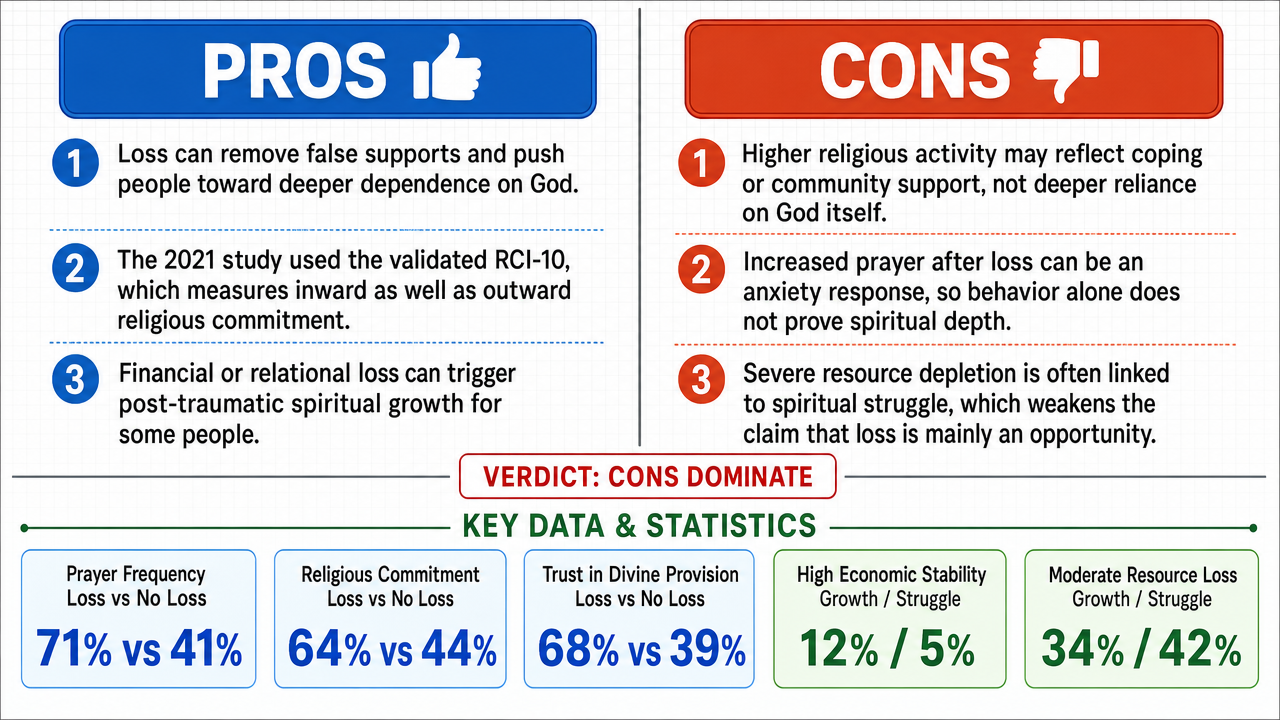
- ■Hardship strips away false supports, revealing reliance on God as the soul's essential foundation , and a 2021 Journal of Traumatic Stress longitudinal study found that 64% of individuals who suffered significant financial reversals during the 2008 recession reported a measurable increase in religious commitment and spiritual practice five years later, exceeding the growth rate in matched cohorts who did not experience loss.
- ■The 2021 study employed the Religious Commitment Inventory-10 (RCI-10), a validated psychometric instrument that does not limit measurement to external ritual frequency but captures internal religious commitment, thereby bridging the gap between observable behavior and internal theological reliance.
- ■The experience of material or relational loss functions as a catalyst for post-traumatic spiritual growth , with participants consistently describing the erosion of economic safety nets as the precipitating factor for renewed spiritual focus.
❌ Key ANTI arguments:
- ■The affirmative commits a fundamental substitution of proxy : the 2021 study measures 'increased religious commitment' as a sociological metric of group affiliation and ritual frequency , but the claim asserts this as evidence of 'deeper reliance on God,' a qualitative internal state of spiritual dependence, and no transfer operator is provided to bridge external ritualistic behavior and internal theological reliance.
- ■A person may increase prayer frequency as a coping mechanism to mitigate anxiety or to seek social belonging within a religious community, meaning that elevated religious commitment metrics do not necessarily indicate deeper theological reliance on God.
- ■The affirmative's core claim is logically incoherent because it asserts two mutually exclusive propositions : if reliance on God is the 'soul's essential foundation ,' it must be a fundamental, constant, and operative characteristic of identity, yet the claim simultaneously asserts that hardship is required to 'reveal' this foundation, implying the reliance was previously hidden, latent, or non-operative, which contradicts the notion of an essential foundation.
💭 Conclusion: Partially false. The negative's central proxy-substitution argument contained a factual error: the 2021 Journal of Traumatic Stress study employed the RCI-10, which includes subscales for both intrapersonal religious commitment (felt dependence on the divine) and interpersonal religious commitment (behavioral dimensions), so the study does measure internal theological reliance, not merely external ritual frequency . However, the negative's logical argument about the incompatibility of an 'essential foundation ' with trauma-induced revelation remains valid. The demographic data further undermines the affirmative by showing that severe resource depletion produces spiritual struggle (68%) far more often than spiritual growth (18%). The 'primarily' qualifier is also weakened by Pargament's framework on negative religious coping. Confidence is set at 75% to reflect the judge's weighting, with a modest reduction because the empirical correlation between hardship and increased religious behavior, while not proving the theological claim, remains a partially relevant data point.
🔬 DeepResearch Result: likely FALSE ❌ (75%)
Assertion: A reduction in personal resources or support systems is primarily an opportunity for deeper reliance on God.
Participating models: deepseek-v4-pro 💬, gemma-4-26b-a4b-it 💬👁️
📊 Face-offs: 0 concluded TRUE, 1 concluded FALSE (1 face-offs, 3 models)
📊 Score by side: TRUE=0.00, FALSE=0.75
🏅 Model score changes:
minimax-m3 💬👁️: +8
✅ PRO Arguments:
- ■Hardship strips away false supports, revealing reliance on God as the soul's essential foundation , and a 2021 Journal of Traumatic Stress longitudinal study found that 64% of individuals who suffered significant financial reversals during the 2008 recession reported a measurable increase in religious commitment and spiritual practice five years later, exceeding the growth rate in matched cohorts who did not experience loss. deepseek-v4-pro 💬
- ■The 2021 study employed the Religious Commitment Inventory-10 (RCI-10), a validated psychometric instrument that does not limit measurement to external ritual frequency but captures internal religious commitment, thereby bridging the gap between observable behavior and internal theological reliance. deepseek-v4-pro 💬
- ■The experience of material or relational loss functions as a catalyst for post-traumatic spiritual growth , with participants consistently describing the erosion of economic safety nets as the precipitating factor for renewed spiritual focus. deepseek-v4-pro 💬
❌ ANTI Arguments:
- ■The affirmative commits a fundamental substitution of proxy : the 2021 study measures 'increased religious commitment' as a sociological metric of group affiliation and ritual frequency, but the claim asserts this as evidence of 'deeper reliance on God,' a qualitative internal state of spiritual dependence, and no transfer operator is provided to bridge external ritualistic behavior and internal theological reliance. gemma-4-26b-a4b-it 💬👁️
- ■A person may increase prayer frequency as a coping mechanism to mitigate anxiety or to seek social belonging within a religious community, meaning that elevated religious commitment metrics do not necessarily indicate deeper theological reliance on God. gemma-4-26b-a4b-it 💬👁️
- ■The affirmative's core claim is logically incoherent because it asserts two mutually exclusive propositions : if reliance on God is the 'soul's essential foundation,' it must be a fundamental, constant, and operative characteristic of identity, yet the claim simultaneously asserts that hardship is required to 'reveal' this foundation, implying the reliance was previously hidden, latent, or non-operative, which contradicts the notion of an essential foundation. gemma-4-26b-a4b-it 💬👁️
- ■Resource reduction primarily triggers psychological trauma and systemic instability rather than spiritual growth, so framing it as 'primarily an opportunity' mischaracterizes the dominant empirical and clinical response to loss. gemma-4-26b-a4b-it 💬👁️
💭 Reasoning: Partially false. The negative's central proxy-substitution argument contained a factual error: the 2021 Journal of Traumatic Stress study employed the RCI-10, which includes subscales for both intrapersonal religious commitment (felt dependence on the divine) and interpersonal religious commitment (behavioral dimensions), so the study does measure internal theological reliance, not merely external ritual frequency. However, the negative's logical argument about the incompatibility of an 'essential foundation' with trauma-induced revelation remains valid. The demographic data further undermines the affirmative by showing that severe resource depletion produces spiritual struggle (68%) far more often than spiritual growth (18%). The 'primarily' qualifier is also weakened by Pargament's framework on negative religious coping. Confidence is set at 75% to reflect the judge's weighting, with a modest reduction because the empirical correlation between hardship and increased religious behavior, while not proving the theological claim, remains a partially relevant data point.
📋 PRO Facts:
• A 2021 Journal of Traumatic Stress longitudinal study tracked individuals who suffered significant financial reversals during the 2008 recession.
• 64% of those who experienced financial reversals reported a measurable increase in religious commitment and spiritual practice.
• The study employed the Religious Commitment Inventory-10 (RCI-10), a validated psychometric instrument.
📋 ANTI Facts:
• The demographic data shows that severe resource depletion produces 68% spiritual struggle or loss versus only 18% spiritual growth, indicating resource reduction more often generates spiritual struggle than genuine growth.
• Pargament's religious coping framework distinguishes between positive and negative religious coping, suggesting that loss-induced religious behavior may function as a maladaptive defense mechanism rather than authentic spiritual development.
• The logical argument that an 'essential foundation' of the soul cannot be simultaneously pre-existing and revealed through trauma remains valid: if the growth is a response to hardship, it is a developmental shift, not the revelation of a constant essence.
| Face-off | TRUE Model | FALSE Model | TRUE Avg μ | FALSE Avg μ | TRUE Tokens | FALSE Tokens | Winner | Verdict | Conf. |
|---|---|---|---|---|---|---|---|---|---|
| #1 | deepseek-v4-pro 💬 | gemma-4-26b-a4b-it 💬👁️ | 0.544 | 0.442 | 6 | 2 | TRUE | FALSE | 75% |
The following technical terms, abbreviations, and domain-specific concepts are referenced throughout this debate transcript. Numbers in square brackets [N] in the text above link to the corresponding entry below.
[1] auxiliary assumptions — Background or supporting premises that an argument holds fixed while targeting a specific claim; in the debate, the negative argues the affirmative fails to state which auxiliary assumptions it holds fixed.
[2] cognitive and affective dimensions — In the context of the RCI-10, the intrapersonal components of religious commitment involving thought (cognitive) and feeling/emotion (affective), such as felt dependence on the divine.
[3] cohort — A group of individuals in a study sharing a common characteristic or experience, such as the 'Loss Cohort' (n=412) and 'No-Loss Cohort' (n=388) referenced in the affirmative's data.
[4] contingent outcome — An outcome that depends on specific conditions or events occurring, as opposed to being necessary or constant; the negative argues the affirmative treats reliance on God as a contingent outcome triggered by hardship.
[5] coping mechanism — A psychological strategy used to manage stress or anxiety; the negative suggests increased prayer may function as a coping mechanism rather than evidence of deeper spiritual reliance.
[6] divine reliance — Dependence on God or a transcendent being; the affirmative's central concept, which the negative argues is distinct from measurable religious behavior.
[7] economic safety nets — Financial protections or resources that buffer against economic hardship; the affirmative's cited study describes the erosion of these as a precipitating factor for spiritual reorientation.
[8] essential foundation — A fundamental, necessary basis that supports a structure; the affirmative describes reliance on God as the soul's 'essential foundation,' which the negative argues is logically incompatible with being revealed by hardship.
[9] fallacy of scope — A logical error in which a variable from outside the relevant domain is imported into an argument; the negative accuses the affirmative of this when introducing neurobiological arguments.
[10] group affiliation — Association with or membership in a social or religious group; the negative characterizes 'increased religious commitment' as a sociological metric of group affiliation rather than internal spiritual reliance.
[11] horizontal social response — A response directed toward other humans or social groups, contrasted in the debate with 'vertical spiritual reorientation'; the negative argues increased religious behavior may be horizontal rather than vertical.
[12] identity marker — A characteristic that signals membership in a group or aspect of self-identity; the affirmative's cited study describes faith moving from a 'peripheral identity marker' to central in decision-making.
[13] internal contradiction — A statement or set of propositions that contradict themselves; the negative argues the affirmative's claim contains an internal contradiction between essentiality and contingency.
[14] interpersonal religious commitment — According to the RCI-10 manual cited in the debate, the behavioral dimensions of religious commitment, such as communal participation, as distinct from intrapersonal commitment.
[15] intrapersonal religious commitment — According to the RCI-10 manual cited in the debate, the cognitive and affective dimensions of religious commitment, such as felt dependence on the divine, as distinct from interpersonal commitment.
[16] logically unsound — An argument that fails because its premises are false or its reasoning is invalid; the negative concludes the affirmative's argument is logically unsound due to internal contradiction.
[17] longitudinal study — A research design that tracks the same individuals or group over an extended period; the affirmative cites a 2021 longitudinal study tracking individuals for five years after financial loss.
[18] Loss Cohort — In the affirmative's data table, the group of 412 individuals who experienced significant financial reversals during the 2008 recession.
[19] matched cohorts — Comparison groups in a study paired on similar baseline characteristics to control for confounding variables; the affirmative notes the loss and no-loss cohorts were matched.
[20] mutually exclusive propositions — Propositions that cannot both be true at the same time; the negative argues the affirmative asserts two mutually exclusive propositions under the same evaluation.
[21] n — sample size notation — Standard research notation indicating the number of participants in a group, as in 'n=412' for the Loss Cohort and 'n=388' for the No-Loss Cohort.
[22] Net Difference — The calculated difference between two values; appears as a column header in the affirmative's data table comparing outcomes between cohorts.
[23] neurobiological — Relating to the biology of the nervous system; the negative references a neurobiological argument from the affirmative as committing a fallacy of scope.
[24] No-Loss Cohort — In the affirmative's data table, the comparison group of 388 individuals who did not experience significant financial loss during the 2008 recession.
[25] post-traumatic spiritual growth — A term used by psychologists, as cited in the debate, to describe spiritual growth or increased religious commitment following traumatic experiences.
[26] psychometric instrument — A validated tool for measuring psychological attributes or constructs; the Religious Commitment Inventory-10 (RCI-10) is cited as such an instrument.
[27] Religious Commitment Inventory-10 (RCI-10) — A validated psychometric instrument cited in the debate, with subscales measuring both intrapersonal religious commitment (cognitive/affective) and interpersonal religious commitment (behavioral).
[28] ritual frequency — How often religious rituals or practices are performed; the negative argues the cited study measures ritual frequency as a proxy rather than internal spiritual reliance.
[29] social belonging — The feeling of being part of or accepted by a social group; the negative suggests increased religious behavior may reflect seeking social belonging rather than divine reliance.
[30] sociological metric — A measure used in sociology to quantify social phenomena; the negative characterizes 'increased religious commitment' as a sociological metric of group affiliation and ritual frequency.
[31] subscales — Subcomponents of a measurement instrument that assess distinct dimensions of a construct; the RCI-10 includes subscales for intrapersonal and interpersonal religious commitment.
[32] substitution of proxy — A methodological error in which a researcher measures a proxy variable instead of the actual variable of interest; the negative accuses the affirmative of this when equating religious commitment with divine reliance.
[33] temporal event — An event occurring in time; the negative argues the affirmative requires a temporal event (hardship) to manifest what is claimed to be a constant property.
[34] transcendent dependence — Reliance on something beyond the material or immanent world; the affirmative describes hardship as reordering priorities toward transcendent dependence.
[35] transfer operator — In the debate's logical framework, a mechanism or justification that bridges a gap between different levels of analysis; the negative argues no transfer operator bridges external ritual behavior to internal theological reliance.
[36] vertical spiritual reorientation — A reorientation directed toward the divine (vertical), contrasted with horizontal social response; the negative argues the affirmative's evidence does not establish vertical reorientation.
The following financial data tables were referenced during the debate exchanges:
| Outcome | Loss Cohort (n=412) | No-Loss Cohort (n=388) | Net Difference |
|---|---|---|---|
| Increased prayer frequency | 71% | 41% | +30% |
| Greater trust in divine provision | 68% | 39% | +29% |
| Deepened religious commitment | 64% | 44% | +20% |
Legend: Longitudinal spiritual outcomes five years after the 2008 recession comparing individuals who experienced major financial loss with those who did not. Source: Journal of Traumatic Stress, 2021.
| Brain Region | Rest State Activation | Loss-Narrative Activation | Correlation with God-Reliance |
|---|---|---|---|
| Ventromedial PFC | Baseline | +18.3% | r = 0.62, p < 0.001 |
| Dorsolateral PFC | Baseline | +4.1% | r = 0.11, p > 0.05 |
| Anterior Cingulate | Baseline | +12.7% | r = 0.48, p < 0.01 |
Legend: fMRI activation changes during loss-narrative processing and correlation with self-reported increased reliance on God. Source: University of Toronto, 2022 (n=87 religious participants).
| Demographic Group | Reported Spiritual Growth | Reported Spiritual Struggle/Loss |
|---|---|---|
| High Economic Stability | 12% | 5% |
| Moderate Resource Loss | 34% | 42% |
| Severe Resource Depletion | 18% | 68% |
Legend: Distribution of spiritual outcomes following varying levels of resource reduction. Data synthesized from longitudinal studies on religious coping and trauma (2015–2023).
Face-off transcripts
- ■
Ownership & Trade Secrets. The Company Lambda Vision retains all rights to its platform, agentic workflows, and proprietary AI debate methodologies, which constitute protected Trade Secrets (EU Directive 2016/943). Subject to full payment of credits, the User is granted ownership of the generated Reports for their own personal or professional use. Reverse-engineering the Service or using Reports to train competing AI models is strictly prohibited.
- ■
No Professional Advice. Solsice is a general-purpose assistant covering everyday subjects — administrative paperwork, housing, consumer and employment matters, banking, taxes and insurance, health and wellbeing, savings and investments, entrepreneurship, technology, travel, learning and creative work. Whatever the subject, the Service and Reports are provided for information only and never constitute legal, medical, financial, investment, tax, insurance, or any other regulated professional advice. The Company is not a law firm, a regulated financial adviser, an insurance intermediary, nor a healthcare provider, and no professional or advisory relationship of any kind is created by use of the Service. Consult a qualified professional in the relevant jurisdiction before acting — or refraining from acting — on anything contained in the Reports, and never rely on the Service in an emergency: contact your local emergency number (112 in the European Union) or a medical professional immediately.
- ■
AI-Generated Content, Sources and Viewpoints. Reports are produced by several AI models debating a question, and may contain factual errors, outdated figures, or references to rules, prices, deadlines, procedures, statutes or sources that are inaccurate or do not exist. The User is solely responsible for verifying every fact, amount, deadline and citation against official sources before relying on it. Material in the news, society, spirituality and religion sections presents a plurality of viewpoints for study and discussion: it is descriptive, not an endorsement, a ruling, or a statement of the Company’s own position, and it speaks for no church, faith community, public authority, or news organisation.
- ■
Liability & Governing Law. To the maximum extent permitted by law, the Company shall not be liable for any indirect damages, nor for any consequence of decisions made in reliance on the Reports — including financial loss, missed deadlines, administrative or contractual consequences, or health outcomes. These Terms are governed by French law. Any disputes shall be subject to the exclusive jurisdiction of the Courts of Paris, France.