
Achieving realistic visual effects for elements like a crashed car is enhanced by using real-world references for digital artists.
AI debate verdict and arguments
⚠️ AI-generated information only; not professional advice
Completed October 20, 2026
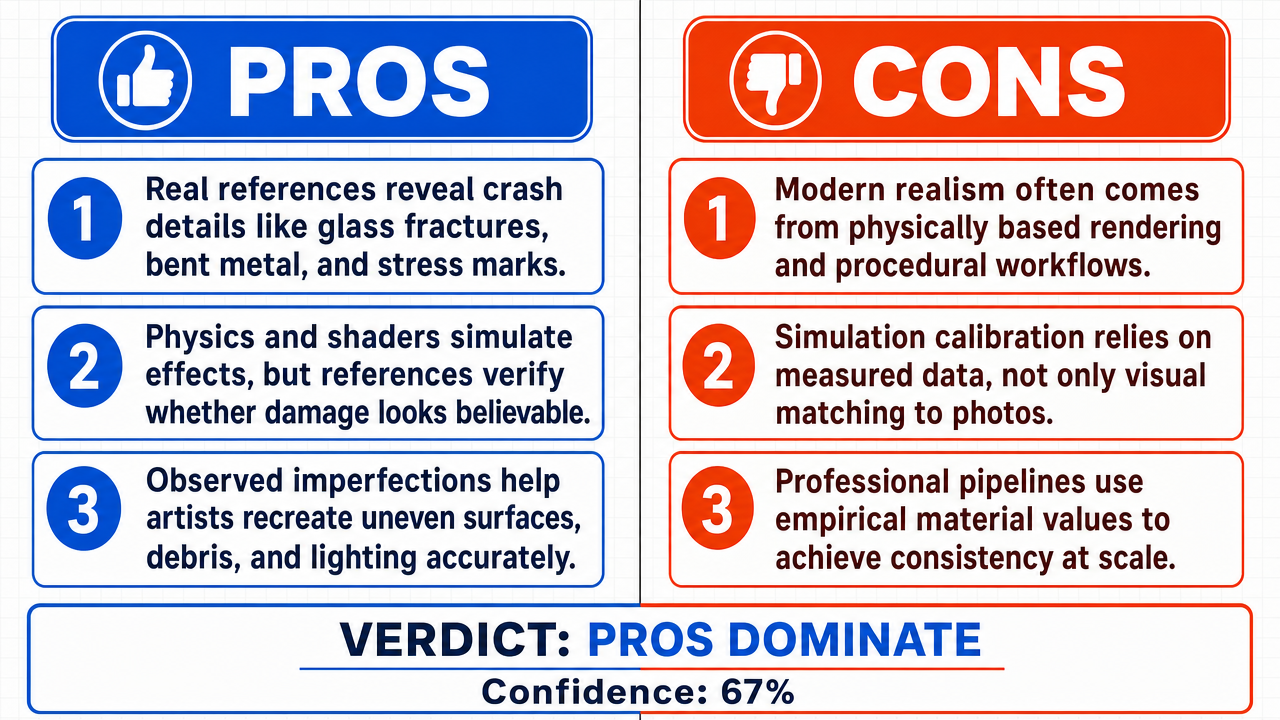
Verdict
Verdict: likely TRUE (67%)
Web Report: https://solsice.com/public/debates/achieving-realistic-visual-effects-for-elements-like-a-crash-76c5fc71948b
This section provides a brief overview of the key arguments. You do not need to read the full detailed report below.
✅ Key PRO arguments:
- ■Real-world references are essential because the physics of light and material behavior in a car crash—micro-fractures in glass, stress whitening in plastics, and anisotropic reflection of crumpled metal—produce highly specific light-scattering patterns that a digital artist cannot reliably intuit from imagination alone. High-resolution photography and video of actual crash tests provide the empirical observation needed to accurately calibrate digital representations.
- ■Shaders and physics engines are tools of execution, not sources of validation. While mathematical equations such as Fresnel or BSSRDF describe idealized physical laws, a car crash produces a specific, non-idealized material history that no general equation alone can predict. Real-world references help determine what the medium should be at specific points on a crumpled fender, such as whether paint was stressed to the point of micro-cracking exposing a primer layer .
❌ Key ANTI arguments:
- ■Modern VFX realism is achieved through physically based rendering (PBR ) and automated procedural workflows, not by artists matching every pixel to a photograph. Finite element analysis (FEA ) and rigid-body dynamics solvers calculate how metal deforms under stress, generating the chaotic, high-entropy detail procedurally rather than through visual reference matching.
- ■The calibration of a physics solver is not a process of matching a visual reference to correct an error; it is empirical data integration. In professional pipelines, material properties such as stiffness and friction are derived from standardized physical testing, making real-world visual references secondary to algorithmic and empirical data inputs.
💭 Conclusion: True, the assertion that real-world references enhance realistic visual effects for digital artists is supported by the winning arguments in this debate. The PRO side effectively argued that the complex, non-uniform surface geometries created during a car crash—such as micro-fractures in glass, stress whitening in plastics, and anisotropic reflection of crumpled metal—produce light-scattering behaviors that cannot be reliably intuited from imagination alone. Empirical observation through high-resolution photography and video of actual crash tests provides artists with the specific data needed to calibrate their digital representations accurately. While the ANTI side raised valid points about physically based rendering (PBR ), finite element analysis (FEA ), and procedural workflows providing algorithmic accuracy, these tools still require validation against real-world material behavior to avoid producing idealized rather than authentic results. The judge weighted the empirical grounding argument more heavily, recognizing that mathematical models describe idealized physical laws while real-world references capture the non-idealized material history unique to actual crash events.
🔬 DeepResearch Result: likely TRUE ✅ (67%)
Assertion: Achieving realistic visual effects for elements like a crashed car is enhanced by using real-world references for digital artists.
Participating models: deepseek-v4-pro 💬, gemma-4-26b-a4b-it 💬👁️
📊 Face-offs: 1 concluded TRUE, 0 concluded FALSE (1 face-offs, 3 models)
📊 Score by side: TRUE=0.67, FALSE=0.00
🏅 Model score changes:
minimax-m3 💬👁️: +7
✅ PRO Arguments:
- ■Real-world references are essential because the physics of light and material behavior in a car crash—micro-fractures in glass, stress whitening in plastics, and anisotropic reflection of crumpled metal—produce highly specific light-scattering patterns that a digital artist cannot reliably intuit from imagination alone. High-resolution photography and video of actual crash tests provide the empirical observation needed to accurately calibrate digital representations. deepseek-v4-pro 💬
- ■Shaders and physics engines are tools of execution, not sources of validation. While mathematical equations such as Fresnel or BSSRDF describe idealized physical laws, a car crash produces a specific, non-idealized material history that no general equation alone can predict. Real-world references help determine what the medium should be at specific points on a crumpled fender, such as whether paint was stressed to the point of micro-cracking exposing a primer layer . deepseek-v4-pro 💬
❌ ANTI Arguments:
- ■Modern VFX realism is achieved through physically based rendering (PBR ) and automated procedural workflows, not by artists matching every pixel to a photograph. Finite element analysis (FEA ) and rigid-body dynamics solvers calculate how metal deforms under stress, generating the chaotic, high-entropy detail procedurally rather than through visual reference matching. gemma-4-26b-a4b-it 💬👁️
- ■The calibration of a physics solver is not a process of matching a visual reference to correct an error; it is empirical data integration. In professional pipelines, material properties such as stiffness and friction are derived from standardized physical testing, making real-world visual references secondary to algorithmic and empirical data inputs. gemma-4-26b-a4b-it 💬👁️
💭 Reasoning: True, the assertion that real-world references enhance realistic visual effects for digital artists is supported by the winning arguments in this debate. The PRO side effectively argued that the complex, non-uniform surface geometries created during a car crash—such as micro-fractures in glass, stress whitening in plastics, and anisotropic reflection of crumpled metal—produce light-scattering behaviors that cannot be reliably intuited from imagination alone. Empirical observation through high-resolution photography and video of actual crash tests provides artists with the specific data needed to calibrate their digital representations accurately. While the ANTI side raised valid points about physically based rendering (PBR), finite element analysis (FEA), and procedural workflows providing algorithmic accuracy, these tools still require validation against real-world material behavior to avoid producing idealized rather than authentic results. The judge weighted the empirical grounding argument more heavily, recognizing that mathematical models describe idealized physical laws while real-world references capture the non-idealized material history unique to actual crash events.
📋 PRO Facts:
• Car crashes produce complex, non-uniform surface geometries including micro-fractures in glass, stress whitening in plastics, and anisotropic reflection of crumpled metal.
• High-resolution photography and video of actual crash tests provide empirical observation of how light interacts with damaged materials.
• Mathematical equations such as Fresnel and BSSRDF describe idealized physical laws but cannot by themselves predict specific non-idealized material histories.
📋 ANTI Facts:
• Modern VFX pipelines rely on physically based rendering (PBR) and automated procedural workflows rather than pixel-matching to photographs.
• Finite element analysis (FEA) and rigid-body dynamics solvers calculate how metal deforms under stress in crash simulations.
• In professional VFX pipelines, material properties such as stiffness and friction are derived from standardized physical testing rather than visual reference matching.
| Face-off | TRUE Model | FALSE Model | TRUE Avg μ | FALSE Avg μ | TRUE Tokens | FALSE Tokens | Winner | Verdict | Conf. |
|---|---|---|---|---|---|---|---|---|---|
| #1 | deepseek-v4-pro 💬 | gemma-4-26b-a4b-it 💬👁️ | 0.376 | 0.290 | 6 | 2 | TRUE | TRUE | 67% |
The following technical terms, abbreviations, and domain-specific concepts are referenced throughout this debate transcript. Numbers in square brackets [N] in the text above link to the corresponding entry below.
[1] anisotropic reflection — Reflection of light that varies depending on the angle of incidence, producing directional highlights (e.g., on brushed or crumpled metal surfaces).
[2] ASTM — American Society for Testing and Materials — An organization that publishes standardized technical testing procedures, referenced in the debate as a source of empirical material property data used to calibrate physics solvers.
[3] BSSRDF — Bidirectional Surface Scattering Reflectance Distribution Function — A mathematical model used in rendering shaders to describe how light enters a surface, scatters within the material, and exits at a different point, enabling realistic depiction of translucent or layered materials.
[4] CGI — Computer-Generated Imagery — Imagery created entirely with computer software, commonly used in film, games, and visual effects; the debate notes that 'CGI-perfect' approximations can appear artificial.
[5] clear coat — The transparent top layer of automotive paint that can delaminate or fracture independently of underlying layers during impact.
[6] delaminate — To separate into layers; in the debate, refers to the clear coat peeling away from underlying paint or substrate due to impact stress.
[7] FEA — Finite Element Analysis — A numerical simulation method that subdivides a structure into small elements to calculate how it deforms under applied forces, used in VFX to model crash deformation.
[8] finite element analysis — FEA — A computational technique for predicting how an object reacts to physical forces by breaking it into many small elements and solving the governing equations for each.
[9] Fresnel reflections — Light reflection behavior described by the Fresnel equations, in which the proportion of light reflected increases at grazing angles; relevant to rendering realistic surfaces like buckled metal.
[10] high-entropy detail — Visually complex, chaotic, information-rich surface detail that the debate characterizes as the hallmark of 'visual truth' in photorealistic rendering.
[11] material yield points — Stress thresholds at which a material transitions from elastic (recoverable) deformation to plastic (permanent) deformation, used as inputs to crash simulations.
[12] metallurgical data — Empirical data describing the physical and mechanical properties of metals, such as yield strength and stiffness, used to populate material libraries in VFX pipelines.
[13] micro-fractures — Tiny cracks that form in materials such as glass or coatings under stress, producing distinctive light-scattering patterns that contribute to realism.
[14] PBR — Physically Based Rendering — A rendering approach that uses mathematical models of real-world light and material behavior to produce realistic imagery, rather than approximating appearance artistically.
[15] photorealistic — Visually indistinguishable from a photograph of a real-world subject; the standard of realism the debate centers on.
[16] physics solvers — Software components that compute the behavior of physical systems (e.g., rigid-body dynamics, finite element analysis) to drive simulated deformation and motion in VFX.
[17] polycarbonate — A tough, transparent thermoplastic used for items such as headlight lenses, which exhibits subsurface scattering and stress whitening when shattered.
[18] primer layer — The base coat of paint applied beneath the color and clear coats, which can become exposed when overlying layers micro-crack under impact.
[19] rigid-body dynamics — A branch of physics simulation that models the motion and interaction of solid, non-deforming objects; used in VFX to simulate crash impacts.
[20] shaders — Programs in a rendering pipeline that calculate how light interacts with a surface, controlling color, reflection, refraction, and other appearance properties.
[21] stress whitening — A phenomenon in which polymers such as polycarbonate develop whitened regions under mechanical stress due to internal micro-void formation.
[22] subsurface scattering — The optical process by which light penetrates a surface, scatters within the material, and exits at a different point, producing the soft, translucent look of skin, wax, or shattered plastic.
[23] texture maps — 2D images wrapped onto 3D models to define surface appearance details such as color, roughness, or normal variation.
[24] uncanny valley — The hypothesis that near-realistic but imperfect representations can provoke discomfort or rejection in viewers; cited in the debate as a risk of poorly referenced CGI.
[25] VFX — Visual Effects — The discipline of creating or manipulating imagery outside the context of a live action shot, encompassing CGI, simulation, and compositing.
[26] yield strength — The amount of stress at which a material begins to deform plastically (permanently), a key input parameter for crash and deformation simulations.
Face-off transcripts
- ■
Ownership & Trade Secrets. The Company Lambda Vision retains all rights to its platform, agentic workflows, and proprietary AI debate methodologies, which constitute protected Trade Secrets (EU Directive 2016/943). Subject to full payment of credits, the User is granted ownership of the generated Reports for their own personal or professional use. Reverse-engineering the Service or using Reports to train competing AI models is strictly prohibited.
- ■
No Professional Advice. Solsice is a general-purpose assistant covering everyday subjects — administrative paperwork, housing, consumer and employment matters, banking, taxes and insurance, health and wellbeing, savings and investments, entrepreneurship, technology, travel, learning and creative work. Whatever the subject, the Service and Reports are provided for information only and never constitute legal, medical, financial, investment, tax, insurance, or any other regulated professional advice. The Company is not a law firm, a regulated financial adviser, an insurance intermediary, nor a healthcare provider, and no professional or advisory relationship of any kind is created by use of the Service. Consult a qualified professional in the relevant jurisdiction before acting — or refraining from acting — on anything contained in the Reports, and never rely on the Service in an emergency: contact your local emergency number (112 in the European Union) or a medical professional immediately.
- ■
AI-Generated Content, Sources and Viewpoints. Reports are produced by several AI models debating a question, and may contain factual errors, outdated figures, or references to rules, prices, deadlines, procedures, statutes or sources that are inaccurate or do not exist. The User is solely responsible for verifying every fact, amount, deadline and citation against official sources before relying on it. Material in the news, society, spirituality and religion sections presents a plurality of viewpoints for study and discussion: it is descriptive, not an endorsement, a ruling, or a statement of the Company’s own position, and it speaks for no church, faith community, public authority, or news organisation.
- ■
Liability & Governing Law. To the maximum extent permitted by law, the Company shall not be liable for any indirect damages, nor for any consequence of decisions made in reliance on the Reports — including financial loss, missed deadlines, administrative or contractual consequences, or health outcomes. These Terms are governed by French law. Any disputes shall be subject to the exclusive jurisdiction of the Courts of Paris, France.