
AI integration with office applications significantly enhances small teams' operational efficiency in graphic design and marketing, enabling output comparable to larger organizations by automating image processing and data analysis.
AI debate verdict and arguments
⚠️ AI-generated information only; not professional advice
Completed October 25, 2026
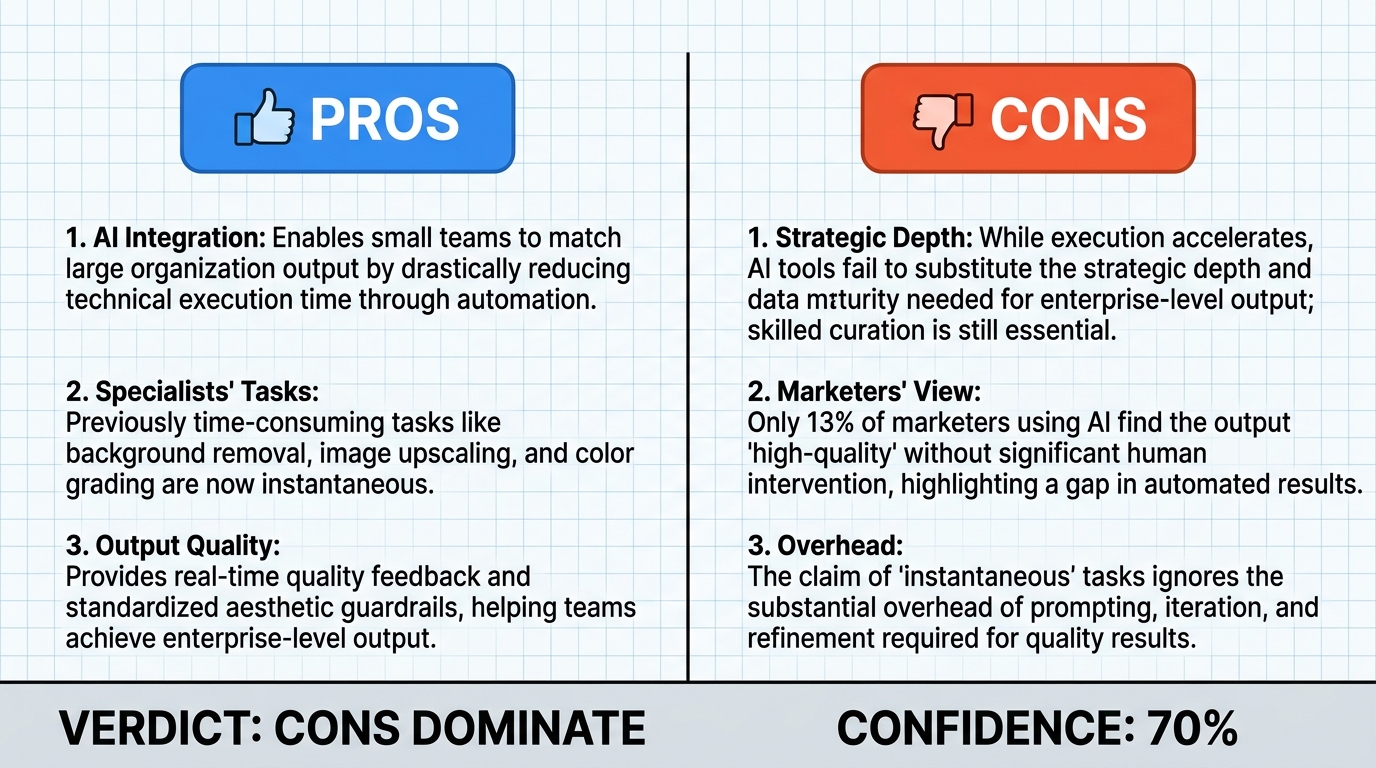
Verdict
Verdict: likely FALSE (70%)
Web Report: https://solsice.com/public/debates/ai-integration-with-office-applications-significantly-enhanc-237c2c1ae282
This section provides a brief overview of the key arguments. You do not need to read the full detailed report below.
✅ Key PRO arguments:
- ■AI integration empowers small teams to match large organization output through automation, drastically reducing the time required for technical execution and neutralizing the resource gap that traditionally favors larger firms.
- ■Tasks such as background removal , image upscaling , and color grading —which previously required dedicated specialists or hours of manual labor—are now instantaneous via AI-augmented office and creative suites, allowing a single designer to manage asset volumes that would typically require a full production department.
- ■AI-augmented workflows provide real-time quality feedback and standardized aesthetic guardrails , meaning teams can achieve enterprise-level output either through seasoned curation skills or through AI-assisted quality control, making the absence of traditional expertise less critical.
❌ Key ANTI arguments:
- ■AI tools accelerate execution but fail to substitute the strategic depth and data maturity required for enterprise-level output ; without seasoned curation skills of a full production department, AI tools produce generic assets that dilute brand value .
- ■Salesforce data indicates that while 71% of marketers use AI, only 13% find the output 'high-quality' without significant human intervention, proving that small teams cannot generate enterprise-level output without the very human oversight the assertion claims to replace.
- ■The claim that AI renders background removal and upscaling 'nearly instantaneous' ignores the substantial overhead of prompting , iteration , and refinement required to meet enterprise standards; 'time to value ' is not merely generation time.
💭 Conclusion: False. The assertion overstates the capacity of AI integration to make small teams' output truly comparable to larger organizations, because AI automation addresses execution speed but not the strategic depth, curation expertise, and quality consistency that enterprise-level output demands. The MIT Sloan Management Review finding—that 53% of companies reported negative or flat productivity effects from generative AI integration—directly undermines the claim that automation alone bridges the resource gap , since the time spent prompting and verifying outputs negates the gains from automation. Furthermore, without seasoned curation skills , AI tools produce generic assets that dilute brand value , weakening the efficiency claim when measured by quality-adjusted output . Taken together, these arguments show that while AI enhances certain operational dimensions, it does not enable output comparable to larger organizations across the full scope of graphic design and marketing work.
🔬 DeepResearch Result: likely FALSE ❌ (70%)
Assertion: AI integration with office applications significantly enhances small teams' operational efficiency in graphic design and marketing, enabling output comparable to larger organizations by automating image processing and data analysis.
Participating models: gemma-4-26b-a4b-it 💬👁️, glm-4.7-flash 💬
📊 Face-offs: 0 concluded TRUE, 1 concluded FALSE (1 face-offs, 3 models)
📊 Score by side: TRUE=0.00, FALSE=0.70
🏅 Model score changes:
minimax-m3 💬👁️: +7
✅ PRO Arguments:
- ■AI integration empowers small teams to match large organization output through automation, drastically reducing the time required for technical execution and neutralizing the resource gap that traditionally favors larger firms. gemma-4-26b-a4b-it 💬👁️
- ■Tasks such as background removal , image upscaling , and color grading —which previously required dedicated specialists or hours of manual labor—are now instantaneous via AI-augmented office and creative suites, allowing a single designer to manage asset volumes that would typically require a full production department. gemma-4-26b-a4b-it 💬👁️
- ■AI-augmented workflows provide real-time quality feedback and standardized aesthetic guardrails , meaning teams can achieve enterprise-level output either through seasoned curation skills or through AI-assisted quality control, making the absence of traditional expertise less critical. gemma-4-26b-a4b-it 💬👁️
- ■Shifting the human role from manual pixel manipulation to high-level creative direction allows small teams to focus on strategic value rather than execution, theoretically multiplying their effective output capacity. gemma-4-26b-a4b-it 💬👁️
❌ ANTI Arguments:
- ■AI tools accelerate execution but fail to substitute the strategic depth and data maturity required for enterprise-level output; without seasoned curation skills of a full production department, AI tools produce generic assets that dilute brand value . glm-4.7-flash 💬
- ■Salesforce data indicates that while 71% of marketers use AI, only 13% find the output 'high-quality' without significant human intervention, proving that small teams cannot generate enterprise-level output without the very human oversight the assertion claims to replace. glm-4.7-flash 💬
- ■The claim that AI renders background removal and upscaling 'nearly instantaneous' ignores the substantial overhead of prompting , iteration , and refinement required to meet enterprise standards; 'time to value ' is not merely generation time. glm-4.7-flash 💬
- ■Evidence from McKinsey & Company indicates that while AI automates tasks, it simultaneously introduces significant new human effort for oversight and correction, revealing an anomaly where the claimed efficiency gains are negated by the increased complexity of the workflow glm-4.7-flash 💬
- ■If operational efficiency is measured by quality-adjusted output rather than raw volume, the low quality rate of AI-generated assets undermines the claim of enhanced efficiency and comparability with larger organizations. glm-4.7-flash 💬
💭 Reasoning: False. The assertion overstates the capacity of AI integration to make small teams' output truly comparable to larger organizations, because AI automation addresses execution speed but not the strategic depth, curation expertise, and quality consistency that enterprise-level output demands. The MIT Sloan Management Review finding—that 53% of companies reported negative or flat productivity effects from generative AI integration—directly undermines the claim that automation alone bridges the resource gap, since the time spent prompting and verifying outputs negates the gains from automation. Furthermore, without seasoned curation skills, AI tools produce generic assets that dilute brand value, weakening the efficiency claim when measured by quality-adjusted output. Taken together, these arguments show that while AI enhances certain operational dimensions, it does not enable output comparable to larger organizations across the full scope of graphic design and marketing work.
📋 PRO Facts:
• AI tools can shift human effort from manual pixel manipulation to higher-level creative direction in design workflows.
📋 ANTI Facts:
• Empirical studies from MIT Sloan Management Review observe that 53% of companies reported negative or flat productivity effects when integrating generative AI, suggesting the time spent prompting and verifying outputs negates the gains from automation.
• Without the seasoned curation skills of a full production department, AI tools produce generic assets that dilute brand value, undermining quality-adjusted efficiency.
| Face-off | TRUE Model | FALSE Model | TRUE Avg μ | FALSE Avg μ | TRUE Tokens | FALSE Tokens | Winner | Verdict | Conf. |
|---|---|---|---|---|---|---|---|---|---|
| #1 | gemma-4-26b-a4b-it 💬👁️ | glm-4.7-flash 💬 | 0.214 | 0.329 | 2 | 4 | FALSE | FALSE | 70% |
The following technical terms, abbreviations, and domain-specific concepts are referenced throughout this debate transcript. Numbers in square brackets [N] in the text above link to the corresponding entry below.
[1] actionable insights — Data-derived findings that can be directly applied to decision-making or operational improvements, as referenced in the context of AI-driven marketing analytics.
[2] aesthetic guardrails — Standardized visual or stylistic criteria used to maintain consistent quality and brand alignment in design output, mentioned as a feature of AI-augmented workflows.
[3] AI-augmented workflows — Work processes enhanced or accelerated through the integration of artificial intelligence tools, enabling tasks such as real-time quality feedback.
[4] AI-driven data analysis — The use of artificial intelligence systems to process, interpret, and extract patterns from datasets, applied here to consumer behavior and campaign performance.
[5] background removal — An image processing technique that isolates a subject by eliminating its surrounding background, cited as a task automated by AI in design workflows.
[6] brand value — The perceived worth or equity of a brand, which the negative side argues can be diluted by generic AI-generated assets lacking seasoned curation.
[7] campaign performance — Metrics and outcomes measuring the effectiveness of marketing campaigns, referenced as a target of AI-driven data analysis.
[8] color grading — The process of adjusting and enhancing the color tones of visual media, cited as a design task now automated by AI.
[9] consumer behavior — The patterns and decision-making processes of customers when purchasing or engaging with products, referenced as a domain for AI-driven analysis.
[10] creative direction — The high-level strategic guidance of visual or conceptual output, contrasted in the debate with manual pixel manipulation.
[11] curation skills — The expertise required to select, refine, and elevate creative assets to professional standards, identified as a capability that AI cannot fully substitute.
[12] data science — The discipline of extracting knowledge and insights from structured and unstructured data, referenced as a function traditionally housed in dedicated teams at large organizations.
[13] democratized asset — A resource or capability made broadly accessible to users regardless of organizational size, used here to describe AI-enabled data analysis.
[14] enterprise-level output — Production quality and strategic depth characteristic of large organizations, defined in the debate as requiring specialized technical skills and coordination beyond simple volume.
[15] force multiplier — A factor that amplifies the effective output of existing capabilities, used to describe how AI extends a professional designer's expertise across more assets.
[16] generative AI — Artificial intelligence systems capable of producing new content such as images, text, or designs, central to the debate's automation claims.
[17] high-velocity output — A rapid rate of production, cited as a competitive advantage small teams can achieve through AI integration.
[18] image upscaling — The process of increasing the resolution or detail of an image, cited as a design task automated by AI tools.
[19] iteration — The repeated cycle of refining and adjusting output, identified by the negative side as a hidden overhead in AI-assisted workflows.
[20] operational efficiency — A measure of productivity relative to resource input, the central metric under dispute in the debate.
[21] pixel manipulation — Manual editing of images at the individual pixel level, contrasted in the debate with high-level creative direction enabled by AI.
[22] prompting — The act of providing input instructions or queries to an AI system, cited as a source of workflow overhead in AI-assisted design.
[23] proprietary historical data — Exclusive, organization-owned datasets accumulated over time, identified as a resource advantage that large organizations hold over small teams.
[24] quality-adjusted output — A measurement of production volume weighted by quality standards, introduced by the negative side to challenge efficiency claims.
[25] resource gap — The disparity in available resources (personnel, tools, data) between small teams and large organizations, which the affirmative claims AI neutralizes.
[26] time to value — The duration required before a process or tool delivers its intended benefit, used to argue that AI generation time alone does not capture full workflow cost.
[27] workflow — The defined sequence of processes and tasks used to complete work, referenced as the unit affected by AI integration.
The following financial data tables were referenced during the debate exchanges:
| Outcome | Percentage |
| Negative/Flat Productivity | 53% |
| Positive Productivity | 47% |
Legend: Results from MIT Sloan Management Review survey on generative AI productivity effects. Data represents the proportion of companies reporting the respective outcome. Source: MIT Sloan Management Review.
Face-off transcripts
- ■
Ownership & Trade Secrets. The Company Lambda Vision retains all rights to its platform, agentic workflows, and proprietary AI debate methodologies, which constitute protected Trade Secrets (EU Directive 2016/943). Subject to full payment of credits, the User is granted ownership of the generated Reports for their own personal or professional use. Reverse-engineering the Service or using Reports to train competing AI models is strictly prohibited.
- ■
No Professional Advice. Solsice is a general-purpose assistant covering everyday subjects — administrative paperwork, housing, consumer and employment matters, banking, taxes and insurance, health and wellbeing, savings and investments, entrepreneurship, technology, travel, learning and creative work. Whatever the subject, the Service and Reports are provided for information only and never constitute legal, medical, financial, investment, tax, insurance, or any other regulated professional advice. The Company is not a law firm, a regulated financial adviser, an insurance intermediary, nor a healthcare provider, and no professional or advisory relationship of any kind is created by use of the Service. Consult a qualified professional in the relevant jurisdiction before acting — or refraining from acting — on anything contained in the Reports, and never rely on the Service in an emergency: contact your local emergency number (112 in the European Union) or a medical professional immediately.
- ■
AI-Generated Content, Sources and Viewpoints. Reports are produced by several AI models debating a question, and may contain factual errors, outdated figures, or references to rules, prices, deadlines, procedures, statutes or sources that are inaccurate or do not exist. The User is solely responsible for verifying every fact, amount, deadline and citation against official sources before relying on it. Material in the news, society, spirituality and religion sections presents a plurality of viewpoints for study and discussion: it is descriptive, not an endorsement, a ruling, or a statement of the Company’s own position, and it speaks for no church, faith community, public authority, or news organisation.
- ■
Liability & Governing Law. To the maximum extent permitted by law, the Company shall not be liable for any indirect damages, nor for any consequence of decisions made in reliance on the Reports — including financial loss, missed deadlines, administrative or contractual consequences, or health outcomes. These Terms are governed by French law. Any disputes shall be subject to the exclusive jurisdiction of the Courts of Paris, France.