
An entrepreneur's personal contribution, matched by 'honor loans' from support organizations, is a universally effective strategy for securing bank financing for business acquisition.
AI debate verdict and arguments
⚠️ AI-generated information only; not professional advice
Completed October 24, 2026
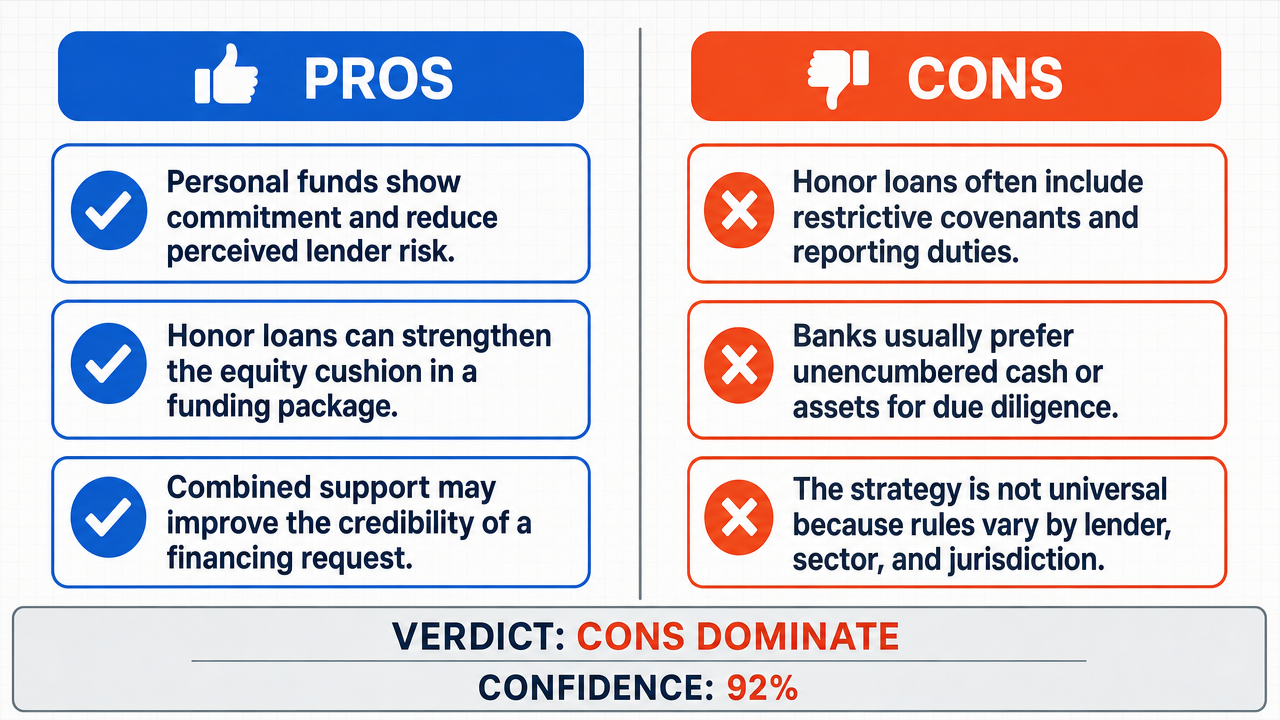
Verdict
Verdict: likely FALSE (92%)
Web Report: https://solsice.com/public/debates/an-entrepreneur-s-personal-contribution-matched-by-honor-loa-309dd9d7237a
This section provides a brief overview of the key arguments. You do not need to read the full detailed report below.
✅ Key PRO arguments:
- ■Personal equity combined with honor loans creates an optimal risk-mitigation profile by demonstrating 'skin in the game ,' aligning the entrepreneur's financial interests with the acquisition's success and reducing moral hazard for lenders.
- ■Honor loans from support organizations function as a secondary layer of loss absorption , effectively increasing the equity cushion presented to the bank and improving the borrower's risk profile.
- ■The opposition's position is logically incoherent because it simultaneously asserts that the strategy fails to guarantee financing while claiming regulatory and covenant factors make it categorically impossible, holding a proposition and its negation at once.
❌ Key ANTI arguments:
- ■Honor loans typically carry restrictive covenants such as limitations on dividend payouts, restrictions on further borrowing, and mandatory reporting requirements, which reduce operational flexibility and depress cash flow, thereby weakening the Debt Service Coverage Ratio (DSCR) that banks rigorously evaluate.
- ■Standard banking practice requires the entrepreneur's contribution to be in the form of unencumbered cash or assets to satisfy due diligence on liquidity and commitment; honor loans are contingent on business performance and creditworthiness , creating a circular dependency that banks do not accept as valid equity substitution.
- ■The strategy cannot be 'universally' effective because regulatory leverage caps and covenant restrictions vary across jurisdictions, sectors, and lender policies, meaning the same structure can succeed in one context and fail in another.
💭 Conclusion: False. The assertion is rejected because the word 'universally' overstates the applicability of the personal-equity-plus-honor-loan strategy. The winning side demonstrated that honor loans typically carry restrictive covenants that depress cash flow and the Debt Service Coverage Ratio, which banks evaluate rigorously. Furthermore, banks generally require unencumbered cash equity rather than contingent debt instruments, meaning honor loans do not reliably substitute for true equity contribution. The circular dependency created when honor loans are contingent on the business's own performance undermines their value as a credit-enhancement signal. Because the claim is compound (personal contribution AND matched honor loans, applied universally), confidence is set at the level of the weakest sub-claim, which is the universal applicability of honor loans as an equity substitute.
🔬 DeepResearch Result: likely FALSE ❌ (92%)
Assertion: An entrepreneur's personal contribution, matched by 'honor loans ' from support organizations, is a universally effective strategy for securing bank financing for business acquisition.
Participating models: gemma-4-26b-a4b-it 💬👁️, glm-4.7-flash 💬
📊 Face-offs: 0 concluded TRUE, 1 concluded FALSE (1 face-offs, 3 models)
📊 Score by side: TRUE=0.00, FALSE=0.92
🏅 Model score changes:
minimax-m3 💬👁️: +9
✅ PRO Arguments:
- ■Personal equity combined with honor loans creates an optimal risk-mitigation profile by demonstrating 'skin in the game ,' aligning the entrepreneur's financial interests with the acquisition's success and reducing moral hazard for lenders. gemma-4-26b-a4b-it 💬👁️
- ■Honor loans from support organizations function as a secondary layer of loss absorption , effectively increasing the equity cushion presented to the bank and improving the borrower's risk profile. gemma-4-26b-a4b-it 💬👁️
- ■The opposition's position is logically incoherent because it simultaneously asserts that the strategy fails to guarantee financing while claiming regulatory and covenant factors make it categorically impossible, holding a proposition and its negation at once. gemma-4-26b-a4b-it 💬👁️
❌ ANTI Arguments:
- ■Honor loans typically carry restrictive covenants such as limitations on dividend payouts, restrictions on further borrowing, and mandatory reporting requirements, which reduce operational flexibility and depress cash flow, thereby weakening the Debt Service Coverage Ratio (DSCR) that banks rigorously evaluate. glm-4.7-flash 💬
- ■Standard banking practice requires the entrepreneur's contribution to be in the form of unencumbered cash or assets to satisfy due diligence on liquidity and commitment; honor loans are contingent on business performance and creditworthiness , creating a circular dependency that banks do not accept as valid equity substitution. glm-4.7-flash 💬
- ■The strategy cannot be 'universally' effective because regulatory leverage caps and covenant restrictions vary across jurisdictions, sectors, and lender policies, meaning the same structure can succeed in one context and fail in another. glm-4.7-flash 💬
💭 Reasoning: False. The assertion is rejected because the word 'universally' overstates the applicability of the personal-equity-plus-honor-loan strategy. The winning side demonstrated that honor loans typically carry restrictive covenants that depress cash flow and the Debt Service Coverage Ratio , which banks evaluate rigorously. Furthermore, banks generally require unencumbered cash equity rather than contingent debt instruments, meaning honor loans do not reliably substitute for true equity contribution. The circular dependency created when honor loans are contingent on the business's own performance undermines their value as a credit-enhancement signal. Because the claim is compound (personal contribution AND matched honor loans, applied universally), confidence is set at the level of the weakest sub-claim, which is the universal applicability of honor loans as an equity substitute.
📋 PRO Facts:
• Personal equity contribution aligns the entrepreneur's financial interests with the acquisition's success, reducing moral hazard for lenders.
• Honor loans from development agencies or specialized funds can act as a secondary layer of loss absorption in a financing structure.
• Banks evaluate the Debt Service Coverage Ratio (DSCR) as a key metric in acquisition financing decisions.
📋 ANTI Facts:
• Honor loans frequently include restrictive covenants that negatively impact cash flow and lower DSCR coverage.
• Standard banking due diligence requires the borrower's contribution to be unencumbered cash or assets, not contingent debt instruments.
• Honor loans are typically contingent on the business's performance and the entrepreneur's creditworthiness, creating a circular dependency that banks do not treat as valid equity.
| Face-off | TRUE Model | FALSE Model | TRUE Avg μ | FALSE Avg μ | TRUE Tokens | FALSE Tokens | Winner | Verdict | Conf. |
|---|---|---|---|---|---|---|---|---|---|
| #1 | gemma-4-26b-a4b-it 💬👁️ | glm-4.7-flash 💬 | 0.184 | 0.407 | 4 | 4 | FALSE | FALSE | 92% |
The following technical terms, abbreviations, and domain-specific concepts are referenced throughout this debate transcript. Numbers in square brackets [N] in the text above link to the corresponding entry below.
[1] Basel III/IV — Basel III / Basel IV — International banking regulatory frameworks that set capital adequacy, leverage, and risk-weighting standards for commercial banks.
[2] capital structure — The mix of debt and equity financing used by a business to fund its operations and acquisitions.
[3] cash equity — An equity contribution made in the form of liquid cash or unencumbered assets, as opposed to contingent or borrowed funds.
[4] circular dependency — A logical condition in which two requirements each depend on the other being satisfied first, making the overall condition potentially unsatisfiable.
[5] contingent debt — Debt whose availability or enforceability depends on specified conditions, such as the borrower's performance or creditworthiness.
[6] credit profile — An assessment of a borrower's credit history, capacity, and overall ability to meet debt obligations.
[7] creditworthiness — A lender's evaluation of a borrower's reliability and ability to repay debt obligations.
[8] debt service — The scheduled repayment of loan principal and interest over a given period.
[9] Debt Service Coverage Ratio — DSCR — A financial metric comparing a business's net operating income to its debt service obligations, used by banks to assess repayment capacity.
[10] development agencies — Organizations (often public or quasi-public) that provide financial or technical support to entrepreneurs and businesses, sometimes via instruments such as honor loans.
[11] due diligence — The investigative process by which a lender or buyer verifies the financial, legal, and operational status of a borrower or target before committing to a transaction.
[12] equity cushion — The layer of equity capital that absorbs losses before senior debt is impacted, reducing lender exposure.
[13] equity gap — The shortfall between the equity a borrower can contribute and the equity a lender requires to approve financing.
[14] honor loans — Loans extended by support organizations (such as development agencies or specialized funds), often unsecured or quasi-equity in nature, whose terms rely on the borrower's good faith rather than standard collateral.
[15] leverage caps — Regulatory or contractual limits on the amount of debt a borrower or bank can carry relative to equity or capital.
[16] liquidity — The availability of cash or easily sellable assets to meet short-term obligations.
[17] loss absorption — The capacity of a capital layer (equity or subordinated debt) to absorb financial losses before senior creditors are affected.
[18] moral hazard — The risk that a party, insulated from consequences, takes on greater risk; in lending, mitigated when borrowers have personal capital at stake.
[19] net cash flow — The residual cash generated by a business after operating expenses and debt service, used to assess debt repayment capacity.
[20] quasi-equity — A financial instrument that shares characteristics of both debt and equity, often subordinated and sometimes contingent, used to absorb losses.
[21] restrictive covenants — Contractual conditions in a loan agreement that limit the borrower's actions, such as restrictions on dividends, additional borrowing, or required reporting.
[22] risk weights — Percentages assigned to asset categories under regulatory frameworks (e.g., Basel III/IV) reflecting their relative credit risk, used to compute capital requirements.
[23] risk-weighted asset — risk-weighted asset (RWA) — An asset value adjusted by its assigned risk weight, used by banks to determine regulatory capital requirements.
[24] senior debt — Debt that has priority over other debts in repayment from the borrower's assets or cash flows in the event of default.
[25] skin in the game — A borrower's personal financial stake in a venture, signaling alignment of interests and reducing moral hazard for lenders.
[26] subordination — The ranking of debt such that one creditor's claim is paid only after another's, affecting loss absorption priority.
[27] unencumbered assets — Assets free of liens, pledges, or other claims, available to be used as collateral or counted as equity contribution.
The following financial data tables were referenced during the debate exchanges:
| Funding Component | Risk Absorption Tier | Impact on Bank LTV |
|---|---|---|
| Personal Contribution | First Loss | Increases Equity Base |
| Honor Loans | Second Loss | Bridges Equity Gap |
| Bank Debt | Senior Position | Optimizes Leverage |
Legend: Comparison of how different capital layers absorb risk and affect the Loan-to-Value ratio in an acquisition.
| Capital Structure Component | Impact on Cash Flow | Impact on DSCR |
|---|---|---|
| Personal Equity | Neutral | Neutral |
| Honor Loan (with covenants) | Negative (Restrictions) | Negative (Lower Coverage) |
| Bank Debt | Neutral (if serviced) | Positive (if serviced) |
Legend: Hypothetical impact of adding an honor loan with covenants on cash flow and debt service coverage ratios. Source: Standard banking risk assessment models.
| Factor | Opposition View | Economic Reality |
|---|---|---|
| Honor Loans | Increases Debt/Regulatory Risk | Increases Equity/Reduces RWA |
| Covenants | Undermine DSCR | Formalize Subordination/Protect Bank |
| Equity Gap | Irrelevant due to Caps | Bridged by Honor Loans to meet Caps |
Legend: Comparison of the opposition's interpretation of financing constraints versus the actual regulatory and structural impact of the proposed strategy.
| Requirement | Standard Bank Expectation | Honor Loan Reality |
|---|---|---|
| Borrower Contribution | Cash / Unencumbered Assets | Contingent Debt / Performance-based |
| Validation Method | Direct Liquidity Check | Indirect Credit Check |
| Risk Profile | Low (Cash is hard) | High (Contingent on Success) |
Legend: Comparison of standard bank requirements for borrower contribution versus the nature of honor loans. Source: Standard M&A financing guidelines.
Face-off transcripts
- ■
Ownership & Trade Secrets. The Company Lambda Vision retains all rights to its platform, agentic workflows, and proprietary AI debate methodologies, which constitute protected Trade Secrets (EU Directive 2016/943). Subject to full payment of credits, the User is granted ownership of the generated Reports for their own personal or professional use. Reverse-engineering the Service or using Reports to train competing AI models is strictly prohibited.
- ■
No Professional Advice. Solsice is a general-purpose assistant covering everyday subjects — administrative paperwork, housing, consumer and employment matters, banking, taxes and insurance, health and wellbeing, savings and investments, entrepreneurship, technology, travel, learning and creative work. Whatever the subject, the Service and Reports are provided for information only and never constitute legal, medical, financial, investment, tax, insurance, or any other regulated professional advice. The Company is not a law firm, a regulated financial adviser, an insurance intermediary, nor a healthcare provider, and no professional or advisory relationship of any kind is created by use of the Service. Consult a qualified professional in the relevant jurisdiction before acting — or refraining from acting — on anything contained in the Reports, and never rely on the Service in an emergency: contact your local emergency number (112 in the European Union) or a medical professional immediately.
- ■
AI-Generated Content, Sources and Viewpoints. Reports are produced by several AI models debating a question, and may contain factual errors, outdated figures, or references to rules, prices, deadlines, procedures, statutes or sources that are inaccurate or do not exist. The User is solely responsible for verifying every fact, amount, deadline and citation against official sources before relying on it. Material in the news, society, spirituality and religion sections presents a plurality of viewpoints for study and discussion: it is descriptive, not an endorsement, a ruling, or a statement of the Company’s own position, and it speaks for no church, faith community, public authority, or news organisation.
- ■
Liability & Governing Law. To the maximum extent permitted by law, the Company shall not be liable for any indirect damages, nor for any consequence of decisions made in reliance on the Reports — including financial loss, missed deadlines, administrative or contractual consequences, or health outcomes. These Terms are governed by French law. Any disputes shall be subject to the exclusive jurisdiction of the Courts of Paris, France.