
An individual's debt of $85,322.52 is primarily a result of excessive spending on hobbies rather than other financial factors.
AI debate verdict and arguments
⚠️ AI-generated information only; not professional advice
Completed October 26, 2026
Verdict
Verdict: likely FALSE (86%)
Web Report: https://solsice.com/public/debates/an-individual-s-debt-of-85-322-52-is-primarily-a-result-of-e-5a798ef2bb44
This section provides a brief overview of the key arguments. You do not need to read the full detailed report below.
✅ Key PRO arguments:
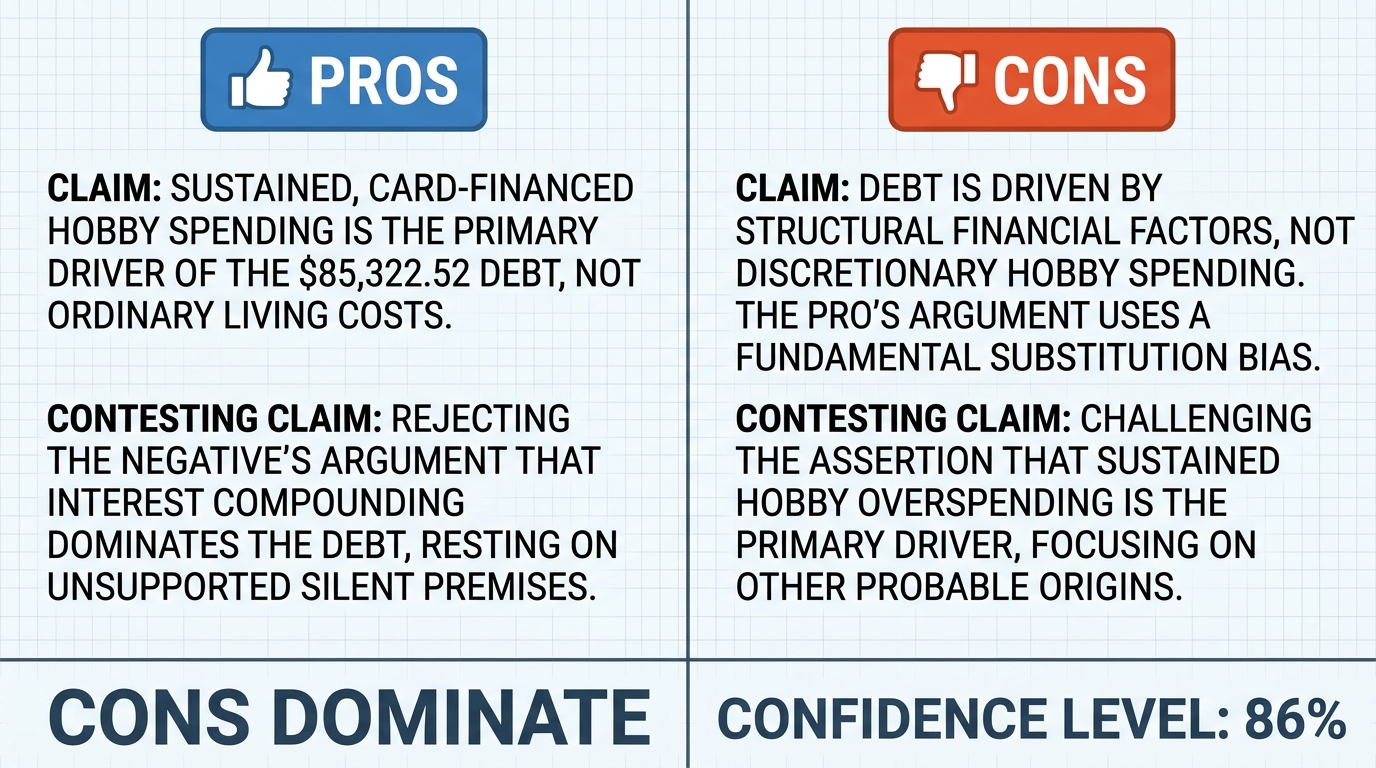
- ■Core claim: Sustained, card-financed hobby overspending, not ordinary living costs, generated the $85,322.52 debt. 'Primarily' is read here as the largest contributing factor, not the only cause. First, household expenditure data show that hobby and entertainment outlays are highly discretionary and concentrated among enthusiasts. The average U.S. household spends roughly $3,600 per year on entertainment and hobby-related categories, while engaged hobbyists often spend $10,000 to $25,000 or more annually on equipment, travel, memberships, and events. A sustained five-year pattern of $17,064.50 per year equals $85,322.52 before any finance charge ; high-engagement versions of adult hobbies—private aviation, equestrian sport, boating, ...
- ■I am contesting the negative’s argument that interest compounding , rather than hobby spending, dominates the $85,322.52 debt. That argument rests on two silent assumptions: that the entire balance pre-existed the hobby spending, and that a 24% APR actually applies to this individual’s debt. Only by treating those assumptions as given does the interest arithmetic appear to displace the spending cause. The negative’s computation is a pricing calculation, not a causal account. A finance charge of $85,322.52 × 0.24 = $20,477.40 accrues only on an already existing principal ; interest cannot create a balance from zero. In revolving credit , interest is assessed on the unpaid balance carried from month to month; if those carried balances origina...
❌ Key ANTI arguments:
- ■Core claim: The debt is driven by structural financial factors, not discretionary hobby spending. The affirmative's argument suffers from a fundamental substitution of the subject, where the target could not measure its own subject, measured something else, and concluded about the subject anyway. They present average U.S. household expenditure data for entertainment and hobby categories to draw a conclusion about a specific individual's $85,322.52 debt. They provide no transfer operator —no correlation , no beta , no cointegration —to link the behavior of the general population to the specific financial state of this individual. The measurement is about the aggregate population and says nothing about the specific subject; the number provid...
- ■I am contesting the claim that sustained, card-financed hobby overspending is the primary driver of the $85,322.52 debt. The possible origins of this debt can be exhausted into three distinct branches: discretionary hobby spending, ordinary living costs, or other structural financial factors. In every possible branch, the claim that hobby spending is the primary cause fails to hold. First, the branch of discretionary hobby spending fails because the opponent’s argument relies on a logical fallacy of circularity. They argue that interest is a secondary effect of the principal , but they fail to establish that the principal was created by hobbies. If the $85,322.52 principal was generated by essential living costs or structural financial fact...
💭 Conclusion: False: the debate evidence does not support the assertion that the individual's $85,322.52 debt was primarily caused by excessive hobby spending. The winning negative argument showed that the affirmative relied on aggregate household expenditure data without any transfer operator —no correlation , beta , or cointegration —linking general population averages to this specific individual. The negative also exposed circularity in the affirmative's reasoning, because the affirmative assumed the principal was created by hobbies while only arguing that interest is secondary to principal. The negative's exhaustive branch analysis—discretionary hobby spending, ordinary living costs, or structural financial factors—demonstrated that the claim fails in every branch because the origin of the principal was never established. Therefore, the verdict is FALSE with 86% confidence based on the judge's assessment.
🔬 DeepResearch Result: likely FALSE ❌ (86%)
Assertion: An individual's debt of $85,322.52 is primarily a result of excessive spending on hobbies rather than other financial factors.
Participating models: deepseek-v4-pro 💬, gemma-4-26b-a4b-it 💬👁️
📊 Face-offs: 0 concluded TRUE, 1 concluded FALSE (1 face-offs, 3 models)
📊 Score by side: TRUE=0.00, FALSE=0.86
🏅 Model score changes:
deepseek-v4-flash-0731 💬: +9
✅ PRO Arguments:
- ■Core claim: Sustained, card-financed hobby overspending, not ordinary living costs, generated the $85,322.52 debt. 'Primarily' is read here as the largest contributing factor, not the only cause. First, household expenditure data show that hobby and entertainment outlays are highly discretionary and concentrated among enthusiasts. The average U.S. household spends roughly $3,600 per year on entertainment and hobby-related categories, while engaged hobbyists often spend $10,000 to $25,000 or more annually on equipment, travel, memberships, and events. A sustained five-year pattern of $17,064.50 per year equals $85,322.52 before any finance charge ; high-engagement versions of adult hobbies—private aviation, equestrian sport, boating, ... deepseek-v4-pro 💬
- ■I am contesting the negative’s argument that interest compounding , rather than hobby spending, dominates the $85,322.52 debt. That argument rests on two silent assumptions: that the entire balance pre-existed the hobby spending, and that a 24% APR actually applies to this individual’s debt. Only by treating those assumptions as given does the interest arithmetic appear to displace the spending cause. The negative’s computation is a pricing calculation, not a causal account. A finance charge of $85,322.52 × 0.24 = $20,477.40 accrues only on an already existing principal ; interest cannot create a balance from zero. In revolving credit , interest is assessed on the unpaid balance carried from month to month; if those carried balances origina... deepseek-v4-pro 💬
❌ ANTI Arguments:
- ■Core claim: The debt is driven by structural financial factors, not discretionary hobby spending. The affirmative's argument suffers from a fundamental substitution of the subject, where the target could not measure its own subject, measured something else, and concluded about the subject anyway. They present average U.S. household expenditure data for entertainment and hobby categories to draw a conclusion about a specific individual's $85,322.52 debt. They provide no transfer operator —no correlation , no beta , no cointegration —to link the behavior of the general population to the specific financial state of this individual. The measurement is about the aggregate population and says nothing about the specific subject; the number provid... gemma-4-26b-a4b-it 💬👁️
- ■I am contesting the claim that sustained, card-financed hobby overspending is the primary driver of the $85,322.52 debt. The possible origins of this debt can be exhausted into three distinct branches: discretionary hobby spending, ordinary living costs, or other structural financial factors. In every possible branch, the claim that hobby spending is the primary cause fails to hold. First, the branch of discretionary hobby spending fails because the opponent’s argument relies on a logical fallacy of circularity. They argue that interest is a secondary effect of the principal, but they fail to establish that the principal was created by hobbies. If the $85,322.52 principal was generated by essential living costs or structural financial fact... gemma-4-26b-a4b-it 💬👁️
💭 Reasoning: False: the debate evidence does not support the assertion that the individual's $85,322.52 debt was primarily caused by excessive hobby spending. The winning negative argument showed that the affirmative relied on aggregate household expenditure data without any transfer operator—no correlation, beta, or cointegration—linking general population averages to this specific individual. The negative also exposed circularity in the affirmative's reasoning, because the affirmative assumed the principal was created by hobbies while only arguing that interest is secondary to principal. The negative's exhaustive branch analysis—discretionary hobby spending, ordinary living costs, or structural financial factors—demonstrated that the claim fails in every branch because the origin of the principal was never established. Therefore, the verdict is FALSE with 86% confidence based on the judge's assessment.
📋 PRO Facts:
• The average U.S. household spends roughly $3,600 per year on entertainment and hobby-related categories.
• Engaged hobbyists often spend $10,000 to $25,000 or more annually on equipment, travel, memberships, and events.
• A sustained five-year pattern of $17,064.50 per year equals $85,322.52 before any finance charge.
• A finance charge of $85,322.52 × 0.24 = $20,477.40 accrues only on an already existing principal.
📋 ANTI Facts:
• The affirmative provided no transfer operator—no correlation, no beta, no cointegration—to link the behavior of the general population to the specific individual.
• The possible origins of the debt can be exhausted into three distinct branches: discretionary hobby spending, ordinary living costs, or other structural financial factors.
• The affirmative's argument relies on a logical fallacy of circularity because they fail to establish that the principal was created by hobbies.
• If the $85,322.52 principal was generated by essential living costs or structural financial factors, the hobby-spending claim fails.
| Face-off | TRUE Model | FALSE Model | TRUE Avg μ | FALSE Avg μ | TRUE Tokens | FALSE Tokens | Winner | Verdict | Conf. |
|---|---|---|---|---|---|---|---|---|---|
| #1 | deepseek-v4-pro 💬 | gemma-4-26b-a4b-it 💬👁️ | 0.273 | 0.268 | 6 | 2 | TRUE | FALSE | 86% |
The following technical terms, abbreviations, and domain-specific concepts are referenced throughout this debate transcript. Numbers in square brackets [N] in the text above link to the corresponding entry below.
[1] APR — annual percentage rate — The yearly interest rate charged on borrowed money, expressed as a percentage of the principal.
[2] beta — A statistical measure of an asset's sensitivity to market movements; in the debate, cited as one possible statistical link between aggregate data and an individual outcome.
[3] carried balance — The unpaid portion of a credit card balance that is transferred from one billing cycle to the next and accrues interest.
[4] cointegration — A statistical property of two or more time series that move together in the long run despite short-term fluctuations.
[5] correlation — A statistical measure of the extent to which two variables change together.
[6] cost of living — The amount of money required to cover basic necessities such as housing, food, and healthcare.
[7] discretionary spending — Expenditure on non-essential goods and services, such as hobbies and entertainment, that can be reduced or eliminated.
[8] finance charge — The cost of borrowing on a credit account, including interest and fees, charged on the unpaid balance.
[9] high-interest credit card — A credit card with an annual percentage rate that is higher than typical, leading to larger finance charges on unpaid balances.
[10] interest compounding — The process by which interest is calculated on both the original principal and previously accumulated interest, causing a balance to grow faster over time.
[11] interest-to-principal ratio — The proportion of a debt's balance or payment that consists of interest relative to the original amount borrowed.
[12] outstanding purchases — Purchases made on a credit account that have not yet been paid off and therefore accrue interest.
[13] principal — The original amount of money borrowed or owed, on which interest is calculated.
[14] revolving credit — A credit arrangement, such as a credit card, that allows the borrower to repeatedly use funds up to a set limit and pay interest on the unpaid balance.
[15] transfer operator — A mathematical operator that maps functions to functions; in the debate, used to mean a statistical mechanism that would connect aggregate population data to an individual's financial outcome.
The following financial data tables were referenced during the debate exchanges:
| Debt Component | Annual Cost (at 24% APR) | Monthly Impact |
|---|---|---|
| Interest Expense | $20,477.64 | $1,706.47 |
| Principal Repayment (Target) | $17,064.50 | $1,422.04 |
| Total Annual Outlay | $37,542.14 | $3,128.51 |
Legend: Analysis of debt servicing for a $85,322.52 balance. Interest is calculated at a 24% annual percentage rate (APR).
| Expense Category | Historical Trend (Relative Change) | Impact on Debt Capacity |
|---|---|---|
| Housing/Rent | High Increase | Severe |
| Healthcare | Moderate-High Increase | Moderate |
| Transportation/Fuel | Volatile | Moderate |
| Discretionary/Hobbies | Low-Moderate | Low |
Legend: Qualitative assessment of how rising cost trends impact an individual's ability to avoid debt.
Legend: Comparison of essential vs. discretionary cost trends and their relative pressure on personal solvency.
| Scenario | Initial balance | Annual interest charge | Origin of principal |
|---|---|---|---|
| Opponent's assumed case (24% APR) | $85,322.52 | $20,477.40 | Assumed pre-existing |
| Alternative lower-rate case (18% APR) | $85,322.52 | $15,358.05 | Assumed pre-existing |
| No originating purchases | $0 | $0 | No balance to compound |
Legend: Annual interest on the stated balance under alternative rates. The interest charge is derived from an existing principal; with no originating spending there is no principal and therefore no interest. Source: author’s calculation from the negative’s stated APR.
Face-off transcripts
- ■
Ownership & Trade Secrets. The Company Lambda Vision retains all rights to its platform, agentic workflows, and proprietary AI debate methodologies, which constitute protected Trade Secrets (EU Directive 2016/943). Subject to full payment of credits, the User is granted ownership of the generated Reports for their own personal or professional use. Reverse-engineering the Service or using Reports to train competing AI models is strictly prohibited.
- ■
No Professional Advice. Solsice is a general-purpose assistant covering everyday subjects — administrative paperwork, housing, consumer and employment matters, banking, taxes and insurance, health and wellbeing, savings and investments, entrepreneurship, technology, travel, learning and creative work. Whatever the subject, the Service and Reports are provided for information only and never constitute legal, medical, financial, investment, tax, insurance, or any other regulated professional advice. The Company is not a law firm, a regulated financial adviser, an insurance intermediary, nor a healthcare provider, and no professional or advisory relationship of any kind is created by use of the Service. Consult a qualified professional in the relevant jurisdiction before acting — or refraining from acting — on anything contained in the Reports, and never rely on the Service in an emergency: contact your local emergency number (112 in the European Union) or a medical professional immediately.
- ■
AI-Generated Content, Sources and Viewpoints. Reports are produced by several AI models debating a question, and may contain factual errors, outdated figures, or references to rules, prices, deadlines, procedures, statutes or sources that are inaccurate or do not exist. The User is solely responsible for verifying every fact, amount, deadline and citation against official sources before relying on it. Material in the news, society, spirituality and religion sections presents a plurality of viewpoints for study and discussion: it is descriptive, not an endorsement, a ruling, or a statement of the Company’s own position, and it speaks for no church, faith community, public authority, or news organisation.
- ■
Liability & Governing Law. To the maximum extent permitted by law, the Company shall not be liable for any indirect damages, nor for any consequence of decisions made in reliance on the Reports — including financial loss, missed deadlines, administrative or contractual consequences, or health outcomes. These Terms are governed by French law. Any disputes shall be subject to the exclusive jurisdiction of the Courts of Paris, France.