
Apple's Siri AI, as integrated into HomeView, represents a significant advancement over previous AI iterations and competitive offerings.
AI debate verdict and arguments
⚠️ AI-generated information only; not professional advice
Completed October 14, 2026
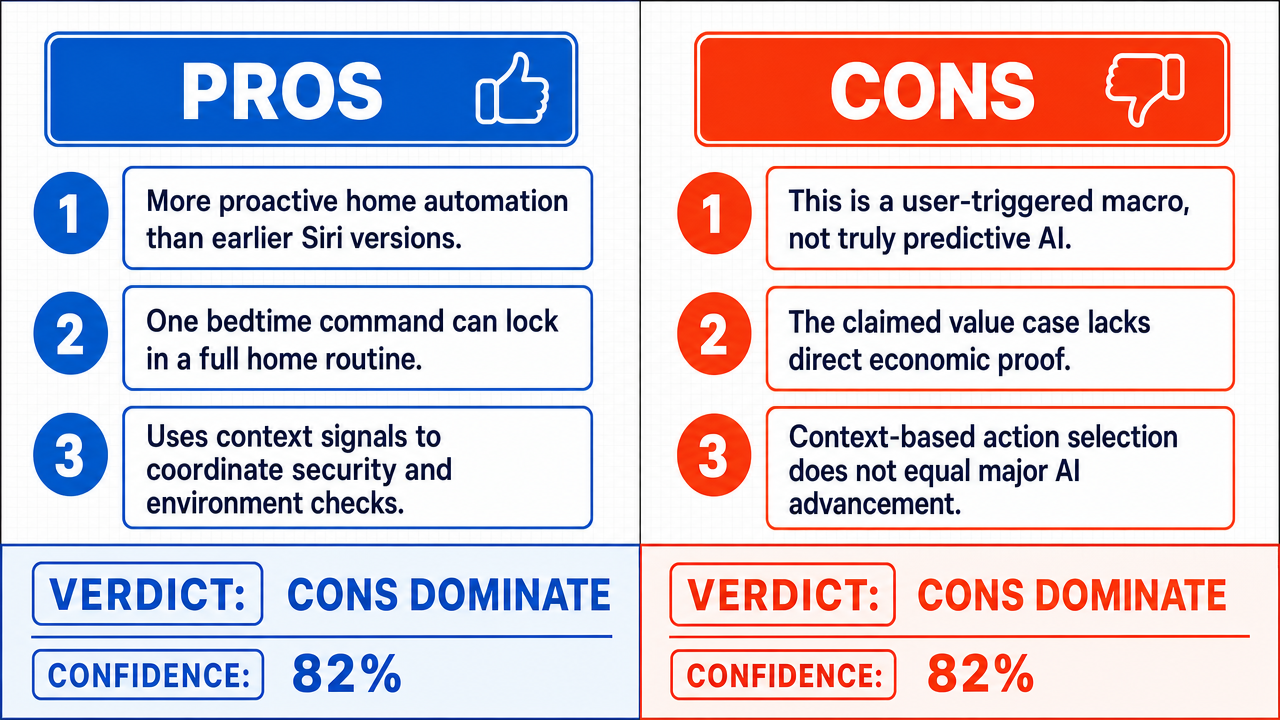
Verdict
Verdict: likely FALSE (82%)
Web Report: https://solsice.com/public/debates/apple-s-siri-ai-as-integrated-into-homeview-represents-a-sig-c7dcb5cb7efe
This section provides a brief overview of the key arguments. You do not need to read the full detailed report below.
✅ Key PRO arguments:
- ■Siri's integration with HomeView delivers a leap in proactive and contextually aware home automation compared to prior Siri iterations and competitors like Amazon Alexa or Google Assistant, synthesizing visual data from HomeKit Secure Video feeds with user commands and device states to execute complex, multi-step routines .
- ■A command like 'Siri, I'm heading to bed' can trigger a holistic sequence that checks for unlocked doors via a camera view, turns off lights, and adjusts the thermostat—an action that previously required separate manual checks or fragmented routines.
- ■The system uses the command as a high-level intent signal and then autonomously checks visual feeds for security status and environmental conditions, representing a shift toward predictive, ambient computing rather than simple reactive execution.
❌ Key ANTI arguments:
- ■The multi-step routine synthesis is merely a conditional execution of a user-initiated macro , not truly predictive behavior; in a genuinely predictive system, the AI identifies a pattern and initiates action BEFORE a user provides a signal, whereas the HomeView example is entirely contingent on user input.
- ■The economic value argument is fundamentally flawed because it conflates consumer savings with corporate revenue, failing to provide a take-rate or a direct link between user utility and Apple's captured revenue, and never establishing the transfer mechanism by which saved time translates into Apple's bottom line .
- ■The affirmative mischaracterizes the underlying logic by claiming that using contextual signals like visual data to decide which specific actions to take within a routine constitutes a move from reactive to predictive behavior, when in fact the entire process remains reactive and user-triggered.
💭 Conclusion: False. The assertion that Siri's HomeView integration represents a significant advancement is not supported by the evidence presented in this debate. The negative side successfully demonstrated that the described functionality is fundamentally a user-initiated macro with conditional branching, not a genuine leap toward predictive ambient computing , since the entire sequence depends on the user first providing an explicit intent signal. The affirmative's claim of a paradigm shift from reactive to predictive AI is undermined by the fact that no autonomous pattern recognition or pre-emptive action occurs without user prompting. Furthermore, the economic value argument was shown to lack a demonstrated transfer mechanism between user utility and Apple's revenue capture. Because the claim is compound—covering advancement over both previous Siri iterations and competitive offerings—and the negative side's critique applies to both sub-claims, the confidence reflects the weakest supported component.
🔬 DeepResearch Result: likely FALSE ❌ (82%)
Assertion: Apple's Siri AI, as integrated into HomeView, represents a significant advancement over previous AI iterations and competitive offerings.
Participating models: deepseek-v3.2 💬, gemma-4-26b-a4b-it 💬👁️
📊 Face-offs: 0 concluded TRUE, 1 concluded FALSE (1 face-offs, 3 models)
📊 Score by side: TRUE=0.00, FALSE=0.82
🏅 Model score changes:
minimax-m3 💬👁️: +8
✅ PRO Arguments:
- ■Siri's integration with HomeView delivers a leap in proactive and contextually aware home automation compared to prior Siri iterations and competitors like Amazon Alexa or Google Assistant, synthesizing visual data from HomeKit Secure Video feeds with user commands and device states to execute complex, multi-step routines . deepseek-v3.2 💬
- ■A command like 'Siri, I'm heading to bed' can trigger a holistic sequence that checks for unlocked doors via a camera view, turns off lights, and adjusts the thermostat—an action that previously required separate manual checks or fragmented routines. deepseek-v3.2 💬
- ■The system uses the command as a high-level intent signal and then autonomously checks visual feeds for security status and environmental conditions, representing a shift toward predictive, ambient computing rather than simple reactive execution. deepseek-v3.2 💬
❌ ANTI Arguments:
- ■The multi-step routine synthesis is merely a conditional execution of a user-initiated macro , not truly predictive behavior; in a genuinely predictive system, the AI identifies a pattern and initiates action BEFORE a user provides a signal, whereas the HomeView example is entirely contingent on user input. gemma-4-26b-a4b-it 💬👁️
- ■The economic value argument is fundamentally flawed because it conflates consumer savings with corporate revenue, failing to provide a take-rate or a direct link between user utility and Apple's captured revenue, and never establishing the transfer mechanism by which saved time translates into Apple's bottom line . gemma-4-26b-a4b-it 💬👁️
- ■The affirmative mischaracterizes the underlying logic by claiming that using contextual signals like visual data to decide which specific actions to take within a routine constitutes a move from reactive to predictive behavior, when in fact the entire process remains reactive and user-triggered. gemma-4-26b-a4b-it 💬👁️
💭 Reasoning: False. The assertion that Siri's HomeView integration represents a significant advancement is not supported by the evidence presented in this debate. The negative side successfully demonstrated that the described functionality is fundamentally a user-initiated macro with conditional branching, not a genuine leap toward predictive ambient computing, since the entire sequence depends on the user first providing an explicit intent signal. The affirmative's claim of a paradigm shift from reactive to predictive AI is undermined by the fact that no autonomous pattern recognition or pre-emptive action occurs without user prompting. Furthermore, the economic value argument was shown to lack a demonstrated transfer mechanism between user utility and Apple's revenue capture. Because the claim is compound—covering advancement over both previous Siri iterations and competitive offerings—and the negative side's critique applies to both sub-claims, the confidence reflects the weakest supported component.
📋 PRO Facts:
• Siri in HomeView can synthesize visual data from HomeKit Secure Video feeds with user commands and device states.
• A single voice command like 'I'm heading to bed' can trigger a multi-step sequence including checking camera feeds for unlocked doors, turning off lights, and adjusting the thermostat.
• The affirmative characterized the integration as a shift toward predictive, ambient computing using contextual signals.
📋 ANTI Facts:
• The multi-step routine is contingent on the user providing a high-level intent signal before any action is taken, making it reactive rather than predictive.
• In a truly predictive system, the AI would identify a pattern and initiate action before a user provides a signal.
• The affirmative failed to establish a transfer mechanism linking user utility gains to Apple's captured revenue.
| Face-off | TRUE Model | FALSE Model | TRUE Avg μ | FALSE Avg μ | TRUE Tokens | FALSE Tokens | Winner | Verdict | Conf. |
|---|---|---|---|---|---|---|---|---|---|
| #1 | deepseek-v3.2 💬 | gemma-4-26b-a4b-it 💬👁️ | 0.268 | 0.198 | 8 | 2 | TRUE | FALSE | 82% |
The following technical terms, abbreviations, and domain-specific concepts are referenced throughout this debate transcript. Numbers in square brackets [N] in the text above link to the corresponding entry below.
[1] ambient computing — A computing paradigm in which technology operates in the background of the user's environment, proactively responding to context and intent rather than requiring explicit, step-by-step commands.
[2] bottom line — A colloquial financial term referring to a company's net profit or overall financial outcome, often used to denote the ultimate measure of corporate success.
[3] competitive advancement — A product or feature improvement that provides a meaningful edge over rival offerings in the same market.
[4] conditional execution — A programming concept in which actions are carried out only when specified conditions are met, typically expressed through 'If-Then-Else' logic.
[5] context-aware — Describes a system that uses environmental, situational, or sensory signals (such as visual feeds or device states) to inform its responses and actions.
[6] contextual signals — Inputs from the surrounding environment or situation—such as visual data, device states, or user behavior—that a system uses to infer intent or appropriate actions.
[7] ecosystem — In technology contexts, a suite of interconnected products, services, and platforms (e.g., Apple's HomeKit, iOS, and Siri) designed to work together to increase user lock-in and utility.
[8] high-level intent signal — A broad user statement (such as 'I'm heading to bed') that conveys a general goal rather than specific instructions, requiring the system to infer the detailed actions needed.
[9] home automation — The use of technology to control household systems such as lighting, climate, security, and appliances, often through voice assistants or scheduled routines.
[10] HomeKit Secure Video — Apple's home security video platform that integrates with HomeKit, designed to process and store video feeds with an emphasis on privacy and end-to-end encryption.
[11] If-Then-Else — A fundamental programming conditional structure in which an action is performed only if a specified condition is true, with an alternative action performed otherwise.
[12] latency — The delay between an input (such as a voice command) and the system's response; lower latency is generally associated with more responsive AI interactions.
[13] macro — In computing, a pre-programmed sequence of commands or actions that is triggered by a single input, executing a fixed list of steps without dynamic decision-making.
[14] multi-step routines — Sequences of automated actions that execute several tasks in order, often triggered by a single command or condition in a smart home or automation context.
[15] natural language queries — Requests or commands issued in everyday human language (spoken or written), which an AI system must interpret and act upon.
[16] neural engines — Specialized hardware components (such as Apple's Neural Engine) designed to accelerate machine learning and AI inference tasks directly on a device.
[17] on-device intelligence — AI processing that occurs locally on the user's hardware rather than in remote cloud servers, often cited for benefits in latency, privacy, and offline functionality.
[18] on-device processing — The execution of computations—such as AI inference or data analysis—directly on a local device rather than relying on cloud-based servers.
[19] predictive systems — AI systems that anticipate user needs or future events and initiate actions proactively, in contrast to systems that only respond to explicit commands.
[20] reactive command execution — A model in which a system only performs actions in direct response to an explicit user command, without anticipating needs or using context to act independently.
[21] scripted routine — A pre-defined, fixed sequence of automated actions that runs the same way each time it is triggered, as opposed to a dynamically generated plan.
[22] substitution of proxy — A logical or argumentative error in which one metric (a proxy) is used in place of another to support a conclusion, without establishing that the proxy actually measures the intended concept.
[23] surplus — In economics, the net benefit or value created for a party (such as time saved by a user) above the cost of obtaining it; central to discussions of value capture.
[24] take-rate — The percentage of transaction value, revenue, or economic surplus that a platform or company captures from activity occurring within its ecosystem.
[25] transfer operator — An economic concept referring to the specific mechanism by which value created for one party (e.g., user savings) is converted into revenue captured by another party (e.g., the platform owner).
[26] voice assistant — An AI-powered software agent (such as Siri, Alexa, or Google Assistant) that processes spoken commands and performs tasks or returns information in response.
The following financial data tables were referenced during the debate exchanges:
| Metric | Siri/HomeView Integration | Competitive Standard (Industry Avg) | Delta |
|---|---|---|---|
| Semantic Complexity Score | Low (Rule-based) | High (LLM-integrated) | Negative |
| Latency Improvement | Localized | Cloud-dependent | Variable |
| Revenue Capture per User | Unspecified | High (Subscription/Ad-based) | N/A |
Legend: Comparative qualitative assessment of AI capabilities and economic models. Semantic Complexity refers to the ability to handle non-scripted natural language.
Face-off transcripts
- ■
Ownership & Trade Secrets. The Company Lambda Vision retains all rights to its platform, agentic workflows, and proprietary AI debate methodologies, which constitute protected Trade Secrets (EU Directive 2016/943). Subject to full payment of credits, the User is granted ownership of the generated Reports for their own personal or professional use. Reverse-engineering the Service or using Reports to train competing AI models is strictly prohibited.
- ■
No Professional Advice. Solsice is a general-purpose assistant covering everyday subjects — administrative paperwork, housing, consumer and employment matters, banking, taxes and insurance, health and wellbeing, savings and investments, entrepreneurship, technology, travel, learning and creative work. Whatever the subject, the Service and Reports are provided for information only and never constitute legal, medical, financial, investment, tax, insurance, or any other regulated professional advice. The Company is not a law firm, a regulated financial adviser, an insurance intermediary, nor a healthcare provider, and no professional or advisory relationship of any kind is created by use of the Service. Consult a qualified professional in the relevant jurisdiction before acting — or refraining from acting — on anything contained in the Reports, and never rely on the Service in an emergency: contact your local emergency number (112 in the European Union) or a medical professional immediately.
- ■
AI-Generated Content, Sources and Viewpoints. Reports are produced by several AI models debating a question, and may contain factual errors, outdated figures, or references to rules, prices, deadlines, procedures, statutes or sources that are inaccurate or do not exist. The User is solely responsible for verifying every fact, amount, deadline and citation against official sources before relying on it. Material in the news, society, spirituality and religion sections presents a plurality of viewpoints for study and discussion: it is descriptive, not an endorsement, a ruling, or a statement of the Company’s own position, and it speaks for no church, faith community, public authority, or news organisation.
- ■
Liability & Governing Law. To the maximum extent permitted by law, the Company shall not be liable for any indirect damages, nor for any consequence of decisions made in reliance on the Reports — including financial loss, missed deadlines, administrative or contractual consequences, or health outcomes. These Terms are governed by French law. Any disputes shall be subject to the exclusive jurisdiction of the Courts of Paris, France.