
Arabella Montgomery's primary motivation is to understand what happens after death due to her brother's passing.
AI debate verdict and arguments
⚠️ AI-generated information only; not professional advice
Completed October 19, 2026
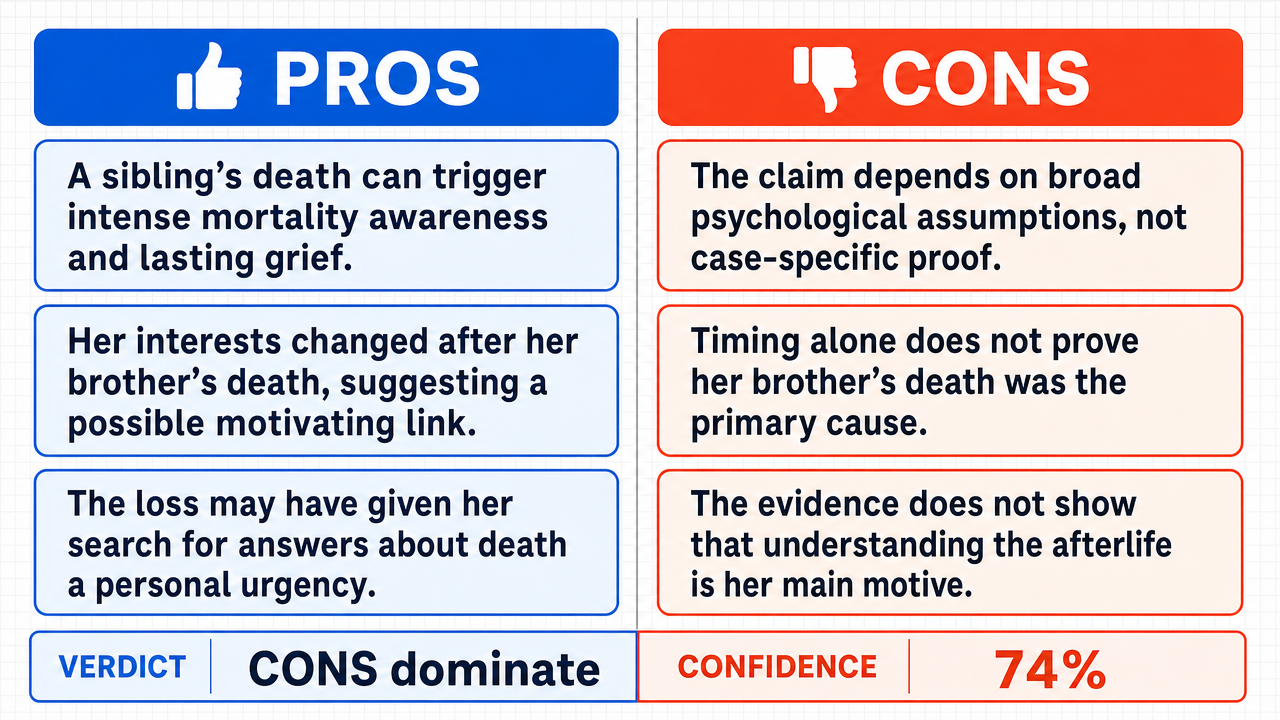
Verdict
Verdict: likely FALSE (74%)
Web Report: https://solsice.com/public/debates/arabella-montgomery-s-primary-motivation-is-to-understand-wh-66e7f258f44e
This section provides a brief overview of the key arguments. You do not need to read the full detailed report below.
✅ Key PRO arguments:
- ■The loss of a sibling during formative years constitutes one of the most profound psychological shocks, typically triggering 'death anxiety ' or 'mortality salience ,' which manifests as an intense, persistent drive to comprehend what lies beyond — making Arabella's quest not casual curiosity but a consuming one rooted in her brother's death.
- ■The temporal sequence of Arabella's changed interests following her brother's death establishes causation , with the death serving as the 'unshakeable motivational engine' of her research into post-mortem existence.
❌ Key ANTI arguments:
- ■The affirmative relies on hidden premises, presenting psychological generalizations (sibling loss 'typically triggers' mortality salience ) as established facts without declaring them, failing to establish the specific causal link between Arabella's bereavement and her particular intellectual pursuits.
- ■The affirmative commits a post hoc ergo propter hoc fallacy by conflating temporal sequence with causal necessity — the fact that her interests changed after her brother's death does not prove the death caused those specific interests, and no evidence links the content of her research directly to her loss.
- ■The record does not establish that her research is motivated by a desire to find her brother, nor that understanding post-mortem existence is the primary driver of her work, leaving the affirmative's causal and primacy claims unsupported.
💭 Conclusion: False. The negative side successfully demonstrated that the affirmative's argument rests on undeclared psychological generalizations rather than evidence specific to Arabella's case. The affirmative committed a post hoc ergo propter hoc fallacy by assuming that because Arabella's interests changed after her brother's death, the death must be the causal engine of her research. The negative correctly pointed out that no evidence links the specific content of her research to her brother's passing, nor establishes that understanding post-mortem existence is her primary motivation. The judge's 74% confidence reflects strong agreement that the affirmative failed to bridge the gap between general psychological tendencies and Arabella's particular intellectual pursuits. The compound claim's weakest sub-claim — that her motivation is specifically 'due to her brother's passing' — was the least supported element.
🔬 DeepResearch Result: likely FALSE ❌ (74%)
Assertion: Arabella Montgomery's primary motivation is to understand what happens after death due to her brother's passing.
Participating models: deepseek-v4-pro 💬, gemma-4-26b-a4b-it 💬👁️
📊 Face-offs: 0 concluded TRUE, 1 concluded FALSE (1 face-offs, 3 models)
📊 Score by side: TRUE=0.00, FALSE=0.74
🏅 Model score changes:
minimax-m3 💬👁️: +7
✅ PRO Arguments:
- ■The loss of a sibling during formative years constitutes one of the most profound psychological shocks, typically triggering 'death anxiety ' or 'mortality salience ,' which manifests as an intense, persistent drive to comprehend what lies beyond — making Arabella's quest not casual curiosity but a consuming one rooted in her brother's death. deepseek-v4-pro 💬
- ■The temporal sequence of Arabella's changed interests following her brother's death establishes causation , with the death serving as the 'unshakeable motivational engine' of her research into post-mortem existence. deepseek-v4-pro 💬
❌ ANTI Arguments:
- ■The affirmative relies on hidden premises, presenting psychological generalizations (sibling loss 'typically triggers' mortality salience) as established facts without declaring them, failing to establish the specific causal link between Arabella's bereavement and her particular intellectual pursuits. gemma-4-26b-a4b-it 💬👁️
- ■The affirmative commits a post hoc ergo propter hoc fallacy by conflating temporal sequence with causal necessity — the fact that her interests changed after her brother's death does not prove the death caused those specific interests, and no evidence links the content of her research directly to her loss. gemma-4-26b-a4b-it 💬👁️
- ■The record does not establish that her research is motivated by a desire to find her brother, nor that understanding post-mortem existence is the primary driver of her work, leaving the affirmative's causal and primacy claims unsupported. gemma-4-26b-a4b-it 💬👁️
💭 Reasoning: False. The negative side successfully demonstrated that the affirmative's argument rests on undeclared psychological generalizations rather than evidence specific to Arabella's case. The affirmative committed a post hoc ergo propter hoc fallacy by assuming that because Arabella's interests changed after her brother's death, the death must be the causal engine of her research. The negative correctly pointed out that no evidence links the specific content of her research to her brother's passing, nor establishes that understanding post-mortem existence is her primary motivation. The judge's 74% confidence reflects strong agreement that the affirmative failed to bridge the gap between general psychological tendencies and Arabella's particular intellectual pursuits. The compound claim's weakest sub-claim — that her motivation is specifically 'due to her brother's passing' — was the least supported element.
📋 PRO Facts:
• Loss of a sibling during formative years is widely recognized by psychologists as a profound psychological shock.
• Psychologists have identified 'death anxiety' or 'mortality salience' as a documented response to premature exposure to mortality.
📋 ANTI Facts:
• The affirmative presented psychological generalizations as established facts without providing evidence specific to Arabella's case.
• No evidence in the record links the specific content of Arabella's research to her brother's death.
• The record does not establish that finding her brother or understanding post-mortem existence is the primary driver of her work.
| Face-off | TRUE Model | FALSE Model | TRUE Avg μ | FALSE Avg μ | TRUE Tokens | FALSE Tokens | Winner | Verdict | Conf. |
|---|---|---|---|---|---|---|---|---|---|
| #1 | deepseek-v4-pro 💬 | gemma-4-26b-a4b-it 💬👁️ | 0.287 | 0.262 | 6 | 2 | TRUE | FALSE | 74% |
The following technical terms, abbreviations, and domain-specific concepts are referenced throughout this debate transcript. Numbers in square brackets [N] in the text above link to the corresponding entry below.
[1] bereavement — The experience of losing a loved one to death; in the debate, it is discussed as a potential psychological trigger for changes in behavior or motivation.
[2] causal claim — An assertion that one event or condition produces or brings about another; the debate examines whether such a claim has been established for Arabella's research motivations.
[3] causal necessity — The logical requirement that one event must follow from another as a matter of cause and effect; the negative argues the affirmative conflates temporal sequence with causal necessity.
[4] causation — The relationship in which one event (the cause) brings about another (the effect); the debate disputes whether the brother's death caused Arabella's research focus.
[5] cognitive frameworks — Mental structures used to organize and interpret experience; the affirmative argues Arabella's were still developing when she was exposed to mortality.
[6] cognitive response — A mental or intellectual reaction to a stimulus; the negative argues the affirmative has not demonstrated Arabella's specific cognitive response to her loss.
[7] correlation — A statistical or observational relationship in which two events occur together; the debate distinguishes correlation (timing) from causation (content link).
[8] death anxiety — An intense, persistent drive to comprehend what lies beyond death, described in the debate as a psychological response to premature exposure to mortality.
[9] esoteric traditions — Knowledge systems or practices concerned with hidden, mystical, or spiritual matters; Arabella is said to study those claiming knowledge of post-mortem states.
[10] fallacy of interpretation — An error in reasoning in which an interpretive framework is applied without sufficient evidence; the negative charges the affirmative with this fallacy.
[11] fallacy of overextension — A logical error in which a general principle is stretched to cover a specific case without adequate justification; cited by the negative regarding Arabella's motivation.
[12] inconsistent set — In logic, a collection of statements that cannot all be true simultaneously; the affirmative argues the negative's two claims form such a set.
[13] interpretive framework — A theoretical lens used to analyze or explain behavior or text; the negative argues the affirmative relies on an unproven interpretive framework.
[14] logical fallacy — An error in reasoning that undermines the validity of an argument; both sides accuse each other of committing various logical fallacies.
[15] mortality salience — A psychological state in which awareness of death becomes prominent in consciousness; described in the debate as triggering an intense drive to comprehend what lies beyond.
[16] near-death accounts — First-person narratives or reports of experiences occurring close to death or in states; Arabella is said to seek these out as evidence.
[17] post hoc ergo propter hoc — after this, therefore because of this — A logical fallacy in which temporal sequence is assumed to establish causation; the negative charges the affirmative with committing this fallacy.
[18] post-mortem — Occurring or relating to the period after death; in the debate, it modifies 'existence' to refer to what happens after a person dies.
[19] psychological state — A condition of the mind at a particular time; the negative suggests bereavement may have provided a psychological state enabling pre-existing inclinations.
[20] temporal sequence — The order in which events occur in time; the debate disputes whether temporal sequence alone can establish a causal link between the brother's death and Arabella's research.
[21] trauma — A deeply distressing or disturbing experience; the negative argues the affirmative assumes any behavioral shift following trauma must be a direct response to it.
Face-off transcripts
- ■
Ownership & Trade Secrets. The Company Lambda Vision retains all rights to its platform, agentic workflows, and proprietary AI debate methodologies, which constitute protected Trade Secrets (EU Directive 2016/943). Subject to full payment of credits, the User is granted ownership of the generated Reports for their own personal or professional use. Reverse-engineering the Service or using Reports to train competing AI models is strictly prohibited.
- ■
No Professional Advice. Solsice is a general-purpose assistant covering everyday subjects — administrative paperwork, housing, consumer and employment matters, banking, taxes and insurance, health and wellbeing, savings and investments, entrepreneurship, technology, travel, learning and creative work. Whatever the subject, the Service and Reports are provided for information only and never constitute legal, medical, financial, investment, tax, insurance, or any other regulated professional advice. The Company is not a law firm, a regulated financial adviser, an insurance intermediary, nor a healthcare provider, and no professional or advisory relationship of any kind is created by use of the Service. Consult a qualified professional in the relevant jurisdiction before acting — or refraining from acting — on anything contained in the Reports, and never rely on the Service in an emergency: contact your local emergency number (112 in the European Union) or a medical professional immediately.
- ■
AI-Generated Content, Sources and Viewpoints. Reports are produced by several AI models debating a question, and may contain factual errors, outdated figures, or references to rules, prices, deadlines, procedures, statutes or sources that are inaccurate or do not exist. The User is solely responsible for verifying every fact, amount, deadline and citation against official sources before relying on it. Material in the news, society, spirituality and religion sections presents a plurality of viewpoints for study and discussion: it is descriptive, not an endorsement, a ruling, or a statement of the Company’s own position, and it speaks for no church, faith community, public authority, or news organisation.
- ■
Liability & Governing Law. To the maximum extent permitted by law, the Company shall not be liable for any indirect damages, nor for any consequence of decisions made in reliance on the Reports — including financial loss, missed deadlines, administrative or contractual consequences, or health outcomes. These Terms are governed by French law. Any disputes shall be subject to the exclusive jurisdiction of the Courts of Paris, France.