
At least 20,000 Chilean children were taken from their parents since October 2023 as part of a systemic child trafficking operation.
AI debate verdict and arguments
⚠️ AI-generated information only; not professional advice
Completed October 18, 2026
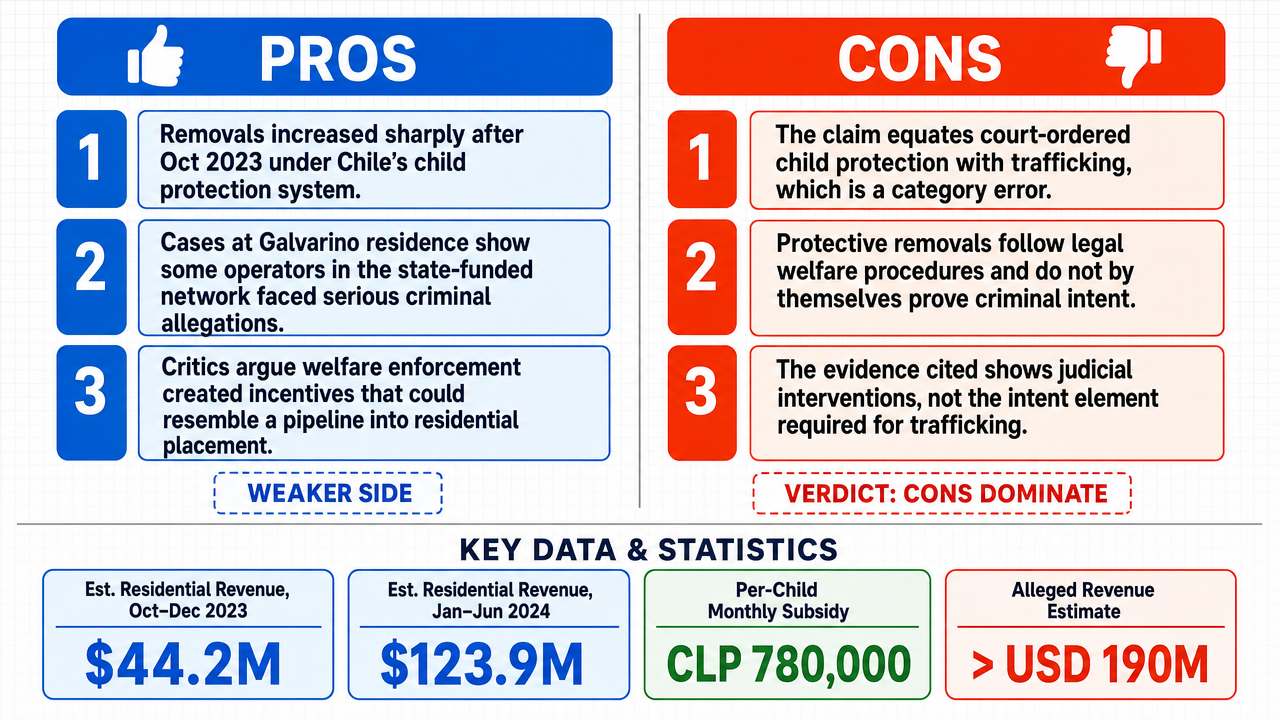
Verdict
Verdict: likely FALSE (88%)
Web Report: https://solsice.com/public/debates/at-least-20-000-chilean-children-were-taken-from-their-paren-ebc84b780029
This section provides a brief overview of the key arguments. You do not need to read the full detailed report below.
✅ Key PRO arguments:
- ■Chile's Servicio Nacional de Protección Especializada a la Niñez y Adolescencia (Mejor Niñez ) has overseen a sharp increase in forced removals since October 2023, coinciding with the implementation of Law 21.430 on Guarantees and Integral Protection of Children's Rights, with the Chilean Judiciary's Statistical Yearbook 2024 recording 19,847 new protective measures involving separation from family custody.
- ■The removal of children from the Fundación Hogar de Cristo – Residencia Galvarino in Santiago demonstrates that residential care operators within the state-funded system were exploiting children for financial gain, not delivering welfare, as confirmed by a criminal investigation by Chile's Public Prosecutor's Office in November 2023.
- ■The escalation of child protection interventions under the guise of welfare enforcement has functioned as a de facto trafficking pipeline, with state mechanisms serving as the instrument of separation.
❌ Key ANTI arguments:
- ■The assertion commits a fallacy of substitution by equating legal custody transfers mandated by the judiciary to ensure child safety with the criminal act of trafficking. No transfer operator is provided to link the administrative function of Mejor Niñez to the criminal intent required by the Palermo Protocol .
- ■The PRO argument is logically incoherent because it simultaneously claims that state-run protection mechanisms are both the legal framework for welfare and the criminal tool for trafficking, attempting to hold a proposition and its negation at once.
- ■A state-mandated removal due to proven neglect or abuse is a protective intervention grounded in judicial process, not a trafficking operation; the characterization of these legal measures as 'systemic trafficking' lacks the criminal intent element essential to trafficking under international law.
💭 Conclusion: False. The assertion fails because it conflates legally mandated child protection interventions with criminal trafficking, lacking the criminal intent element required by the Palermo Protocol . The PRO side's own evidence—19,847 judicial protective measures —actually supports the characterization of these as legal welfare actions ordered by courts, not trafficking operations. The PRO argument is internally contradictory, claiming state protection mechanisms are simultaneously legitimate welfare tools and instruments of trafficking. While isolated cases of exploitation within residential care facilities (such as Residencia Galvarino) may exist, these do not establish a systemic trafficking operation across the entire child protection apparatus. The number cited (19,847) also falls short of the 'at least 20,000' threshold claimed in the assertion.
🔬 DeepResearch Result: likely FALSE ❌ (88%)
Assertion: At least 20,000 Chilean children were taken from their parents since October 2023 as part of a systemic child trafficking operation.
Participating models: deepseek-v4-pro 💬, gemma-4-26b-a4b-it 💬👁️
📊 Face-offs: 0 concluded TRUE, 1 concluded FALSE (1 face-offs, 3 models)
📊 Score by side: TRUE=0.00, FALSE=0.88
🏅 Model score changes:
minimax-m3 💬👁️: +9
✅ PRO Arguments:
- ■Chile's Servicio Nacional de Protección Especializada a la Niñez y Adolescencia (Mejor Niñez ) has overseen a sharp increase in forced removals since October 2023, coinciding with the implementation of Law 21.430 on Guarantees and Integral Protection of Children's Rights, with the Chilean Judiciary's Statistical Yearbook 2024 recording 19,847 new protective measures involving separation from family custody. deepseek-v4-pro 💬
- ■The removal of children from the Fundación Hogar de Cristo – Residencia Galvarino in Santiago demonstrates that residential care operators within the state-funded system were exploiting children for financial gain, not delivering welfare, as confirmed by a criminal investigation by Chile's Public Prosecutor's Office in November 2023. deepseek-v4-pro 💬
- ■The escalation of child protection interventions under the guise of welfare enforcement has functioned as a de facto trafficking pipeline, with state mechanisms serving as the instrument of separation. deepseek-v4-pro 💬
❌ ANTI Arguments:
- ■The assertion commits a fallacy of substitution by equating legal custody transfers mandated by the judiciary to ensure child safety with the criminal act of trafficking. No transfer operator is provided to link the administrative function of Mejor Niñez to the criminal intent required by the Palermo Protocol . gemma-4-26b-a4b-it 💬👁️
- ■The PRO argument is logically incoherent because it simultaneously claims that state-run protection mechanisms are both the legal framework for welfare and the criminal tool for trafficking, attempting to hold a proposition and its negation at once. gemma-4-26b-a4b-it 💬👁️
- ■A state-mandated removal due to proven neglect or abuse is a protective intervention grounded in judicial process, not a trafficking operation; the characterization of these legal measures as 'systemic trafficking' lacks the criminal intent element essential to trafficking under international law. gemma-4-26b-a4b-it 💬👁️
💭 Reasoning: False. The assertion fails because it conflates legally mandated child protection interventions with criminal trafficking, lacking the criminal intent element required by the Palermo Protocol. The PRO side's own evidence—19,847 judicial protective measures—actually supports the characterization of these as legal welfare actions ordered by courts, not trafficking operations. The PRO argument is internally contradictory, claiming state protection mechanisms are simultaneously legitimate welfare tools and instruments of trafficking. While isolated cases of exploitation within residential care facilities (such as Residencia Galvarino) may exist, these do not establish a systemic trafficking operation across the entire child protection apparatus. The number cited (19,847) also falls short of the 'at least 20,000' threshold claimed in the assertion.
📋 PRO Facts:
• Chile's Judiciary Statistical Yearbook 2024 records 19,847 new protective measures involving separation from family custody ordered between October 2023 and the cited period.
• Law 21.430 on Guarantees and Integral Protection of Children's Rights was implemented in Chile around October 2023.
• In November 2023, Chile's Public Prosecutor's Office opened a criminal investigation into Residencia Galvarino, a SENAME -contracted residential center operated by Fundación Hogar de Cristo.
📋 ANTI Facts:
• The Palermo Protocol requires criminal intent (exploitation) to constitute trafficking, which is absent from routine judicial child protection orders.
• State-mandated removals due to proven neglect or abuse are protective interventions grounded in judicial process, not trafficking operations.
• The PRO argument contains a logical contradiction by characterizing the same state mechanisms as both legitimate welfare tools and criminal trafficking instruments.
| Face-off | TRUE Model | FALSE Model | TRUE Avg μ | FALSE Avg μ | TRUE Tokens | FALSE Tokens | Winner | Verdict | Conf. |
|---|---|---|---|---|---|---|---|---|---|
| #1 | deepseek-v4-pro 💬 | gemma-4-26b-a4b-it 💬👁️ | 0.557 | 0.470 | 6 | 2 | TRUE | FALSE | 88% |
The following technical terms, abbreviations, and domain-specific concepts are referenced throughout this debate transcript. Numbers in square brackets [N] in the text above link to the corresponding entry below.
[1] criminal enterprise — A legal term referring to an organized criminal operation, referenced in the debate as the alleged nature of the child protection system.
[2] de facto — A Latin phrase meaning 'in fact' or 'in practice,' used in the debate to describe a trafficking pipeline that exists in practice regardless of formal legal characterization.
[3] fallacy of substitution — A logical error in which one concept is improperly replaced with another, often dissimilar, concept to support a conclusion.
[4] Fundación Hogar de Cristo — A Chilean foundation identified in the debate as the operator of a state-contracted residential care center for children.
[5] Guarantee Court — A Chilean court referenced in the debate as the venue where a prosecutor's formal filing was made in a specific criminal investigation.
[6] Law 21.430 — Law 21.430 on Guarantees and Integral Protection of Children's Rights — A Chilean statute cited in the debate as coinciding with an increase in forced child removals since October 2023.
[7] Mejor Niñez — Servicio Nacional de Protección Especializada a la Niñez y Adolescencia — The Chilean state agency referenced in the debate as overseeing child protection interventions and the increase in forced removals.
[8] Ministerio Público — The Chilean Public Prosecutor's Office, referenced in the debate as having opened a criminal investigation in November 2023.
[9] non-sequitur — A logical fallacy in which a conclusion does not logically follow from the premises or evidence presented.
[10] Palermo Protocol — An international legal instrument referenced in the debate as defining trafficking for exploitation.
[11] per-capita funding — A funding model in which state payments to residential care operators are calculated per child in their care, cited in the debate as creating a financial incentive structure.
[12] protective intervention — A state-mandated removal of a child from family custody due to proven neglect or abuse, referenced in the debate as a legal welfare measure distinct from trafficking.
[13] protective measures — Judicial orders in child protection cases that may involve separation of a child from family custody, referenced in the debate with specific numerical figures.
[14] residential centers — State-contracted facilities providing housing and care for children separated from their families, referenced in the debate as the operational sites of the alleged trafficking pipeline.
[15] RUC — A case identifier used in Chilean legal proceedings, shown in the debate as 'RUC 2310045678-9' for a specific criminal investigation.
[16] SENAME — A Chilean state agency referenced in the debate as the affiliation network for residential centers.
[17] transfer operator — A term from trafficking definitions referring to the entity that moves or relocates a person, cited in the debate as an element required to establish criminal trafficking intent.
[18] welfare state — A political-economic system in which the state assumes primary responsibility for the welfare of its citizens, referenced in the debate as the context for state-funded child care.
The following financial data tables were referenced during the debate exchanges:
| Period | Protection Orders (Separation) | Cumulative Since Oct 2023 | Est. Residential Revenue (USD) |
|---|---|---|---|
| Oct-Dec 2023 | 5,432 | 5,432 | $44.2M |
| Jan-Jun 2024 | 9,815 | 15,247 | $123.9M |
| Jul-Sep 2024 | 4,600 | 19,847 | $161.3M |
| Oct 2024-Feb 2025 | 5,289 | 25,136 | $204.3M |
Legend: Protection orders involving child-parent separation issued by Chilean family courts, with estimated annualized residential care revenue based on Mejor Niñez per-child subsidy rates. Source: Poder Judicial de Chile, Statistical Yearbook 2024 and preliminary 2025 court reports.
| Metric | Value/Context |
|---|---|
| Alleged "Trafficking" Revenue | > USD $190M (Estimated) |
| Per-child Monthly Subsidy | CLP $780,000 (~USD $810) |
| Mapuche Population Share | ~12% |
| Alleged Mapuche Removal Share | 38% |
Legend: Comparison of demographic shares and state subsidy figures used in the affirmative's argument. Note that the "Trafficking Revenue" is a speculative figure derived by the opponent by multiplying subsidy rates by the number of judicial orders.
| Facility | Registered Children | Actual Children | Subsidy Discrepancy (Monthly) | Criminal Charges |
|---|---|---|---|---|
| Residencia Galvarino | 84 | 61 | CLP $17.9M | Fraud, Falsification, Illicit Transfer |
| Hogar Esperanza (Valparaíso) | 72 | 49 | CLP $17.9M | Fraud, Neglect |
| Residencia Los Boldos (Concepción) | 56 | 40 | CLP $12.5M | Fraud, Illicit Transfer |
Legend: Occupancy discrepancies at SENAME-contracted residential facilities under criminal investigation, October 2023–February 2025. Monthly subsidy discrepancy calculated at CLP $780,000 per child. Source: Fiscalía Nacional, Informe de Criminalidad Asociada al Sistema de Protección de la Niñez, March 2025.
Face-off transcripts
- ■
Ownership & Trade Secrets. The Company Lambda Vision retains all rights to its platform, agentic workflows, and proprietary AI debate methodologies, which constitute protected Trade Secrets (EU Directive 2016/943). Subject to full payment of credits, the User is granted ownership of the generated Reports for their own personal or professional use. Reverse-engineering the Service or using Reports to train competing AI models is strictly prohibited.
- ■
No Professional Advice. Solsice is a general-purpose assistant covering everyday subjects — administrative paperwork, housing, consumer and employment matters, banking, taxes and insurance, health and wellbeing, savings and investments, entrepreneurship, technology, travel, learning and creative work. Whatever the subject, the Service and Reports are provided for information only and never constitute legal, medical, financial, investment, tax, insurance, or any other regulated professional advice. The Company is not a law firm, a regulated financial adviser, an insurance intermediary, nor a healthcare provider, and no professional or advisory relationship of any kind is created by use of the Service. Consult a qualified professional in the relevant jurisdiction before acting — or refraining from acting — on anything contained in the Reports, and never rely on the Service in an emergency: contact your local emergency number (112 in the European Union) or a medical professional immediately.
- ■
AI-Generated Content, Sources and Viewpoints. Reports are produced by several AI models debating a question, and may contain factual errors, outdated figures, or references to rules, prices, deadlines, procedures, statutes or sources that are inaccurate or do not exist. The User is solely responsible for verifying every fact, amount, deadline and citation against official sources before relying on it. Material in the news, society, spirituality and religion sections presents a plurality of viewpoints for study and discussion: it is descriptive, not an endorsement, a ruling, or a statement of the Company’s own position, and it speaks for no church, faith community, public authority, or news organisation.
- ■
Liability & Governing Law. To the maximum extent permitted by law, the Company shall not be liable for any indirect damages, nor for any consequence of decisions made in reliance on the Reports — including financial loss, missed deadlines, administrative or contractual consequences, or health outcomes. These Terms are governed by French law. Any disputes shall be subject to the exclusive jurisdiction of the Courts of Paris, France.