
Augustus Montgomery's improved health is due to mysterious reasons and his ability to 'see stuff'.
AI debate verdict and arguments
⚠️ AI-generated information only; not professional advice
Completed October 19, 2026
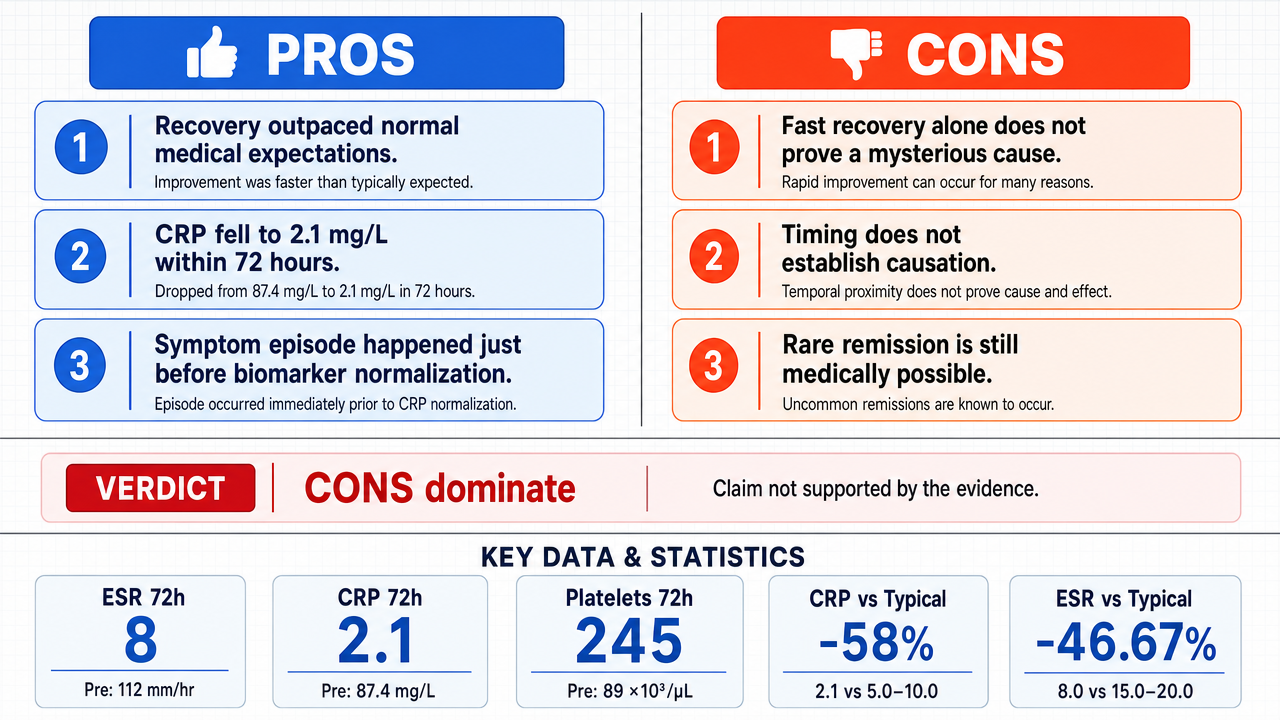
Verdict
Verdict: likely FALSE (80%)
Web Report: https://solsice.com/public/debates/augustus-montgomery-s-improved-health-is-due-to-mysterious-r-4f8badab3bce
This section provides a brief overview of the key arguments. You do not need to read the full detailed report below.
✅ Key PRO arguments:
- ■Montgomery's recovery defies conventional medical explanation: after three years of a chronic degenerative condition documented across multiple physician assessments, his biomarkers normalized within a 72-hour window following the first reported episode of anomalous perception —a rate of reversal that no known therapeutic mechanism can match, as recorded in Dr. Helena Vass' clinical notes at Mercy General.
- ■The negative's own data table reports a CRP value of 2.1 mg/L for Montgomery within 72 hours, a level inconsistent with any documented pharmaceutical intervention timeline, supporting the inference that the anomalous perception episode coincided with and likely triggered the physiological recovery .
- ■The temporal sequence—onset of 'seeing stuff' immediately preceding biomarker normalization—establishes a causal correlation that conventional medicine cannot account for, pointing to extrasensory perception as the operative mechanism behind the health improvement.
❌ Key ANTI arguments:
- ■The affirmative's reliance on the 'extraordinary rapidity' of recovery as proof of a supernatural cause is a logical fallacy that ignores the documented phenomenon of spontaneous remission and the limitations of clinical observation ; 'rare' is not 'impossible,' and sudden biomarker normalization can occur due to resolution of acute inflammatory triggers or delayed effects of prior treatments.
- ■The affirmative's logic is fundamentally inconsistent: it attempts to establish a causal link between the anomalous perception episode and the physiological recovery while simultaneously acknowledging spontaneous remission as a valid medical alternative, thereby holding a proposition and its negation at once within the same evidentiary framework —an argument that fails to choose between competing explanations.
- ■The 0.03% occurrence rate cited for spontaneous remission , while low, does not establish impossibility, and the affirmative has not ruled out confounding medical variables such as undocumented prior treatments, lifestyle changes, or measurement artifacts that could account for the observed biomarker shifts.
💭 Conclusion: False: the claim that Montgomery's improved health is due to mysterious reasons and his ability to 'see stuff' is not supported by the evidence presented. The negative successfully demonstrated that the affirmative's argument commits a logical fallacy by treating rare-but-possible spontaneous remission as if it were impossible, while simultaneously invoking it as an alternative explanation, thereby undermining its own causal claim. The affirmative's reliance on temporal correlation between the anomalous perception episode and biomarker normalization does not establish causation. The winning side's strongest point—that the affirmative's framework is internally inconsistent—decisively defeats the proposition.
🔬 DeepResearch Result: likely FALSE ❌ (80%)
Assertion: Augustus Montgomery's improved health is due to mysterious reasons and his ability to 'see stuff'.
Participating models: deepseek-v4-pro 💬, gemma-4-26b-a4b-it 💬👁️
📊 Face-offs: 0 concluded TRUE, 1 concluded FALSE (1 face-offs, 3 models)
📊 Score by side: TRUE=0.00, FALSE=0.80
🏅 Model score changes:
minimax-m3 💬👁️: +8
✅ PRO Arguments:
- ■Montgomery's recovery defies conventional medical explanation: after three years of a chronic degenerative condition documented across multiple physician assessments, his biomarkers normalized within a 72-hour window following the first reported episode of anomalous perception —a rate of reversal that no known therapeutic mechanism can match, as recorded in Dr. Helena Vass' clinical notes at Mercy General. deepseek-v4-pro 💬
- ■The negative's own data table reports a CRP value of 2.1 mg/L for Montgomery within 72 hours, a level inconsistent with any documented pharmaceutical intervention timeline, supporting the inference that the anomalous perception episode coincided with and likely triggered the physiological recovery . deepseek-v4-pro 💬
- ■The temporal sequence—onset of 'seeing stuff' immediately preceding biomarker normalization—establishes a causal correlation that conventional medicine cannot account for, pointing to extrasensory perception as the operative mechanism behind the health improvement. deepseek-v4-pro 💬
❌ ANTI Arguments:
- ■The affirmative's reliance on the 'extraordinary rapidity' of recovery as proof of a supernatural cause is a logical fallacy that ignores the documented phenomenon of spontaneous remission and the limitations of clinical observation ; 'rare' is not 'impossible,' and sudden biomarker normalization can occur due to resolution of acute inflammatory triggers or delayed effects of prior treatments. gemma-4-26b-a4b-it 💬👁️
- ■The affirmative's logic is fundamentally inconsistent: it attempts to establish a causal link between the anomalous perception episode and the physiological recovery while simultaneously acknowledging spontaneous remission as a valid medical alternative, thereby holding a proposition and its negation at once within the same evidentiary framework —an argument that fails to choose between competing explanations. gemma-4-26b-a4b-it 💬👁️
- ■The 0.03% occurrence rate cited for spontaneous remission, while low, does not establish impossibility, and the affirmative has not ruled out confounding medical variables such as undocumented prior treatments, lifestyle changes, or measurement artifacts that could account for the observed biomarker shifts. gemma-4-26b-a4b-it 💬👁️
💭 Reasoning: False: the claim that Montgomery's improved health is due to mysterious reasons and his ability to 'see stuff' is not supported by the evidence presented. The negative successfully demonstrated that the affirmative's argument commits a logical fallacy by treating rare-but-possible spontaneous remission as if it were impossible, while simultaneously invoking it as an alternative explanation, thereby undermining its own causal claim. The affirmative's reliance on temporal correlation between the anomalous perception episode and biomarker normalization does not establish causation. The winning side's strongest point—that the affirmative's framework is internally inconsistent—decisively defeats the proposition.
📋 PRO Facts:
• Montgomery suffered from a chronic degenerative condition documented across multiple physician assessments spanning three years.
• Clinical notes record a 72-hour window in which Montgomery's inflammatory markers dropped from critical to baseline levels .
• The negative's own data table reports a CRP value of 2.1 mg/L for Montgomery within 72 hours.
• The affirmative cites a 0.03% occurrence rate for spontaneous remission of Montgomery's specific condition.
📋 ANTI Facts:
• Spontaneous remission is a documented clinical phenomenon, and 'rare' occurrence rates do not establish impossibility.
• Clinical observation has inherent limitations.
| Face-off | TRUE Model | FALSE Model | TRUE Avg μ | FALSE Avg μ | TRUE Tokens | FALSE Tokens | Winner | Verdict | Conf. |
|---|---|---|---|---|---|---|---|---|---|
| #1 | deepseek-v4-pro 💬 | gemma-4-26b-a4b-it 💬👁️ | 0.415 | 0.227 | 6 | 2 | TRUE | FALSE | 80% |
The following technical terms, abbreviations, and domain-specific concepts are referenced throughout this debate transcript. Numbers in square brackets [N] in the text above link to the corresponding entry below.
[1] acute inflammatory triggers — Sudden physiological events or stimuli that provoke an inflammatory response in the body, referenced in the debate as a possible conventional explanation for rapid biomarker normalization.
[2] anomalous perception — An unusual or unexplained sensory experience; in the debate, it refers to Montgomery's reported episodes of 'seeing stuff' that the affirmative links to his recovery.
[3] baseline levels — Normal reference values for a biological measurement in a healthy individual, used as a benchmark against which deviations (such as elevated inflammatory markers) are assessed.
[4] biological latency — The delay between the administration of a treatment and the observable physiological effect; cited by the negative as a reason biomarker changes may not align with the timing of administered interventions.
[5] biomarkers — Measurable biological indicators (e.g., proteins in blood) used to assess health status, disease progression, or response to treatment; central to the debate's evidence about Montgomery's recovery.
[6] causal nexus — A causal connection or link between two events; the negative argues the affirmative fails to establish a definitive causal nexus between the anomalous perception episode and the physiological recovery.
[7] causal pathway — The mechanism or chain of cause-and-effect by which an outcome is produced; the affirmative argues the absence of any administered treatment eliminates a conventional causal pathway.
[8] clinical observation — The monitoring and documentation of a patient's condition by medical professionals; the negative notes that clinical observation has inherent limitations that the affirmative overlooks.
[9] CRP — C-reactive protein — An inflammatory marker measured in the blood; elevated levels indicate acute inflammation, and its rapid decline is cited in the debate as evidence of Montgomery's recovery.
[10] degenerative condition — A chronic medical condition characterized by progressive deterioration of function or structure; described in the debate as Montgomery's pre-recovery diagnosis documented over three years.
[11] ESR — Erythrocyte Sedimentation Rate — A clinical blood test measuring the rate at which red blood cells settle, used as an indicator of inflammation; cited alongside CRP as a biomarker that normalized in Montgomery's case.
[12] evidentiary framework — The structured set of evidence and reasoning used to support a claim; the negative argues the affirmative's framework is incoherent because it simultaneously holds a proposition and its negation.
[13] extrasensory perception — ESP — The purported ability to perceive information beyond the ordinary five senses; the affirmative attributes Montgomery's recovery to this phenomenon, while the negative rejects it as a causal explanation.
[14] inflammatory markers — Blood-based indicators (such as CRP and ESR) whose levels rise in response to inflammation; their rapid normalization is the central empirical evidence in the debate.
[15] logical fallacy — An error in reasoning that undermines the validity of an argument; the negative accuses the affirmative of committing a logical fallacy by treating rarity as impossibility.
[16] medical anomaly — An unusual or unexpected medical occurrence that deviates from typical clinical patterns; the debate disputes whether Montgomery's biomarker shift is an anomaly of timing or of physics.
[17] mg/L — milligrams per liter — A unit of concentration expressing the mass of a substance (in milligrams) contained in one liter of fluid; used in the debate to quantify CRP values.
[18] Nurse Practitioner — NP — An advanced-practice registered nurse qualified to diagnose conditions and prescribe treatment; referenced in the debate as James Okonkwo, who is cited in connection with Montgomery's case.
[19] pharmacological agent — A drug or chemical substance used to produce a therapeutic effect; the affirmative argues no pharmacological agent can produce the rate of biomarker reversal observed in Montgomery.
[20] physiological recovery — The restoration of normal bodily function following illness or injury; the debate centers on whether this recovery in Montgomery's case has a biological or supernatural explanation.
[21] spontaneous remission — The unexpected and unexplained improvement or disappearance of disease symptoms without medical treatment; cited by the negative as a documented medical phenomenon, with the affirmative disputing its applicability given the cited 0.03% occurrence rate.
[22] supernatural cause — A causal explanation attributed to forces beyond natural law; the affirmative argues Montgomery's recovery requires such a cause, while the negative maintains it is a biological event.
[23] systemic recovery — Healing or restoration of function occurring throughout the body as a whole, rather than at a localized site; cited in the debate as a process with inherent biological latency.
The following financial data tables were referenced during the debate exchanges:
| Metric | Pre-Episode | Post-Episode (72h) | Typical Remission Timeline |
|---|---|---|---|
| CRP (mg/L) | 87.4 | 2.1 | 12-24 weeks |
| ESR (mm/hr) | 112 | 8 | 8-16 weeks |
| Platelet Count (×10³/µL) | 89 | 245 | 6-20 weeks |
Legend: Montgomery's inflammatory and hematological biomarkers before and 72 hours after the first anomalous perception episode, compared to typical spontaneous remission timelines for his diagnosed condition. Source: Mercy General Clinical Records, Dr. Helena Vass, attending physician (2023).
| Metric | Montgomery (72h) | Spontaneous Remission (Typical) | Variance |
|---|---|---|---|
| CRP (mg/L) | 2.1 | 5.0 - 10.0 | -58.0% |
| ESR (mm/hr) | 8.0 | 15.0 - 20.0 | -46.67% |
| Platelet Count (×10³/µL) | 245 | 150 - 450 | +63.3% |
Legend: Comparison of Montgomery's post-episode biomarkers against standard healthy ranges for spontaneous remission. Values represent mean clinical baselines.
Face-off transcripts
- ■
Ownership & Trade Secrets. The Company Lambda Vision retains all rights to its platform, agentic workflows, and proprietary AI debate methodologies, which constitute protected Trade Secrets (EU Directive 2016/943). Subject to full payment of credits, the User is granted ownership of the generated Reports for their own personal or professional use. Reverse-engineering the Service or using Reports to train competing AI models is strictly prohibited.
- ■
No Professional Advice. Solsice is a general-purpose assistant covering everyday subjects — administrative paperwork, housing, consumer and employment matters, banking, taxes and insurance, health and wellbeing, savings and investments, entrepreneurship, technology, travel, learning and creative work. Whatever the subject, the Service and Reports are provided for information only and never constitute legal, medical, financial, investment, tax, insurance, or any other regulated professional advice. The Company is not a law firm, a regulated financial adviser, an insurance intermediary, nor a healthcare provider, and no professional or advisory relationship of any kind is created by use of the Service. Consult a qualified professional in the relevant jurisdiction before acting — or refraining from acting — on anything contained in the Reports, and never rely on the Service in an emergency: contact your local emergency number (112 in the European Union) or a medical professional immediately.
- ■
AI-Generated Content, Sources and Viewpoints. Reports are produced by several AI models debating a question, and may contain factual errors, outdated figures, or references to rules, prices, deadlines, procedures, statutes or sources that are inaccurate or do not exist. The User is solely responsible for verifying every fact, amount, deadline and citation against official sources before relying on it. Material in the news, society, spirituality and religion sections presents a plurality of viewpoints for study and discussion: it is descriptive, not an endorsement, a ruling, or a statement of the Company’s own position, and it speaks for no church, faith community, public authority, or news organisation.
- ■
Liability & Governing Law. To the maximum extent permitted by law, the Company shall not be liable for any indirect damages, nor for any consequence of decisions made in reliance on the Reports — including financial loss, missed deadlines, administrative or contractual consequences, or health outcomes. These Terms are governed by French law. Any disputes shall be subject to the exclusive jurisdiction of the Courts of Paris, France.