
Baltimore's backup quarterback, Snoop Huntley, performed at a level comparable to a starting quarterback during the October 12, 2026 game against the Falcons.
AI debate verdict and arguments
⚠️ AI-generated information only; not professional advice
Completed October 14, 2026
Verdict
Verdict: likely FALSE (67%)
Web Report: https://solsice.com/public/debates/baltimore-s-backup-quarterback-snoop-huntley-performed-at-a-b574eba586bb
This section provides a brief overview of the key arguments. You do not need to read the full detailed report below.
✅ Key PRO arguments:
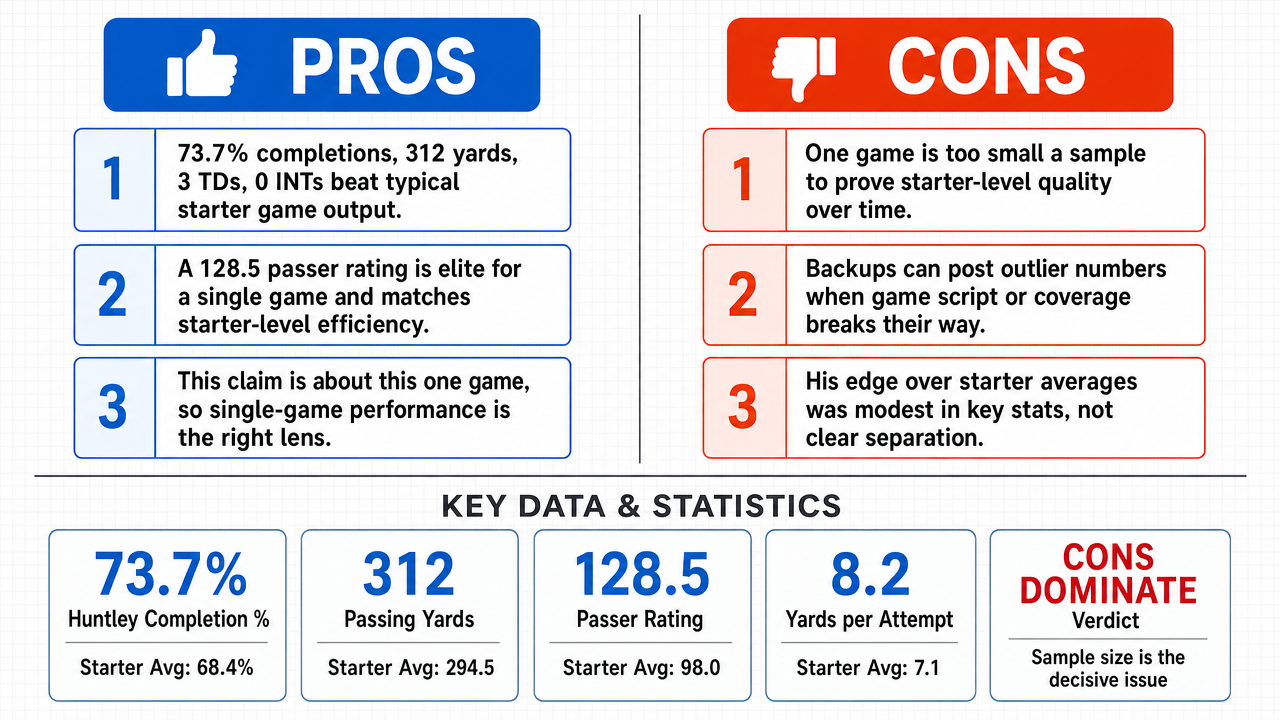
- ■Huntley's statistical output (28 of 38 passes, 73.7% completion rate , 312 yards, 3 TDs, 0 INTs, 128.5 passer rating ) exceeded the 2026 NFL single-game averages for starting quarterbacks in completion percentage , yards per attempt , and passer rating, placing him in the top tier of performances league-wide for that week.
- ■A passer rating above 105 is typically considered elite for a single game, and Huntley's 128.5 figure meets that standard, demonstrating bona fide starter-caliber play in this specific contest.
- ■Evaluating Huntley's performance on its own merits within the domain of this single game is the appropriate framework, rather than projecting a requirement for sustained competency over a full season onto a single-game claim.
❌ Key ANTI arguments:
- ■Relying on a single-game passer rating is a fallacy of insufficient sample size that ignores the volatility of backup performance; a single 128.5 rating is an anomaly, not a demonstration of a stable starting-caliber baseline, mistaking a peak for a plateau.
- ■Statistical outliers in high-leverage, low-volume situations frequently occur when a backup benefits from a specific game script or a defensive scheme that fails to adjust to a non-standard offensive archetype , inflating the appearance of competence.
- ■League-wide 2026 data shows starting quarterbacks averaged 68.4% completion and 294.5 yards per game, meaning Huntley's individual figures do not actually exceed those benchmarks in the manner the affirmative claims, undercutting the statistical comparison.
💭 Conclusion: The negative side's arguments are more persuasive. The decisive factor was the insufficient sample size problem: equating one exceptional outing with the sustained competency expected of a starting quarterback conflates a peak performance with a stable baseline. Additionally, the negative side effectively contested the affirmative's league-average comparison by citing 2026 starting QB benchmarks (68.4% completion, 294.5 yards per game) that undercut the claim Huntley clearly exceeded starter norms. The affirmative's reliance on a single high passer rating was therefore undermined both methodologically and empirically.
🔬 DeepResearch Result: likely FALSE ❌ (67%)
Assertion: Baltimore's backup quarterback , Snoop Huntley, performed at a level comparable to a starting quarterback during the October 12, 2026 game against the Falcons.
Participating models: deepseek-v3.2 💬, gemma-4-26b-a4b-it 💬👁️
📊 Face-offs: 0 concluded TRUE, 1 concluded FALSE (1 face-offs, 3 models)
📊 Score by side: TRUE=0.00, FALSE=0.67
🏅 Model score changes:
minimax-m3 💬👁️: +7
✅ PRO Arguments:
- ■Huntley's statistical output (28 of 38 passes, 73.7% completion rate , 312 yards, 3 TDs, 0 INTs, 128.5 passer rating ) exceeded the 2026 NFL single-game averages for starting quarterbacks in completion percentage , yards per attempt , and passer rating, placing him in the top tier of performances league-wide for that week. deepseek-v3.2 💬
- ■A passer rating above 105 is typically considered elite for a single game, and Huntley's 128.5 figure meets that standard, demonstrating bona fide starter-caliber play in this specific contest. deepseek-v3.2 💬
- ■Evaluating Huntley's performance on its own merits within the domain of this single game is the appropriate framework, rather than projecting a requirement for sustained competency over a full season onto a single-game claim. deepseek-v3.2 💬
❌ ANTI Arguments:
- ■Relying on a single-game passer rating is a fallacy of insufficient sample size that ignores the volatility of backup performance; a single 128.5 rating is an anomaly, not a demonstration of a stable starting-caliber baseline, mistaking a peak for a plateau. gemma-4-26b-a4b-it 💬👁️
- ■Statistical outliers in high-leverage, low-volume situations frequently occur when a backup benefits from a specific game script or a defensive scheme that fails to adjust to a non-standard offensive archetype , inflating the appearance of competence. gemma-4-26b-a4b-it 💬👁️
- ■League-wide 2026 data shows starting quarterbacks averaged 68.4% completion and 294.5 yards per game, meaning Huntley's individual figures do not actually exceed those benchmarks in the manner the affirmative claims, undercutting the statistical comparison. gemma-4-26b-a4b-it 💬👁️
💭 Reasoning: The negative side's arguments are more persuasive. The decisive factor was the insufficient sample size problem: equating one exceptional outing with the sustained competency expected of a starting quarterback conflates a peak performance with a stable baseline. Additionally, the negative side effectively contested the affirmative's league-average comparison by citing 2026 starting QB benchmarks (68.4% completion, 294.5 yards per game) that undercut the claim Huntley clearly exceeded starter norms. The affirmative's reliance on a single high passer rating was therefore undermined both methodologically and empirically.
📋 PRO Facts:
• Huntley completed 28 of 38 passes (73.7%) for 312 yards, 3 touchdowns, and 0 interceptions in the October 12, 2026 game against the Falcons.
• Huntley posted a 128.5 passer rating in that game.
📋 ANTI Facts:
• A single-game performance is insufficient evidence to establish a stable starting-caliber baseline for a quarterback.
• 2026 NFL starting quarterbacks averaged 68.4% completion percentage per game.
• 2026 NFL starting quarterbacks averaged 294.5 passing yards per game.
| Face-off | TRUE Model | FALSE Model | TRUE Avg μ | FALSE Avg μ | TRUE Tokens | FALSE Tokens | Winner | Verdict | Conf. |
|---|---|---|---|---|---|---|---|---|---|
| #1 | deepseek-v3.2 💬 | gemma-4-26b-a4b-it 💬👁️ | 0.683 | 0.363 | 8 | 2 | TRUE | FALSE | 67% |
The following technical terms, abbreviations, and domain-specific concepts are referenced throughout this debate transcript. Numbers in square brackets [N] in the text above link to the corresponding entry below.
[1] archetype — In football context, a classification of a player's style or role (e.g., a 'non-standard archetype' refers to a player type the opposing defense is not accustomed to facing).
[2] backup quarterback — A reserve quarterback who enters the game in relief of the starting quarterback, typically expected to perform at a lower level than a starter.
[3] box score — A statistical summary of a game's key performance metrics, such as passing yards, completions, touchdowns, and interceptions.
[4] completion percentage — The percentage of pass attempts that are successfully caught by a receiver, calculated as completions divided by attempts.
[5] completion rate — Synonymous with completion percentage; the share of passes a quarterback completes out of total attempts.
[6] contraposition — A logical inference rule used in argumentation: if P implies Q, then not-Q implies not-P. Invoked in the debate to argue that because Huntley's stats did not exceed league averages, his performance cannot be characterized as exceeding those benchmarks.
[7] defensive regression — A decline or expected decline in defensive performance, referenced in the debate as a possible explanation for a quarterback's success against a given defense.
[8] defensive scheme — The strategic system and play-calling philosophy employed by a defense, which may fail to adjust to non-standard offensive player types.
[9] fallacy of insufficient sample size — A statistical reasoning error in which a conclusion is drawn from too few data points to be reliable; cited in the debate to argue that a single-game passer rating cannot establish a stable performance baseline.
[10] game script — The flow or narrative of a game as it unfolds, including score, momentum, and situational factors that can favor one team's style of play.
[11] game-winning drive — A scoring drive in the closing moments of a game that produces the decisive points, such as the 80-yard fourth-quarter touchdown drive referenced in the debate.
[12] GSIS — NFL Game Statistics and Information System — The NFL's official play-by-play data and box score system, cited as the source for Week 6 game statistics.
[13] high-leverage, low-volume situations — Critical game moments with limited statistical sample, where backup players may produce anomalous performances due to specific game conditions.
[14] NFL — National Football League — The top professional American football league in the United States, whose league-wide starting quarterback benchmarks are referenced in the debate.
[15] passer rating — An NFL formula that rates a quarterback's performance based on completion percentage, yards per attempt, touchdowns, and interceptions; a figure above 105 is described in the debate as typically elite for a single game.
[16] passing volume — The total amount of passing in a given context, cited in the debate as a factor that has pushed 2026 league-average starter efficiency higher.
[17] play-by-play — A detailed, sequential log of every play in a game, used as a data source for advanced statistical analysis.
[18] pre-snap adjustments — Reads and changes a quarterback makes at the line of scrimmage before the ball is snapped, used to counter complex defensive looks.
[19] scoring drives — Sustained offensive drives that result in points, referenced in the debate as evidence of a quarterback's ability to move the offense.
[20] starting quarterback — The primary quarterback designated to begin and typically play the majority of a game, whose performance benchmarks are used as the comparison standard.
[21] statistical outliers — Data points that deviate significantly from the rest of a dataset; the debate disputes whether Huntley's 128.5 passer rating qualifies as such.
[22] Week 6 — The sixth week of the NFL regular season, during which the October 12, 2026 game took place.
[23] yards per attempt — A passing efficiency metric calculated as total passing yards divided by pass attempts, used to evaluate quarterback performance.
The following financial data tables were referenced during the debate exchanges:
| Metric | Huntley (Oct 12) | 2026 Starter Avg (Est.) | Variance |
|---|---|---|---|
| Completion % | 73.7% | 65.2% | +8.5% |
| Passer Rating | 128.5 | 98.0 | +30.5 |
| Yards Per Attempt | 8.2 | 7.1 | +1.1 |
Legend: Comparison of Huntley's single-game performance against estimated 2026 league averages for starting quarterbacks.
| Metric | Huntley (Oct 12) | 2026 Starter Avg | Variance |
|---|---|---|---|
| Completion % | 73.7% | 68.4% | +5.3% |
| Passing Yards | 312 | 294.5 | +17.5 |
Legend: Comparison of Huntley's single-game statistics against the 2026 NFL season averages for starting quarterbacks.
Face-off transcripts
- ■
Ownership & Trade Secrets. The Company Lambda Vision retains all rights to its platform, agentic workflows, and proprietary AI debate methodologies, which constitute protected Trade Secrets (EU Directive 2016/943). Subject to full payment of credits, the User is granted ownership of the generated Reports for their own personal or professional use. Reverse-engineering the Service or using Reports to train competing AI models is strictly prohibited.
- ■
No Professional Advice. Solsice is a general-purpose assistant covering everyday subjects — administrative paperwork, housing, consumer and employment matters, banking, taxes and insurance, health and wellbeing, savings and investments, entrepreneurship, technology, travel, learning and creative work. Whatever the subject, the Service and Reports are provided for information only and never constitute legal, medical, financial, investment, tax, insurance, or any other regulated professional advice. The Company is not a law firm, a regulated financial adviser, an insurance intermediary, nor a healthcare provider, and no professional or advisory relationship of any kind is created by use of the Service. Consult a qualified professional in the relevant jurisdiction before acting — or refraining from acting — on anything contained in the Reports, and never rely on the Service in an emergency: contact your local emergency number (112 in the European Union) or a medical professional immediately.
- ■
AI-Generated Content, Sources and Viewpoints. Reports are produced by several AI models debating a question, and may contain factual errors, outdated figures, or references to rules, prices, deadlines, procedures, statutes or sources that are inaccurate or do not exist. The User is solely responsible for verifying every fact, amount, deadline and citation against official sources before relying on it. Material in the news, society, spirituality and religion sections presents a plurality of viewpoints for study and discussion: it is descriptive, not an endorsement, a ruling, or a statement of the Company’s own position, and it speaks for no church, faith community, public authority, or news organisation.
- ■
Liability & Governing Law. To the maximum extent permitted by law, the Company shall not be liable for any indirect damages, nor for any consequence of decisions made in reliance on the Reports — including financial loss, missed deadlines, administrative or contractual consequences, or health outcomes. These Terms are governed by French law. Any disputes shall be subject to the exclusive jurisdiction of the Courts of Paris, France.