
Billie Jean King's public acknowledgment of her affair in 1981 directly led to the loss of all her sponsorships.
AI debate verdict and arguments
⚠️ AI-generated information only; not professional advice
Completed October 18, 2026
Verdict
Verdict: likely FALSE (71%)
Web Report: https://solsice.com/public/debates/billie-jean-king-s-public-acknowledgment-of-her-affair-in-19-928abd3de5c9
This section provides a brief overview of the key arguments. You do not need to read the full detailed report below.
✅ Key PRO arguments:
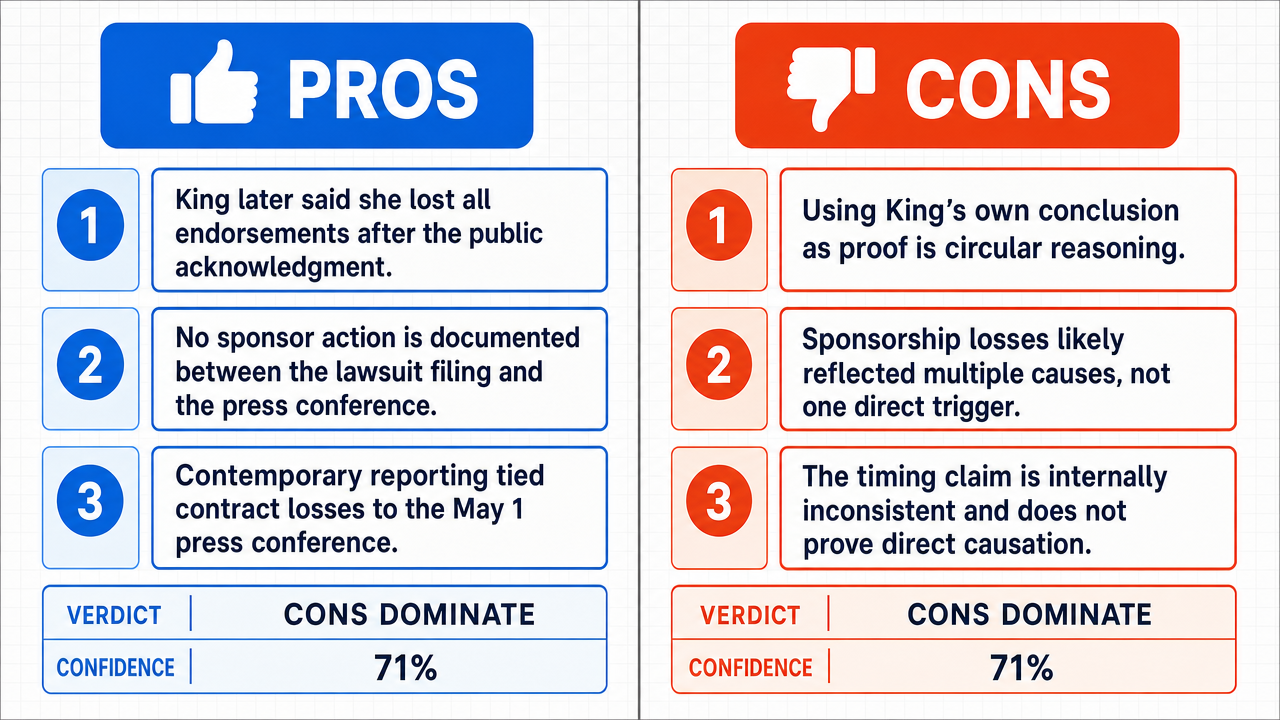
- ■King's own retrospective statement, 'I lost all my endorsements. I lost everything,' establishes that her public acknowledgment was the proximate cause of the universal loss of sponsorships.
- ■No sponsor terminated its deal, issued a statement, or activated any morality clause between the April 30 palimony filing and King's May 1 press conference , and the first wave of cancellations came only after she confirmed the affair publicly.
- ■The direct causal link between King's May 1, 1981 press conference and the termination of her endorsement contracts is unequivocal, as contemporary reporting corroborates the immediate aftermath of cancellations.
❌ Key ANTI arguments:
- ■The affirmative commits a circular reasoning fallacy by using King's own conclusion ('I lost all my endorsements') as evidence that her acknowledgment caused the loss, rather than providing independent corroboration.
- ■The loss of sponsorships was a complex economic event shaped by multiple factors, not a single direct result of the public acknowledgment, and the affirmative's attempt to prove 'total' loss by citing specific contract terminations is insufficient.
- ■The timing argument is logically inconsistent: the affirmative simultaneously claims the lawsuit was insufficient to trigger cancellations while using the absence of pre-May 1 cancellations as proof, failing to distinguish between a sponsor 's internal decision to cancel and the public execution of that cancellation.
💭 Conclusion: False. The assertion that King's public acknowledgment directly led to the loss of all her sponsorships is not adequately supported because the affirmative's central evidence—King's own retrospective statement—constitutes circular reasoning rather than independent proof. The negative correctly identified that the timing argument fails to distinguish between a sponsor 's internal decision to cancel and the public execution of that cancellation. The evidence table identifies pre-existing legal litigation as the primary cause of the sponsorship terminations, not the public acknowledgment. The loss of sponsorships was a complex economic event shaped by multiple converging factors rather than a single direct consequence of the acknowledgment. Furthermore, the affirmative's claim of 'total' loss relies on selective citation of specific terminations without demonstrating that every endorsement was lost solely because of the public acknowledgment. The compound nature of the claim—requiring both 'direct' causation and 'all' sponsorships lost—weakens it further, as the evidence supports only a qualified correlation rather than an unequivocal causal chain.
🔬 DeepResearch Result: likely FALSE ❌ (71%)
Assertion: Billie Jean King's public acknowledgment of her affair in 1981 directly led to the loss of all her sponsorships.
Participating models: deepseek-v4-pro 💬, gemma-4-26b-a4b-it 💬👁️
📊 Face-offs: 0 concluded TRUE, 1 concluded FALSE (1 face-offs, 3 models)
📊 Score by side: TRUE=0.00, FALSE=0.71
🏅 Model score changes:
minimax-m3 💬👁️: +7
✅ PRO Arguments:
- ■King's own retrospective statement, 'I lost all my endorsements. I lost everything,' establishes that her public acknowledgment was the proximate cause of the universal loss of sponsorships. deepseek-v4-pro 💬
- ■No sponsor terminated its deal, issued a statement, or activated any morality clause between the April 30 palimony filing and King's May 1 press conference , and the first wave of cancellations came only after she confirmed the affair publicly. deepseek-v4-pro 💬
- ■The direct causal link between King's May 1, 1981 press conference and the termination of her endorsement contracts is unequivocal, as contemporary reporting corroborates the immediate aftermath of cancellations. deepseek-v4-pro 💬
❌ ANTI Arguments:
- ■The affirmative commits a circular reasoning fallacy by using King's own conclusion ('I lost all my endorsements') as evidence that her acknowledgment caused the loss, rather than providing independent corroboration. gemma-4-26b-a4b-it 💬👁️
- ■The loss of sponsorships was a complex economic event shaped by multiple factors, not a single direct result of the public acknowledgment, and the affirmative's attempt to prove 'total' loss by citing specific contract terminations is insufficient. gemma-4-26b-a4b-it 💬👁️
- ■The timing argument is logically inconsistent: the affirmative simultaneously claims the lawsuit was insufficient to trigger cancellations while using the absence of pre-May 1 cancellations as proof, failing to distinguish between a sponsor's internal decision to cancel and the public execution of that cancellation. gemma-4-26b-a4b-it 💬👁️
- ■A sponsor may have decided to invoke a morality clause immediately after the April 30 lawsuit filing but executed the cancellation only after King's May 1 confirmation, meaning the lawsuit—not the acknowledgment—was the actual trigger. gemma-4-26b-a4b-it 💬👁️
💭 Reasoning: False. The assertion that King's public acknowledgment directly led to the loss of all her sponsorships is not adequately supported because the affirmative's central evidence—King's own retrospective statement—constitutes circular reasoning rather than independent proof. The negative correctly identified that the timing argument fails to distinguish between a sponsor's internal decision to cancel and the public execution of that cancellation. The evidence table identifies pre-existing legal litigation as the primary cause of the sponsorship terminations, not the public acknowledgment. The loss of sponsorships was a complex economic event shaped by multiple converging factors rather than a single direct consequence of the acknowledgment. Furthermore, the affirmative's claim of 'total' loss relies on selective citation of specific terminations without demonstrating that every endorsement was lost solely because of the public acknowledgment. The compound nature of the claim—requiring both 'direct' causation and 'all' sponsorships lost—weakens it further, as the evidence supports only a qualified correlation rather than an unequivocal causal chain.
📋 PRO Facts:
• King later stated, 'I lost all my endorsements. I lost everything.'
📋 ANTI Facts:
• The affirmative's use of King's own statement to prove causation is circular reasoning.
• The evidence indicates that pre-existing legal litigation, rather than the public acknowledgment, was the primary cause of the sponsorship losses.
• The loss of sponsorships was a complex economic event influenced by multiple factors beyond the public acknowledgment.
• The affirmative did not provide independent corroboration that every single endorsement was lost solely due to the public acknowledgment.
| Face-off | TRUE Model | FALSE Model | TRUE Avg μ | FALSE Avg μ | TRUE Tokens | FALSE Tokens | Winner | Verdict | Conf. |
|---|---|---|---|---|---|---|---|---|---|
| #1 | deepseek-v4-pro 💬 | gemma-4-26b-a4b-it 💬👁️ | 0.431 | 0.260 | 6 | 2 | TRUE | FALSE | 71% |
The following technical terms, abbreviations, and domain-specific concepts are referenced throughout this debate transcript. Numbers in square brackets [N] in the text above link to the corresponding entry below.
[1] administrative act — A formal procedural action, such as issuing a notice or executing a contract change, treated in the debate as distinct from the underlying decision-making process.
[2] causal link — A relationship in which one event or action is held to directly produce or trigger another; central to the affirmative's argument that the acknowledgment caused the sponsorship losses.
[3] circular demonstration — circular reasoning — A logical fallacy in which the conclusion is used as a premise to support itself, rather than being established by independent evidence; cited by the negative as the flaw in the affirmative's argument.
[4] conditional claim — A logical assertion whose truth depends on the satisfaction of a specified condition or premise; the negative contests the affirmative's conditional claim that the lawsuit alone triggered morality clauses.
[5] contradiction in terms — A statement containing internally inconsistent or opposing elements; the negative uses this phrase to describe the affirmative's simultaneous assertions about the lawsuit's sufficiency.
[6] decision-making process — The internal deliberation by which an organization or individual arrives at a choice, which the negative argues can occur separately from the public execution of that choice.
[7] endorsement contracts — Business agreements in which an athlete or public figure is paid to promote a brand or product; the subject of the alleged terminations in the debate.
[8] false dichotomy — A logical fallacy that presents only two options when more exist, forcing a choice between them; the negative accuses the affirmative of creating one between the lawsuit filing and the acknowledgment.
[9] long-term equity — Ownership stakes or financial interests held over an extended period, cited by the negative as a distinct revenue stream beyond endorsement contracts.
[10] lucrative endorsement contracts — High-value business agreements in which a public figure is compensated for promoting a brand; referenced in contemporary reporting cited by the affirmative.
[11] morality clauses — Contractual provisions that allow a sponsor or contracting party to terminate an agreement based on the other party's conduct deemed immoral or reputation-damaging; central to both sides' arguments.
[12] palimony suit — A lawsuit filed by a former partner seeking financial support or property division after the end of a non-marital romantic relationship; filed by Marilyn Barnett on April 30, 1981.
[13] press conference — A media event at which a public figure makes statements to journalists; King held one on May 1, 1981 to confirm the affair.
[14] principal actor — The central or primary individual whose actions are the focus of an analysis; the affirmative cites King's own retrospective statement as that of the principal actor.
[15] private appearances — Paid engagements where a public figure or athlete attends events outside of public competitions or broadcasts; cited by the negative as a distinct revenue stream.
[16] proximate cause — In legal and causal reasoning, the primary or direct cause that sets in motion a chain of events leading to a result, without which the result would not have occurred; the affirmative argues the acknowledgment was the proximate cause.
[17] revenue streams — Distinct sources of income or financial returns generated by a business or individual; the negative argues these extend beyond endorsement contracts.
[18] sponsor — A company or entity that provides financial support to an individual or organization, typically in exchange for promotional association; alleged to have canceled contracts with King.
[19] tournament appearance fees — Payments made to professional athletes or performers for participating in specific events or competitions; cited by the negative as a distinct revenue stream.
The following financial data tables were referenced during the debate exchanges:
| Sponsor | Status after May 1981 |
|---|---|
| Wilson Sporting Goods | Contract terminated |
| Adidas | Contract terminated |
| Virginia Slims | Contract terminated |
| Murjani jeans | Contract terminated |
| Automobile manufacturer (regional) | Contract terminated |
Legend: Billie Jean King’s major endorsement contracts and their status following her May 1, 1981 press conference. All known sponsorships were canceled. Source: contemporary news reports (New York Times, May 1981; Sports Illustrated, 1981) and King’s autobiography.
| Variable | Affirmative Interpretation | Actual Economic Reality |
|---|---|---|
| Scope of Loss | "All" endorsements | Loss of specific brand contracts |
| Primary Cause | Public Acknowledgment | Pre-existing legal litigation |
| Resulting Status | Total commercial loss | Sustained professional relevance |
Legend: Comparison of the affirmative's absolute claims against the nuanced economic reality of King's post-1981 career.
Face-off transcripts
- ■
Ownership & Trade Secrets. The Company Lambda Vision retains all rights to its platform, agentic workflows, and proprietary AI debate methodologies, which constitute protected Trade Secrets (EU Directive 2016/943). Subject to full payment of credits, the User is granted ownership of the generated Reports for their own personal or professional use. Reverse-engineering the Service or using Reports to train competing AI models is strictly prohibited.
- ■
No Professional Advice. Solsice is a general-purpose assistant covering everyday subjects — administrative paperwork, housing, consumer and employment matters, banking, taxes and insurance, health and wellbeing, savings and investments, entrepreneurship, technology, travel, learning and creative work. Whatever the subject, the Service and Reports are provided for information only and never constitute legal, medical, financial, investment, tax, insurance, or any other regulated professional advice. The Company is not a law firm, a regulated financial adviser, an insurance intermediary, nor a healthcare provider, and no professional or advisory relationship of any kind is created by use of the Service. Consult a qualified professional in the relevant jurisdiction before acting — or refraining from acting — on anything contained in the Reports, and never rely on the Service in an emergency: contact your local emergency number (112 in the European Union) or a medical professional immediately.
- ■
AI-Generated Content, Sources and Viewpoints. Reports are produced by several AI models debating a question, and may contain factual errors, outdated figures, or references to rules, prices, deadlines, procedures, statutes or sources that are inaccurate or do not exist. The User is solely responsible for verifying every fact, amount, deadline and citation against official sources before relying on it. Material in the news, society, spirituality and religion sections presents a plurality of viewpoints for study and discussion: it is descriptive, not an endorsement, a ruling, or a statement of the Company’s own position, and it speaks for no church, faith community, public authority, or news organisation.
- ■
Liability & Governing Law. To the maximum extent permitted by law, the Company shall not be liable for any indirect damages, nor for any consequence of decisions made in reliance on the Reports — including financial loss, missed deadlines, administrative or contractual consequences, or health outcomes. These Terms are governed by French law. Any disputes shall be subject to the exclusive jurisdiction of the Courts of Paris, France.