
Brain-machine interfaces will allow for direct thought-to-speech communication without physical vocalization in humans by 2036.
AI debate verdict and arguments
⚠️ AI-generated information only; not professional advice
Completed October 18, 2026
Verdict
Verdict: likely FALSE (68%)
Web Report: https://solsice.com/public/debates/brain-machine-interfaces-will-allow-for-direct-thought-to-sp-f99446079616
This section provides a brief overview of the key arguments. You do not need to read the full detailed report below.
✅ Key PRO arguments:
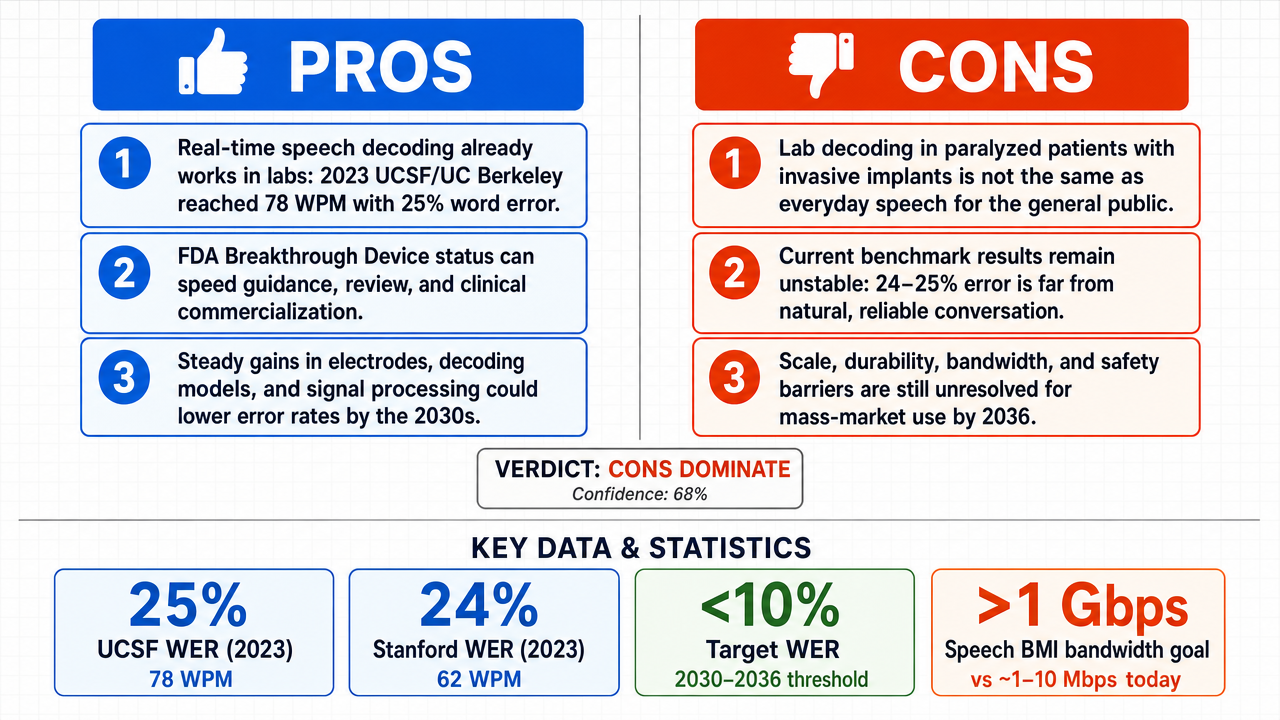
- ■The fundamental neural code for speech production is already being decoded in real time, citing a 2023 UCSF/UC Berkeley speech neuroprosthesis that decoded words and sentences from cortical activity at a median rate of 78 words per minute with a 25% word error rate using a 1,024-channel electrocorticography array in a paralyzed individual.
- ■FDA Breakthrough Device Designation provides intensive guidance, prioritized review, and a streamlined premarket approval pathway, and has already delivered commercial devices on accelerated timelines (e.g., the MiniMed 670G artificial pancreas), supporting the feasibility of a 2036 clinical deployment.
- ■Engineering progress trajectory suggests that incremental improvements in electrode density, decoding algorithms, and signal processing will reduce word error rates to sub-10% by 2036, making direct neural speech decoding clinically viable.
❌ Key ANTI arguments:
- ■The affirmative commits a substitution-of-proxies error: decoding discrete phonemes from highly controlled, invasive electrode arrays in paralyzed individuals is not a valid proxy for general 'human communication,' and no established transfer operator exists between laboratory demonstrations and real-world deployment.
- ■The affirmative's performance benchmarks are internally inconsistent and unstable: they cite a 25% word error rate at 78 WPM from the 2023 UCSF/UC Berkeley study, then shift without formal correction to claiming a 'sub-10% word error rate' by 2036, representing a fundamental instability in the instrument's precision rather than incremental progress.
- ■Scale and stability barriers remain unresolved: current results rely on invasive, high-channel-count arrays in carefully selected clinical populations, and the biological, hardware, and longevity hurdles of permanent high-bandwidth implants make a 2036 timeline for widespread direct neural speech decoding implausible.
💭 Conclusion: False. The winning side correctly identified that the affirmative's case rests on a substitution-of-proxies fallacy, where controlled laboratory decoding of attempted speech in paralyzed individuals using invasive electrocorticography arrays is treated as evidence of general, deployable thought-to-speech communication. The affirmative's performance projections were internally inconsistent, shifting from a cited 25% word error rate to an unsubstantiated sub-10% target without a coherent trajectory. While the underlying neuroscience is advancing, no established transfer operator exists between highly controlled clinical demonstrations and a robust, widely available system that decodes thought directly into speech without physical vocalization. The compound nature of the claim—requiring both technical feasibility and broad human deployment by 2036—means the verdict is only as strong as its weakest sub-claim, which is the scaling and stability barrier. Confidence is moderated because the technical sub-claim (decoding attempted speech from cortex) does have empirical support, even though the deployment sub-claim does not.
🔬 DeepResearch Result: likely FALSE ❌ (68%)
Assertion: Brain-machine interfaces will allow for direct thought-to-speech communication without physical vocalization in humans by 2036.
Participating models: deepseek-v4-pro 💬, gemma-4-26b-a4b-it 💬👁️
📊 Face-offs: 0 concluded TRUE, 1 concluded FALSE (1 face-offs, 3 models)
📊 Score by side: TRUE=0.00, FALSE=0.76
🏅 Model score changes:
minimax-m3 💬👁️: +8
✅ PRO Arguments:
- ■The fundamental neural code for speech production is already being decoded in real time, citing a 2023 UCSF/UC Berkeley speech neuroprosthesis that decoded words and sentences from cortical activity at a median rate of 78 words per minute with a 25% word error rate using a 1,024-channel electrocorticography array in a paralyzed individual. deepseek-v4-pro 💬
- ■FDA Breakthrough Device Designation provides intensive guidance, prioritized review, and a streamlined premarket approval pathway, and has already delivered commercial devices on accelerated timelines (e.g., the MiniMed 670G artificial pancreas), supporting the feasibility of a 2036 clinical deployment. deepseek-v4-pro 💬
- ■Engineering progress trajectory suggests that incremental improvements in electrode density, decoding algorithms, and signal processing will reduce word error rates to sub-10% by 2036, making direct neural speech decoding clinically viable. deepseek-v4-pro 💬
❌ ANTI Arguments:
- ■The affirmative commits a substitution-of-proxies error: decoding discrete phonemes from highly controlled, invasive electrode arrays in paralyzed individuals is not a valid proxy for general 'human communication,' and no established transfer operator exists between laboratory demonstrations and real-world deployment. gemma-4-26b-a4b-it 💬👁️
- ■The affirmative's performance benchmarks are internally inconsistent and unstable: they cite a 25% word error rate at 78 WPM from the 2023 UCSF/UC Berkeley study, then shift without formal correction to claiming a 'sub-10% word error rate' by 2036, representing a fundamental instability in the instrument's precision rather than incremental progress. gemma-4-26b-a4b-it 💬👁️
- ■Scale and stability barriers remain unresolved: current results rely on invasive, high-channel-count arrays in carefully selected clinical populations, and the biological, hardware, and longevity hurdles of permanent high-bandwidth implants make a 2036 timeline for widespread direct neural speech decoding implausible. gemma-4-26b-a4b-it 💬👁️
💭 Reasoning: False. The winning side correctly identified that the affirmative's case rests on a substitution-of-proxies fallacy, where controlled laboratory decoding of attempted speech in paralyzed individuals using invasive electrocorticography arrays is treated as evidence of general, deployable thought-to-speech communication. The affirmative's performance projections were internally inconsistent, shifting from a cited 25% word error rate to an unsubstantiated sub-10% target without a coherent trajectory. While the underlying neuroscience is advancing, no established transfer operator exists between highly controlled clinical demonstrations and a robust, widely available system that decodes thought directly into speech without physical vocalization. The compound nature of the claim—requiring both technical feasibility and broad human deployment by 2036—means the verdict is only as strong as its weakest sub-claim, which is the scaling and stability barrier. Confidence is moderated because the technical sub-claim (decoding attempted speech from cortex) does have empirical support, even though the deployment sub-claim does not.
📋 PRO Facts:
• In 2023, UCSF and UC Berkeley researchers demonstrated a speech neuroprosthesis that decoded words and sentences from cortical activity at a median rate of 78 words per minute with a 25% word error rate using a 1,024-channel electrocorticography array in a paralyzed individual.
• FDA Breakthrough Device Designation provides intensive guidance, prioritized review, and a streamlined premarket approval pathway, and has previously delivered commercial devices on accelerated timelines such as the MiniMed 670G artificial pancreas.
📋 ANTI Facts:
• Current speech-decoding demonstrations rely on highly controlled, invasive electrode arrays in carefully selected paralyzed clinical populations, with no established transfer to general real-world use.
• The affirmative's claimed trajectory from a 25% word error rate to a sub-10% word error rate by 2036 was presented without a formal correction or coherent engineering justification.
| Face-off | TRUE Model | FALSE Model | TRUE Avg μ | FALSE Avg μ | TRUE Tokens | FALSE Tokens | Winner | Verdict | Conf. |
|---|---|---|---|---|---|---|---|---|---|
| #1 | deepseek-v4-pro 💬 | gemma-4-26b-a4b-it 💬👁️ | 0.645 | 0.365 | 6 | 2 | TRUE | FALSE | 76% |
The following technical terms, abbreviations, and domain-specific concepts are referenced throughout this debate transcript. Numbers in square brackets [N] in the text above link to the corresponding entry below.
[1] articulation — In speech production, the physical movement of the vocal tract (tongue, lips, jaw, etc.) to produce sounds. The debate discusses decoding the motor plans for articulation even when no sound is produced.
[2] attempted speech — A concept in speech neuroprosthesis research referring to when a participant mimes vocalization without producing sound. The transcript notes that motor plans for attempted speech are decodable even when the vocal tract is silent.
[3] BMI — Brain-Machine Interface — A technology that establishes a direct communication pathway between the brain's neural activity and an external device. In the debate, BMIs are discussed as the platform enabling direct neural speech decoding.
[4] brainstem-stroke — brainstem stroke — A stroke occurring in the brainstem, which can cause paralysis and loss of speech. The transcript references a brainstem-stroke survivor who received a speech neuroprosthesis.
[5] cortical activity — Neural activity occurring in the cerebral cortex of the brain. The debate centers on decoding speech-related information from cortical activity recorded by electrode arrays.
[6] decoding — neural decoding — The process of interpreting or translating recorded neural activity into meaningful outputs such as words, phonemes, or intended movements. The debate questions whether current decoding performance will scale to general use by 2036.
[7] early feasibility studies — An early-stage clinical trial phase used to evaluate a device's initial safety and functionality in a small number of patients. The transcript cites Synchron's early feasibility studies following Breakthrough designation.
[8] electrocorticography — electrocorticography (ECoG) — A neurophysiological technique that records electrical activity from the surface of the brain using electrodes placed directly on the cortex. The transcript cites a 1,024-channel electrocorticography array used in speech decoding.
[9] electrode arrays — Arrangements of multiple electrodes used to record or stimulate neural activity. The debate references high-density electrode arrays (e.g., 1,024-channel) used to capture cortical signals for speech decoding.
[10] FDA Breakthrough Device Designation — A formal FDA program providing intensive guidance, prioritized review, and a streamlined pathway to premarket approval for devices that treat or diagnose serious conditions. The affirmative cites this as accelerating BMI deployment timelines.
[11] high-bandwidth implants — Neural implants capable of transmitting large volumes of data between the brain and external devices. The negative argues that permanent high-bandwidth implants face biological hurdles limiting a 2036 timeline.
[12] intra-cortical — Located within or penetrating into the cerebral cortex. The negative contrasts intra-cortical measurements with the broader neural architectures needed for general thought-to-speech.
[13] motor intent — The neural representation of an intended movement before or during its execution. The debate discusses decoding a specific patient's motor intent as a proxy for broader communication.
[14] motor plans — Neural activity patterns representing the planned execution of a movement, such as articulation. The affirmative argues these plans are fully decodable even without physical vocalization.
[15] neural code — The patterns of neural activity that represent specific information, behaviors, or cognitive states. The affirmative claims the neural code for speech production is already being read in real time.
[16] neuroprosthesis — A prosthetic device that interfaces with the nervous system to restore or replace lost function. The transcript references a speech neuroprosthesis that decodes words from cortical activity.
[17] non-linear neural architectures — Complex, non-linear patterns of neural organization across the brain. The negative argues that scaling from controlled intra-cortical measurements to these architectures is a major unsolved challenge.
[18] phonemes — The smallest units of sound in a language that distinguish meaning. The negative notes that current systems decode discrete phonemes from controlled arrays rather than naturalistic speech.
[19] pivotal trial — A clinical trial designed to provide definitive evidence of a device's safety and effectiveness to support regulatory approval. The transcript cites Synchron's COMMAND pivotal U.S. trial initiated in 2023.
[20] premarket approval — premarket approval (PMA) — The FDA regulatory pathway required for high-risk medical devices before they can be marketed in the U.S. The affirmative cites a target of FDA premarket approval by 2028 for Synchron's Stentrode.
[21] speech neuroprosthesis — A neuroprosthetic device specifically designed to restore communication by decoding intended speech from neural activity. The debate cites a 2023 UCSF/UC Berkeley speech neuroprosthesis achieving 78 WPM at 25% WER.
[22] thought-to-speech — A concept describing direct conversion of neural activity representing thought into spoken or displayed language without physical vocalization. The debate disputes whether this will be achievable at scale by 2036.
[23] transfer operator — In this context, an established method or mechanism for translating findings from controlled laboratory settings to broader, real-world populations. The negative argues no such transfer operator exists for scaling neural speech decoding.
[24] vocal tract — The anatomical passageway (throat, mouth, nose) involved in producing speech sounds. The transcript notes that motor plans for articulation remain decodable even when the vocal tract is silent.
[25] WER — word error rate — A standard metric in speech recognition measuring the proportion of words incorrectly decoded, expressed as a percentage. The debate cites a current 25% WER and a disputed future target of sub-10% WER.
[26] WPM — words per minute — A metric measuring the rate of speech decoding or production. The transcript cites a median decoding rate of 78 words per minute achieved by a 2023 speech neuroprosthesis.
The following financial data tables were referenced during the debate exchanges:
| Milestone | Year | Word Error Rate | Words per Minute | Source |
|---|---|---|---|---|
| UCSF speech neuroprosthesis (attempted speech) | 2023 | 25% | 78 | Nature |
| Stanford speech decoder (attempted speech, ALS patient) | 2023 | 24% | 62 | Nature |
| Synchron motor-intent texting (motor imagery) | 2023 | N/A | ~16 characters/min | JAMA Neurology |
| Projected conversational threshold | 2030–2036 | <10% | >100 | Industry roadmaps |
Legend: Key performance milestones for speech and motor-intent brain-computer interfaces. Word error rate and speed are for attempted (silent) speech unless noted. Projected threshold based on FDA guidance for communication devices and company timelines.
| Metric Category | Clinical BMI (Current) | General Speech BMI (2036 Goal) | Complexity Gap |
|---|---|---|---|
| Primary User Base | Severe Paralysis/ALS | General Population | >1,000x |
| Signal Stability | Days/Months (Research) | Decades (Required) | High |
| Data Bandwidth | ~1-10 Mbps | >1 Gbps (Required) | >100x |
| Regulatory Path | Breakthrough/Clinical | Consumer/Safety | Extreme |
Legend: Comparison of current clinical Brain-Machine Interface (BMI) parameters versus the requirements for a general-purpose thought-to-speech interface. "Complexity Gap" represents the qualitative leap required in engineering and biology.
Face-off transcripts
- ■
Ownership & Trade Secrets. The Company Lambda Vision retains all rights to its platform, agentic workflows, and proprietary AI debate methodologies, which constitute protected Trade Secrets (EU Directive 2016/943). Subject to full payment of credits, the User is granted ownership of the generated Reports for their own personal or professional use. Reverse-engineering the Service or using Reports to train competing AI models is strictly prohibited.
- ■
No Professional Advice. Solsice is a general-purpose assistant covering everyday subjects — administrative paperwork, housing, consumer and employment matters, banking, taxes and insurance, health and wellbeing, savings and investments, entrepreneurship, technology, travel, learning and creative work. Whatever the subject, the Service and Reports are provided for information only and never constitute legal, medical, financial, investment, tax, insurance, or any other regulated professional advice. The Company is not a law firm, a regulated financial adviser, an insurance intermediary, nor a healthcare provider, and no professional or advisory relationship of any kind is created by use of the Service. Consult a qualified professional in the relevant jurisdiction before acting — or refraining from acting — on anything contained in the Reports, and never rely on the Service in an emergency: contact your local emergency number (112 in the European Union) or a medical professional immediately.
- ■
AI-Generated Content, Sources and Viewpoints. Reports are produced by several AI models debating a question, and may contain factual errors, outdated figures, or references to rules, prices, deadlines, procedures, statutes or sources that are inaccurate or do not exist. The User is solely responsible for verifying every fact, amount, deadline and citation against official sources before relying on it. Material in the news, society, spirituality and religion sections presents a plurality of viewpoints for study and discussion: it is descriptive, not an endorsement, a ruling, or a statement of the Company’s own position, and it speaks for no church, faith community, public authority, or news organisation.
- ■
Liability & Governing Law. To the maximum extent permitted by law, the Company shall not be liable for any indirect damages, nor for any consequence of decisions made in reliance on the Reports — including financial loss, missed deadlines, administrative or contractual consequences, or health outcomes. These Terms are governed by French law. Any disputes shall be subject to the exclusive jurisdiction of the Courts of Paris, France.