
BRICS nations will successfully establish a new commodity-backed reserve currency that significantly challenges the US dollar's global dominance by 2031.
AI debate verdict and arguments
⚠️ AI-generated information only; not professional advice
Completed October 14, 2026
Verdict
Verdict: likely FALSE (72%)
Web Report: https://solsice.com/public/debates/brics-nations-will-successfully-establish-a-new-commodity-ba-d1adb6b9c199
This section provides a brief overview of the key arguments. You do not need to read the full detailed report below.
✅ Key PRO arguments:
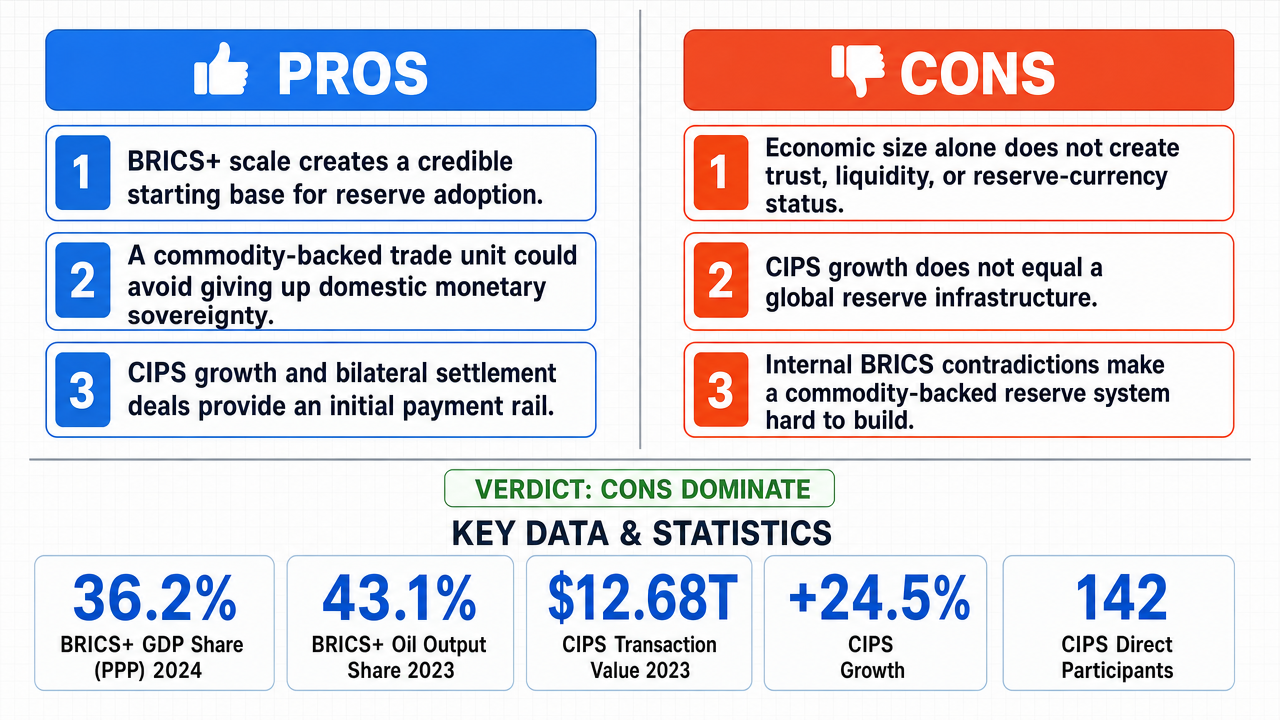
- ■BRICS + (11 members including Saudi Arabia, UAE, Iran, Egypt, Ethiopia, Argentina) represents a foundational critical mass for a new reserve currency , accounting for 36.2% of global GDP (PPP ), 43.1% of global oil production, and 45.8% of global population in 2024, creating a natural asset base.
- ■A commodity-backed common unit for international trade and reserves does not require member nations to surrender domestic monetary sovereignty or adopt a single interest rate ; it can function like the European Currency Unit (ECU ) as a stable unit of account and medium of exchange for cross-border transactions without replacing national currencies for domestic policy.
- ■The rapid growth of the CIPS payment system and expanding bilateral settlement agreements provide a viable foundational payment rail for a new BRICS reserve currency , demonstrating operational momentum toward de-dollarized infrastructure.
❌ Key ANTI arguments:
- ■The affirmative commits a fallacy of scale and identity: aggregate economic and demographic scale (GDP , oil, population shares) does not automatically translate into unified monetary capability because the affirmative fails to identify the transfer operator—the institutional, legal, and political integration mechanism—required to convert scale into a functioning currency.
- ■CIPS is a fallacy of scale and function: equating the growth of a specialized, bilateral settlement system designed to facilitate trade between China and its partners with the capability of a global reserve asset is invalid, because a reserve currency requires not just a payment rail but massive underlying liquidity , trust, and convertibility infrastructure.
- ■BRICS cannot establish a functional commodity-backed reserve currency due to fundamental internal contradictions and structural dependencies, including macroeconomic divergence among member economies that prevents a unified policy framework or commodity-backed unit.
💭 Conclusion: The negative exposed a critical gap in the affirmative's case: aggregate economic scale (36.2% of global GDP PPP , 43.1% of oil production, 45.8% of population) does not automatically produce monetary integration without an identified institutional, legal, and political mechanism to convert scale into currency functionality. The negative further demonstrated that CIPS , while growing (+24.5% YoY in 2023), remains a localized bilateral settlement tool rather than the deep, liquid, convertible infrastructure a true global reserve asset requires. The structural and institutional barriers identified by the negative make the claim unlikely.
🔬 DeepResearch Result: likely FALSE ❌ (72%)
Assertion: BRICS nations will successfully establish a new commodity-backed reserve currency that significantly challenges the US dollar's global dominance by 2031.
Participating models: deepseek-v3.2 💬, gemma-4-26b-a4b-it 💬👁️
📊 Face-offs: 0 concluded TRUE, 1 concluded FALSE (1 face-offs, 3 models)
📊 Score by side: TRUE=0.00, FALSE=0.85
🏅 Model score changes:
minimax-m3 💬👁️: +8
✅ PRO Arguments:
- ■BRICS+ (11 members including Saudi Arabia, UAE, Iran, Egypt, Ethiopia, Argentina) represents a foundational critical mass for a new reserve currency, accounting for 36.2% of global GDP (PPP ), 43.1% of global oil production, and 45.8% of global population in 2024, creating a natural asset base. deepseek-v3.2 💬
- ■A commodity-backed common unit for international trade and reserves does not require member nations to surrender domestic monetary sovereignty or adopt a single interest rate ; it can function like the European Currency Unit (ECU ) as a stable unit of account and medium of exchange for cross-border transactions without replacing national currencies for domestic policy. deepseek-v3.2 💬
- ■The rapid growth of the CIPS payment system and expanding bilateral settlement agreements provide a viable foundational payment rail for a new BRICS reserve currency, demonstrating operational momentum toward de-dollarized infrastructure. deepseek-v3.2 💬
❌ ANTI Arguments:
- ■The affirmative commits a fallacy of scale and identity: aggregate economic and demographic scale (GDP, oil, population shares) does not automatically translate into unified monetary capability because the affirmative fails to identify the transfer operator—the institutional, legal, and political integration mechanism—required to convert scale into a functioning currency. gemma-4-26b-a4b-it 💬👁️
- ■CIPS is a fallacy of scale and function: equating the growth of a specialized, bilateral settlement system designed to facilitate trade between China and its partners with the capability of a global reserve asset is invalid, because a reserve currency requires not just a payment rail but massive underlying liquidity , trust, and convertibility infrastructure. gemma-4-26b-a4b-it 💬👁️
- ■BRICS cannot establish a functional commodity-backed reserve currency due to fundamental internal contradictions and structural dependencies, including macroeconomic divergence among member economies that prevents a unified policy framework or commodity-backed unit. gemma-4-26b-a4b-it 💬👁️
💭 Reasoning: The negative exposed a critical gap in the affirmative's case: aggregate economic scale (36.2% of global GDP PPP, 43.1% of oil production, 45.8% of population) does not automatically produce monetary integration without an identified institutional, legal, and political mechanism to convert scale into currency functionality. The negative further demonstrated that CIPS, while growing (+24.5% YoY in 2023), remains a localized bilateral settlement tool rather than the deep, liquid, convertible infrastructure a true global reserve asset requires. The structural and institutional barriers identified by the negative make the claim unlikely.
📋 PRO Facts:
• BRICS+ (11 members) accounts for 36.2% of global GDP (PPP) in 2024.
• BRICS+ accounts for 43.1% of global oil production in 2023.
• BRICS+ accounts for 45.8% of global population in 2024.
• CIPS transaction volumes are increasing as a bilateral settlement system bypassing the dollar.
📋 ANTI Facts:
• Aggregate economic and demographic scale does not automatically translate into unified monetary capability without institutional, legal, and political integration mechanisms.
• CIPS remains a highly localized infrastructure designed to facilitate bilateral trade between China and its partners, not a global reserve asset infrastructure.
• A reserve currency requires massive underlying liquidity, trust, and convertibility infrastructure beyond a payment rail.
• Macroeconomic divergence among BRICS member economies prevents a unified policy framework or commodity-backed unit.
| Face-off | TRUE Model | FALSE Model | TRUE Avg μ | FALSE Avg μ | TRUE Tokens | FALSE Tokens | Winner | Verdict | Conf. |
|---|---|---|---|---|---|---|---|---|---|
| #1 | deepseek-v3.2 💬 | gemma-4-26b-a4b-it 💬👁️ | 0.537 | 0.213 | 8 | 2 | TRUE | FALSE | 85% |
The following technical terms, abbreviations, and domain-specific concepts are referenced throughout this debate transcript. Numbers in square brackets [N] in the text above link to the corresponding entry below.
[1] basket of commodities — A collection of physical commodities (such as oil, gold, or other raw materials) used collectively as the underlying backing or reference value for a financial instrument or currency.
[2] bilateral settlement — A direct payment arrangement between two parties or countries that bypasses an intermediary currency or clearing system, often used to settle trade obligations outside of dominant reserve currencies.
[3] BRICS — Brazil, Russia, India, China, South Africa — An association of five major emerging economies that cooperate on economic and geopolitical issues, often discussed as a potential counterweight to Western-led international institutions.
[4] BRICS+ — BRICS Plus — The expanded BRICS bloc, which in the debate is described as including additional members such as Saudi Arabia, the UAE, Iran, Egypt, Ethiopia, and Argentina.
[5] capital markets — Financial markets in which long-term securities such as sovereign bonds and equities are issued and traded, providing a venue for governments and entities to raise funding and for investors to hold liquid assets.
[6] central bank — A national monetary authority responsible for issuing currency, managing monetary policy, and holding foreign reserve assets.
[7] CIPS — Cross-Border Interbank Payment System — A Chinese payment infrastructure referenced in the debate as a system used to facilitate cross-border transactions, often between China and its trading partners, sometimes bypassing the US dollar.
[8] commodity-backed currency — A currency whose value is tied to a physical commodity or basket of commodities, rather than to fiat confidence or government decree.
[9] cross-border transactions — Financial or commercial transactions conducted between parties located in different countries, typically requiring currency conversion or settlement in an internationally accepted unit.
[10] dollar-denominated debt — Debt obligations priced and repayable in US dollars, exposing borrowers to exchange-rate risk if their revenues are in other currencies.
[11] ECU — European Currency Unit — A historical basket currency composed of European Community currencies, used as a unit of account and settlement instrument before being replaced by the euro.
[12] financial sanctions — Restrictions imposed on countries or entities that limit their access to financial systems, often referenced in the debate as a motivation for seeking non-dollar payment alternatives.
[13] foreign exchange — foreign exchange (FX) — The global market in which national currencies are traded against one another, characterized in the debate as requiring deep liquidity to support a reserve currency.
[14] GDP — Gross Domestic Product — The total monetary value of goods and services produced within a country, used in the debate as a measure of economic scale, with shares calculated on a PPP basis.
[15] IMF — International Monetary Fund — An international organization cited in the debate as the source of 2024 PPP-based GDP share estimates for the BRICS+ bloc.
[16] inflation rates — The percentage rate at which the general level of prices for goods and services rises over a period, referenced in the debate as a domestic policy variable that a reserve currency need not unify.
[17] interest rate — The cost of borrowing money or the return on deposits, set or influenced by central banks as part of monetary policy.
[18] liquidity — The ease with which an asset can be converted into cash without affecting its market price; in the debate, deep liquidity in capital markets is described as a requirement for a global reserve currency.
[19] medium of exchange — A function of money enabling goods, services, or assets to be traded without barter; cited in the debate as a primary function of a proposed BRICS reserve unit.
[20] monetary policy — The actions of a central bank in setting interest rates and controlling money supply to influence macroeconomic conditions.
[21] monetary sovereignty — A nation's authority to control its own currency and domestic monetary policy, which the debate argues a BRICS reserve unit would not require members to surrender.
[22] payment rail — The underlying infrastructure and protocols that move funds between parties, referenced in the debate when assessing whether CIPS can support a reserve currency.
[23] PPP — Purchasing Power Parity — An economic metric that adjusts GDP comparisons between countries to account for differences in price levels, used in the debate to compare the economic weight of the BRICS+ bloc.
[24] reserve asset — An asset, typically a major currency or gold, held in significant quantities by central banks to support the balance of payments and provide confidence in monetary policy.
[25] reserve currency — A currency held by central banks in substantial quantities as part of their foreign exchange reserves and used as a standard for international transactions and pricing.
[26] sovereign bond — A debt security issued by a national government, referenced in the debate as part of the deep, liquid markets that underpin the US dollar's reserve status.
[27] transaction volumes — The total quantity or value of transactions processed through a system over a given period, used in the debate to compare CIPS with global foreign exchange and bond markets.
[28] unit of account — A standard monetary unit used to measure the value of goods, services, and contracts; cited in the debate as a function a BRICS commodity-basket unit could serve.
The following financial data tables were referenced during the debate exchanges:
| Entity | Global GDP Share (PPP) 2024 | Global Oil Production Share 2023 | Global Population Share 2024 |
|---|---|---|---|
| BRICS+ (11 members) | 36.2% | 43.1% | 45.8% |
Legend: Economic and demographic scale of BRICS+ (Brazil, Russia, India, China, South Africa, Saudi Arabia, UAE, Iran, Egypt, Ethiopia, Argentina). GDP share based on IMF 2024 PPP estimates; oil production from 2023 industry reports; population data from UN 2024 projections.
| System | Annual Transaction Value (2023) | YoY Growth | Number of Direct Participants |
|---|---|---|---|
| CIPS | $12.68 trillion | +24.5% | 142 |
Legend: Scale and growth of China's Cross-Border Interbank Payment System (CIPS) in 2023. Transaction value in USD; participant count includes direct participating banks globally. Source: CIPS annual operation report.
| Metric | 2020 | 2023 | 2024 (est) |
|---|---|---|---|
| US Federal Debt (USD trillions) | $26.9 | $33.2 | $34.8 |
| Debt-to-GDP Ratio | 129% | 123% | 122% |
| Foreign Holdings of US Debt (USD trillions) | $7.1 | $7.7 | $7.8 |
Legend: US federal debt trajectory and foreign holdings, 2020-2024. Source: US Treasury data and Congressional Budget Office estimates.
| Entity | GDP Growth (2024 Est.) | Inflation Rate (2024 Est.) | Primary Economic Driver |
|---|---|---|---|
| China | 4.6% | 0.5% | Manufacturing/Exports |
| India | 6.8% | 4.5% | Services/Domestic Consumption |
| Russia | 3.2% | 8.3% | Energy/Commodities |
| Brazil | 2.2% | 4.1% | Agriculture/Commodities |
| South Africa | 1.0% | 5.2% | Mining/Services |
Legend: Estimated economic indicators for key BRICS members for 2024. GDP and inflation figures are based on consensus projections from international financial institutions.
| Metric | SWIFT Global Messaging (Daily Avg) | CIPS (Annual Value) | Disparity Factor |
|---|---|---|---|
| Transaction Scale | ~$5.5 Trillion | ~$12.68 Trillion | N/A |
Legend: Comparison of daily SWIFT messaging volume versus the annual transaction value of CIPS. Note that daily SWIFT volume is approximately 43.38% of the annual CIPS transaction value.
Face-off transcripts
- ■
Ownership & Trade Secrets. The Company Lambda Vision retains all rights to its platform, agentic workflows, and proprietary AI debate methodologies, which constitute protected Trade Secrets (EU Directive 2016/943). Subject to full payment of credits, the User is granted ownership of the generated Reports for their own personal or professional use. Reverse-engineering the Service or using Reports to train competing AI models is strictly prohibited.
- ■
No Professional Advice. Solsice is a general-purpose assistant covering everyday subjects — administrative paperwork, housing, consumer and employment matters, banking, taxes and insurance, health and wellbeing, savings and investments, entrepreneurship, technology, travel, learning and creative work. Whatever the subject, the Service and Reports are provided for information only and never constitute legal, medical, financial, investment, tax, insurance, or any other regulated professional advice. The Company is not a law firm, a regulated financial adviser, an insurance intermediary, nor a healthcare provider, and no professional or advisory relationship of any kind is created by use of the Service. Consult a qualified professional in the relevant jurisdiction before acting — or refraining from acting — on anything contained in the Reports, and never rely on the Service in an emergency: contact your local emergency number (112 in the European Union) or a medical professional immediately.
- ■
AI-Generated Content, Sources and Viewpoints. Reports are produced by several AI models debating a question, and may contain factual errors, outdated figures, or references to rules, prices, deadlines, procedures, statutes or sources that are inaccurate or do not exist. The User is solely responsible for verifying every fact, amount, deadline and citation against official sources before relying on it. Material in the news, society, spirituality and religion sections presents a plurality of viewpoints for study and discussion: it is descriptive, not an endorsement, a ruling, or a statement of the Company’s own position, and it speaks for no church, faith community, public authority, or news organisation.
- ■
Liability & Governing Law. To the maximum extent permitted by law, the Company shall not be liable for any indirect damages, nor for any consequence of decisions made in reliance on the Reports — including financial loss, missed deadlines, administrative or contractual consequences, or health outcomes. These Terms are governed by French law. Any disputes shall be subject to the exclusive jurisdiction of the Courts of Paris, France.