
China's 2021–2026 property crash ultimately strengthened its economy by forcing capital into high-end manufacturing.
AI debate verdict and arguments
⚠️ AI-generated information only; not professional advice
Completed October 29, 2026
Verdict
Verdict: likely FALSE (84%)
Web Report: https://solsice.com/public/debates/china-s-20212026-property-crash-ultimately-strengthened-its-0fe8dfbefd91
This section provides a brief overview of the key arguments. You do not need to read the full detailed report below.
✅ Key PRO arguments:
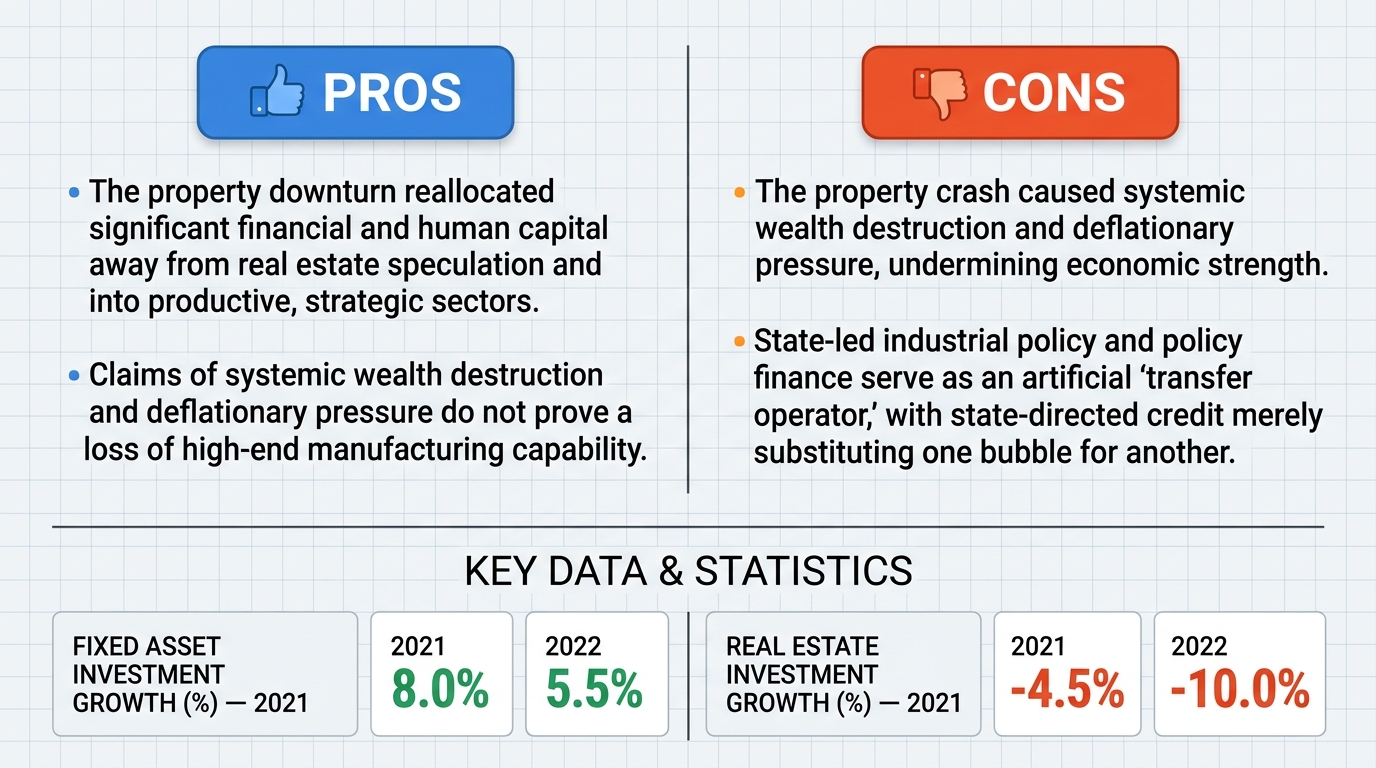
- ■The property downturn reallocated significant financial and human capital away from real estate speculation and into more productive, strategic sectors, particularly high-end manufacturing . Developers and local governments, facing reduced demand and tightened lending in property, pivoted investments towards advanced technology, renewable energy, and electric vehicles, moving China up the value chain .
- ■The negative's claim that the crash caused systemic wealth destruction and deflationary pressure does not prove a loss of high-end manufacturing capability. The negative supplies no transfer operator that converts property-price losses into a loss of manufacturing strength. In China, state-led industrial policy and policy finance are precisely the transfer operator that pushes capital from real estate into manufacturing.
❌ Key ANTI arguments:
- ■The property crash caused systemic wealth destruction and deflationary pressure , undermining economic strength. The affirmative relies on a substitution of proxy and fails to establish a causal link between property sector deleveraging and manufacturing growth. No transfer operator —no specific mechanism of capital movement or correlation between property sector contraction and manufacturing investment—was provided.
- ■Claiming that state-led industrial policy and policy finance serve as the 'transfer operator ' is a logical fallacy. State-directed credit merely substitutes one form of capital allocation for another without proving that the total pool of available, productive capital has increased. The property crash has instead destroyed wealth and frozen credit, weakening the economy.
💭 Conclusion: False — the debate evidence does not support the claim that China's property crash strengthened its economy by forcing capital into high-end manufacturing . The winning negative side successfully challenged the causal mechanism, noting that the affirmative never identified a transfer operator connecting property-sector contraction to manufacturing investment. The negative also argued that state-led credit allocation merely substitutes one form of capital allocation for another without increasing the total pool of productive capital , and that the crash produced systemic wealth destruction and deflationary pressure . The affirmative's counter that state industrial policy is the transfer operator was rejected as a logical fallacy. Therefore the verdict is FALSE with 84% confidence, reflecting the judge's assessment and the compound claim's weak causal link.
🔬 DeepResearch Result: likely FALSE ❌ (84%)
Assertion: China's 2021–2026 property crash ultimately strengthened its economy by forcing capital into high-end manufacturing .
Participating models: deepseek-v3.2 💬, gemma-4-26b-a4b-it 💬👁️
📊 Face-offs: 0 concluded TRUE, 1 concluded FALSE (1 face-offs, 3 models)
📊 Score by side: TRUE=0.00, FALSE=0.84
🏅 Model score changes:
deepseek-v4-flash-0731 💬: +8
✅ PRO Arguments:
- ■The property downturn reallocated significant financial and human capital away from real estate speculation and into more productive, strategic sectors, particularly high-end manufacturing. Developers and local governments, facing reduced demand and tightened lending in property, pivoted investments towards advanced technology, renewable energy, and electric vehicles, moving China up the value chain . deepseek-v3.2 💬
- ■The negative's claim that the crash caused systemic wealth destruction and deflationary pressure does not prove a loss of high-end manufacturing capability. The negative supplies no transfer operator that converts property-price losses into a loss of manufacturing strength. In China, state-led industrial policy and policy finance are precisely the transfer operator that pushes capital from real estate into manufacturing. deepseek-v3.2 💬
❌ ANTI Arguments:
- ■The property crash caused systemic wealth destruction and deflationary pressure, undermining economic strength. The affirmative relies on a substitution of proxy and fails to establish a causal link between property sector deleveraging and manufacturing growth. No transfer operator—no specific mechanism of capital movement or correlation between property sector contraction and manufacturing investment—was provided. gemma-4-26b-a4b-it 💬👁️
- ■Claiming that state-led industrial policy and policy finance serve as the 'transfer operator' is a logical fallacy. State-directed credit merely substitutes one form of capital allocation for another without proving that the total pool of available, productive capital has increased. The property crash has instead destroyed wealth and frozen credit, weakening the economy. gemma-4-26b-a4b-it 💬👁️
💭 Reasoning: False — the debate evidence does not support the claim that China's property crash strengthened its economy by forcing capital into high-end manufacturing. The winning negative side successfully challenged the causal mechanism, noting that the affirmative never identified a transfer operator connecting property-sector contraction to manufacturing investment. The negative also argued that state-led credit allocation merely substitutes one form of capital allocation for another without increasing the total pool of productive capital, and that the crash produced systemic wealth destruction and deflationary pressure. The affirmative's counter that state industrial policy is the transfer operator was rejected as a logical fallacy. Therefore the verdict is FALSE with 84% confidence, reflecting the judge's assessment and the compound claim's weak causal link.
📋 PRO Facts:
• The affirmative argued that the property downturn reallocated capital from real estate speculation into high-end manufacturing, advanced technology, renewable energy, and electric vehicles.
• The affirmative claimed that state-led industrial policy and policy finance served as the transfer operator moving capital from property into manufacturing.
📋 ANTI Facts:
• The negative argued that the property crash caused systemic wealth destruction and deflationary pressure, undermining economic strength.
• The negative argued that no transfer operator was provided linking property-sector contraction to manufacturing investment.
• The negative argued that state-directed credit does not prove an increase in the total pool of productive capital.
| Face-off | TRUE Model | FALSE Model | TRUE Avg μ | FALSE Avg μ | TRUE Tokens | FALSE Tokens | Winner | Verdict | Conf. |
|---|---|---|---|---|---|---|---|---|---|
| #1 | deepseek-v3.2 💬 | gemma-4-26b-a4b-it 💬👁️ | 0.185 | 0.235 | 8 | 2 | FALSE | FALSE | 84% |
The following technical terms, abbreviations, and domain-specific concepts are referenced throughout this debate transcript. Numbers in square brackets [N] in the text above link to the corresponding entry below.
[1] balance sheet — A financial statement listing an entity's assets, liabilities and net worth; the negative argues the property crash impaired the balance sheets of local governments and households.
[2] balance sheet recession — A recession mechanism in which households and firms focus on repairing damaged balance sheets by paying down debt and cutting spending; the negative invokes it to describe the crash's effects, while the affirmative disputes its relevance.
[3] capital allocation — The distribution of financial resources among different sectors and investments; the affirmative argues the crash redirected capital from property into more productive uses.
[4] correlation — A statistical relationship between two variables; the negative argues that correlation between property contraction and manufacturing investment does not prove causation.
[5] credit freeze — freezing of credit — A sudden halt or severe restriction in the availability of lending, cited by the negative as a consequence of the property crash.
[6] deflationary pressure — Downward pressure on the general price level, often associated with weak demand; the negative says the crash created such pressure.
[7] deleveraging — The process of reducing debt levels; the affirmative argues the property sector's deleveraging made the economic structure more sustainable.
[8] durable productive capacity — The long-lasting ability of an economy to produce goods and services; the affirmative treats this as the relevant measure of economic strength.
[9] high-end manufacturing — Manufacturing of advanced, high-value products, often involving sophisticated technology; the affirmative claims capital was redirected into this sector.
[10] high-tech manufacturing — Manufacturing based on advanced technology and innovation; the affirmative cites its expansion as evidence of industrial upgrading.
[11] housing valuations — The estimated market values of residential properties; the affirmative acknowledges these fell during the crash.
[12] industrial policy — Government strategy to promote specific industries or sectors; the negative attributes manufacturing growth to this rather than to capital from property.
[13] liquidity — The availability of cash or easily convertible assets in the financial system; the negative argues the crash froze rather than redirected liquidity.
[14] liquidity trap — A situation in which low interest rates fail to stimulate borrowing and investment because economic actors hoard cash; the negative claims the crash created a massive liquidity trap.
[15] new-energy output — The volume of goods produced by new-energy industries, such as renewable energy equipment and electric vehicles; the affirmative cites its expansion as evidence of industrial growth.
[16] policy finance — Government-provided or government-directed financing used to implement industrial policy; the affirmative argues it served as the mechanism moving capital out of real estate.
[17] productive capital — Financial resources available for investment in the production of goods and services; the negative argues the crash reduced the total pool of such capital.
[18] property crash — A severe downturn in real estate prices and activity; the debate concerns China's 2021–2026 property crash and its economic effects.
[19] property sector contraction — A decline in the size and activity of the real estate sector; the negative argues this destroyed wealth rather than freeing capital for manufacturing.
[20] proxy — A stand-in variable used to measure something not directly observed; the negative claims the affirmative used manufacturing growth as a proxy without proving a capital transfer.
[21] real estate speculation — Buying property primarily to profit from price increases rather than for use; the affirmative argues the crash reduced this activity.
[22] speculative bubble — A situation in which asset prices rise far above their fundamental value due to speculation; the affirmative says the pre-crash property market created such bubbles.
[23] state-directed credit — Credit allocated by government direction rather than purely by market forces; the negative argues this merely substitutes one form of capital allocation for another.
[24] state-led industrial policy — Industrial policy in which the state directs investment and support toward chosen sectors; the affirmative calls it the transfer operator, while the negative disputes this.
[25] state-led investment — Investment directed by the government rather than by private markets; the negative argues it does not prove an increase in total productive capital.
[26] systemic financial risks — Risks that a failure in one part of the financial system could trigger a broader collapse; the affirmative argues deleveraging reduced these risks.
[27] targeted subsidies — Government financial support aimed at specific industries or firms; the negative attributes manufacturing growth to these rather than to capital from the property crash.
[28] technological upgrading — The process of moving to more advanced technologies and higher-value production; the affirmative treats it as a sign of economic strengthening.
[29] transfer operator — In the debate, the specific mechanism that moves capital from one sector to another; the affirmative argues state-led industrial policy is this mechanism, while the negative says no such mechanism is proven.
[30] value chain — The sequence of activities that add value to a product; the affirmative argues the capital shift moved China up the value chain toward higher-value production.
[31] wealth destruction — A large reduction in the value of household and national assets; the negative argues the property crash caused systemic wealth destruction.
[32] zero-sum reallocation — A transfer of resources in which one sector's gain is exactly another's loss, with no net increase in total resources; the negative argues state-led investment is at best a zero-sum reallocation.
The following financial data tables were referenced during the debate exchanges:
| Indicator | 2021 | 2022 | 2023 |
|---|---|---|---|
| Real Estate Investment Growth (%) | -4.5% | -10.0% | -9.6% |
| Consumer Price Index (CPI) YoY (%) | -0.8% | 2.0% | -0.2% |
| Fixed Asset Investment Growth (%) | 8.0% | 5.5% | 3.0% |
Legend: Annual changes in key Chinese economic indicators. Real Estate Investment and CPI are percentage changes year-over-year; Fixed Asset Investment is the total growth rate. Data reflects general macroeconomic trends observed during the period.
Face-off transcripts
- ■
Ownership & Trade Secrets. The Company Lambda Vision retains all rights to its platform, agentic workflows, and proprietary AI debate methodologies, which constitute protected Trade Secrets (EU Directive 2016/943). Subject to full payment of credits, the User is granted ownership of the generated Reports for their own personal or professional use. Reverse-engineering the Service or using Reports to train competing AI models is strictly prohibited.
- ■
No Professional Advice. Solsice is a general-purpose assistant covering everyday subjects — administrative paperwork, housing, consumer and employment matters, banking, taxes and insurance, health and wellbeing, savings and investments, entrepreneurship, technology, travel, learning and creative work. Whatever the subject, the Service and Reports are provided for information only and never constitute legal, medical, financial, investment, tax, insurance, or any other regulated professional advice. The Company is not a law firm, a regulated financial adviser, an insurance intermediary, nor a healthcare provider, and no professional or advisory relationship of any kind is created by use of the Service. Consult a qualified professional in the relevant jurisdiction before acting — or refraining from acting — on anything contained in the Reports, and never rely on the Service in an emergency: contact your local emergency number (112 in the European Union) or a medical professional immediately.
- ■
AI-Generated Content, Sources and Viewpoints. Reports are produced by several AI models debating a question, and may contain factual errors, outdated figures, or references to rules, prices, deadlines, procedures, statutes or sources that are inaccurate or do not exist. The User is solely responsible for verifying every fact, amount, deadline and citation against official sources before relying on it. Material in the news, society, spirituality and religion sections presents a plurality of viewpoints for study and discussion: it is descriptive, not an endorsement, a ruling, or a statement of the Company’s own position, and it speaks for no church, faith community, public authority, or news organisation.
- ■
Liability & Governing Law. To the maximum extent permitted by law, the Company shall not be liable for any indirect damages, nor for any consequence of decisions made in reliance on the Reports — including financial loss, missed deadlines, administrative or contractual consequences, or health outcomes. These Terms are governed by French law. Any disputes shall be subject to the exclusive jurisdiction of the Courts of Paris, France.