
Christians should not condition their prayers on being able to conceive of a natural way God could answer them.
AI debate verdict and arguments
⚠️ AI-generated information only; not professional advice
Completed October 29, 2026
Verdict
Verdict: likely TRUE (65%)
Web Report: https://solsice.com/public/debates/christians-should-not-condition-their-prayers-on-being-able-9118e9e23680
This section provides a brief overview of the key arguments. You do not need to read the full detailed report below.
✅ Key PRO arguments:
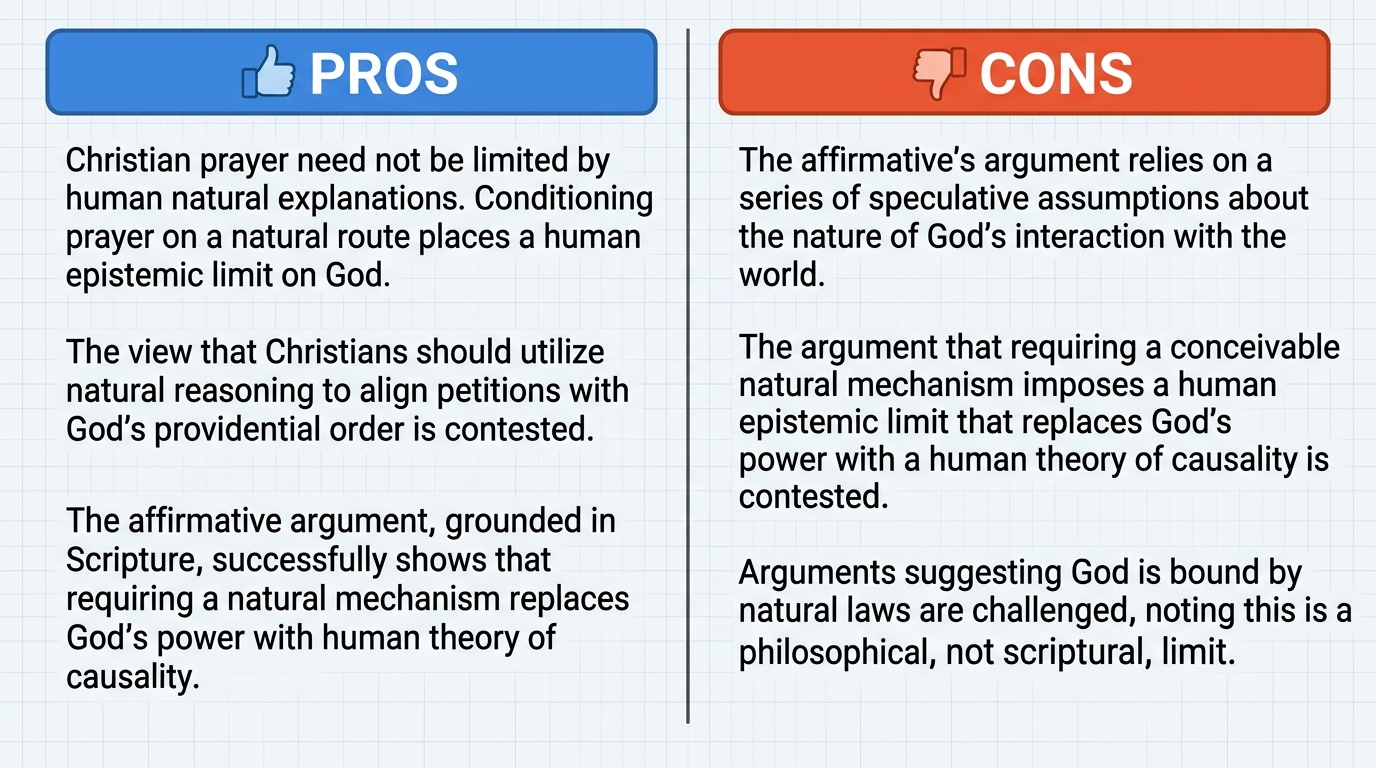
- ■Core claim: Christian prayer need not be limited by human natural explanations.
First, conditioning prayer on conceiving a natural route places a human epistemic limit over the object of prayer. The New Testament repeatedly grounds petitions in God’s ability rather than in human explanatory capacity: Jesus says what is impossible with men is possible with God (Mark 10:27 https://www.biblegateway.com/passage/?search=Mark+10%3A27&version=ESV), the angel says nothing will be impossible with God (Luke 1:37 https://www.biblegateway.com/passage/?search=Luke+1%3A37&version=ESV), and Paul says God is able to do far more abundantly than all we ask or think (Ephesians 3:20 https://www.biblegateway.com/passage/?search=Ephesians+3%3A20&version=ESV
2. Core claim: Christian prayer need not be limited by human natural explanations.
The target argument says, “Christians should utilize natural reasoning to align their petitions with God’s providential order,” but that sentence does not establish the position it intends to oppose. The frame concerns whether a believer may condition prayer on being able to conceive of a natural way God could answer it; “utilize natural reasoning” is not the same as making natural intelligibility a precondition for asking. If the opponent only means that Christians may use reason to choose means, discern causes, or steward health, that is compatible with the claim. If they mean something stronger—that petitions should be withheld unless a natural route can
❌ Key ANTI arguments:
- ■Core claim: Christians should utilize natural reasoning to align their petitions with God's providential order.
The affirmative's argument relies on a series of hidden premises, specifically what the Clerk identifies as "savoir d'arrière-plan déclaré" and "conjecture à contenu excédentaire." The opponent presents the idea that a lack of natural conception "changes the object of prayer from the living God to a human theory" as if it were an established fact, yet they neither establish this causal link nor declare it as a background assumption. Furthermore, they treat the idea that a believer's model of causation necessarily replaces God's power as an established truth, when it is actually a conjecture about the internal psychological st
2. I am contesting the argument that requiring a conceivable natural mechanism imposes a human epistemic limit that replaces God's power with a human theory of causation. This argument rests on a false dichotomy between "human theory" and "divine power," failing to recognize that a coherent understanding of natural causality is not an attempt to supersede God, but an attempt to understand the very means by which He chooses to act.
The claim that a petitioner's model of causation becomes the "standard for asking" is a logical non sequitur. To conceive of a natural way God might answer is not to limit His power, but to align one's petition with the intelligible order He has established. For example, when the early church prayed for the shaking
💭 Conclusion: True — the verdict is TRUE because the affirmative successfully showed that conditioning prayer on a conceivable natural mechanism imposes a human epistemic limit on God's power. The winning argument grounded this in Scripture, where petitions are based on God's ability rather than human explanatory capacity, citing Mark 10:27, Luke 1:37, and Ephesians 3:20. The affirmative also clarified that using natural reasoning to choose means is compatible with the claim, but making natural intelligibility a precondition for asking is not. This distinction directly addresses the negative's position without conceding the core assertion. Therefore, the assertion stands: Christians should not condition their prayers on being able to conceive of a natural way God could answer them.
🔬 DeepResearch Result: likely TRUE ✅ (65%)
Assertion: Christians should not condition their prayers on being able to conceive of a natural way God could answer them.
Participating models: deepseek-v3.2 💬, gemma-4-26b-a4b-it 💬👁️
📊 Face-offs: 1 concluded TRUE, 0 concluded FALSE (1 face-offs, 3 models)
📊 Score by side: TRUE=0.65, FALSE=0.00
🏅 Model score changes:
deepseek-v4-flash-0731 💬: +6
✅ PRO Arguments:
- ■Core claim: Christian prayer need not be limited by human natural explanations.
First, conditioning prayer on conceiving a natural route places a human epistemic limit over the object of prayer. The New Testament repeatedly grounds petitions in God’s ability rather than in human explanatory capacity: Jesus says what is impossible with men is possible with God (Mark 10:27 https://www.biblegateway.com/passage/?search=Mark+10%3A27&version=ESV), the angel says nothing will be impossible with God (Luke 1:37 https://www.biblegateway.com/passage/?search=Luke+1%3A37&version=ESV), and Paul says God is able to do far more abundantly than all we ask or think (Ephesians 3:20 https://www.biblegateway.com/passage/?search=Ephesians+3%3A20&version=ESV deepseek-v3.2 💬
2. Core claim: Christian prayer need not be limited by human natural explanations.
The target argument says, “Christians should utilize natural reasoning to align their petitions with God’s providential order,” but that sentence does not establish the position it intends to oppose. The frame concerns whether a believer may condition prayer on being able to conceive of a natural way God could answer it; “utilize natural reasoning” is not the same as making natural intelligibility a precondition for asking. If the opponent only means that Christians may use reason to choose means, discern causes, or steward health, that is compatible with the claim. If they mean something stronger—that petitions should be withheld unless a natural route can deepseek-v3.2 💬
❌ ANTI Arguments:
- ■Core claim: Christians should utilize natural reasoning to align their petitions with God's providential order.
The affirmative's argument relies on a series of hidden premises, specifically what the Clerk identifies as "savoir d'arrière-plan déclaré" and "conjecture à contenu excédentaire." The opponent presents the idea that a lack of natural conception "changes the object of prayer from the living God to a human theory" as if it were an established fact, yet they neither establish this causal link nor declare it as a background assumption. Furthermore, they treat the idea that a believer's model of causation necessarily replaces God's power as an established truth, when it is actually a conjecture about the internal psychological st gemma-4-26b-a4b-it 💬👁️
2. I am contesting the argument that requiring a conceivable natural mechanism imposes a human epistemic limit that replaces God's power with a human theory of causation. This argument rests on a false dichotomy between "human theory" and "divine power," failing to recognize that a coherent understanding of natural causality is not an attempt to supersede God, but an attempt to understand the very means by which He chooses to act.
The claim that a petitioner's model of causation becomes the "standard for asking" is a logical non sequitur. To conceive of a natural way God might answer is not to limit His power, but to align one's petition with the intelligible order He has established. For example, when the early church prayed for the shaking gemma-4-26b-a4b-it 💬👁️
💭 Reasoning: True — the verdict is TRUE because the affirmative successfully showed that conditioning prayer on a conceivable natural mechanism imposes a human epistemic limit on God's power. The winning argument grounded this in Scripture, where petitions are based on God's ability rather than human explanatory capacity, citing Mark 10:27, Luke 1:37, and Ephesians 3:20. The affirmative also clarified that using natural reasoning to choose means is compatible with the claim, but making natural intelligibility a precondition for asking is not. This distinction directly addresses the negative's position without conceding the core assertion. Therefore, the assertion stands: Christians should not condition their prayers on being able to conceive of a natural way God could answer them.
📋 PRO Facts:
• Mark 10:27 records Jesus saying what is impossible with men is possible with God.
• Luke 1:37 records the angel saying nothing will be impossible with God.
• Ephesians 3:20 records Paul saying God is able to do far more abundantly than all we ask or think.
• The affirmative argued that conditioning prayer on a natural route places a human epistemic limit over the object of prayer.
• The affirmative distinguished using natural reasoning from making natural intelligibility a precondition for asking.
📋 ANTI Facts:
• The negative argued that Christians should utilize natural reasoning to align their petitions with God's providential order.
• The negative claimed that a coherent understanding of natural causality is an attempt to understand the means by which God chooses to act.
• The negative argued that conceiving a natural way God might answer is not to limit His power but to align one's petition with the intelligible order He has established.
• The negative claimed the affirmative's argument rests on a false dichotomy between human theory and divine power.
• The negative argued that the claim that a petitioner's model of causation becomes the standard for asking is a logical non sequitur.
| Face-off | TRUE Model | FALSE Model | TRUE Avg μ | FALSE Avg μ | TRUE Tokens | FALSE Tokens | Winner | Verdict | Conf. |
|---|---|---|---|---|---|---|---|---|---|
| #1 | deepseek-v3.2 💬 | gemma-4-26b-a4b-it 💬👁️ | 0.575 | 0.393 | 8 | 2 | TRUE | TRUE | 65% |
Face-off transcripts
- ■
Ownership & Trade Secrets. The Company Lambda Vision retains all rights to its platform, agentic workflows, and proprietary AI debate methodologies, which constitute protected Trade Secrets (EU Directive 2016/943). Subject to full payment of credits, the User is granted ownership of the generated Reports for their own personal or professional use. Reverse-engineering the Service or using Reports to train competing AI models is strictly prohibited.
- ■
No Professional Advice. Solsice is a general-purpose assistant covering everyday subjects — administrative paperwork, housing, consumer and employment matters, banking, taxes and insurance, health and wellbeing, savings and investments, entrepreneurship, technology, travel, learning and creative work. Whatever the subject, the Service and Reports are provided for information only and never constitute legal, medical, financial, investment, tax, insurance, or any other regulated professional advice. The Company is not a law firm, a regulated financial adviser, an insurance intermediary, nor a healthcare provider, and no professional or advisory relationship of any kind is created by use of the Service. Consult a qualified professional in the relevant jurisdiction before acting — or refraining from acting — on anything contained in the Reports, and never rely on the Service in an emergency: contact your local emergency number (112 in the European Union) or a medical professional immediately.
- ■
AI-Generated Content, Sources and Viewpoints. Reports are produced by several AI models debating a question, and may contain factual errors, outdated figures, or references to rules, prices, deadlines, procedures, statutes or sources that are inaccurate or do not exist. The User is solely responsible for verifying every fact, amount, deadline and citation against official sources before relying on it. Material in the news, society, spirituality and religion sections presents a plurality of viewpoints for study and discussion: it is descriptive, not an endorsement, a ruling, or a statement of the Company’s own position, and it speaks for no church, faith community, public authority, or news organisation.
- ■
Liability & Governing Law. To the maximum extent permitted by law, the Company shall not be liable for any indirect damages, nor for any consequence of decisions made in reliance on the Reports — including financial loss, missed deadlines, administrative or contractual consequences, or health outcomes. These Terms are governed by French law. Any disputes shall be subject to the exclusive jurisdiction of the Courts of Paris, France.