
Civil fines and settlements for large healthcare corporations are ineffective deterrents against repeated fraudulent behavior.
AI debate verdict and arguments
⚠️ AI-generated information only; not professional advice
Completed October 14, 2026
Verdict
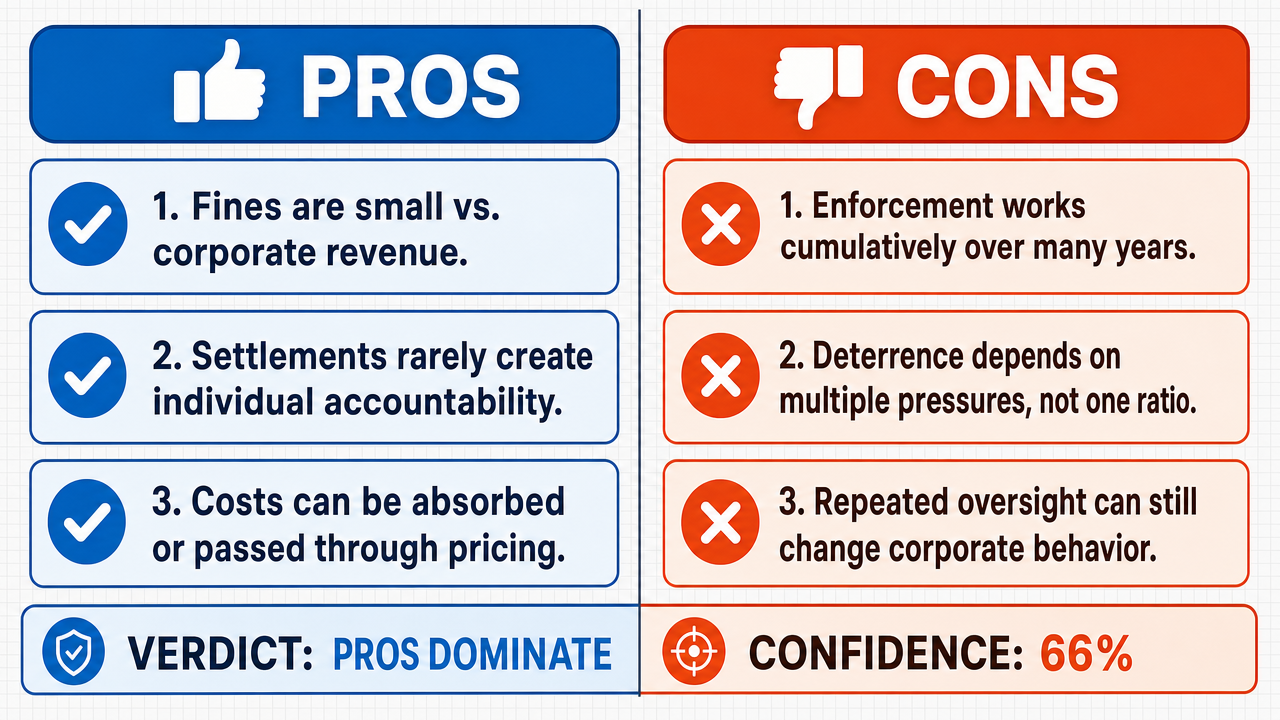
Verdict: likely TRUE (66%)
Web Report: https://solsice.com/public/debates/civil-fines-and-settlements-for-large-healthcare-corporation-78ea1b6e4ef1
This section provides a brief overview of the key arguments. You do not need to read the full detailed report below.
✅ Key PRO arguments:
- ■The financial impact of civil fines and settlements is negligible relative to the revenues and profits of large healthcare corporations, making them a tolerable cost of doing business rather than a meaningful deterrent ; major pharmaceutical companies have incurred billions in penalties while continuing to generate significantly larger annual profits, and a settlement representing a single-digit percentage of annual revenue does not alter underlying business incentives.
- ■The integration of civil settlements with criminal prosecutions under the Yates Memo (2015) has not produced meaningful individual accountability : the empirical record demonstrates that the evidentiary foundation it creates rarely translates into actual prosecutions of senior executives, and program exclusion under OIG authority is almost never deployed against major corporations, rendering the threat a hollow deterrent .
- ■Because corporate fines can be absorbed, written off, or passed on through pricing, they fail to create the kind of existential threat needed to redirect executive decision-making away from fraudulent conduct, particularly when corporations calculate that the expected value of fraud exceeds the expected cost of any eventual penalty.
❌ Key ANTI arguments:
- ■The affirmative's framing treats settlements as isolated static costs rather than dynamic variables within a cumulative multi-year enforcement regime; the imposition of massive settlements, especially when coupled with OIG -mandated Corporate Integrity Agreements (CIAs), forces fundamental shifts in compliance infrastructure and long-term corporate governance that a single-year revenue ratio obscures.
- ■Deterrent effectiveness is not a binary function of any single profit-margin ratio; it is multi-dimensional and breaks into exhaustive cases where either the settlement fails to alter corporate behavior or it succeeds, and the 'failure' branch is empirically contradicted by documented post-settlement compliance reforms and ongoing monitoring obligations imposed on healthcare corporations.
💭 Conclusion: The winning side established that civil fines and settlements for large healthcare corporations function more as a tolerable cost of doing business than as a meaningful deterrent , because settlement amounts consistently represent only a small share of the offending corporation's annual revenues and profits. The empirical disconnect between corporate penalties and the prosecution of individual executives under the Yates Memo further weakens any claim that the current enforcement architecture imposes genuine accountability on decision-makers. The opposing side's reliance on long-term compliance reforms and Corporate Integrity Agreements did not overcome the core observation that proportional fines leave underlying profit incentives intact.
🔬 DeepResearch Result: likely TRUE ✅ (66%)
Assertion: Civil fines and settlements for large healthcare corporations are ineffective deterrents against repeated fraudulent behavior.
Participating models: deepseek-v3.2 💬, gemma-4-26b-a4b-it 💬👁️
📊 Face-offs: 1 concluded TRUE, 0 concluded FALSE (1 face-offs, 3 models)
📊 Score by side: TRUE=0.66, FALSE=0.00
🏅 Model score changes:
minimax-m3 💬👁️: +7
✅ PRO Arguments:
- ■The financial impact of civil fines and settlements is negligible relative to the revenues and profits of large healthcare corporations, making them a tolerable cost of doing business rather than a meaningful deterrent ; major pharmaceutical companies have incurred billions in penalties while continuing to generate significantly larger annual profits, and a settlement representing a single-digit percentage of annual revenue does not alter underlying business incentives. deepseek-v3.2 💬
- ■The integration of civil settlements with criminal prosecutions under the Yates Memo (2015) has not produced meaningful individual accountability : the empirical record demonstrates that the evidentiary foundation it creates rarely translates into actual prosecutions of senior executives, and program exclusion under OIG authority is almost never deployed against major corporations, rendering the threat a hollow deterrent. deepseek-v3.2 💬
- ■Because corporate fines can be absorbed, written off, or passed on through pricing, they fail to create the kind of existential threat needed to redirect executive decision-making away from fraudulent conduct, particularly when corporations calculate that the expected value of fraud exceeds the expected cost of any eventual penalty. deepseek-v3.2 💬
❌ ANTI Arguments:
- ■The affirmative's framing treats settlements as isolated static costs rather than dynamic variables within a cumulative multi-year enforcement regime; the imposition of massive settlements, especially when coupled with OIG-mandated Corporate Integrity Agreements (CIAs), forces fundamental shifts in compliance infrastructure and long-term corporate governance that a single-year revenue ratio obscures. gemma-4-26b-a4b-it 💬👁️
- ■Deterrent effectiveness is not a binary function of any single profit-margin ratio; it is multi-dimensional and breaks into exhaustive cases where either the settlement fails to alter corporate behavior or it succeeds, and the 'failure' branch is empirically contradicted by documented post-settlement compliance reforms and ongoing monitoring obligations imposed on healthcare corporations. gemma-4-26b-a4b-it 💬👁️
💭 Reasoning: The winning side established that civil fines and settlements for large healthcare corporations function more as a tolerable cost of doing business than as a meaningful deterrent, because settlement amounts consistently represent only a small share of the offending corporation's annual revenues and profits. The empirical disconnect between corporate penalties and the prosecution of individual executives under the Yates Memo further weakens any claim that the current enforcement architecture imposes genuine accountability on decision-makers. The opposing side's reliance on long-term compliance reforms and Corporate Integrity Agreements did not overcome the core observation that proportional fines leave underlying profit incentives intact.
📋 PRO Facts:
• Major pharmaceutical companies have paid billions of dollars in civil penalties while continuing to generate significantly larger annual profits.
• The Yates Memo was issued in 2015 to prioritize individual accountability in corporate fraud prosecutions.
• A 2021 settlement involving a major drug distributor was cited as an example of the gap between corporate penalties and individual executive prosecutions.
• OIG-mandated program exclusion is almost never deployed against major healthcare corporations.
📋 ANTI Facts:
• Corporate Integrity Agreements are mandatory following major healthcare settlements.
• These agreements impose ongoing monitoring obligations on healthcare corporations.
• Settlements trigger documented post-settlement compliance reforms that restructure internal governance.
| Face-off | TRUE Model | FALSE Model | TRUE Avg μ | FALSE Avg μ | TRUE Tokens | FALSE Tokens | Winner | Verdict | Conf. |
|---|---|---|---|---|---|---|---|---|---|
| #1 | deepseek-v3.2 💬 | gemma-4-26b-a4b-it 💬👁️ | 0.411 | 0.302 | 8 | 2 | TRUE | TRUE | 66% |
The following technical terms, abbreviations, and domain-specific concepts are referenced throughout this debate transcript. Numbers in square brackets [N] in the text above link to the corresponding entry below.
[1] Annual profit margin — A financial metric representing a corporation's profit as a percentage of its annual revenue, referenced in the debate as a measure of whether settlement amounts meaningfully impact corporate finances.
[2] Annual revenue — The total income a corporation generates over a fiscal year, used in the debate as a benchmark to evaluate the relative size of civil settlements.
[3] Binary state — A logical condition with only two possible outcomes (success or failure), invoked in the debate to argue that deterrent effectiveness should not be reduced to a single ratio.
[4] CIA — Corporate Integrity Agreement — An agreement mandated by the Office of Inspector General that imposes rigorous oversight, independent monitoring, and mandatory reporting requirements on corporations following healthcare fraud settlements.
[5] Civil fines — Monetary penalties imposed through civil (non-criminal) legal proceedings, discussed in the debate as a potential deterrent against healthcare fraud.
[6] Civil settlement — A resolution of a civil legal dispute in which a corporation agrees to pay a sum without admitting criminal liability, discussed in the debate as a potential deterrent.
[7] Compliance infrastructure — The internal systems, policies, and procedures a corporation implements to ensure adherence to legal and regulatory requirements, referenced as being transformed by Corporate Integrity Agreements.
[8] Corporate governance — The system of rules, practices, and processes by which a corporation is directed and controlled, referenced in the debate as being influenced by enforcement actions.
[9] Corporate officer — A high-ranking executive of a corporation, such as at the vice-president level or above, referenced in the debate regarding individual accountability for fraud.
[10] Cost of compliance — The ongoing financial burden a corporation bears to meet regulatory requirements, referenced in the debate as a non-linear cost imposed by Corporate Integrity Agreements.
[11] Criminal charges — Formal accusations of criminal wrongdoing brought against an individual or entity, referenced in the debate as a potential consequence distinct from civil settlements.
[12] Criminal prosecutions — Legal proceedings initiated by the government against individuals or entities accused of criminal conduct, referenced in the debate as a mechanism for individual accountability.
[13] Cumulative deterrent effect — The aggregate impact of multiple enforcement actions over time on corporate behavior, referenced in the debate as a dynamic variable rather than a single-year cost.
[14] Deterrent — A penalty or consequence intended to discourage future misconduct, central to the debate's question about whether civil fines effectively deter healthcare fraud.
[15] Drug distributor — A company that supplies pharmaceutical products to pharmacies, hospitals, and other entities, referenced in the debate in the context of opioid crisis settlements.
[16] Enforcement regimes — Multi-year systems of regulatory oversight and legal action designed to ensure compliance, referenced in the debate as creating cumulative deterrent effects.
[17] Evidentiary foundation — The underlying evidence supporting a legal claim or prosecution, referenced in the debate regarding whether civil settlements provide a basis for individual criminal accountability.
[18] Exhaustive and mutually exclusive branches — A logical framework in which all possible outcomes are covered and no two outcomes can occur simultaneously, used in the debate to argue that settlements either alter corporate behavior or they do not.
[19] Fiscal year — A 12-month period used by corporations for accounting and financial reporting purposes, referenced in the debate as the timeframe for matching settlement amounts to revenue figures.
[20] Healthcare fraud — Deliberate deception or misrepresentation by healthcare entities for financial gain, the central misconduct discussed in the debate.
[21] Independent monitoring — Oversight conducted by external parties not affiliated with the corporation, mandated under Corporate Integrity Agreements to ensure compliance.
[22] Individual accountability — The principle that specific persons, rather than only corporations, should be held responsible for misconduct, referenced in the debate regarding the Yates Memo.
[23] Mandatory reporting requirements — Obligations imposed on corporations to disclose specific information to regulators, referenced as a component of Corporate Integrity Agreements.
[24] Non-linear costs — Costs that do not scale proportionally with revenue or settlement size, referenced in the debate to describe the disproportionate compliance burden imposed by settlements.
[25] OIG — Office of Inspector General — A government oversight body that mandates Corporate Integrity Agreements and imposes compliance requirements on healthcare corporations following fraud settlements.
[26] Opioid crisis — A public health epidemic involving widespread misuse of opioid medications, referenced in the debate in the context of a major drug distributor settlement.
[27] Pharmaceutical companies — Corporations that develop, manufacture, and market drugs, referenced in the debate as examples of entities subject to large healthcare fraud settlements.
[28] Program exclusion — A regulatory penalty that bars a corporation from participating in federal healthcare programs, referenced in the debate as a rarely deployed deterrent.
[29] Risk of detection — The probability that misconduct will be discovered by regulators or law enforcement, referenced in the debate as a heightened consequence following a settlement.
[30] Settlement — An agreement resolving a legal dispute in which a party agrees to pay a sum, referenced throughout the debate as the primary enforcement mechanism at issue.
[31] Single-digit percentage — A figure less than 10%, referenced in the debate to characterize settlement amounts as a small fraction of corporate annual revenue.
[32] Treasury — The government department that receives civil settlement payments, referenced in the debate as the recipient of fines paid by healthcare corporations.
[33] U.S. Department of Justice — The federal executive department responsible for enforcing U.S. laws, referenced in the debate as the source of press releases documenting healthcare fraud settlements.
[34] Yates Memo — A 2015 memorandum that explicitly prioritized holding individuals accountable in corporate fraud investigations, referenced in the debate regarding individual accountability for healthcare fraud.
The following financial data tables were referenced during the debate exchanges:
| Company | Settlement Amount | Annual Revenue (Year of Settlement) | Settlement as % of Revenue |
|---|---|---|---|
| Company A | $2.3B | $51.7B | 4.4% |
| Company B | $1.4B | $44.3B | 3.2% |
| Company C | $900M | $28.0B | 3.2% |
Legend: Examples of large civil settlements with major pharmaceutical corporations. Settlement amounts in USD; revenue figures correspond to the fiscal year of the settlement. Data compiled from U.S. Department of Justice press releases and corporate annual reports.
| Enforcement Category | Impact Type | Primary Deterrent Mechanism |
|---|---|---|
| Civil Settlements | Financial | Direct capital reduction and loss of liquidity |
| Corporate Integrity Agreements | Structural | Mandatory independent monitoring and compliance overhaul |
| Program Exclusion Risk | Existential | Threat of total loss of Medicare/Medicaid revenue |
| Individual Liability | Personal | Criminal prosecution and executive clawbacks |
Legend: Categorization of deterrent mechanisms used in healthcare fraud enforcement. Impact types represent the nature of the consequence.
Face-off transcripts
- ■
Ownership & Trade Secrets. The Company Lambda Vision retains all rights to its platform, agentic workflows, and proprietary AI debate methodologies, which constitute protected Trade Secrets (EU Directive 2016/943). Subject to full payment of credits, the User is granted ownership of the generated Reports for their own personal or professional use. Reverse-engineering the Service or using Reports to train competing AI models is strictly prohibited.
- ■
No Professional Advice. Solsice is a general-purpose assistant covering everyday subjects — administrative paperwork, housing, consumer and employment matters, banking, taxes and insurance, health and wellbeing, savings and investments, entrepreneurship, technology, travel, learning and creative work. Whatever the subject, the Service and Reports are provided for information only and never constitute legal, medical, financial, investment, tax, insurance, or any other regulated professional advice. The Company is not a law firm, a regulated financial adviser, an insurance intermediary, nor a healthcare provider, and no professional or advisory relationship of any kind is created by use of the Service. Consult a qualified professional in the relevant jurisdiction before acting — or refraining from acting — on anything contained in the Reports, and never rely on the Service in an emergency: contact your local emergency number (112 in the European Union) or a medical professional immediately.
- ■
AI-Generated Content, Sources and Viewpoints. Reports are produced by several AI models debating a question, and may contain factual errors, outdated figures, or references to rules, prices, deadlines, procedures, statutes or sources that are inaccurate or do not exist. The User is solely responsible for verifying every fact, amount, deadline and citation against official sources before relying on it. Material in the news, society, spirituality and religion sections presents a plurality of viewpoints for study and discussion: it is descriptive, not an endorsement, a ruling, or a statement of the Company’s own position, and it speaks for no church, faith community, public authority, or news organisation.
- ■
Liability & Governing Law. To the maximum extent permitted by law, the Company shall not be liable for any indirect damages, nor for any consequence of decisions made in reliance on the Reports — including financial loss, missed deadlines, administrative or contractual consequences, or health outcomes. These Terms are governed by French law. Any disputes shall be subject to the exclusive jurisdiction of the Courts of Paris, France.