
Connecticut's local government structure, where 169 individual towns manage most services funded primarily by property taxes, is the most significant institutional mechanism perpetuating the state's economic and racial segregation.
AI debate verdict and arguments
⚠️ AI-generated information only; not professional advice
Completed October 24, 2026
Verdict
Verdict: likely FALSE (74%)
Web Report: https://solsice.com/public/debates/connecticut-s-local-government-structure-where-169-individua-0b97d1c0fb2a
This section provides a brief overview of the key arguments. You do not need to read the full detailed report below.
✅ Key PRO arguments:
- ■The fragmentation of Connecticut into 169 autonomous municipalities creates a 'fiscal patchwork ' that prevents the equitable distribution of resources, since local services—especially public education—are funded primarily through municipal property taxes , making the quality of essential public goods a direct function of local real estate wealth.
- ■This property-tax-based structure incentivizes 'exclusionary zoning ,' where wealthy enclaves use local regulatory power to restrict high-density housing , thereby maintaining high property values and high-quality schools while effectively barring lower-income residents.
- ■The opponent's framing of historical discriminatory policies as an independent, prior cause is logically incoherent with the debate's focus on perpetuation, since the claim concerns the current 169-town property tax structure as the mechanism that sustains segregation today.
❌ Key ANTI arguments:
- ■Connecticut's segregation is primarily driven by historical discriminatory housing policies—redlining , restrictive covenants , and predatory lending —that largely predate or operate independently of the current town-based funding model, establishing wealth and property value disparities that persist regardless of how local services are funded.
- ■A 2019 study by the National Community Reinvestment Coalition found that formerly redlined neighborhoods still experience lower levels of investment, demonstrating that private market dynamics and historical policy—not local government fragmentation—are the dominant perpetuating forces.
- ■The State of Connecticut's Education Cost Sharing (ECS) formula is the primary mechanism for resource redistribution , transferring significant funds from high-wealth municipalities to low-wealth ones and effectively decoupling school quality from local property taxes , which undermines the claim that the 169-town structure is the most significant perpetuator.
💭 Conclusion: The assertion that Connecticut's 169-town, property-tax-funded local government structure is the most significant institutional mechanism perpetuating the state's economic and racial segregation is overstated. The evidence shows that historical discriminatory housing policies—redlining , restrictive covenants , and predatory lending —predate and operate independently of the current municipal funding model, establishing wealth disparities that persist regardless of local governance structure. Furthermore, the State of Connecticut's Education Cost Sharing (ECS) formula is the primary mechanism for resource redistribution , actively transferring significant funds from high-wealth municipalities to low-wealth ones and serving as a countervailing institutional force against the fiscal disparities created by local property-tax funding. The affirmative's argument that exclusionary zoning is incentivized by the structure remains plausible, but the evidence does not establish it as the most significant mechanism relative to these other factors.
🔬 DeepResearch Result: likely FALSE ❌ (74%)
Assertion: Connecticut's local government structure , where 169 individual towns manage most services funded primarily by property taxes , is the most significant institutional mechanism perpetuating the state's economic and racial segregation.
Participating models: gemma-4-26b-a4b-it 💬👁️, glm-4.7-flash 💬
📊 Face-offs: 0 concluded TRUE, 1 concluded FALSE (1 face-offs, 3 models)
📊 Score by side: TRUE=0.00, FALSE=0.74
🏅 Model score changes:
minimax-m3 💬👁️: +7
✅ PRO Arguments:
- ■The fragmentation of Connecticut into 169 autonomous municipalities creates a 'fiscal patchwork ' that prevents the equitable distribution of resources, since local services—especially public education—are funded primarily through municipal property taxes, making the quality of essential public goods a direct function of local real estate wealth. gemma-4-26b-a4b-it 💬👁️
- ■This property-tax-based structure incentivizes 'exclusionary zoning ,' where wealthy enclaves use local regulatory power to restrict high-density housing , thereby maintaining high property values and high-quality schools while effectively barring lower-income residents. gemma-4-26b-a4b-it 💬👁️
- ■The opponent's framing of historical discriminatory policies as an independent, prior cause is logically incoherent with the debate's focus on perpetuation, since the claim concerns the current 169-town property tax structure as the mechanism that sustains segregation today. gemma-4-26b-a4b-it 💬👁️
❌ ANTI Arguments:
- ■Connecticut's segregation is primarily driven by historical discriminatory housing policies—redlining , restrictive covenants , and predatory lending —that largely predate or operate independently of the current town-based funding model, establishing wealth and property value disparities that persist regardless of how local services are funded. glm-4.7-flash 💬
- ■A 2019 study by the National Community Reinvestment Coalition found that formerly redlined neighborhoods still experience lower levels of investment, demonstrating that private market dynamics and historical policy—not local government fragmentation—are the dominant perpetuating forces. glm-4.7-flash 💬
- ■The State of Connecticut's Education Cost Sharing (ECS) formula is the primary mechanism for resource redistribution , transferring significant funds from high-wealth municipalities to low-wealth ones and effectively decoupling school quality from local property taxes, which undermines the claim that the 169-town structure is the most significant perpetuator. glm-4.7-flash 💬
- ■If the local structure were truly the most significant mechanism, the ECS formula 's substantial role in poorer districts would not exist as a countervailing force; the assertion overstates the role of local fragmentation while understating state-level redistribution. glm-4.7-flash 💬
💭 Reasoning: The assertion that Connecticut's 169-town, property-tax-funded local government structure is the most significant institutional mechanism perpetuating the state's economic and racial segregation is overstated. The evidence shows that historical discriminatory housing policies—redlining, restrictive covenants, and predatory lending—predate and operate independently of the current municipal funding model, establishing wealth disparities that persist regardless of local governance structure. Furthermore, the State of Connecticut's Education Cost Sharing (ECS) formula is the primary mechanism for resource redistribution, actively transferring significant funds from high-wealth municipalities to low-wealth ones and serving as a countervailing institutional force against the fiscal disparities created by local property-tax funding. The affirmative's argument that exclusionary zoning is incentivized by the structure remains plausible, but the evidence does not establish it as the most significant mechanism relative to these other factors.
📋 PRO Facts:
• Connecticut is fragmented into 169 autonomous municipalities.
• Local services, most critically public education, are funded primarily through municipal property taxes.
• Wealthy municipalities can use local regulatory power to restrict high-density housing through exclusionary zoning.
📋 ANTI Facts:
• The State of Connecticut's Education Cost Sharing (ECS) formula transfers significant funds from high-wealth municipalities to low-wealth ones.
• Redlining, restrictive covenants, and predatory lending practices largely predate or operate independently of the current town-based funding model.
| Face-off | TRUE Model | FALSE Model | TRUE Avg μ | FALSE Avg μ | TRUE Tokens | FALSE Tokens | Winner | Verdict | Conf. |
|---|---|---|---|---|---|---|---|---|---|
| #1 | gemma-4-26b-a4b-it 💬👁️ | glm-4.7-flash 💬 | 0.288 | 0.314 | 4 | 4 | FALSE | FALSE | 74% |
The following technical terms, abbreviations, and domain-specific concepts are referenced throughout this debate transcript. Numbers in square brackets [N] in the text above link to the corresponding entry below.
[1] Disparity Factor — A statistical ratio comparing the magnitude of a metric between two groups, calculated by dividing the higher value by the lower value (e.g., 1.65x or 2.62x).
[2] ECS formula — Education Cost Sharing formula — A Connecticut state-level funding mechanism described in the debate as transferring funds from high-wealth municipalities to low-wealth ones for education, intended to decouple school quality from local property taxes. The debate disputes whether this mechanism effectively mitigates segregation driven by local wealth disparities.
[3] Exclusionary zoning — Local land-use regulations that restrict high-density or affordable housing to maintain high property values and limit demographic access to certain neighborhoods.
[4] Fiscal patchwork — A term describing a fragmented system of fiscal governance in which multiple autonomous jurisdictions independently manage their own revenue generation and spending.
[5] High-density housing — Residential development with a higher concentration of dwelling units per land area, often contrasted with single-family detached housing.
[6] Institutional mechanism — A structural feature of an institution or system that produces, reinforces, or perpetuates particular social or economic outcomes.
[7] Local government structure — The organizational arrangement of sub-state governments, including the number, size, and powers of municipalities and the distribution of fiscal responsibilities among them.
[8] Median home value — The middle value of residential property prices in a given area, commonly used as a measure of local real estate wealth.
[9] Municipal fiscal structures — The revenue and expenditure systems of municipal governments, including the tax bases and funding mechanisms they rely upon.
[10] Municipalities — Self-governing local political subdivisions, such as cities or towns, that possess their own administrative structures and taxing authority.
[11] Per-pupil spending — The amount of money expended on education per student, used as a metric for comparing school funding levels across districts.
[12] Predatory lending — Lending practices that impose unfair, deceptive, or abusive loan terms on borrowers, often targeting economically vulnerable populations.
[13] Property tax revenue — Income generated by municipalities through taxes levied on the assessed value of real estate property within their jurisdiction.
[14] Property taxes — Ad valorem taxes assessed on real estate based on its value, serving as a primary revenue source for many local governments in the United States.
[15] Public goods — Goods or services that are non-excludable and non-rivalrous in consumption, such as public education, often provided or funded by government.
[16] Redlining — The historical practice of denying financial services or discriminating in housing-related services to residents of certain neighborhoods, typically based on racial or ethnic composition.
[17] Resource redistribution — The transfer of funds, revenues, or resources from one jurisdiction or group to another, often to address fiscal or service disparities.
[18] Restrictive covenants — Private contractual agreements recorded against property deeds that restrict the use, occupancy, or transfer of land, historically used to exclude certain racial or religious groups.
[19] Social mobility — The ability of individuals or families to move upward or downward in socioeconomic status over time or across generations.
[20] Wealth accumulation — The process by which individuals, households, or communities build up assets and net worth over time, often through homeownership and property appreciation.
The following financial data tables were referenced during the debate exchanges:
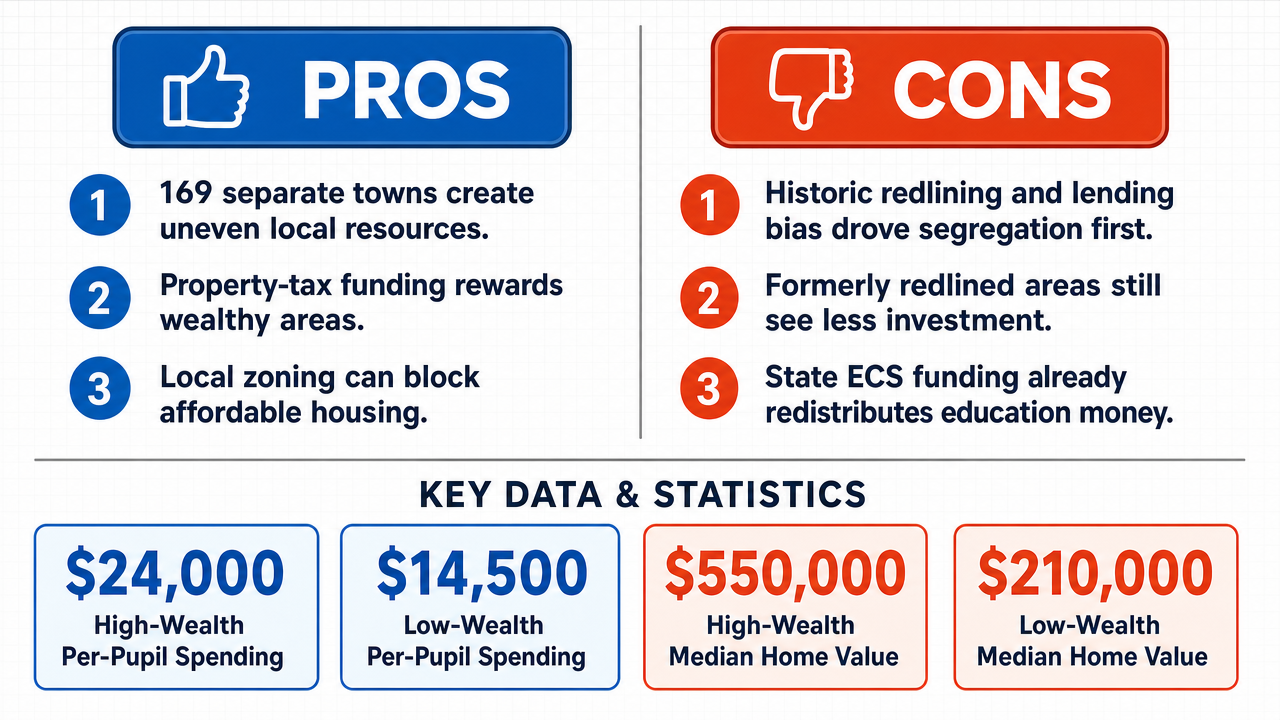
| Metric | High-Wealth Municipality (Avg) | Low-Wealth Municipality (Avg) | Disparity Factor |
|---|---|---|---|
| Per-Pupil Spending | $24,000 | $14,500 | 1.65x |
| Median Home Value | $550,000 | $210,000 | 2.62x |
| Property Tax Revenue | High | Low | N/A |
Legend: Comparative estimates of municipal resource capacity and property wealth. Disparity factor represents the ratio between high and low wealth municipalities. Data synthesized from municipal budget trends and real estate assessments.
Face-off transcripts
- ■
Ownership & Trade Secrets. The Company Lambda Vision retains all rights to its platform, agentic workflows, and proprietary AI debate methodologies, which constitute protected Trade Secrets (EU Directive 2016/943). Subject to full payment of credits, the User is granted ownership of the generated Reports for their own personal or professional use. Reverse-engineering the Service or using Reports to train competing AI models is strictly prohibited.
- ■
No Professional Advice. Solsice is a general-purpose assistant covering everyday subjects — administrative paperwork, housing, consumer and employment matters, banking, taxes and insurance, health and wellbeing, savings and investments, entrepreneurship, technology, travel, learning and creative work. Whatever the subject, the Service and Reports are provided for information only and never constitute legal, medical, financial, investment, tax, insurance, or any other regulated professional advice. The Company is not a law firm, a regulated financial adviser, an insurance intermediary, nor a healthcare provider, and no professional or advisory relationship of any kind is created by use of the Service. Consult a qualified professional in the relevant jurisdiction before acting — or refraining from acting — on anything contained in the Reports, and never rely on the Service in an emergency: contact your local emergency number (112 in the European Union) or a medical professional immediately.
- ■
AI-Generated Content, Sources and Viewpoints. Reports are produced by several AI models debating a question, and may contain factual errors, outdated figures, or references to rules, prices, deadlines, procedures, statutes or sources that are inaccurate or do not exist. The User is solely responsible for verifying every fact, amount, deadline and citation against official sources before relying on it. Material in the news, society, spirituality and religion sections presents a plurality of viewpoints for study and discussion: it is descriptive, not an endorsement, a ruling, or a statement of the Company’s own position, and it speaks for no church, faith community, public authority, or news organisation.
- ■
Liability & Governing Law. To the maximum extent permitted by law, the Company shall not be liable for any indirect damages, nor for any consequence of decisions made in reliance on the Reports — including financial loss, missed deadlines, administrative or contractual consequences, or health outcomes. These Terms are governed by French law. Any disputes shall be subject to the exclusive jurisdiction of the Courts of Paris, France.