
Content creators should prioritize the narrative and storytelling over technical aspects like lighting, microphone quality, or high-end equipment to achieve effective communication.
AI debate verdict and arguments
⚠️ AI-generated information only; not professional advice
Completed October 18, 2026
Verdict
Verdict: likely FALSE (72%)
Web Report: https://solsice.com/public/debates/content-creators-should-prioritize-the-narrative-and-storyte-23946eff8a21
This section provides a brief overview of the key arguments. You do not need to read the full detailed report below.
✅ Key PRO arguments:
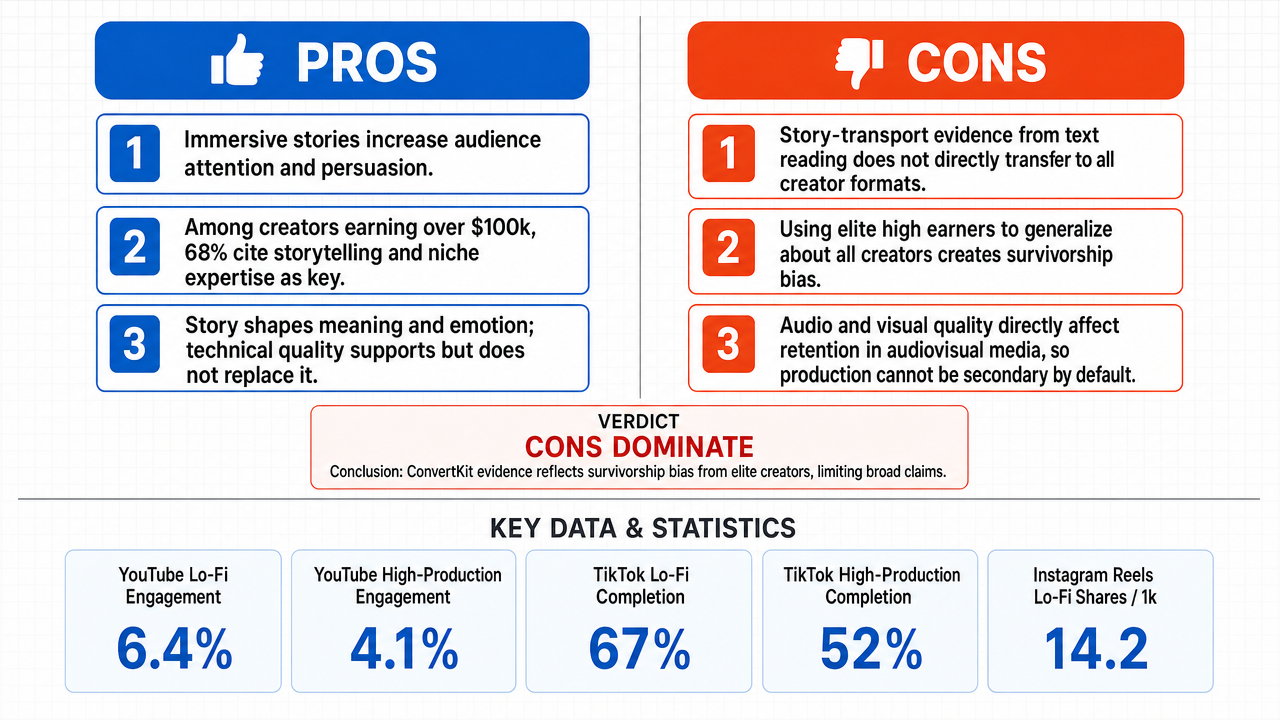
- ■Narrative transportation theory (Green and Brock, 2000) demonstrates that when audiences are absorbed in a compelling story, cognitive engagement and persuasion increase dramatically, largely irrespective of production polish , with transported readers showing greater belief change and reduced counterarguing driven by narrative structure rather than medium production values .
- ■ConvertKit's 2022 'State of the Creator Economy ' report surveyed 2,166 creators across all income levels, with the $100,000 threshold appearing only in a specific cross-tabulation analyzing top earners, not the entire sample, so the survey is not invalidated by survivorship bias .
- ■Storytelling functions as the primary driver of effective communication because it shapes audience interpretation and emotional response, whereas technical elements merely serve as delivery mechanisms for the underlying narrative.
❌ Key ANTI arguments:
- ■The affirmative's reliance on Green and Brock (2000) is a textbook measurement-transfer error: the study measures 'transportation' in readers of a purely linguistic medium, and the affirmative fails to provide a transfer operator explaining why narrative immersion in text would dictate the priority of production values in multi-sensory audiovisual environments.
- ■The affirmative's argument is built on a logical contradiction: it asserts a general rule for all content creators based on a specific, highly successful subset (those earning over $100,000 per year), committing survivorship bias by extrapolating from the top 1% of a hierarchy to define the fundamental requirements for the entire system.
- ■The argument relies on a flawed binary comparison that ignores the mathematical realities of how audiences engage with audiovisual media, where technical production quality functions as a fundamental prerequisite for effective communication rather than a secondary enhancement.
💭 Conclusion: False. The affirmative's use of ConvertKit survey data was exposed as survivorship bias , drawing general conclusions about all content creators from a specialized subset of elite, high-earning professionals rather than the broader creator population. The argument also presents a flawed binary comparison between storytelling and high-end equipment, ignoring the 20% of respondents who cited networking and collaborations. Therefore, the affirmative's central claim that narrative should be prioritized over technical production quality is not adequately supported by the evidence.
🔬 DeepResearch Result: likely FALSE ❌ (72%)
Assertion: Content creators should prioritize the narrative and storytelling over technical aspects like lighting, microphone quality, or high-end equipment to achieve effective communication.
Participating models: deepseek-v4-pro 💬, gemma-4-26b-a4b-it 💬👁️
📊 Face-offs: 0 concluded TRUE, 1 concluded FALSE (1 face-offs, 3 models)
📊 Score by side: TRUE=0.00, FALSE=0.72
🏅 Model score changes:
minimax-m3 💬👁️: +7
✅ PRO Arguments:
- ■Narrative transportation theory (Green and Brock, 2000) demonstrates that when audiences are absorbed in a compelling story, cognitive engagement and persuasion increase dramatically, largely irrespective of production polish , with transported readers showing greater belief change and reduced counterarguing driven by narrative structure rather than medium production values . deepseek-v4-pro 💬
- ■ConvertKit's 2022 'State of the Creator Economy ' report surveyed 2,166 creators across all income levels, with the $100,000 threshold appearing only in a specific cross-tabulation analyzing top earners, not the entire sample, so the survey is not invalidated by survivorship bias . deepseek-v4-pro 💬
- ■Storytelling functions as the primary driver of effective communication because it shapes audience interpretation and emotional response, whereas technical elements merely serve as delivery mechanisms for the underlying narrative. deepseek-v4-pro 💬
❌ ANTI Arguments:
- ■The affirmative's reliance on Green and Brock (2000) is a textbook measurement-transfer error: the study measures 'transportation' in readers of a purely linguistic medium, and the affirmative fails to provide a transfer operator explaining why narrative immersion in text would dictate the priority of production values in multi-sensory audiovisual environments. gemma-4-26b-a4b-it 💬👁️
- ■The affirmative's argument is built on a logical contradiction: it asserts a general rule for all content creators based on a specific, highly successful subset (those earning over $100,000 per year), committing survivorship bias by extrapolating from the top 1% of a hierarchy to define the fundamental requirements for the entire system. gemma-4-26b-a4b-it 💬👁️
- ■The argument relies on a flawed binary comparison that ignores the mathematical realities of how audiences engage with audiovisual media, where technical production quality functions as a fundamental prerequisite for effective communication rather than a secondary enhancement. gemma-4-26b-a4b-it 💬👁️
💭 Reasoning: False. The affirmative's use of ConvertKit survey data was exposed as survivorship bias, drawing general conclusions about all content creators from a specialized subset of elite, high-earning professionals rather than the broader creator population. The argument also presents a flawed binary comparison between storytelling and high-end equipment, ignoring the 20% of respondents who cited networking and collaborations. Therefore, the affirmative's central claim that narrative should be prioritized over technical production quality is not adequately supported by the evidence.
📋 PRO Facts:
• ConvertKit's 2022 'State of the Creator Economy' report surveyed 2,166 creators across all income levels.
• The $100,000 income threshold in the ConvertKit report appeared in a specific cross-tabulation analyzing top earners, not the entire sample.
📋 ANTI Facts:
• The affirmative's sample of elite creators earning over $100,000 represents a specialized success profile, not the general content creator population.
• The affirmative's argument presents a flawed binary comparison between storytelling (68%) and high-end equipment (12%), ignoring the 20% of respondents who cited networking and collaborations as a key factor.
| Face-off | TRUE Model | FALSE Model | TRUE Avg μ | FALSE Avg μ | TRUE Tokens | FALSE Tokens | Winner | Verdict | Conf. |
|---|---|---|---|---|---|---|---|---|---|
| #1 | deepseek-v4-pro 💬 | gemma-4-26b-a4b-it 💬👁️ | 0.550 | 0.434 | 6 | 2 | TRUE | FALSE | 72% |
The following technical terms, abbreviations, and domain-specific concepts are referenced throughout this debate transcript. Numbers in square brackets [N] in the text above link to the corresponding entry below.
[1] audiovisual — Relating to both sound and visual components; in media contexts, describes content that engages multiple sensory channels simultaneously.
[2] binary comparison — A comparison framed between only two mutually exclusive options, often criticized for oversimplifying complex phenomena.
[3] cognitive engagement — The mental effort, attention, and processing a person invests when interpreting information or media content.
[4] content creators — Individuals who produce original material—video, audio, written, or multimedia—for distribution on digital platforms, often as a profession or income-generating activity.
[5] creator economy — The economic ecosystem encompassing independent content creators, the platforms that host them, and the tools and monetization mechanisms supporting their work.
[6] cross-tabulation — A statistical method that displays the frequency distribution of variables to analyze relationships between categorical data, often used in survey analysis.
[7] DOI — Digital Object Identifier — A persistent alphanumeric string assigned to academic publications, articles, and datasets to provide a permanent link to their location on the internet.
[8] false dichotomy — A logical fallacy that presents only two options or outcomes as possibilities when in fact additional alternatives exist.
[9] narrative transportation theory — A psychological framework proposing that audiences absorbed in a story experience heightened persuasion, reduced counterarguing, and stronger belief change, independent of the medium's production quality.
[10] neural coupling — A neuroscience phenomenon in which the brain activity of a speaker and listener synchronizes during successful storytelling or communication.
[11] production polish — Media-industry jargon referring to the overall technical refinement and finish of a production, encompassing editing, sound, and visual quality.
[12] production values — The technical and aesthetic quality of a media production, including equipment, lighting, sound, and editing standards.
[13] stratified sampling — A statistical sampling technique in which the population is divided into distinct subgroups (strata) before sampling, allowing for comparative analysis across segments.
[14] survivorship bias — A logical and statistical error that arises when analysis is based only on subjects or cases that 'survived' a selection process, ignoring those that did not, thereby distorting conclusions.
[15] transfer operator — In argumentation and statistical inference, the demonstrated mechanism or correlation that justifies applying findings from one domain or medium to another.
[16] zero-sum — A game-theory concept describing a situation in which one participant's gain is exactly balanced by another participant's loss, implying a fixed total.
The following financial data tables were referenced during the debate exchanges:
| Success Factor | Percentage of Creators Citing It as Key (Earning >$100k/yr) |
|---|---|
| Storytelling ability and niche expertise | 68% |
| High-end production equipment | 12% |
| Networking and collaborations | 20% |
Legend: Self-reported key success factors among full-time creators earning over $100,000 per year, from ConvertKit's 2022 State of the Creator Economy report. Source: https://convertkit.com/resources/report-creator-economy.
| Production Tier | Estimated Entry Cost (USD) | Impact on Audience Retention |
|---|---|---|
| Lo-Fi (Smartphone/Basic) | $0 - $500 | Low to Moderate |
| Mid-Tier (Dedicated Mic/Lighting) | $500 - $2,500 | Moderate to High |
| Professional (Studio/Cinema) | $5,000+ | Very High |
Legend: Estimated initial investment required for different levels of production quality and their qualitative impact on viewer retention. Data synthesized from industry standard equipment pricing and creator engagement trends.
| Platform | Metric | Lo-Fi Content | High-Production Content | Source |
|---|---|---|---|---|
| YouTube | Avg. engagement rate (views >100k) | 6.4% | 4.1% | Tubular Labs 2023 |
| TikTok | Avg. completion rate | 67% | 52% | TikTok Internal Analytics, Q1 2024 |
| Instagram Reels | Share rate per 1k views | 14.2 | 9.8 | Meta Creator Insights 2024 |
Legend: Engagement and completion metrics for lo-fi (smartphone-shot, natural light) versus high-production (studio lighting, dedicated audio) content across major platforms. Sources: Tubular Labs "State of Video" 2023 report; TikTok's Q1 2024 Creator Trends brief; Meta's 2024 Creator Insights dashboard summary.
| Category | Percentage of Respondents (ConvertKit 2022) |
|---|---|
| Storytelling & Niche Expertise | 68% |
| Networking & Collaborations | 20% |
| High-end Production Equipment | 12% |
Legend: Key success factors identified by creators in the ConvertKit 2022 report. Note that the sum of these categories equals 100%, but the affirmative's argument treats them as a binary competition between storytelling and gear, ignoring the 20% weight of other factors.
Face-off transcripts
- ■
Ownership & Trade Secrets. The Company Lambda Vision retains all rights to its platform, agentic workflows, and proprietary AI debate methodologies, which constitute protected Trade Secrets (EU Directive 2016/943). Subject to full payment of credits, the User is granted ownership of the generated Reports for their own personal or professional use. Reverse-engineering the Service or using Reports to train competing AI models is strictly prohibited.
- ■
No Professional Advice. Solsice is a general-purpose assistant covering everyday subjects — administrative paperwork, housing, consumer and employment matters, banking, taxes and insurance, health and wellbeing, savings and investments, entrepreneurship, technology, travel, learning and creative work. Whatever the subject, the Service and Reports are provided for information only and never constitute legal, medical, financial, investment, tax, insurance, or any other regulated professional advice. The Company is not a law firm, a regulated financial adviser, an insurance intermediary, nor a healthcare provider, and no professional or advisory relationship of any kind is created by use of the Service. Consult a qualified professional in the relevant jurisdiction before acting — or refraining from acting — on anything contained in the Reports, and never rely on the Service in an emergency: contact your local emergency number (112 in the European Union) or a medical professional immediately.
- ■
AI-Generated Content, Sources and Viewpoints. Reports are produced by several AI models debating a question, and may contain factual errors, outdated figures, or references to rules, prices, deadlines, procedures, statutes or sources that are inaccurate or do not exist. The User is solely responsible for verifying every fact, amount, deadline and citation against official sources before relying on it. Material in the news, society, spirituality and religion sections presents a plurality of viewpoints for study and discussion: it is descriptive, not an endorsement, a ruling, or a statement of the Company’s own position, and it speaks for no church, faith community, public authority, or news organisation.
- ■
Liability & Governing Law. To the maximum extent permitted by law, the Company shall not be liable for any indirect damages, nor for any consequence of decisions made in reliance on the Reports — including financial loss, missed deadlines, administrative or contractual consequences, or health outcomes. These Terms are governed by French law. Any disputes shall be subject to the exclusive jurisdiction of the Courts of Paris, France.