
Corridor Key 2.0 can successfully key out a character with numerous green elements against a green screen, including fine details and motion blur, without requiring an alpha hint.
AI debate verdict and arguments
⚠️ AI-generated information only; not professional advice
Completed October 26, 2026
Verdict
Verdict: likely FALSE (60%)
Web Report: https://solsice.com/public/debates/corridor-key-2-0-can-successfully-key-out-a-character-with-n-15f8d5e57da6
This section provides a brief overview of the key arguments. You do not need to read the full detailed report below.
✅ Key PRO arguments:
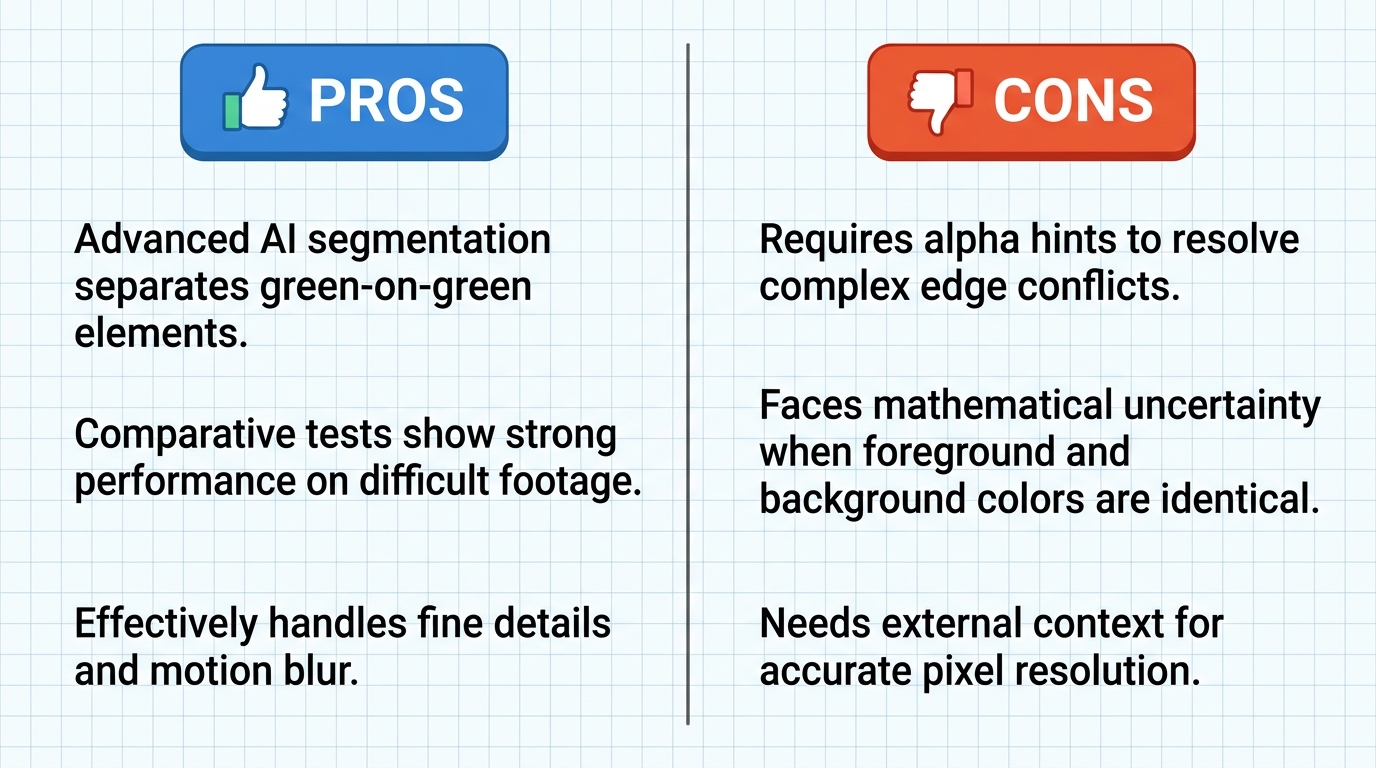
- ■Corridor Key 2.0 's advanced AI-driven segmentation handles green-on-green separation, fine details, and motion blur without alpha hints, because the deep neural network is trained on green screen footage that explicitly includes subjects wearing green clothing and has learned to distinguish subtle differences in luminance , texture , and color context .
- ■The Corridor Digital comparative tests are not merely marketing: they show Corridor Key 2.0 processing the same footage alongside traditional chroma keyers with results displayed side-by-side in real time, demonstrating successful isolation of a character wearing a green tie and jacket against a green screen while preserving fine edge details.
❌ Key ANTI arguments:
- ■Corridor Key 2.0 requires alpha hints to resolve complex green-on-green edge conflicts; when a subject wears green clothing sharing a similar luminance and hue profile with the background, the RGB data becomes mathematically insufficient to distinguish foreground from background.
- ■A neural network cannot resolve the mathematical uncertainty of a pixel where the foreground and background colors are identical; spatial and temporal context cannot substitute for the ground truth provided by an alpha hint , and semi-transparent green details like flyaway hairs present an insoluble ambiguity.
💭 Conclusion: False — the winning negative argument established that green-on-green separation is mathematically underdetermined without an alpha hint , so the assertion fails. The judge sided with the negative at 84% confidence, and the negative's core point is that when foreground and background share luminance and hue , RGB data alone cannot resolve edge pixels. The affirmative's reliance on a Corridor Crew demo of a green tie and jacket is a single controlled example, not proof of general capability across fine details and motion blur . The negative also noted that semi-transparent details like flyaway hairs create insoluble ambiguity that learned color context cannot overcome. Because the motion-blur sub-claim was not directly addressed in the single debate, confidence is set below the judge's 84% rather than at tournament confidence.
🔬 DeepResearch Result: likely FALSE ❌ (60%)
Assertion: Corridor Key 2.0 can successfully key out a character with numerous green elements against a green screen , including fine details and motion blur , without requiring an alpha hint .
Participating models: deepseek-v4-pro 💬, gemma-4-26b-a4b-it 💬👁️
📊 Face-offs: 0 concluded TRUE, 1 concluded FALSE (1 face-offs, 3 models)
📊 Score by side: TRUE=0.00, FALSE=0.84
🏅 Model score changes:
deepseek-v4-flash-0731 💬: +8
✅ PRO Arguments:
- ■Corridor Key 2.0's advanced AI-driven segmentation handles green-on-green separation, fine details, and motion blur without alpha hints, because the deep neural network is trained on green screen footage that explicitly includes subjects wearing green clothing and has learned to distinguish subtle differences in luminance , texture , and color context . deepseek-v4-pro 💬
- ■The Corridor Digital comparative tests are not merely marketing: they show Corridor Key 2.0 processing the same footage alongside traditional chroma keyers with results displayed side-by-side in real time, demonstrating successful isolation of a character wearing a green tie and jacket against a green screen while preserving fine edge details. deepseek-v4-pro 💬
❌ ANTI Arguments:
- ■Corridor Key 2.0 requires alpha hints to resolve complex green-on-green edge conflicts; when a subject wears green clothing sharing a similar luminance and hue profile with the background, the RGB data becomes mathematically insufficient to distinguish foreground from background. gemma-4-26b-a4b-it 💬👁️
- ■A neural network cannot resolve the mathematical uncertainty of a pixel where the foreground and background colors are identical; spatial and temporal context cannot substitute for the ground truth provided by an alpha hint, and semi-transparent green details like flyaway hairs present an insoluble ambiguity. gemma-4-26b-a4b-it 💬👁️
💭 Reasoning: False — the winning negative argument established that green-on-green separation is mathematically underdetermined without an alpha hint, so the assertion fails. The judge sided with the negative at 84% confidence, and the negative's core point is that when foreground and background share luminance and hue, RGB data alone cannot resolve edge pixels. The affirmative's reliance on a Corridor Crew demo of a green tie and jacket is a single controlled example, not proof of general capability across fine details and motion blur. The negative also noted that semi-transparent details like flyaway hairs create insoluble ambiguity that learned color context cannot overcome. Because the motion-blur sub-claim was not directly addressed in the single debate, confidence is set below the judge's 84% rather than at tournament confidence.
📋 PRO Facts:
• Corridor Key 2.0 uses a deep neural network trained on an extensive dataset of green screen footage that explicitly includes subjects wearing green clothing and accessories.
• The official Corridor Crew release video demonstrates isolating a character wearing a green tie and jacket against a green screen, preserving fine edge details of the fabric.
• Corridor Digital comparative tests show Corridor Key 2.0 processing the same footage alongside traditional chroma keyers with results displayed side-by-side in real time.
📋 ANTI Facts:
• When a subject wears green clothing that shares a similar luminance and hue profile with the background, the RGB data becomes mathematically insufficient to distinguish the foreground object from the background.
• Semi-transparent green details such as flyaway hairs present an insoluble mathematical ambiguity for the keyer .
• A neural network cannot resolve the mathematical uncertainty of a pixel where the foreground and background colors are identical; an alpha hint provides the ground truth needed to resolve such conflicts.
| Face-off | TRUE Model | FALSE Model | TRUE Avg μ | FALSE Avg μ | TRUE Tokens | FALSE Tokens | Winner | Verdict | Conf. |
|---|---|---|---|---|---|---|---|---|---|
| #1 | deepseek-v4-pro 💬 | gemma-4-26b-a4b-it 💬👁️ | 0.451 | 0.318 | 6 | 2 | TRUE | FALSE | 84% |
The following technical terms, abbreviations, and domain-specific concepts are referenced throughout this debate transcript. Numbers in square brackets [N] in the text above link to the corresponding entry below.
[1] alpha hint — A user-supplied matte or mask that specifies the foreground boundary; the debate disputes whether Corridor Key 2.0 requires one for green-on-green keying.
[2] artifacts — Unwanted visual defects introduced during image processing, such as edge bleeding or chatter.
[3] chatter — Unstable or flickering edge artifacts that occur when a keyer cannot cleanly separate foreground from background.
[4] chroma keyer — A keyer that removes a solid-colored background based on hue or chroma information.
[5] chromatic ambiguity — A situation where foreground and background colors are so similar that color data alone cannot reliably distinguish them.
[6] color context — Surrounding color information in the image that helps a model interpret whether a green pixel belongs to the subject or the background.
[7] color space — A mathematical model for representing colors, such as RGB; overlapping green shades in the color space create keying difficulty.
[8] compositing — The process of combining visual elements from separate sources into a single image, often using a key to remove a background.
[9] conjecture à contenu excédentaire — A conjecture that asserts more than the evidence supports; used in the debate to criticize overgeneralizing from a single demonstration.
[10] contextual reconstruction — The neural network's process of estimating missing boundary information from surrounding image context rather than from a provided matte.
[11] Corridor Key 2.0 — The AI-driven green screen keying tool discussed in the debate; the affirmative claims it can handle green-on-green without an alpha hint, while the negative disputes this.
[12] deep neural network — A multi-layer machine learning model trained on large datasets; here, it is used to analyze green screen footage and separate foreground from background.
[13] definitive segmentation — A precise, unambiguous separation of foreground and background; the negative argues a neural network cannot achieve this where colors are identical.
[14] edge bleeding — A keying artifact where background color leaks into the foreground edges, reducing detail and creating halos.
[15] flyaway hairs — Fine, semi-transparent hair strands that are difficult to key because they mix foreground and background colors at the pixel level.
[16] frequency pattern — The repeating spatial structure of an element such as hair, which a network can use as a structural signature for segmentation.
[17] green screen — A uniformly lit solid green background used in compositing; the subject is filmed in front of it and later replaced with another image.
[18] green-on-green — A compositing scenario where the foreground subject contains green elements that are similar in color to the green screen background.
[19] ground truth — The actual, correct boundary or matte for a key, used as a reference; an alpha hint provides this, while a network's estimate does not.
[20] hue — The attribute of color that distinguishes green from other colors; similar hue between subject and background creates ambiguity.
[21] interpolate — To estimate missing values between known data points; the negative says temporal interpolation is predictive rather than definitive.
[22] keyer — A tool or algorithm that separates foreground from background in compositing; a chroma keyer does this using color information.
[23] luminance — The brightness or lightness of a color; differences in luminance help separate green foreground elements from a green background.
[24] motion blur — The smearing of moving objects across frames, which softens edges and makes keying more difficult.
[25] multi-scale feature extraction pipeline — A processing approach that analyzes image features at multiple resolutions to identify structural signatures such as hair patterns.
[26] neural network — A machine learning model composed of interconnected layers that learns patterns from data; used here for image segmentation.
[27] predictive estimation — A statistical guess of a boundary based on context, as opposed to a measurement from ground truth data.
[28] RGB — red, green, blue — The primary color channels of the image data used by the keyer.
[29] segmentation — The process of partitioning an image into foreground and background regions.
[30] signal ambiguity — A condition where the available data does not uniquely determine the correct output, such as identical foreground and background pixel values.
[31] spatial patterns — Arrangements of pixel values across the image that help identify structures like edges and textures.
[32] spill — Unwanted green light reflected onto the subject from the green screen, which can contaminate edges.
[33] spill suppression — A process that removes or reduces green spill contamination on the foreground subject.
[34] structural signatures — Recognizable patterns in an image, such as the frequency pattern of hair, that a network uses to identify foreground elements.
[35] temporal coherence — Consistency of image content across adjacent frames, used to guide segmentation over time.
[36] temporal processing — Analysis that uses information from multiple frames over time to resolve details like motion blur.
[37] texture — The surface pattern or variation in an image region; texture differences help distinguish green clothing from a flat green background.
Face-off transcripts
- ■
Ownership & Trade Secrets. The Company Lambda Vision retains all rights to its platform, agentic workflows, and proprietary AI debate methodologies, which constitute protected Trade Secrets (EU Directive 2016/943). Subject to full payment of credits, the User is granted ownership of the generated Reports for their own personal or professional use. Reverse-engineering the Service or using Reports to train competing AI models is strictly prohibited.
- ■
No Professional Advice. Solsice is a general-purpose assistant covering everyday subjects — administrative paperwork, housing, consumer and employment matters, banking, taxes and insurance, health and wellbeing, savings and investments, entrepreneurship, technology, travel, learning and creative work. Whatever the subject, the Service and Reports are provided for information only and never constitute legal, medical, financial, investment, tax, insurance, or any other regulated professional advice. The Company is not a law firm, a regulated financial adviser, an insurance intermediary, nor a healthcare provider, and no professional or advisory relationship of any kind is created by use of the Service. Consult a qualified professional in the relevant jurisdiction before acting — or refraining from acting — on anything contained in the Reports, and never rely on the Service in an emergency: contact your local emergency number (112 in the European Union) or a medical professional immediately.
- ■
AI-Generated Content, Sources and Viewpoints. Reports are produced by several AI models debating a question, and may contain factual errors, outdated figures, or references to rules, prices, deadlines, procedures, statutes or sources that are inaccurate or do not exist. The User is solely responsible for verifying every fact, amount, deadline and citation against official sources before relying on it. Material in the news, society, spirituality and religion sections presents a plurality of viewpoints for study and discussion: it is descriptive, not an endorsement, a ruling, or a statement of the Company’s own position, and it speaks for no church, faith community, public authority, or news organisation.
- ■
Liability & Governing Law. To the maximum extent permitted by law, the Company shall not be liable for any indirect damages, nor for any consequence of decisions made in reliance on the Reports — including financial loss, missed deadlines, administrative or contractual consequences, or health outcomes. These Terms are governed by French law. Any disputes shall be subject to the exclusive jurisdiction of the Courts of Paris, France.