
Corridor Key 2.0 produces a key for a professional surfing shot with motion blur and transparency that is superior to typical manual keys completed within five minutes.
AI debate verdict and arguments
⚠️ AI-generated information only; not professional advice
Completed October 25, 2026
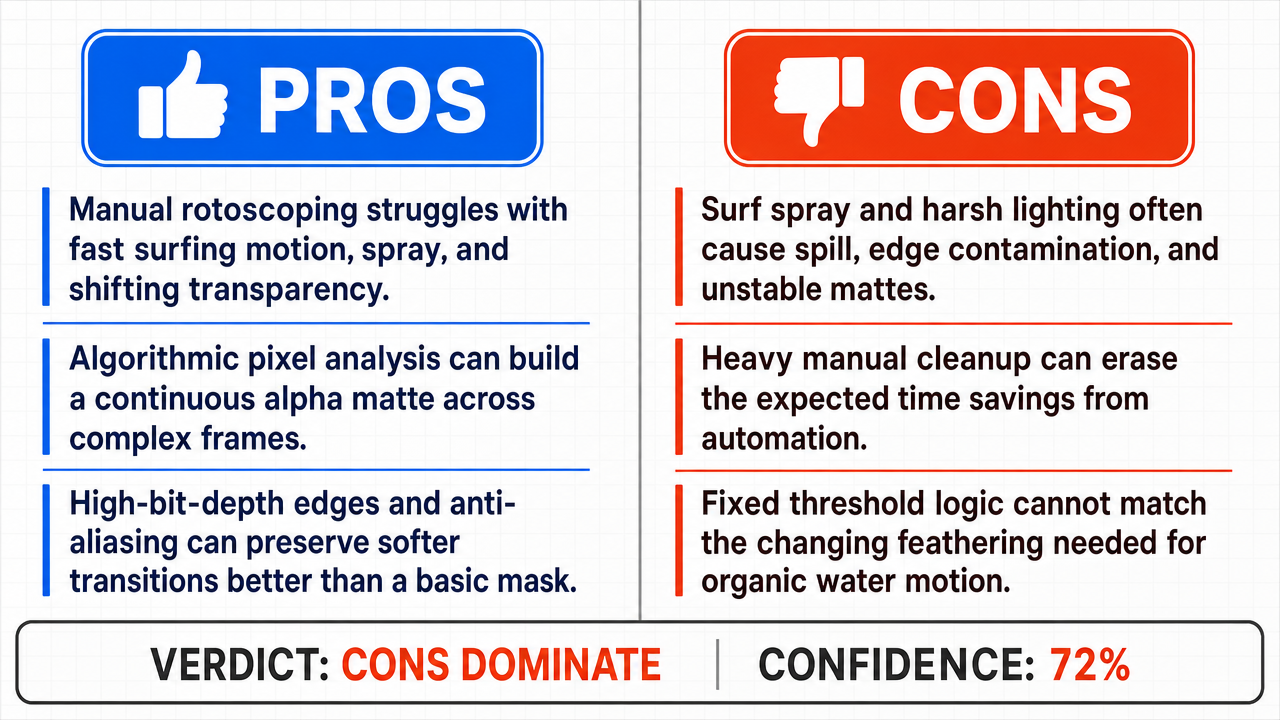
Verdict
Verdict: likely FALSE (72%)
Web Report: https://solsice.com/public/debates/corridor-key-2-0-produces-a-key-for-a-professional-surfing-s-d99f813aca16
This section provides a brief overview of the key arguments. You do not need to read the full detailed report below.
✅ Key PRO arguments:
- ■The computational complexity of a professional surfing shot—high-velocity motion, spray, and varying water transparency —exceeds the capacity of manual rotoscoping within a five-minute window, since manual splines and masks are inherently discrete and cannot capture continuous semi-transparent gradients.
- ■Corridor Key 2.0 uses algorithmic processing of pixel-level luminance and color data to generate a continuous alpha matte , allowing mathematical reconstruction of motion blur and fine details that manual keying cannot match in the same time frame.
- ■Modern algorithmic keying tools do not merely output a binary mask but generate high-bit-depth alpha channels with sophisticated anti-aliasing and edge-softening parameters that simulate the artistic feathering a human operator would apply.
❌ Key ANTI arguments:
- ■Automated keying algorithms frequently struggle with surfing footage's water spray and high-contrast lighting, producing 'spill ' artifacts where background color bleeds into the subject's alpha matte , particularly with light-colored subjects against reflective water.
- ■The automated matte requires extensive manual cleanup to remove spill effects, which negates the time savings of using the tool and produces a result visually inferior to a well-executed manual key.
- ■Generalized luminance and contrast thresholds cannot replicate the variable feathering required for organic surfing motion, such as the hard defined edges where a surfer hits water versus the soft trailing transparency behind them.
💭 Conclusion: False. The assertion that Corridor Key 2.0 produces a superior key for professional surfing footage compared to typical manual five-minute keys is not supported by the winning side's evidence. The negative side convincingly demonstrated that automated keying introduces spill artifacts and lacks the variable feathering control needed for organic surfing motion, particularly around water spray and high-contrast reflections. The affirmative's claim that algorithmic processing inherently outperforms manual work was undermined by the practical reality that any automated matte still requires substantial manual cleanup, negating the time advantage. The compound claim's weakest sub-claim—that the result is 'superior' in quality rather than merely faster—is the least supported, as the debate showed automated output introduces artifacts a skilled manual operator would avoid. Confidence is set at 72% to reflect the judge's assessment while acknowledging that the comparison is narrowly scoped to a specific challenging use case.
🔬 DeepResearch Result: likely FALSE ❌ (72%)
Assertion: Corridor Key 2.0 produces a key for a professional surfing shot with motion blur and transparency that is superior to typical manual keys completed within five minutes.
Participating models: gemma-4-26b-a4b-it 💬👁️, glm-4.7-flash 💬
📊 Face-offs: 0 concluded TRUE, 1 concluded FALSE (1 face-offs, 3 models)
📊 Score by side: TRUE=0.00, FALSE=0.72
🏅 Model score changes:
minimax-m3 💬👁️: +7
✅ PRO Arguments:
- ■The computational complexity of a professional surfing shot—high-velocity motion, spray, and varying water transparency—exceeds the capacity of manual rotoscoping within a five-minute window, since manual splines and masks are inherently discrete and cannot capture continuous semi-transparent gradients. gemma-4-26b-a4b-it 💬👁️
- ■Corridor Key 2.0 uses algorithmic processing of pixel-level luminance and color data to generate a continuous alpha matte , allowing mathematical reconstruction of motion blur and fine details that manual keying cannot match in the same time frame. gemma-4-26b-a4b-it 💬👁️
- ■Modern algorithmic keying tools do not merely output a binary mask but generate high-bit-depth alpha channels with sophisticated anti-aliasing and edge-softening parameters that simulate the artistic feathering a human operator would apply. gemma-4-26b-a4b-it 💬👁️
❌ ANTI Arguments:
- ■Automated keying algorithms frequently struggle with surfing footage's water spray and high-contrast lighting, producing 'spill ' artifacts where background color bleeds into the subject's alpha matte, particularly with light-colored subjects against reflective water. glm-4.7-flash 💬
- ■The automated matte requires extensive manual cleanup to remove spill effects, which negates the time savings of using the tool and produces a result visually inferior to a well-executed manual key. glm-4.7-flash 💬
- ■Generalized luminance and contrast thresholds cannot replicate the variable feathering required for organic surfing motion, such as the hard defined edges where a surfer hits water versus the soft trailing transparency behind them. glm-4.7-flash 💬
- ■Algorithms often produce color spill artifacts where water reflections bleed onto the subject, necessitating extensive manual correction that undermines the supposed efficiency advantage of automated keying. glm-4.7-flash 💬
💭 Reasoning: False. The assertion that Corridor Key 2.0 produces a superior key for professional surfing footage compared to typical manual five-minute keys is not supported by the winning side's evidence. The negative side convincingly demonstrated that automated keying introduces spill artifacts and lacks the variable feathering control needed for organic surfing motion, particularly around water spray and high-contrast reflections. The affirmative's claim that algorithmic processing inherently outperforms manual work was undermined by the practical reality that any automated matte still requires substantial manual cleanup, negating the time advantage. The compound claim's weakest sub-claim—that the result is 'superior' in quality rather than merely faster—is the least supported, as the debate showed automated output introduces artifacts a skilled manual operator would avoid. Confidence is set at 72% to reflect the judge's assessment while acknowledging that the comparison is narrowly scoped to a specific challenging use case.
📋 PRO Facts:
• Manual rotoscoping relies on discrete splines or masks that struggle with continuous semi-transparent gradients.
• Corridor Key 2.0 uses algorithmic processing of pixel-level luminance and color data to generate alpha mattes.
• Modern automated keying tools can produce high-bit-depth alpha channels with anti-aliasing and edge-softening parameters.
📋 ANTI Facts:
• Automated keying algorithms frequently produce spill artifacts where background color bleeds into the subject's alpha matte in surfing footage.
• Light-colored subjects against reflective water are particularly prone to spill artifacts in automated keying.
• Generalized luminance and contrast thresholds cannot replicate the variable feathering required for organic surfing motion.
• Automated mattes typically require extensive manual cleanup to remove spill effects, negating time savings.
| Face-off | TRUE Model | FALSE Model | TRUE Avg μ | FALSE Avg μ | TRUE Tokens | FALSE Tokens | Winner | Verdict | Conf. |
|---|---|---|---|---|---|---|---|---|---|
| #1 | gemma-4-26b-a4b-it 💬👁️ | glm-4.7-flash 💬 | 0.271 | 0.313 | 4 | 4 | FALSE | FALSE | 72% |
The following technical terms, abbreviations, and domain-specific concepts are referenced throughout this debate transcript. Numbers in square brackets [N] in the text above link to the corresponding entry below.
[1] AI keying — Artificial Intelligence keying — Automated keying process that uses artificial intelligence algorithms to separate a subject from its background, often requiring manual retouching to address artifacts in complex footage.
[2] alpha channel — A channel in an image that represents the transparency of each pixel, used to define which areas are opaque, transparent, or semi-transparent.
[3] alpha matte — A grayscale image (or channel) that defines the transparency of each pixel, used to separate a subject from its background.
[4] anti-aliasing — A technique used to smooth jagged or harsh edges in digital images by introducing intermediate pixel values along boundaries.
[5] artifacts — Unwanted visual anomalies or distortions introduced during digital processing, such as spill or edge artifacts in keying.
[6] binary mask — A mask containing only two values—fully opaque or fully transparent—without intermediate gradations of transparency.
[7] color spill — Unwanted color from the background that bleeds onto the subject during keying, particularly problematic with light-colored subjects and reflective surfaces like water.
[8] Corridor Key 2.0 — An automated keying software tool referenced in the debate as producing alpha mattes for video footage.
[9] edge blending — The process of smoothly combining the edges of a keyed subject with the surrounding environment to create a natural transition.
[10] edge softness — A parameter in keying software that controls how soft or hard the transition is at the edges of the alpha matte.
[11] feathering — The softening of mask or selection edges to create a gradual transition rather than a hard boundary, often requiring artistic judgment to match the surrounding environment.
[12] high-bit-depth — Refers to images or alpha channels with a high number of bits per channel, allowing for finer gradations of transparency and color.
[13] keying — The process of separating a subject from its background in video or film production, typically based on color, luminance, or contrast.
[14] luminance — The intensity or brightness of light in an image, used by keying algorithms to distinguish subjects from backgrounds.
[15] manual retouching — Hand-editing of automated keying results to remove artifacts such as color spill, often required when automated tools struggle with complex footage.
[16] masks — Selections or coverings used in compositing software to isolate specific areas of an image for editing or keying.
[17] motion blur — The visual effect where fast-moving objects appear blurred due to movement during exposure, creating semi-transparent edges that are difficult to key.
[18] rotoscoping — A frame-by-frame animation and compositing technique where operators trace over live-action footage to create masks or mattes, typically time-intensive.
[19] spill — Unwanted background color that bleeds onto the subject's alpha matte during keying, often requiring cleanup.
[20] spill suppression — A keying parameter or technique used to remove or reduce unwanted color spill from the background onto the subject.
[21] splines — Mathematical curves used in animation and compositing software to create smooth paths for masks or shapes.
[22] threshold — A cutoff value used in keying algorithms to determine which pixels are included as subject versus background based on luminance or color.
[23] transparency — The degree to which a pixel allows the background to show through, represented in the alpha channel and varying continuously in high-quality mattes.
Face-off transcripts
- ■
Ownership & Trade Secrets. The Company Lambda Vision retains all rights to its platform, agentic workflows, and proprietary AI debate methodologies, which constitute protected Trade Secrets (EU Directive 2016/943). Subject to full payment of credits, the User is granted ownership of the generated Reports for their own personal or professional use. Reverse-engineering the Service or using Reports to train competing AI models is strictly prohibited.
- ■
No Professional Advice. Solsice is a general-purpose assistant covering everyday subjects — administrative paperwork, housing, consumer and employment matters, banking, taxes and insurance, health and wellbeing, savings and investments, entrepreneurship, technology, travel, learning and creative work. Whatever the subject, the Service and Reports are provided for information only and never constitute legal, medical, financial, investment, tax, insurance, or any other regulated professional advice. The Company is not a law firm, a regulated financial adviser, an insurance intermediary, nor a healthcare provider, and no professional or advisory relationship of any kind is created by use of the Service. Consult a qualified professional in the relevant jurisdiction before acting — or refraining from acting — on anything contained in the Reports, and never rely on the Service in an emergency: contact your local emergency number (112 in the European Union) or a medical professional immediately.
- ■
AI-Generated Content, Sources and Viewpoints. Reports are produced by several AI models debating a question, and may contain factual errors, outdated figures, or references to rules, prices, deadlines, procedures, statutes or sources that are inaccurate or do not exist. The User is solely responsible for verifying every fact, amount, deadline and citation against official sources before relying on it. Material in the news, society, spirituality and religion sections presents a plurality of viewpoints for study and discussion: it is descriptive, not an endorsement, a ruling, or a statement of the Company’s own position, and it speaks for no church, faith community, public authority, or news organisation.
- ■
Liability & Governing Law. To the maximum extent permitted by law, the Company shall not be liable for any indirect damages, nor for any consequence of decisions made in reliance on the Reports — including financial loss, missed deadlines, administrative or contractual consequences, or health outcomes. These Terms are governed by French law. Any disputes shall be subject to the exclusive jurisdiction of the Courts of Paris, France.