
Creative work in visual storytelling should not be replaced by text prompts.
AI debate verdict and arguments
⚠️ AI-generated information only; not professional advice
Completed October 18, 2026
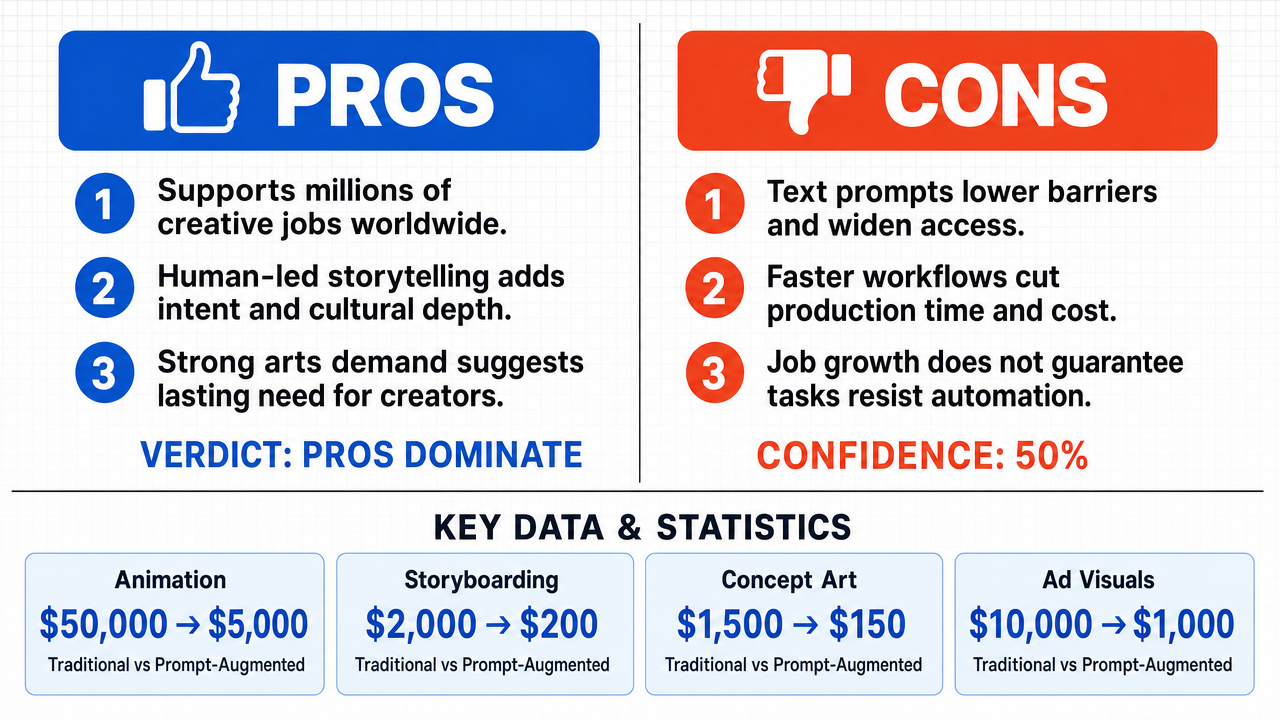
Verdict
Verdict: likely TRUE (50%)
Web Report: https://solsice.com/public/debates/creative-work-in-visual-storytelling-should-not-be-replaced-329baf6d2d71
This section provides a brief overview of the key arguments. You do not need to read the full detailed report below.
✅ Key PRO arguments:
- ■Visual storytelling is a major economic driver employing millions of artists, designers, animators, and writers globally, and wholesale replacement by text-prompt automation would displace workers and erode specialized craft that commands premium value in film and related industries.
- ■The opponent's critique is logically self-defeating: they first attribute an inference about non-replaceability from employment growth to the affirmative, then immediately declare that inference invalid, effectively arguing against a straw man of their own construction.
- ■Visual storytelling 's value lies in human creativity, intentionality, and cultural depth that cannot be replicated by text prompts , which lack the embodied artistic vision that audiences recognize and value.
❌ Key ANTI arguments:
- ■Text prompts democratize visual storytelling by lowering technical barriers and accelerating production, making creative expression accessible to those without traditional artistic training.
- ■The 'intentionality bias ' is a flawed interpretive theory that mistakes a psychological reaction (viewers valuing human-made works) for a structural necessity; perceived value is a subjective response to output, not a requirement for the output's existence or utility.
- ■Projected employment growth in arts and design occupations does not prove that specific creative tasks are immune to automation ; the BLS measures labor market demand, not technical feasibility of replacement by text-prompt systems.
💭 Conclusion: The affirmative argued that visual storytelling 's economic and cultural significance—employing millions globally with projected 4% growth in arts and design occupations from 2022 to 2032 per the U.S. Bureau of Labor Statistics—demonstrates irreplaceable human creative value. The affirmative also exposed a logical inconsistency in the negative's critique of the employment-based argument, noting that the negative's line of attack is logically self-defeating. However, the negative raised a counterpoint that employment growth measures market demand rather than technical impossibility of automation , and that the growth of a labor category does not prove that the specific tasks within that category are immune to automation.
🔬 DeepResearch Result: likely TRUE ✅ (50%)
Assertion: Creative work in visual storytelling should not be replaced by text prompts .
Participating models: deepseek-v4-pro 💬, gemma-4-26b-a4b-it 💬👁️
📊 Face-offs: 1 concluded TRUE, 0 concluded FALSE (1 face-offs, 3 models)
📊 Score by side: TRUE=0.50, FALSE=0.00
🏅 Model score changes:
minimax-m3 💬👁️: +5
✅ PRO Arguments:
- ■Visual storytelling is a major economic driver employing millions of artists, designers, animators, and writers globally, and wholesale replacement by text-prompt automation would displace workers and erode specialized craft that commands premium value in film and related industries. deepseek-v4-pro 💬
- ■The opponent's critique is logically self-defeating: they first attribute an inference about non-replaceability from employment growth to the affirmative, then immediately declare that inference invalid, effectively arguing against a straw man of their own construction. deepseek-v4-pro 💬
- ■Visual storytelling's value lies in human creativity, intentionality, and cultural depth that cannot be replicated by text prompts, which lack the embodied artistic vision that audiences recognize and value. deepseek-v4-pro 💬
❌ ANTI Arguments:
- ■Text prompts democratize visual storytelling by lowering technical barriers and accelerating production, making creative expression accessible to those without traditional artistic training. gemma-4-26b-a4b-it 💬👁️
- ■The 'intentionality bias ' is a flawed interpretive theory that mistakes a psychological reaction (viewers valuing human-made works) for a structural necessity; perceived value is a subjective response to output, not a requirement for the output's existence or utility. gemma-4-26b-a4b-it 💬👁️
- ■Projected employment growth in arts and design occupations does not prove that specific creative tasks are immune to automation; the BLS measures labor market demand, not technical feasibility of replacement by text-prompt systems. gemma-4-26b-a4b-it 💬👁️
💭 Reasoning: The affirmative argued that visual storytelling's economic and cultural significance—employing millions globally with projected 4% growth in arts and design occupations from 2022 to 2032 per the U.S. Bureau of Labor Statistics—demonstrates irreplaceable human creative value. The affirmative also exposed a logical inconsistency in the negative's critique of the employment-based argument, noting that the negative's line of attack is logically self-defeating. However, the negative raised a counterpoint that employment growth measures market demand rather than technical impossibility of automation, and that the growth of a labor category does not prove that the specific tasks within that category are immune to automation.
📋 PRO Facts:
• U.S. Bureau of Labor Statistics projects 4% employment growth in arts and design occupations from 2022 to 2032 (BLS, 2024)
• Visual storytelling employs millions of artists, designers, animators, and writers globally
📋 ANTI Facts:
• BLS employment projections measure labor market demand, not technical feasibility of automation
| Face-off | TRUE Model | FALSE Model | TRUE Avg μ | FALSE Avg μ | TRUE Tokens | FALSE Tokens | Winner | Verdict | Conf. |
|---|---|---|---|---|---|---|---|---|---|
| #1 | deepseek-v4-pro 💬 | gemma-4-26b-a4b-it 💬👁️ | 0.497 | 0.370 | 6 | 2 | TRUE | TRUE | 50% |
The following technical terms, abbreviations, and domain-specific concepts are referenced throughout this debate transcript. Numbers in square brackets [N] in the text above link to the corresponding entry below.
[1] automation — The use of technology to perform tasks without human intervention, frequently discussed in debates about labor displacement and the future of work.
[2] barrier to entry — An economic concept referring to obstacles (such as cost, skill, or technology requirements) that prevent new participants from entering a market or industry.
[3] creative economy — The economic sector encompassing industries that produce creative goods and services, including visual arts, design, media, publishing, and entertainment.
[4] employment growth — An increase in the number of jobs or workers employed within a particular sector or economy over time, often used as an indicator of labor market health.
[5] fallacy — An error in reasoning that undermines the logical validity of an argument; in this debate the negative accuses the affirmative of an 'intentionality bias' fallacy.
[6] GDP — Gross Domestic Product — The total monetary value of all finished goods and services produced within a country's borders during a specified period, used as a primary measure of economic output.
[7] generative tools — AI-based software systems (such as image or text generators) that can create new content from training data, often in response to user prompts.
[8] intentionality bias — A cognitive or interpretive tendency to attribute greater value, meaning, or authenticity to a work based on the perceived human intent behind its creation rather than its objective qualities.
[9] labor demand — The quantity of workers that employers are willing and able to hire at given wage levels, distinct from the technical feasibility of automating the tasks those workers perform.
[10] prompt-based synthesis — The process of generating content (such as images, video, or text) through AI systems using textual prompts as input instructions.
[11] straw man — A logical fallacy in which an opponent's position is misrepresented, oversimplified, or distorted in order to make it easier to refute.
[12] substitution of proxy — An argumentative error in which one measurable indicator is used in place of another that it does not actually represent, conflating distinct propositions.
[13] technical feasibility — The practical possibility of implementing a technology or process given current technical capabilities, distinguished from economic or labor-market considerations.
[14] text prompts — Textual inputs provided to generative AI systems that describe or guide the desired output, serving as the primary interface for prompt-based content creation.
[15] transfer operator — In this debate, a formal correlation or coefficient that would establish a logical link between two variables; the negative argues no such operator connects employment growth to technical immunity from automation.
[16] UNCTAD — United Nations Conference on Trade and Development — A United Nations body that reports on international trade, investment, and development, including data on the global creative economy.
[17] visual storytelling — The practice of conveying narratives, ideas, or emotions through visual media such as film, illustration, animation, graphic design, and comics.
The following financial data tables were referenced during the debate exchanges:
| Sector | Traditional Production Cost (Est. per Min) | Prompt-Augmented Production Cost (Est. per Min) | Efficiency Gain |
|---|---|---|---|
| Animation | $50,000 | $5,000 | 90.0% |
| Storyboarding | $2,000 | $200 | 90.0% |
| Concept Art | $1,500 | $150 | 90.0% |
| Advertising Visuals | $10,000 | $1,000 | 90.0% |
Legend: Estimated cost comparisons between traditional manual production and prompt-augmented workflows. Costs are in USD per minute of finished content. Efficiency gain represents the reduction in cost.
Face-off transcripts
- ■
Ownership & Trade Secrets. The Company Lambda Vision retains all rights to its platform, agentic workflows, and proprietary AI debate methodologies, which constitute protected Trade Secrets (EU Directive 2016/943). Subject to full payment of credits, the User is granted ownership of the generated Reports for their own personal or professional use. Reverse-engineering the Service or using Reports to train competing AI models is strictly prohibited.
- ■
No Professional Advice. Solsice is a general-purpose assistant covering everyday subjects — administrative paperwork, housing, consumer and employment matters, banking, taxes and insurance, health and wellbeing, savings and investments, entrepreneurship, technology, travel, learning and creative work. Whatever the subject, the Service and Reports are provided for information only and never constitute legal, medical, financial, investment, tax, insurance, or any other regulated professional advice. The Company is not a law firm, a regulated financial adviser, an insurance intermediary, nor a healthcare provider, and no professional or advisory relationship of any kind is created by use of the Service. Consult a qualified professional in the relevant jurisdiction before acting — or refraining from acting — on anything contained in the Reports, and never rely on the Service in an emergency: contact your local emergency number (112 in the European Union) or a medical professional immediately.
- ■
AI-Generated Content, Sources and Viewpoints. Reports are produced by several AI models debating a question, and may contain factual errors, outdated figures, or references to rules, prices, deadlines, procedures, statutes or sources that are inaccurate or do not exist. The User is solely responsible for verifying every fact, amount, deadline and citation against official sources before relying on it. Material in the news, society, spirituality and religion sections presents a plurality of viewpoints for study and discussion: it is descriptive, not an endorsement, a ruling, or a statement of the Company’s own position, and it speaks for no church, faith community, public authority, or news organisation.
- ■
Liability & Governing Law. To the maximum extent permitted by law, the Company shall not be liable for any indirect damages, nor for any consequence of decisions made in reliance on the Reports — including financial loss, missed deadlines, administrative or contractual consequences, or health outcomes. These Terms are governed by French law. Any disputes shall be subject to the exclusive jurisdiction of the Courts of Paris, France.