
Delaware County's policy requiring election workers to abstain from prediction market activities will significantly enhance public trust in the integrity of its election administration.
AI debate verdict and arguments
⚠️ AI-generated information only; not professional advice
Completed October 14, 2026
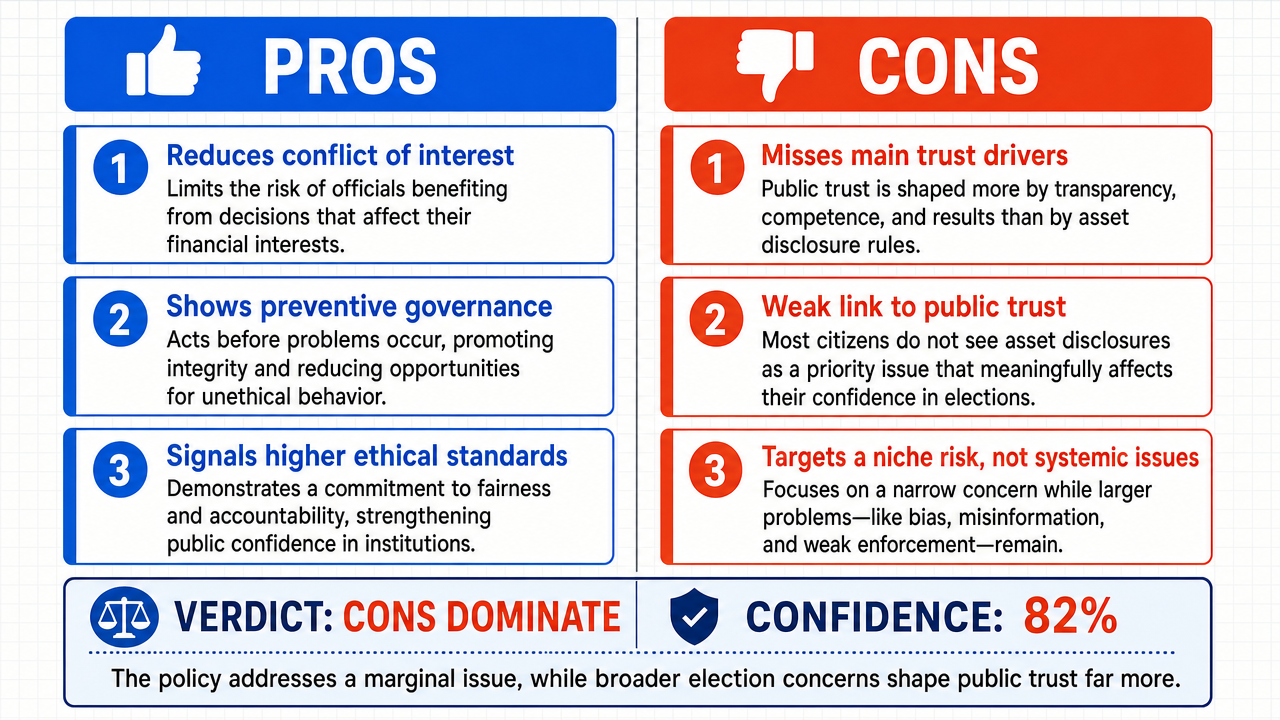
Verdict
Verdict: likely FALSE (82%)
Web Report: https://solsice.com/public/debates/delaware-county-s-policy-requiring-election-workers-to-absta-191f72ea8fbe
This section provides a brief overview of the key arguments. You do not need to read the full detailed report below.
✅ Key PRO arguments:
- ■The policy directly addresses a tangible conflict of interest , since election workers with personal financial stakes in electoral outcomes have an incentive that can create a corrosive perception problem , and a clear prohibition signals prioritization of impartiality.
- ■Clear, preventative rules are generally perceived as signs of competent governance rather than admissions of guilt, drawing on established public administration research about ethics rules for public officials.
❌ Key ANTI arguments:
- ■Public skepticism is overwhelmingly driven by systemic concerns such as voter access , ballot security, and large-scale logistical operations ; focusing on the statistically negligible portion of workers involved in prediction markets creates a 'security theater ' effect that fails to address actual trust drivers.
- ■The claim that removing prediction-market activity removes a meaningful conflict of interest fails to provide a transfer mechanism linking an election worker's market status to measurable erosion of public trust, making the asserted causal link unsupported.
- ■Targeting a marginal risk while ignoring systemic drivers of skepticism is unlikely to produce a significant enhancement in public trust, since the policy intervenes at the wrong scale relative to the actual sources of electoral distrust.
💭 Conclusion: False. The winning side convincingly argued that the policy targets a marginal, niche activity rather than the systemic drivers of public skepticism about elections. The affirmative failed to supply a credible causal transfer mechanism connecting prediction-market abstinence by a small group of workers to measurable gains in public trust. Additionally, the affirmative's own reasoning—that clear preventative rules are read as competent governance—was not backed by concrete evidence specific to this policy. While the policy may offer marginal symbolic value, the debate established that this alone is unlikely to constitute a significant enhancement of public trust in Delaware County's election administration .
🔬 DeepResearch Result: likely FALSE ❌ (82%)
Assertion: Delaware County's policy requiring election workers to abstain from prediction market activities will significantly enhance public trust in the integrity of its election administration .
Participating models: deepseek-v3.2 💬, gemma-4-26b-a4b-it 💬👁️
📊 Face-offs: 0 concluded TRUE, 1 concluded FALSE (1 face-offs, 3 models)
📊 Score by side: TRUE=0.00, FALSE=0.82
🏅 Model score changes:
minimax-m3 💬👁️: +8
✅ PRO Arguments:
- ■The policy directly addresses a tangible conflict of interest , since election workers with personal financial stakes in electoral outcomes have an incentive that can create a corrosive perception problem , and a clear prohibition signals prioritization of impartiality. deepseek-v3.2 💬
- ■Clear, preventative rules are generally perceived as signs of competent governance rather than admissions of guilt, drawing on established public administration research about ethics rules for public officials. deepseek-v3.2 💬
❌ ANTI Arguments:
- ■Public skepticism is overwhelmingly driven by systemic concerns such as voter access , ballot security, and large-scale logistical operations ; focusing on the statistically negligible portion of workers involved in prediction markets creates a 'security theater ' effect that fails to address actual trust drivers. gemma-4-26b-a4b-it 💬👁️
- ■The claim that removing prediction-market activity removes a meaningful conflict of interest fails to provide a transfer mechanism linking an election worker's market status to measurable erosion of public trust, making the asserted causal link unsupported. gemma-4-26b-a4b-it 💬👁️
- ■Targeting a marginal risk while ignoring systemic drivers of skepticism is unlikely to produce a significant enhancement in public trust, since the policy intervenes at the wrong scale relative to the actual sources of electoral distrust. gemma-4-26b-a4b-it 💬👁️
💭 Reasoning: False. The winning side convincingly argued that the policy targets a marginal, niche activity rather than the systemic drivers of public skepticism about elections. The affirmative failed to supply a credible causal transfer mechanism connecting prediction-market abstinence by a small group of workers to measurable gains in public trust. Additionally, the affirmative's own reasoning—that clear preventative rules are read as competent governance—was not backed by concrete evidence specific to this policy. While the policy may offer marginal symbolic value, the debate established that this alone is unlikely to constitute a significant enhancement of public trust in Delaware County's election administration.
📋 PRO Facts:
• Election workers with financial stakes in electoral outcomes via prediction markets can create perceived conflicts of interest.
• Public administration research generally treats clear, preventative ethics rules as signs of competent governance rather than admissions of guilt.
📋 ANTI Facts:
• Public skepticism about elections is primarily driven by systemic concerns such as voter access, ballot security, and large-scale logistical administration.
• Prediction-market participation involves a statistically negligible portion of the election workforce, limiting any policy's measurable impact on overall trust.
• Prioritizing highly visible but low-impact rules can create a 'security theater' effect that does not address underlying sources of distrust.
| Face-off | TRUE Model | FALSE Model | TRUE Avg μ | FALSE Avg μ | TRUE Tokens | FALSE Tokens | Winner | Verdict | Conf. |
|---|---|---|---|---|---|---|---|---|---|
| #1 | deepseek-v3.2 💬 | gemma-4-26b-a4b-it 💬👁️ | 0.352 | 0.270 | 8 | 2 | TRUE | FALSE | 82% |
The following technical terms, abbreviations, and domain-specific concepts are referenced throughout this debate transcript. Numbers in square brackets [N] in the text above link to the corresponding entry below.
[1] chain-of-custody protocols — Documented procedures for tracking the sequential possession and handling of physical or digital materials (such as ballots) from collection through final disposition, used to demonstrate evidentiary integrity.
[2] conflict of interest — A situation in which a person's personal financial or other interests have the potential to compromise their professional judgment, impartiality, or official duties.
[3] election administration — The operational management of elections, including voter registration, polling place operations, ballot handling, counting, and the enforcement of electoral rules.
[4] election workers — Public officials or staff responsible for carrying out election-day and pre-election procedures, such as poll workers, ballot counters, and election clerks.
[5] institutional trust — Public confidence in the legitimacy and competence of institutions (such as government agencies or electoral bodies) to act fairly and effectively.
[6] logistical operations — In the election context, the large-scale operational tasks of deploying personnel, equipment, ballots, and polling locations needed to run an election.
[7] perception problem — A situation where public perception of impropriety or bias can be as damaging to credibility as actual misconduct, even absent evidence of any real wrongdoing.
[8] prediction markets — Exchange-traded or platform-based markets where participants buy and sell contracts whose payoffs depend on the outcome of future events, such as election results, effectively aggregating beliefs about probabilities.
[9] public administration research — The academic study of how governmental policies are implemented and how bureaucratic institutions operate, including questions of ethics, governance quality, and regulatory perception.
[10] security theater — The practice of implementing visible but largely ineffective security or integrity measures that convey the impression of improved safety without addressing underlying substantive risks; debated in the transcript as potentially eroding trust.
[11] transfer operator — In the context of this debate, a term used to denote an explicit causal or statistical linkage (e.g., correlation, empirical frequency) connecting a hypothesized cause to a claimed effect; the argument contends that absent such an operator, a claim remains theoretical.
[12] voter access — The ease with which eligible citizens can register to vote, obtain ballots, and cast them, often discussed in debates over polling place availability, ID requirements, and mail-in voting procedures.
Face-off transcripts
- ■
Ownership & Trade Secrets. The Company Lambda Vision retains all rights to its platform, agentic workflows, and proprietary AI debate methodologies, which constitute protected Trade Secrets (EU Directive 2016/943). Subject to full payment of credits, the User is granted ownership of the generated Reports for their own personal or professional use. Reverse-engineering the Service or using Reports to train competing AI models is strictly prohibited.
- ■
No Professional Advice. Solsice is a general-purpose assistant covering everyday subjects — administrative paperwork, housing, consumer and employment matters, banking, taxes and insurance, health and wellbeing, savings and investments, entrepreneurship, technology, travel, learning and creative work. Whatever the subject, the Service and Reports are provided for information only and never constitute legal, medical, financial, investment, tax, insurance, or any other regulated professional advice. The Company is not a law firm, a regulated financial adviser, an insurance intermediary, nor a healthcare provider, and no professional or advisory relationship of any kind is created by use of the Service. Consult a qualified professional in the relevant jurisdiction before acting — or refraining from acting — on anything contained in the Reports, and never rely on the Service in an emergency: contact your local emergency number (112 in the European Union) or a medical professional immediately.
- ■
AI-Generated Content, Sources and Viewpoints. Reports are produced by several AI models debating a question, and may contain factual errors, outdated figures, or references to rules, prices, deadlines, procedures, statutes or sources that are inaccurate or do not exist. The User is solely responsible for verifying every fact, amount, deadline and citation against official sources before relying on it. Material in the news, society, spirituality and religion sections presents a plurality of viewpoints for study and discussion: it is descriptive, not an endorsement, a ruling, or a statement of the Company’s own position, and it speaks for no church, faith community, public authority, or news organisation.
- ■
Liability & Governing Law. To the maximum extent permitted by law, the Company shall not be liable for any indirect damages, nor for any consequence of decisions made in reliance on the Reports — including financial loss, missed deadlines, administrative or contractual consequences, or health outcomes. These Terms are governed by French law. Any disputes shall be subject to the exclusive jurisdiction of the Courts of Paris, France.