
Digital media addiction should be regulated by governments and corporations using a public health framework similar to environmental pollution controls.
AI debate verdict and arguments
⚠️ AI-generated information only; not professional advice
Completed November 13, 2026
Verdict
Verdict: likely FALSE (76%)
Web Report: https://solsice.com/public/debates/digital-media-addiction-should-be-regulated-by-governments-a-f27ca465799e
This section provides a brief overview of the key arguments. You do not need to read the full detailed report below.
✅ Key PRO arguments:
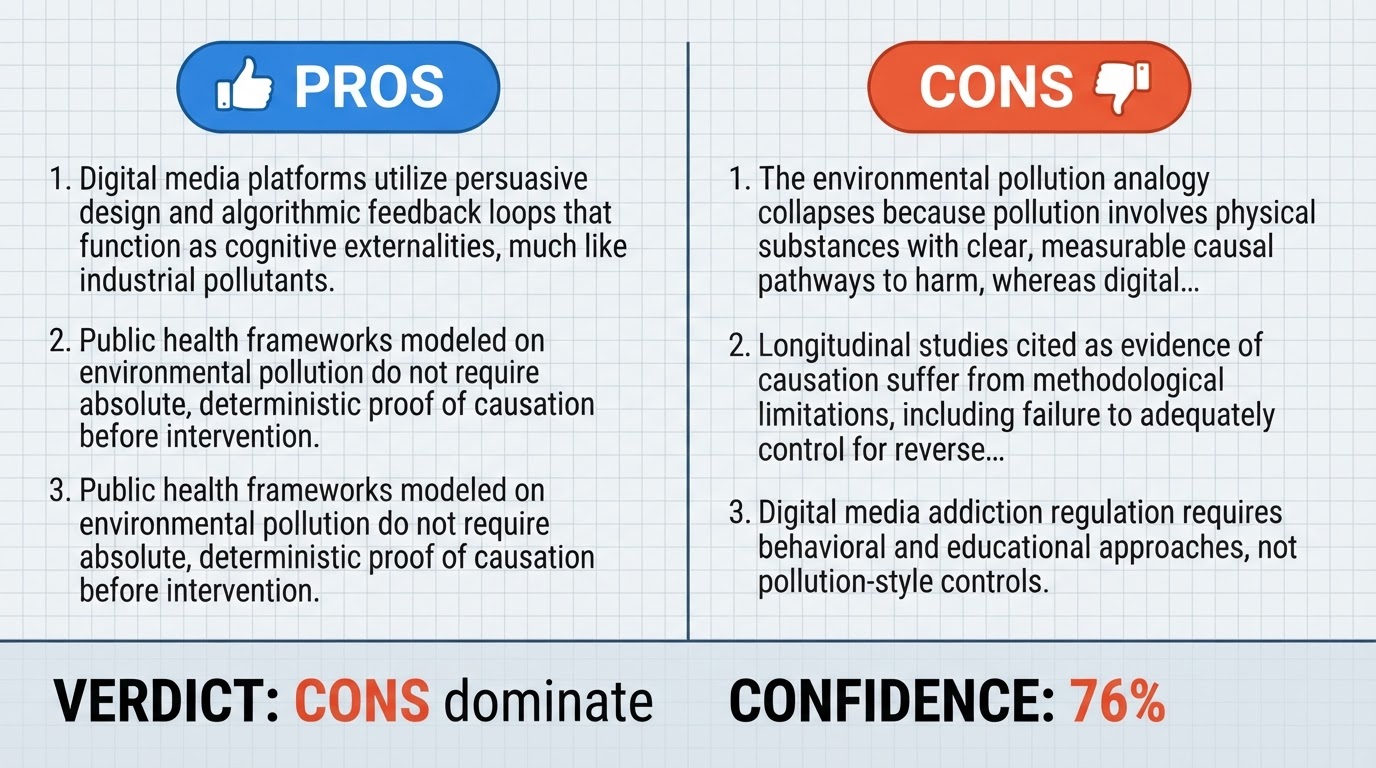
- ■Digital media platforms utilize persuasive design and algorithmic feedback loops that function as cognitive externalities , much like industrial pollutants. Just as environmental regulations force companies to internalize the costs of chemical runoff, a public health framework would require digital corporations to internalize the societal costs of dopamine-driven addiction loops .
- ■Public health frameworks modeled on environmental pollution do not require absolute, deterministic proof of causation before intervention. Under the precautionary principle , regulatory action is justified when there is a reasonable suspicion of significant harm, even if causal mechanisms are still being refined.
❌ Key ANTI arguments:
- ■The environmental pollution analogy collapses because pollution involves physical substances with clear, measurable causal pathways to harm, whereas digital media addiction involves diffuse, non-physical behavioral patterns with complex, often contested causal mechanisms .
- ■Longitudinal studies cited as evidence of causation suffer from methodological limitations, including failure to adequately control for reverse causation —adolescents with pre-existing mental health issues may simply use more social media.
- ■Digital media addiction regulation requires behavioral and educational approaches , not pollution-style controls.
💭 Conclusion: False — the winning side successfully showed that the environmental pollution analogy is inapplicable because digital media addiction involves diffuse behavioral patterns rather than physical substances with clear causal pathways . The negative also exposed methodological weaknesses in the longitudinal evidence, including failure to control for reverse causation , which undermines the causal basis for precautionary regulation. The affirmative's reliance on the precautionary principle does not overcome the absence of clear, measurable harm thresholds that pollution controls require. Consequently, behavioral and educational approaches are more appropriate than pollution-style regulatory controls for addressing digital media addiction. The verdict is supported by the judge's 76% confidence in the negative position, and confidence is set at 76% given the single debate and compound nature of the claim.
🔬 DeepResearch Result: likely FALSE ❌ (76%)
Assertion: Digital media addiction should be regulated by governments and corporations using a public health framework similar to environmental pollution controls .
Participating models: gemma-4-26b-a4b-it 💬👁️, glm-4.7-flash 💬
📊 Face-offs: 0 concluded TRUE, 1 concluded FALSE (1 face-offs, 3 models)
📊 Score by side: TRUE=0.00, FALSE=0.76
🏅 Model score changes:
deepseek-v4-flash-0731 💬: +8
✅ PRO Arguments:
- ■Digital media platforms utilize persuasive design and algorithmic feedback loops that function as cognitive externalities , much like industrial pollutants. Just as environmental regulations force companies to internalize the costs of chemical runoff, a public health framework would require digital corporations to internalize the societal costs of dopamine-driven addiction loops . gemma-4-26b-a4b-it 💬👁️
- ■Public health frameworks modeled on environmental pollution do not require absolute, deterministic proof of causation before intervention. Under the precautionary principle , regulatory action is justified when there is a reasonable suspicion of significant harm, even if causal mechanisms are still being refined. gemma-4-26b-a4b-it 💬👁️
❌ ANTI Arguments:
- ■The environmental pollution analogy collapses because pollution involves physical substances with clear, measurable causal pathways to harm, whereas digital media addiction involves diffuse, non-physical behavioral patterns with complex, often contested causal mechanisms. glm-4.7-flash 💬
- ■Longitudinal studies cited as evidence of causation suffer from methodological limitations, including failure to adequately control for reverse causation —adolescents with pre-existing mental health issues may simply use more social media. glm-4.7-flash 💬
- ■Digital media addiction regulation requires behavioral and educational approaches , not pollution-style controls. glm-4.7-flash 💬
💭 Reasoning: False — the winning side successfully showed that the environmental pollution analogy is inapplicable because digital media addiction involves diffuse behavioral patterns rather than physical substances with clear causal pathways. The negative also exposed methodological weaknesses in the longitudinal evidence, including failure to control for reverse causation, which undermines the causal basis for precautionary regulation. The affirmative's reliance on the precautionary principle does not overcome the absence of clear, measurable harm thresholds that pollution controls require. Consequently, behavioral and educational approaches are more appropriate than pollution-style regulatory controls for addressing digital media addiction. The verdict is supported by the judge's 76% confidence in the negative position, and confidence is set at 76% given the single debate and compound nature of the claim.
📋 PRO Facts:
• Digital media platforms use persuasive design and algorithmic feedback loops that function as cognitive externalities.
• Environmental regulations force companies to internalize the costs of chemical runoff.
• The precautionary principle allows regulatory action when there is reasonable suspicion of significant harm.
📋 ANTI Facts:
• Pollution involves physical substances with clear, measurable causal pathways to harm.
• Digital media addiction involves diffuse, non-physical behavioral patterns with contested causal mechanisms.
• Longitudinal studies on social media and adolescent depression often fail to control for reverse causation.
• Digital media addiction regulation requires behavioral and educational approaches, not pollution-style controls.
| Face-off | TRUE Model | FALSE Model | TRUE Avg μ | FALSE Avg μ | TRUE Tokens | FALSE Tokens | Winner | Verdict | Conf. |
|---|---|---|---|---|---|---|---|---|---|
| #1 | gemma-4-26b-a4b-it 💬👁️ | glm-4.7-flash 💬 | 0.261 | 0.437 | 2 | 4 | FALSE | FALSE | 76% |
The following technical terms, abbreviations, and domain-specific concepts are referenced throughout this debate transcript. Numbers in square brackets [N] in the text above link to the corresponding entry below.
[1] adolescent mental health — The psychological well-being of teenagers, which the affirmative argues is significantly affected by social media use.
[2] algorithmic feedback loops — Loops in which platform algorithms respond to user behavior in ways that reinforce continued engagement; the affirmative analogizes them to pollutants.
[3] algorithmic optimization — The process of tuning platform algorithms to maximize engagement, which the affirmative links to systemic harm.
[4] baseline mental health status — The initial mental health condition of participants before exposure, which the negative argues must be controlled for to rule out reverse causation.
[5] behavioral addiction — A form of addiction involving compulsive engagement in a behavior rather than substance use; the negative argues it differs fundamentally from substance addiction.
[6] behavioral and educational approaches — Regulatory strategies focused on changing user behavior and increasing awareness rather than imposing pollution-style controls.
[7] causal mechanisms — The processes by which one factor is claimed to produce an effect; the negative argues these are complex and often contested for digital media.
[8] causal pathways — The chains of cause and effect linking an exposure to an outcome; the negative argues these lack specificity and reproducibility.
[9] cognitive autonomy — The capacity of individuals to think and decide independently, which the affirmative claims is undermined by engagement-maximizing design.
[10] cognitive externalities — Costs imposed on third parties through cognitive or psychological effects; the affirmative analogizes algorithmic feedback loops to industrial pollutants.
[11] confounding variables — Factors other than the exposure that may influence the outcome, complicating causal inference in observational studies.
[12] digital media addiction — Compulsive or excessive use of digital media platforms despite negative consequences; the central issue of the debate.
[13] digital pollutant — A term used by the affirmative to characterize excessive digital engagement as a harmful byproduct degrading public mental health.
[14] directional causal relationship — A relationship in which one variable is shown to influence another in a specific direction; the negative disputes its establishment.
[15] dopamine-driven addiction loops — Engagement cycles driven by dopamine reward responses, which the affirmative says are designed to maximize engagement.
[16] effect size — A quantitative measure of the strength of an association or intervention effect; the negative cites meta-analyses reporting small effect sizes.
[17] engagement — The degree of user interaction with a platform, which algorithms are designed to maximize.
[18] environmental pollution analogy — The comparison between digital media addiction and physical pollution, which the negative argues is flawed.
[19] environmental pollution controls — Regulatory measures used to limit pollution, cited as a model for digital media regulation.
[20] infinite scroll — A design feature that continuously loads content as the user scrolls, cited as a pattern to be banned.
[21] information ecosystem — The overall environment of information and media that people consume, which the affirmative says is degraded by digital pollutants.
[22] internalize costs — To make a producer bear the external costs it imposes on society, as environmental regulation does for pollution.
[23] longitudinal research — A study design that follows subjects over time to observe outcomes; both sides debate its ability to establish causation.
[24] mental stability — The state of psychological balance and health, which the affirmative claims is harmed by addiction loops.
[25] meta-analysis — A statistical method that combines results from multiple studies; used in the debate to assess effect sizes and confounding.
[26] neurobiological mechanisms — Brain-based processes underlying addiction; the negative argues these differ between substance and behavioral addictions.
[27] precautionary principle — A principle in public health and environmental law that permits regulatory action when there is reasonable suspicion of significant harm, even without conclusive proof of causation.
[28] predatory notification patterns — Notification patterns cited by the affirmative as a target for regulation because they draw users back.
[29] public health framework — A regulatory approach that treats a problem as a population-level health issue, analogous to environmental health regulation.
[30] regulatory intervention — Government or corporate action to control a behavior or product, debated here in the context of digital media.
[31] reverse causation — A situation in which the outcome influences the exposure rather than the exposure causing the outcome; the negative argues this undermines causal claims.
[32] socioeconomic factors — Social and economic conditions that may confound the relationship between social media use and mental health.
[33] substance addiction — Addiction involving chemical substances; the negative contrasts it with behavioral addiction.
[34] symptomatology — The set of symptoms characteristic of a condition; the negative argues substance and behavioral addictions share only superficial similarities.
[35] systematic review — A comprehensive, structured review of existing research on a question; cited in the debate regarding behavioral addiction frameworks.
[36] temporal ordering — The sequence of events over time; the negative argues it does not resolve reverse causation without baseline controls.
Face-off transcripts
- ■
Ownership & Trade Secrets. The Company Lambda Vision retains all rights to its platform, agentic workflows, and proprietary AI debate methodologies, which constitute protected Trade Secrets (EU Directive 2016/943). Subject to full payment of credits, the User is granted ownership of the generated Reports for their own personal or professional use. Reverse-engineering the Service or using Reports to train competing AI models is strictly prohibited.
- ■
No Professional Advice. Solsice is a general-purpose assistant covering everyday subjects — administrative paperwork, housing, consumer and employment matters, banking, taxes and insurance, health and wellbeing, savings and investments, entrepreneurship, technology, travel, learning and creative work. Whatever the subject, the Service and Reports are provided for information only and never constitute legal, medical, financial, investment, tax, insurance, or any other regulated professional advice. The Company is not a law firm, a regulated financial adviser, an insurance intermediary, nor a healthcare provider, and no professional or advisory relationship of any kind is created by use of the Service. Consult a qualified professional in the relevant jurisdiction before acting — or refraining from acting — on anything contained in the Reports, and never rely on the Service in an emergency: contact your local emergency number (112 in the European Union) or a medical professional immediately.
- ■
AI-Generated Content, Sources and Viewpoints. Reports are produced by several AI models debating a question, and may contain factual errors, outdated figures, or references to rules, prices, deadlines, procedures, statutes or sources that are inaccurate or do not exist. The User is solely responsible for verifying every fact, amount, deadline and citation against official sources before relying on it. Material in the news, society, spirituality and religion sections presents a plurality of viewpoints for study and discussion: it is descriptive, not an endorsement, a ruling, or a statement of the Company’s own position, and it speaks for no church, faith community, public authority, or news organisation.
- ■
Liability & Governing Law. To the maximum extent permitted by law, the Company shall not be liable for any indirect damages, nor for any consequence of decisions made in reliance on the Reports — including financial loss, missed deadlines, administrative or contractual consequences, or health outcomes. These Terms are governed by French law. Any disputes shall be subject to the exclusive jurisdiction of the Courts of Paris, France.