
Directly informing a date about a lack of physical attraction, even if difficult, is a valid and honest approach in dating interactions.
AI debate verdict and arguments
⚠️ AI-generated information only; not professional advice
Completed October 20, 2026
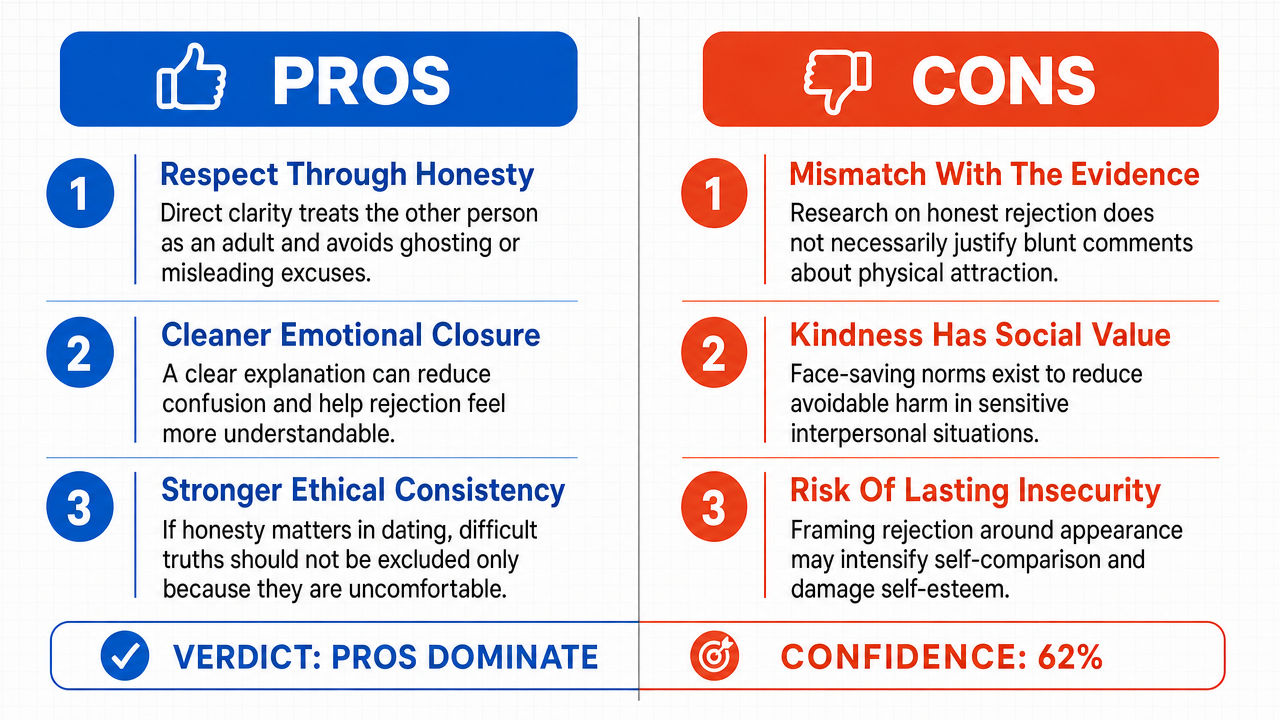
Verdict
Verdict: likely TRUE (62%)
Web Report: https://solsice.com/public/debates/directly-informing-a-date-about-a-lack-of-physical-attractio-384dd5013fac
This section provides a brief overview of the key arguments. You do not need to read the full detailed report below.
✅ Key PRO arguments:
- ■Honesty is a cornerstone of respectful interpersonal conduct, and dating is no exception. Concealing a lack of attraction—whether by ghosting , vague excuses, or prolonged ambiguity—deprives the other person of agency and the opportunity to invest their emotions elsewhere. Research in relationship ethics consistently identifies transparency as a key component of treating others as ends in themselves , not merely as means to avoid discomfort.
- ■A study in the Journal of Social and Personal Relationships found that individuals who received direct, honest explanations for romantic rejection experienced better emotional outcomes, supporting the validity of transparent communication about lack of attraction.
- ■The opponent's objection that validity requires recipient capacity to process identity-linked feedback is internally contradictory—if such capacity were required and unverified, the opponent could not simultaneously assert that the affirmative claim asserts validity. The argument collapses under its own logic.
❌ Key ANTI arguments:
- ■The reliance on the Baxter (2019) study commits a fundamental error of substitution . Research on the benefits of 'honest explanations for romantic rejection' does not validate the specific, unnecessary cruelty of commenting on a partner's physical appearance—there is no logical transfer operator between general honesty and identity-based critique.
- ■Honesty in social contexts is governed by norms of reciprocity and face-saving , which are designed to prevent the very psychological distress that direct disclosure of physical unattractiveness causes. Conflating the general principle of transparency with unsolicited critique of appearance ignores these protective social norms.
- ■The claim that such disclosure reduces self-blame is contradicted by the mechanism of social comparison . When rejection is framed through physical inadequacy, it provides a concrete basis for negative self-evaluation rather than relieving ambiguity, potentially worsening psychological outcomes.
💭 Conclusion: True, the verdict favors the affirmative position that directly informing a date about a lack of physical attraction is a valid and honest approach. The winning side effectively argued that honesty respects the other person's autonomy and provides them with the information needed to make informed emotional decisions, rather than leaving them in prolonged ambiguity. The affirmative successfully defended against the opponent's critique by exposing an internal contradiction in the claim that validity requires unverified recipient processing capacity. While the negative raised legitimate concerns about the psychological impact of identity-based feedback and the limits of generalizing from studies on rejection honesty, the judge found the affirmative's emphasis on transparency , agency , and ethical treatment more compelling. The moderate 62% confidence reflects that this remains a nuanced ethical question where reasonable people may disagree about the balance between honesty and harm.
🔬 DeepResearch Result: likely TRUE ✅ (62%)
Assertion: Directly informing a date about a lack of physical attraction, even if difficult, is a valid and honest approach in dating interactions.
Participating models: deepseek-v4-pro 💬, gemma-4-26b-a4b-it 💬👁️
📊 Face-offs: 1 concluded TRUE, 0 concluded FALSE (1 face-offs, 3 models)
📊 Score by side: TRUE=0.62, FALSE=0.00
🏅 Model score changes:
minimax-m3 💬👁️: +6
✅ PRO Arguments:
- ■Honesty is a cornerstone of respectful interpersonal conduct, and dating is no exception. Concealing a lack of attraction—whether by ghosting , vague excuses, or prolonged ambiguity—deprives the other person of agency and the opportunity to invest their emotions elsewhere. Research in relationship ethics consistently identifies transparency as a key component of treating others as ends in themselves , not merely as means to avoid discomfort. deepseek-v4-pro 💬
- ■A study in the Journal of Social and Personal Relationships found that individuals who received direct, honest explanations for romantic rejection experienced better emotional outcomes, supporting the validity of transparent communication about lack of attraction. deepseek-v4-pro 💬
- ■The opponent's objection that validity requires recipient capacity to process identity-linked feedback is internally contradictory—if such capacity were required and unverified, the opponent could not simultaneously assert that the affirmative claim asserts validity. The argument collapses under its own logic. deepseek-v4-pro 💬
- ■Direct disclosure respects the other person's autonomy by giving them accurate information to make informed decisions about their emotional investment, rather than leaving them in prolonged ambiguity that wastes their time and emotional resources. deepseek-v4-pro 💬
❌ ANTI Arguments:
- ■The reliance on the Baxter (2019) study commits a fundamental error of substitution . Research on the benefits of 'honest explanations for romantic rejection' does not validate the specific, unnecessary cruelty of commenting on a partner's physical appearance—there is no logical transfer operator between general honesty and identity-based critique. gemma-4-26b-a4b-it 💬👁️
- ■Honesty in social contexts is governed by norms of reciprocity and face-saving , which are designed to prevent the very psychological distress that direct disclosure of physical unattractiveness causes. Conflating the general principle of transparency with unsolicited critique of appearance ignores these protective social norms. gemma-4-26b-a4b-it 💬👁️
- ■The claim that such disclosure reduces self-blame is contradicted by the mechanism of social comparison . When rejection is framed through physical inadequacy, it provides a concrete basis for negative self-evaluation rather than relieving ambiguity, potentially worsening psychological outcomes. gemma-4-26b-a4b-it 💬👁️
- ■Directly informing a date about lack of physical attraction is socially destructive and psychologically harmful because it weaponizes an immutable characteristic, transforming a difficult conversation into an identity-level judgment that the recipient cannot meaningfully act upon. gemma-4-26b-a4b-it 💬👁️
💭 Reasoning: True, the verdict favors the affirmative position that directly informing a date about a lack of physical attraction is a valid and honest approach. The winning side effectively argued that honesty respects the other person's autonomy and provides them with the information needed to make informed emotional decisions, rather than leaving them in prolonged ambiguity. The affirmative successfully defended against the opponent's critique by exposing an internal contradiction in the claim that validity requires unverified recipient processing capacity. While the negative raised legitimate concerns about the psychological impact of identity-based feedback and the limits of generalizing from studies on rejection honesty, the judge found the affirmative's emphasis on transparency, agency, and ethical treatment more compelling. The moderate 62% confidence reflects that this remains a nuanced ethical question where reasonable people may disagree about the balance between honesty and harm.
📋 PRO Facts:
• Research in relationship ethics identifies transparency as a key component of treating others as ends in themselves, not merely as means to avoid discomfort.
• A study in the Journal of Social and Personal Relationships found that individuals who received direct, honest explanations for romantic rejection experienced better emotional outcomes.
• Concealing a lack of attraction deprives the other person of agency and the opportunity to invest their emotions elsewhere.
📋 ANTI Facts:
• The Baxter (2019) study on honest explanations for romantic rejection does not establish a logical link to validating specific critique of physical appearance.
• Social norms of reciprocity and face-saving are designed to prevent the psychological distress caused by direct disclosure of physical unattractiveness.
• Framing rejection through physical inadequacy provides a concrete basis for negative social comparison, potentially worsening self-blame rather than reducing it.
| Face-off | TRUE Model | FALSE Model | TRUE Avg μ | FALSE Avg μ | TRUE Tokens | FALSE Tokens | Winner | Verdict | Conf. |
|---|---|---|---|---|---|---|---|---|---|
| #1 | deepseek-v4-pro 💬 | gemma-4-26b-a4b-it 💬👁️ | 0.504 | 0.385 | 6 | 2 | TRUE | TRUE | 62% |
The following technical terms, abbreviations, and domain-specific concepts are referenced throughout this debate transcript. Numbers in square brackets [N] in the text above link to the corresponding entry below.
[1] agency — In ethics and philosophy, the capacity of individuals to make autonomous choices and act independently; respecting agency means acknowledging others' ability to make informed decisions about their own lives.
[2] conjecture — An unproven assumption or supposition advanced as a premise without sufficient evidence; in logical argumentation, a conjecture lacks demonstrated support.
[3] ends in themselves — A Kantian ethical concept referring to the principle that persons should be treated as intrinsically valuable goals, never merely as instruments or means to another's ends.
[4] error of substitution — A logical fallacy in which evidence or reasoning about a general category is illicitly applied to a specific subcategory without establishing the appropriate logical link between them.
[5] face-saving — A sociological concept describing communicative behaviors aimed at preserving a person's social dignity and self-image, particularly during potentially threatening interactions such as rejection.
[6] ghosting — A modern dating/social practice in which one party abruptly ceases all communication without explanation, leaving the other person without closure.
[7] hidden premise — An unstated assumption embedded within an argument that must be accepted for the conclusion to follow; critics often challenge such premises when they are unverified.
[8] interpersonal rejection — The experience of being dismissed or excluded by others in social or romantic contexts, studied in psychology for its effects on self-esteem and emotional well-being.
[9] interpretive theory — A theoretical framework that emphasizes understanding meaning and interpretation rather than causal explanation, often used in social sciences and humanities.
[10] non-contingent traits — Characteristics perceived as stable and unchangeable (such as physical appearance), as opposed to contingent traits that can be modified through effort or behavior.
[11] post-rejection outcomes — The psychological and emotional consequences experienced by individuals following romantic or social rejection, including self-blame, self-evaluation, and emotional closure.
[12] proposition — In logic and debate, a statement or claim that an argument seeks to establish or defend as true.
[13] reciprocity — A social norm governing mutual exchange in relationships, where individuals expect balanced give-and-take in interactions, including consideration for each other's feelings.
[14] respect for persons — A foundational ethical principle, rooted in Kantian deontology, requiring that individuals be treated as autonomous agents deserving of dignity and truthful engagement.
[15] rumination — In psychology, the repetitive and passive focus on one's distress or perceived deficiencies, often triggered by specific feedback such as rejection.
[16] self-blame — The tendency to attribute negative outcomes to one's own perceived flaws or inadequacies, commonly studied as a response to interpersonal rejection.
[17] self-evaluation — The process of assessing one's own worth, abilities, or characteristics, which can be negatively influenced by identity-linked feedback.
[18] social aggression — Behavior intended to harm others' social standing, self-esteem, or relationships, which may include direct and potentially hurtful interpersonal communication.
[19] social anxiety — An anxiety disorder characterized by intense fear of social scrutiny and negative evaluation by others, which can be exacerbated by identity-based rejection.
[20] social comparison — The psychological process by which individuals evaluate themselves in relation to others, often leading to negative self-assessment when unfavorable comparisons are made salient.
[21] transfer operator — In this debate, the missing logical link required to apply general research findings (e.g., on honesty in rejection) to a specific, narrower claim (e.g., disclosing lack of physical attraction).
[22] transparency — In interpersonal ethics, the practice of openness and honesty in communication, allowing others to make informed decisions based on accurate information.
[23] validity — In logic, the property of an argument such that if its premises are true, its conclusion must also be true; distinct from soundness, which requires true premises.
Face-off transcripts
- ■
Ownership & Trade Secrets. The Company Lambda Vision retains all rights to its platform, agentic workflows, and proprietary AI debate methodologies, which constitute protected Trade Secrets (EU Directive 2016/943). Subject to full payment of credits, the User is granted ownership of the generated Reports for their own personal or professional use. Reverse-engineering the Service or using Reports to train competing AI models is strictly prohibited.
- ■
No Professional Advice. Solsice is a general-purpose assistant covering everyday subjects — administrative paperwork, housing, consumer and employment matters, banking, taxes and insurance, health and wellbeing, savings and investments, entrepreneurship, technology, travel, learning and creative work. Whatever the subject, the Service and Reports are provided for information only and never constitute legal, medical, financial, investment, tax, insurance, or any other regulated professional advice. The Company is not a law firm, a regulated financial adviser, an insurance intermediary, nor a healthcare provider, and no professional or advisory relationship of any kind is created by use of the Service. Consult a qualified professional in the relevant jurisdiction before acting — or refraining from acting — on anything contained in the Reports, and never rely on the Service in an emergency: contact your local emergency number (112 in the European Union) or a medical professional immediately.
- ■
AI-Generated Content, Sources and Viewpoints. Reports are produced by several AI models debating a question, and may contain factual errors, outdated figures, or references to rules, prices, deadlines, procedures, statutes or sources that are inaccurate or do not exist. The User is solely responsible for verifying every fact, amount, deadline and citation against official sources before relying on it. Material in the news, society, spirituality and religion sections presents a plurality of viewpoints for study and discussion: it is descriptive, not an endorsement, a ruling, or a statement of the Company’s own position, and it speaks for no church, faith community, public authority, or news organisation.
- ■
Liability & Governing Law. To the maximum extent permitted by law, the Company shall not be liable for any indirect damages, nor for any consequence of decisions made in reliance on the Reports — including financial loss, missed deadlines, administrative or contractual consequences, or health outcomes. These Terms are governed by French law. Any disputes shall be subject to the exclusive jurisdiction of the Courts of Paris, France.