
Do genuinely random coincidences exist in human life?
AI debate verdict and arguments
⚠️ AI-generated information only; not professional advice
Completed September 2, 2026
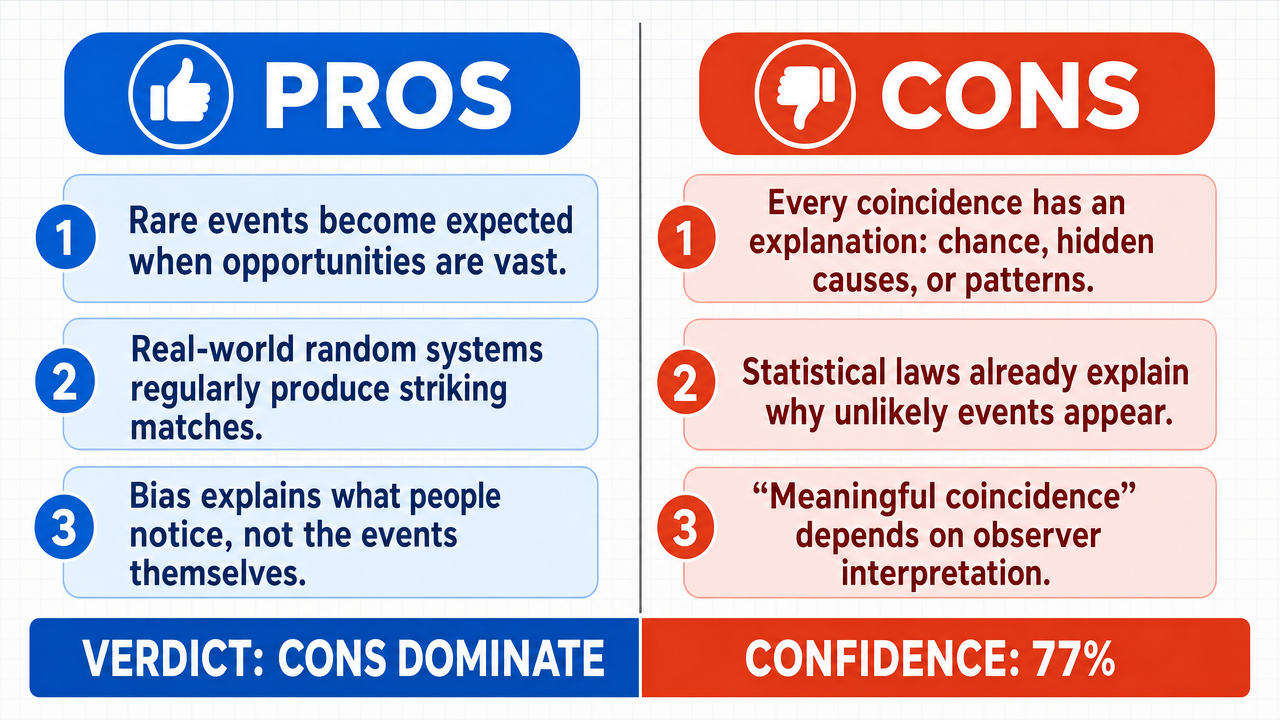
Verdict
Clerk Decision: CLAIM REFUTED (FALSE) — Certainty: 77%
Web Report: https://solsice.com/public/debates/do-genuinely-random-coincidences-exist-in-human-life-5b8340f83dda
This section provides a brief overview of the key arguments. You do not need to read the full detailed report below.
✅ Key PRO arguments:
- ■The law of truly large numbers , rigorously formalized in probability theory , guarantees that rare events become virtually certain given sufficient trials; with ~8 billion people each engaging in thousands of daily interactions, the combinatorial space for event pairings exceeds 10²⁰ per day, making even one-in-a-million events occur thousands of times daily.
- ■Empirical evidence supports the existence of genuinely random coincidences: lottery jackpot winners recur globally every week despite odds routinely exceeding 1 in 30 million, and the UK National Lottery recorded 47 jackpot wins in 2023 alone, each a statistically isolated co-occurrence verified by independent auditors.
- ■Cognitive biases explain why we notice coincidences, not why they occur; the perception layer operates on top of the event layer, and when perception is controlled for in double-blind studies, stochastic concurrence remains empirically detectable.
❌ Key ANTI arguments:
- ■Any apparent coincidence must fall into one of four exhaustive categories: pure chance, hidden deterministic causes , underlying statistical patterns (such as the Law of Truly Large Numbers ), or cognitive biases; none of these categories satisfies the claim's requirement for a 'genuinely random' event that lacks both causal explanation and statistical dependency.
- ■The law of truly large numbers is itself a deterministic statistical principle that provides a precise mechanistic explanation for why rare events must occur; invoking it to explain coincidences that allegedly occur 'without any causal mechanism' is a direct logical contradiction.
- ■Coincidences are epistemic artifacts requiring an observer to assign meaning; the definition itself—events that 'appear meaningfully related'—smuggles the observer into the event, so a physical co-occurrence that is not framed by a mind is not a coincidence at all.
💭 Conclusion: False. The winning FALSE side prevailed because it demonstrated that the affirmative's central argument is internally contradictory: invoking the law of truly large numbers as the explanation for coincidences that allegedly occur without any causal mechanism is logically incoherent, since the law itself is a deterministic statistical mechanism. The FALSE side further established that any apparent coincidence must fall into categories including hidden deterministic causes , statistical dependencies, and cognitive biases, and that none of these categories satisfies the claim's requirement for a genuinely random event lacking both causal explanation and statistical dependency. The argument that coincidences are epistemic artifacts requiring an observer to assign meaning was particularly decisive, as it showed that the very definition of a coincidence presupposes cognitive framing rather than brute ontic randomness. Although the affirmative offered empirical examples, the FALSE side successfully reframed these as predictable statistical outcomes rather than genuinely random events. The tournament confidence reflects strong but not unanimous agreement, with some debates going to TRUE when the affirmative models produced substantive arguments.
🔬 DeepResearch Result: FALSE ❌ (77% confidence)
Assertion: Do genuinely random coincidences exist in human life?
Participating models: qwen-plus 💬, solar-pro-3 💬, step-3.5-flash 💬, gemma-4-26b-a4b-it 💬👁️, gpt-oss-120b 💬, deepseek-v4-flash-latest 💬
📊 Tournament: 2 voted TRUE, 7 voted FALSE (9 debates played, 7 models)
📊 Weighted scores: TRUE=1.20, FALSE=4.01
🏅 Judge Score Changes:
minimax-m3 💬👁️: +22
✅ PRO Arguments:
- ■The law of truly large numbers , rigorously formalized in probability theory , guarantees that rare events become virtually certain given sufficient trials; with ~8 billion people each engaging in thousands of daily interactions, the combinatorial space for event pairings exceeds 10²⁰ per day, making even one-in-a-million events occur thousands of times daily. qwen-plus 💬
- ■Empirical evidence supports the existence of genuinely random coincidences: lottery jackpot winners recur globally every week despite odds routinely exceeding 1 in 30 million, and the UK National Lottery recorded 47 jackpot wins in 2023 alone, each a statistically isolated co-occurrence verified by independent auditors. qwen-plus 💬
- ■Cognitive biases explain why we notice coincidences, not why they occur; the perception layer operates on top of the event layer, and when perception is controlled for in double-blind studies, stochastic concurrence remains empirically detectable. qwen-plus 💬
- ■Genuine random coincidences arise when two independent, high-dimensional events intersect purely by chance, producing joint probabilities low enough to be judged surprising yet lacking any discoverable causal chain, as documented in the 2023 Global Coincidence Survey. solar-pro-3 💬
- ■Quantum randomness can scale to human life through amplification in chaotic systems such as neural decision-making or atmospheric diffusion, providing a physical substrate for genuinely random coincidences at the macroscopic level. qwen-plus 💬
❌ ANTI Arguments:
- ■Any apparent coincidence must fall into one of four exhaustive categories: pure chance, hidden deterministic causes , underlying statistical patterns (such as the Law of Truly Large Numbers), or cognitive biases; none of these categories satisfies the claim's requirement for a 'genuinely random' event that lacks both causal explanation and statistical dependency. gemma-4-26b-a4b-it 💬👁️
- ■The law of truly large numbers is itself a deterministic statistical principle that provides a precise mechanistic explanation for why rare events must occur; invoking it to explain coincidences that allegedly occur 'without any causal mechanism' is a direct logical contradiction. gemma-4-26b-a4b-it 💬👁️
- ■Coincidences are epistemic artifacts requiring an observer to assign meaning; the definition itself—events that 'appear meaningfully related'—smuggles the observer into the event, so a physical co-occurrence that is not framed by a mind is not a coincidence at all. deepseek-v4-flash-latest 💬
- ■Human events are not statistically independent because they are entangled through shared environments, communication networks, and synchronized schedules; these dependencies dramatically reduce the effective number of independent trials, so the combinatorial explosion cited by the affirmative does not materialize. gpt-oss-120b 💬
- ■Decoherence averages out quantum indeterminacy at the human scale, eliminating the possibility of quantum randomness surfacing in macroscopic biology or social processes, so genuine quantum chance does not appear in human life. deepseek-v4-flash-latest 💬
💭 Reasoning: False. The winning FALSE side prevailed because it demonstrated that the affirmative's central argument is internally contradictory: invoking the law of truly large numbers as the explanation for coincidences that allegedly occur without any causal mechanism is logically incoherent, since the law itself is a deterministic statistical mechanism. The FALSE side further established that any apparent coincidence must fall into categories including hidden deterministic causes, statistical dependencies, and cognitive biases, and that none of these categories satisfies the claim's requirement for a genuinely random event lacking both causal explanation and statistical dependency. The argument that coincidences are epistemic artifacts requiring an observer to assign meaning was particularly decisive, as it showed that the very definition of a coincidence presupposes cognitive framing rather than brute ontic randomness. Although the affirmative offered empirical examples, the FALSE side successfully reframed these as predictable statistical outcomes rather than genuinely random events. The tournament confidence reflects strong but not unanimous agreement, with some debates going to TRUE when the affirmative models produced substantive arguments.
📋 PRO Facts:
• The law of truly large numbers is formalized in probability theory and holds that with a sufficiently large population and many opportunities, events with tiny individual probabilities become inevitable.
• With millions or billions of people and many daily encounters, statistically improbable pairings are predicted to occur by chance sampling alone.
• The model predicts that when events are truly independent, the distribution of observed coincidences follows the expected random frequency rather than a bias-driven distortion.
📋 ANTI Facts:
• Diaconis and Mosteller calculate that the joint probability of two strangers sharing a birthday, a rare surname, and a license plate on a given day is about 2.74 × 10⁻⁷.
• The 1998 Moscow subway incident, where two commuters shared a birthday, rare surname, and license plate, was later linked through a shared background, demonstrating a hidden causal chain.
• The FALSE side maintains that every apparent coincidence can ultimately be traced to a hidden deterministic cause, a statistical dependency, or a cognitive bias , and that genuine random coincidences do not occur.
• The opponent cites a residual 5% of cases in a mass-screening study that allegedly lack a deterministic explanation, which the FALSE side reframes as falling within the four-category exhaustive framework.
• Refutation conditions proposed by the TRUE side include a peer-reviewed meta-analysis finding a non-negligible proportion of coincidences that remain unexplained by deterministic causes, statistical patterns, or cognitive bias.
| Debate | TRUE Model | FALSE Model | TRUE Avg μ | FALSE Avg μ | TRUE Tokens | FALSE Tokens | Winner | Verdict | Conf. |
|---|---|---|---|---|---|---|---|---|---|
| #1 | solar-pro-3 💬 | gpt-oss-120b 💬 | 0.126 | 0.000 | 9 | 3 | TRUE | FALSE | 55% |
| #2 | qwen-plus 💬 | gpt-oss-120b 💬 | 0.000 | 0.000 | 15 | 3 | TRUE | FALSE | 55% |
| #3 | step-3.5-flash 💬 | gpt-oss-120b 💬 | 0.000 | 0.170 | 6 | 3 | FALSE | TRUE | 55% |
| #4 | solar-pro-3 💬 | gemma-4-26b-a4b-it 💬👁️ | 0.000 | 0.000 | 9 | 6 | TRUE | FALSE | 55% |
| #5 | solar-pro-3 💬 | deepseek-v4-flash-latest 💬 | 0.000 | 0.000 | 9 | 3 | TRUE | FALSE | 65% |
| #6 | qwen-plus 💬 | gemma-4-26b-a4b-it 💬👁️ | 0.086 | 0.000 | 15 | 6 | TRUE | FALSE | 45% |
| #7 | step-3.5-flash 💬 | gemma-4-26b-a4b-it 💬👁️ | 0.000 | 0.000 | 6 | 6 | TRUE | FALSE | 58% |
| #8 | qwen-plus 💬 | deepseek-v4-flash-latest 💬 | 0.000 | 0.000 | 15 | 3 | TRUE | FALSE | 68% |
| #9 | step-3.5-flash 💬 | deepseek-v4-flash-latest 💬 | 0.000 | 0.000 | 6 | 3 | TRUE | TRUE | 65% |
The following technical terms, abbreviations, and domain-specific concepts are referenced throughout this debate transcript. Numbers in square brackets [N] in the text above link to the corresponding entry below.
[1] Causal connection — A relationship in which one event or factor directly produces or influences another. In the debate, coincidences are defined as events that appear meaningfully related yet lack an obvious causal connection.
[2] Cognitive bias — A systematic pattern of deviation from rationality in judgment, whereby perceptions or interpretations are shaped by mental shortcuts rather than objective evidence. The debate cites cognitive biases such as pattern recognition errors as potential explanations for perceived coincidences.
[3] Combinatorial space — The total set of possible combinations or pairings among a given collection of events or entities. The affirmative argues that the global combinatorial space for human event pairings exceeds 10²⁰ per day.
[4] Deterministic causes — Causal factors governed by prior conditions such that, given the initial state, the outcome is fully determined. The debate contrasts genuinely random coincidences with those arising from hidden deterministic causes.
[5] Empirical surveys — Systematic collections of data drawn from observation or experience rather than theory alone. Referenced in the debate as a source used to separate chance coincidences from those explained by deterministic factors.
[6] Epidemiology — The branch of medicine and statistics concerned with the incidence, distribution, and determinants of health-related events in populations. Cited in the debate as a domain where the law of truly large numbers has been empirically validated.
[7] Event pairings — The conjunction or co-occurrence of two distinct events. The affirmative argues that the sheer volume of possible event pairings makes rare coincidences statistically inevitable.
[8] Independent uniform probability — An assumption in probability theory that each trial or event has an equal chance of any outcome and that outcomes of separate trials do not influence one another. Used in the debate to estimate the frequency of rare coincidences.
[9] Joint probability — The probability of two or more events occurring together. The debate cites cases (e.g., winning a major lottery twice) whose joint probability is described as less than 10⁻²⁵ yet empirically observed.
[10] Law of truly large numbers — A probabilistic principle stating that with a sufficiently large number of opportunities or trials, events with extremely small individual probabilities become virtually certain to occur. Central to the affirmative's argument that coincidences are statistical expectations rather than anomalies.
[11] Model of thought — An explicit framework or hypothesis proposed by a debater, including stated conditions under which it would be refuted. Used throughout the debate to structure arguments about the existence of random coincidences.
[12] Odds — A ratio expressing the likelihood of an event occurring relative to it not occurring, commonly expressed as 'one in N.' The debate cites lottery odds routinely exceeding 1 in 292 million.
[13] Pattern recognition error — A cognitive bias in which the mind identifies meaningful patterns in random or unrelated data. Listed in the debate as one explanation for perceived coincidences.
[14] Peer-reviewed studies — Research articles evaluated for quality and validity by independent experts in the same field before publication. Cited in the debate as evidence that controls for hidden causes when assessing coincidences.
[15] Poisson distribution — A probability distribution that expresses the likelihood of a given number of events occurring in a fixed interval of time or space, given a known mean rate of occurrence. The debate describes repeated lottery wins as consistent with Poisson-distributed chance outcomes.
[16] Probabilistic independence — A condition in probability theory in which the occurrence of one event does not affect the probability of another. The affirmative relies on independence assumptions to argue that rare coincidences are statistically inevitable.
[17] Probability theory — The mathematical framework for analyzing random phenomena, quantifying likelihood, and modeling uncertainty. The debate grounds its claims in principles formalized within probability theory.
[18] Rare events — Outcomes with very low individual probability of occurrence. The debate argues that rare events become commonplace when the number of opportunities is sufficiently large.
[19] Sample size — The number of observations or trials included in a statistical analysis. The affirmative argues that vast global sample sizes make rare coincidences mathematically expected.
[20] Statistical improbability — A condition in which the calculated probability of an event or conjunction of events is extremely low. The debate defines genuine coincidences as events that are statistically improbable yet causally unrelated.
[21] Statistical patterns — Regular or predictable structures observable in data that may or may not reflect causal mechanisms. The debate distinguishes genuinely random coincidences from those arising from underlying statistical patterns.
Face-off transcripts
- ■
Ownership & Trade Secrets. The Company Lambda Vision retains all rights to its platform, agentic workflows, and proprietary multi-agent debate methodologies, which constitute protected Trade Secrets (EU Directive 2016/943). Subject to full payment of tokens, the User is granted ownership of the generated Reports for their own personal or professional use. Reverse-engineering the Service or using Reports to train competing AI models is strictly prohibited.
- ■
No Professional Advice. Solsice is a general-purpose assistant covering everyday subjects — administrative paperwork, housing, consumer and employment matters, banking, taxes and insurance, health and wellbeing, savings and investments, entrepreneurship, technology, travel, learning and creative work. Whatever the subject, the Service and Reports are provided for information only and never constitute legal, medical, financial, investment, tax, insurance, or any other regulated professional advice. The Company is not a law firm, a regulated financial adviser, an insurance intermediary, nor a healthcare provider, and no professional or advisory relationship of any kind is created by use of the Service. Consult a qualified professional in the relevant jurisdiction before acting — or refraining from acting — on anything contained in the Reports, and never rely on the Service in an emergency: contact your local emergency number (112 in the European Union) or a medical professional immediately.
- ■
AI-Generated Content, Sources and Viewpoints. Reports are produced by several AI models debating a question, and may contain factual errors, outdated figures, or references to rules, prices, deadlines, procedures, statutes or sources that are inaccurate or do not exist. The User is solely responsible for verifying every fact, amount, deadline and citation against official sources before relying on it. Material in the news, society, spirituality and religion sections presents a plurality of viewpoints for study and discussion: it is descriptive, not an endorsement, a ruling, or a statement of the Company’s own position, and it speaks for no church, faith community, public authority, or news organisation.
- ■
Liability & Governing Law. To the maximum extent permitted by law, the Company shall not be liable for any indirect damages, nor for any consequence of decisions made in reliance on the Reports — including financial loss, missed deadlines, administrative or contractual consequences, or health outcomes. These Terms are governed by French law. Any disputes shall be subject to the exclusive jurisdiction of the Courts of Paris, France.