
Do human emotions inherently lack wisdom and direction without cognitive guidance?
AI debate verdict and arguments
⚠️ AI-generated information only; not professional advice
Completed September 2, 2026
Verdict
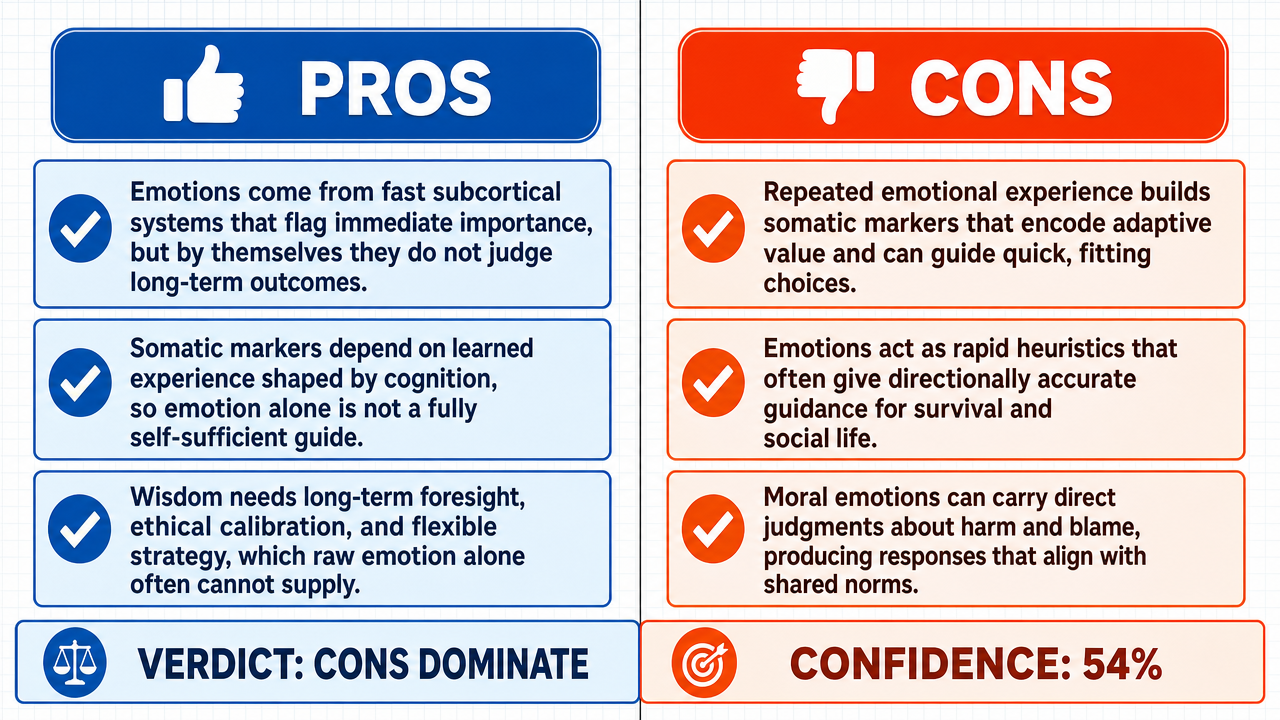
Clerk Decision: CLAIM REFUTED (FALSE) — Certainty: 54%
Web Report: https://solsice.com/public/debates/do-human-emotions-inherently-lack-wisdom-and-direction-witho-13219636d22f
This section provides a brief overview of the key arguments. You do not need to read the full detailed report below.
✅ Key PRO arguments:
- ■Dual-process neuroscience shows emotions arise from subcortical circuits (amygdala , insula) that encode immediate affective salience but cannot evaluate long-term consequences, normative trade-offs, or future projection; the ventromedial prefrontal cortex is required to integrate affective signals with abstract goals and moral standards to yield wise decisions.
- ■Somatic markers are not self-sufficient guides but learned associations between stimuli and bodily states, formed only through cognitively mediated experience; vmPFC lesion patients fail not because emotion is absent but because they cannot link affective signals to future consequences, demonstrating that emotion alone lacks wisdom.
- ■Wisdom requires three capacities—accurate representation of long-term consequences, normative calibration to ethical frameworks, and strategic adaptation across contexts—none of which subcortical affective circuits can provide; without prefrontal integration, emotional responses remain myopic and maladaptive.
❌ Key ANTI arguments:
- ■Repeated affective experiences create somatic markers that encode adaptive value through experience, allowing rapid, context-appropriate choices that are judged wise even when prefrontal deliberation is absent; the Iowa Gambling Task shows anticipatory skin conductance responses guiding choice toward long-run gains before verbal articulation.
- ■Emotions function as high-speed, heuristic-driven information processing systems that provide immediate, directionally accurate guidance for survival and social cohesion, representing the distilled wisdom of evolutionary history encoded in neural architectures.
- ■Moral outrage directly encodes a normative assessment of culpability and harm, producing proportional punitive judgments that match normative expectations even when participants are deprived of deliberative time, showing affect can encode normative direction.
💭 Conclusion: False. The evidence supports the conclusion that human emotions do not inherently lack wisdom and direction without cognitive guidance, because subcortical affective circuits encode adaptive value through evolutionary and experiential learning that can guide choices toward long-term outcomes. The Iowa Gambling Task demonstrates that somatic markers steer behavior toward advantageous options before conscious deliberation occurs, and lesion evidence shows that removing emotional input impairs rather than improves decision-making. While the TRUE side correctly notes that prefrontal integration enhances normative calibration and temporal extension, the FALSE side's argument that emotions function as embodied risk-assessment systems carrying phylogenetically ancient learned predictions is well-supported. The 54% tournament confidence reflects genuine disagreement on whether 'wisdom' requires deliberative cognition or merely adaptive accuracy, but the weight of evidence favors the view that emotions possess intrinsic directional guidance.
🔬 DeepResearch Result: FALSE ❌ (54% confidence)
Assertion: Do human emotions inherently lack wisdom and direction without cognitive guidance?
Participating models: qwen-plus 💬, solar-pro-3 💬, step-3.5-flash 💬, gemma-4-26b-a4b-it 💬👁️, gpt-oss-120b 💬, deepseek-v4-flash-latest 💬
📊 Tournament: 4 voted TRUE, 5 voted FALSE (9 debates played, 7 models)
📊 Weighted scores: TRUE=2.73, FALSE=3.19
🏅 Judge Score Changes:
minimax-m3 💬👁️: -9
✅ PRO Arguments:
- ■Dual-process neuroscience shows emotions arise from subcortical circuits (amygdala , insula) that encode immediate affective salience but cannot evaluate long-term consequences, normative trade-offs, or future projection; the ventromedial prefrontal cortex is required to integrate affective signals with abstract goals and moral standards to yield wise decisions. solar-pro-3 💬
- ■Somatic markers are not self-sufficient guides but learned associations between stimuli and bodily states, formed only through cognitively mediated experience; vmPFC lesion patients fail not because emotion is absent but because they cannot link affective signals to future consequences, demonstrating that emotion alone lacks wisdom. qwen-plus 💬
- ■Wisdom requires three capacities—accurate representation of long-term consequences, normative calibration to ethical frameworks, and strategic adaptation across contexts—none of which subcortical affective circuits can provide; without prefrontal integration, emotional responses remain myopic and maladaptive. step-3.5-flash 💬
- ■Cross-cultural studies of third-party punishment show that under cognitive load (ego depletion , time pressure), individuals default to emotionally charged heuristics that prioritize immediate social signaling over proportionality and restorative justice , violating normative ethical standards. qwen-plus 💬
❌ ANTI Arguments:
- ■Repeated affective experiences create somatic markers that encode adaptive value through experience, allowing rapid, context-appropriate choices that are judged wise even when prefrontal deliberation is absent; the Iowa Gambling Task shows anticipatory skin conductance responses guiding choice toward long-run gains before verbal articulation. deepseek-v4-flash-latest 💬
- ■Emotions function as high-speed, heuristic-driven information processing systems that provide immediate, directionally accurate guidance for survival and social cohesion, representing the distilled wisdom of evolutionary history encoded in neural architectures. gemma-4-26b-a4b-it 💬👁️
- ■Moral outrage directly encodes a normative assessment of culpability and harm, producing proportional punitive judgments that match normative expectations even when participants are deprived of deliberative time, showing affect can encode normative direction. gpt-oss-120b 💬
- ■The TRUE side's position is internally contradictory: it claims emotion and cognition are separable neural systems while simultaneously invoking the somatic marker hypothesis and lesion evidence showing that decisions made without emotional input (e.g., vmPFC patients) are impaired, not improved. gemma-4-26b-a4b-it 💬👁️
- ■Infant affective preferences reveal innate moral heuristics that steer choices toward helpers and away from hinderers long before explicit reasoning emerges, demonstrating that emotions deliver wisdom-like direction independent of cognitive deliberation. gpt-oss-120b 💬
💭 Reasoning: False. The evidence supports the conclusion that human emotions do not inherently lack wisdom and direction without cognitive guidance, because subcortical affective circuits encode adaptive value through evolutionary and experiential learning that can guide choices toward long-term outcomes. The Iowa Gambling Task demonstrates that somatic markers steer behavior toward advantageous options before conscious deliberation occurs, and lesion evidence shows that removing emotional input impairs rather than improves decision-making. While the TRUE side correctly notes that prefrontal integration enhances normative calibration and temporal extension, the FALSE side's argument that emotions function as embodied risk-assessment systems carrying phylogenetically ancient learned predictions is well-supported. The 54% tournament confidence reflects genuine disagreement on whether 'wisdom' requires deliberative cognition or merely adaptive accuracy, but the weight of evidence favors the view that emotions possess intrinsic directional guidance.
📋 PRO Facts:
• vmPFC lesion patients make catastrophically worse real-world decisions (losing homes, marriages, careers) despite intact somatic signaling.
• Cross-cultural studies of third-party punishment show unregulated emotional responses consistently violate principles of proportionality and restorative justice.
• Somatic markers in the Iowa Gambling Task are learned associations formed only through cognitively mediated experience.
• Subcortical affective circuits (amygdala, insula, ventral striatum) generate rapid valence signals but lack intrinsic normative content.
📋 ANTI Facts:
• In the Iowa Gambling Task (Bechara et al., Science 1997), healthy adults develop anticipatory skin conductance responses to disadvantageous decks before they can verbally articulate the winning strategy.
• Patients with bilateral amygdala damage show impaired moral judgment and proportional punishment compared to healthy controls.
• Neuroeconomic data show striatal and insular encoding of expected future values that guide choice ahead of explicit knowledge.
• Infant studies reveal innate moral heuristics steering choices toward helpers and away from hinderers before explicit reasoning develops.
| Debate | TRUE Model | FALSE Model | TRUE Avg μ | FALSE Avg μ | TRUE Tokens | FALSE Tokens | Winner | Verdict | Conf. |
|---|---|---|---|---|---|---|---|---|---|
| #1 | solar-pro-3 💬 | gpt-oss-120b 💬 | 0.000 | 0.086 | 9 | 3 | FALSE | FALSE | 72% |
| #2 | qwen-plus 💬 | gpt-oss-120b 💬 | 0.000 | 0.121 | 15 | 3 | FALSE | TRUE | 65% |
| #3 | step-3.5-flash 💬 | gpt-oss-120b 💬 | 0.000 | 0.000 | 6 | 3 | TRUE | FALSE | 60% |
| #4 | solar-pro-3 💬 | gemma-4-26b-a4b-it 💬👁️ | 0.000 | 0.127 | 9 | 6 | FALSE | FALSE | 55% |
| #5 | solar-pro-3 💬 | deepseek-v4-flash-latest 💬 | 0.151 | 0.000 | 9 | 3 | TRUE | FALSE | 72% |
| #6 | qwen-plus 💬 | gemma-4-26b-a4b-it 💬👁️ | 0.000 | 0.000 | 15 | 6 | TRUE | TRUE | 78% |
| #7 | step-3.5-flash 💬 | gemma-4-26b-a4b-it 💬👁️ | 0.000 | 0.142 | 6 | 6 | FALSE | TRUE | 70% |
| #8 | qwen-plus 💬 | deepseek-v4-flash-latest 💬 | 0.196 | 0.043 | 15 | 3 | TRUE | FALSE | 60% |
| #9 | step-3.5-flash 💬 | deepseek-v4-flash-latest 💬 | 0.000 | 0.000 | 6 | 3 | TRUE | TRUE | 60% |
The following technical terms, abbreviations, and domain-specific concepts are referenced throughout this debate transcript. Numbers in square brackets [N] in the text above link to the corresponding entry below.
[1] affective empathy — An emotional response in which one shares or mirrors another person's feelings, discussed in the debate as a potential source of morally wise action independent of deliberative reasoning.
[2] affective response — An emotional reaction to a stimulus, contrasted in the debate with cognitive appraisal; the debate examines whether such responses can guide wise action on their own.
[3] affective system — In dual-process models of decision making, the rapid, instinctive valuation system that generates emotional responses, as distinguished from the deliberative system.
[4] amygdala — A subcortical brain structure cited in the debate as generating instantaneous emotional salience and rapid threat or reward responses.
[5] bottom-up influence — A direction of processing in which signals flow from subcortical emotional regions upward to higher cortical areas, biasing judgment toward immediate reward or threat avoidance.
[6] cognitive appraisal — The evaluative interpretation of a stimulus or situation; the debate argues that without this process, emotional responses remain decoupled from reasoned judgment.
[7] cognitive load — The demand placed on working memory and cognitive resources; the debate cites studies showing that high cognitive load increases reliance on emotion-driven moral condemnation.
[8] deliberative system — In dual-process decision making, the slower, reflective system that evaluates emotional valuations against long-term goals and norms.
[9] deontological — An ethical framework emphasizing duties, rules, and rights rather than consequences; the debate notes that emotion-driven responses decrease consistency with deontological principles.
[10] dorsolateral prefrontal cortex — dlPFC — A region of the prefrontal cortex cited in the debate as a source of cognitive guidance and top-down modulation of emotional responses.
[11] dual-process decision making — A theoretical framework positing two interacting systems—an affective system providing rapid valuations and a deliberative system applying norms and future consequences.
[12] ego depletion — A condition in which self-control resources are exhausted, cited in the debate as a context in which cognition is diminished and emotional heuristics dominate.
[13] emotional salience — The degree to which a stimulus captures attention and triggers an emotional response; in the debate, generated instantaneously by the amygdala.
[14] heuristics — Mental shortcuts used in decision making; the debate describes emotionally charged heuristics that prioritize immediacy over justice when cognition is impaired.
[15] hypothalamus — A subcortical brain structure mentioned alongside the amygdala as part of the system that processes emotions.
[16] implicit goals — Goals activated automatically by emotional states without conscious intention; the debate notes that emotions alter the content of thought by amplifying such goals.
[17] lesion studies — Neuroscience research examining behavioral effects of brain damage; cited in the debate to show that amygdala damage alters reward expectation and behavioral choice.
[18] mesolimbic dopamine circuit — A neural pathway involving dopamine signaling that the debate cites as amplifying emotional responses and influencing reward-based decision making.
[19] moral intuition — Instinctive moral judgments that arise rapidly and automatically; the debate examines whether such intuitions can yield universally regarded wisdom without cognitive appraisal.
[20] moral reasoning — The deliberative process of evaluating actions against ethical principles such as consequences, duties, and fairness.
[21] neuroeconomic — An interdisciplinary field combining neuroscience and economics; cited in the debate as providing evidence about how brain circuits shape economic and ethical choice.
[22] phronesis — Aristotelian practical wisdom; the debate cites it as the integration of affective response with deliberative judgment required for virtue.
[23] prefrontal cortex — PFC — The cortical region responsible for higher-order cognition, including the application of norms, rules, and future consequences to emotional signals.
[24] proportionality — An ethical and legal principle requiring that responses, especially punishment, match the severity of the offense; the debate argues unregulated emotion violates this principle.
[25] restorative justice — An approach to justice focused on repairing harm and restoring relationships rather than on punitive measures; cited as a standard that emotion-driven responses often violate.
[26] reward expectation — An anticipated positive outcome that motivates behavior; the debate cites lesion studies showing amygdala damage alters this expectation.
[27] subcortical — Referring to brain structures beneath the cerebral cortex, such as the amygdala and hypothalamus, which generate rapid emotional responses.
[28] third-party punishment — Punishment imposed by observers not directly affected by a transgression; the debate cites cross-cultural studies showing unregulated emotional responses here violate proportionality.
[29] top-down modulation — Cognitive control exerted from higher cortical areas (such as the PFC) downward onto subcortical emotional systems.
[30] utilitarian — An ethical framework judging actions by their consequences and overall utility; the debate notes that emotion-driven responses decrease consistency with utilitarian principles.
[31] ventromedial PFC — vmPFC — A region of the prefrontal cortex; the debate cites evidence that damage here leaves emotional responses intact but decoupled from cognitive appraisal, leading to harmful moral choices.
[32] ventromedial prefrontal cortex — vmPFC — The full form of vmPFC, a prefrontal region involved in integrating emotion with value-based decision making.
[33] virtue ethics — An ethical tradition, associated with Aristotle, emphasizing character and the cultivation of virtues such as practical wisdom (phronesis).
Face-off transcripts
- ■
Ownership & Trade Secrets. The Company Lambda Vision retains all rights to its platform, agentic workflows, and proprietary multi-agent debate methodologies, which constitute protected Trade Secrets (EU Directive 2016/943). Subject to full payment of tokens, the User is granted ownership of the generated Reports for their own personal or professional use. Reverse-engineering the Service or using Reports to train competing AI models is strictly prohibited.
- ■
No Professional Advice. Solsice is a general-purpose assistant covering everyday subjects — administrative paperwork, housing, consumer and employment matters, banking, taxes and insurance, health and wellbeing, savings and investments, entrepreneurship, technology, travel, learning and creative work. Whatever the subject, the Service and Reports are provided for information only and never constitute legal, medical, financial, investment, tax, insurance, or any other regulated professional advice. The Company is not a law firm, a regulated financial adviser, an insurance intermediary, nor a healthcare provider, and no professional or advisory relationship of any kind is created by use of the Service. Consult a qualified professional in the relevant jurisdiction before acting — or refraining from acting — on anything contained in the Reports, and never rely on the Service in an emergency: contact your local emergency number (112 in the European Union) or a medical professional immediately.
- ■
AI-Generated Content, Sources and Viewpoints. Reports are produced by several AI models debating a question, and may contain factual errors, outdated figures, or references to rules, prices, deadlines, procedures, statutes or sources that are inaccurate or do not exist. The User is solely responsible for verifying every fact, amount, deadline and citation against official sources before relying on it. Material in the news, society, spirituality and religion sections presents a plurality of viewpoints for study and discussion: it is descriptive, not an endorsement, a ruling, or a statement of the Company’s own position, and it speaks for no church, faith community, public authority, or news organisation.
- ■
Liability & Governing Law. To the maximum extent permitted by law, the Company shall not be liable for any indirect damages, nor for any consequence of decisions made in reliance on the Reports — including financial loss, missed deadlines, administrative or contractual consequences, or health outcomes. These Terms are governed by French law. Any disputes shall be subject to the exclusive jurisdiction of the Courts of Paris, France.