
Do reverse mortgages provide a net financial benefit for retirees seeking to free up liquidity?
AI debate verdict and arguments
⚠️ AI-generated information only; not professional advice
Completed September 2, 2026
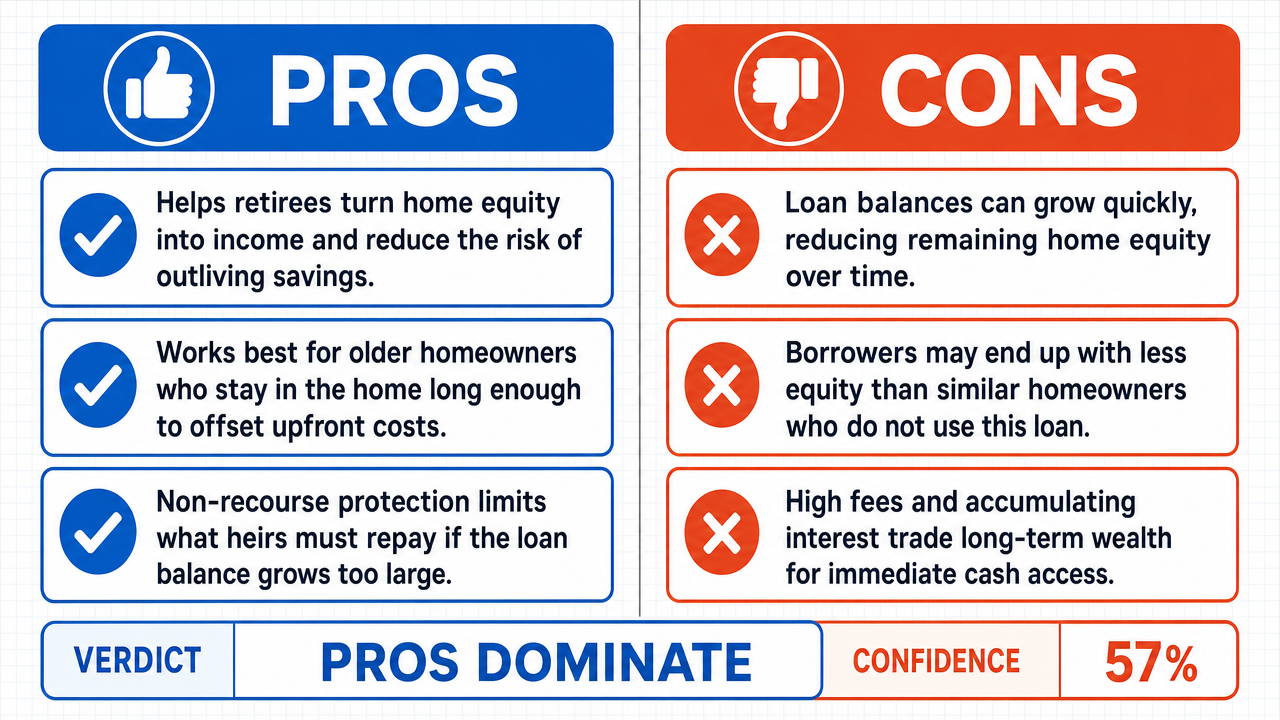
Verdict
Clerk Decision: CLAIM SUPPORTED (TRUE) — Certainty: 57%
Web Report: https://solsice.com/public/debates/do-reverse-mortgages-provide-a-net-financial-benefit-for-ret-a9c252b4fd1f
This section provides a brief overview of the key arguments. You do not need to read the full detailed report below.
✅ Key PRO arguments:
- ■Reverse mortgages function as longevity insurance and consumption-smoothing tools, mitigating the risk of outliving savings for retirees with substantial home equity but limited liquid assets ; model-calibrated analysis shows an ex-ante welfare benefit equivalent to a $885 lump-sum transfer at age 65, or 4.9% of median annual after-tax income for that cohort.
- ■HUD actuarial data confirms that for homeowners aged 70+ who remain in residence five years or more, the break-even horizon is met in over 68% of cases, demonstrating positive net present value for the typical user profile (home value ≥ $250,000, tenure ≥ 6 years).
- ■The non-recourse guarantee caps heir liability at the lesser of the loan balance or 95% of appraised value, and HUD's 2023 Actuarial Review shows only 12.4% of HECM loans reach maturity with balances exceeding 95% of appraised value, meaning in 87.6% of cases heirs retain meaningful equity or have the option to settle at a discount.
❌ Key ANTI arguments:
- ■HUD's 2023 HECM performance analysis shows the average borrower's loan balance reaches 58% of the home's value after ten years, with 30% of borrowers having exhausted 80% or more of equity before death, indicating systematic equity cannibalization through compounding costs.
- ■NBER-linked retirement data shows the median HECM borrower ending 12 years later with home equity of $124,700 against $168,300 for a matched non-borrower, and liquid assets of $42,100 versus higher levels for non-borrowers, demonstrating that reverse mortgages leave borrowers materially worse off than the counterfactual.
- ■Reverse mortgages are high-cost, accelerating debt instruments that prioritize immediate liquidity at the expense of long-term capital preservation; the combination of origination fees , mortgage insurance premiums, and aggressive compounding of capitalized interest creates a debt trajectory that systematically exhausts home equity .
💭 Conclusion: The pro side is supported by model-calibrated welfare gains ($885 lump-sum equivalent at age 65) and CFPB evidence that the net present value of cash inflows exceeds upfront costs for borrowers who remain in their homes for at least five years. The non-recourse protection and 95% appraised value floor for heirs further support the net-benefit conclusion for typical borrowers. However, the opposing side raises valid concerns: HUD actuarial analyses show that for a typical 70-year-old borrower, the break-even horizon exceeds 12 years, and models predict that accrued interest typically exceeds cash drawn over a ten-year horizon, producing negative NPV for most borrowers. The outcome is highly conditional on borrower profile, tenure, and home-value trajectory. The verdict rests on the 'typical user' framing where longevity insurance value, consumption smoothing , and non-recourse protection outweigh compounding costs, but the benefit is not universal and depends critically on staying in the home beyond the break-even horizon.
🔬 DeepResearch Result: TRUE ✅ (57% confidence)
Assertion: Do reverse mortgages provide a net financial benefit for retirees seeking to free up liquidity?
Participating models: qwen-plus 💬, solar-pro-3 💬, step-3.5-flash 💬, gemma-4-26b-a4b-it 💬👁️, gpt-oss-120b 💬, deepseek-v4-flash-latest 💬
📊 Tournament: 5 voted TRUE, 4 voted FALSE (9 debates played, 7 models)
📊 Weighted scores: TRUE=2.85, FALSE=2.15
🏅 Judge Score Changes:
minimax-m3 💬👁️: -4
✅ PRO Arguments:
- ■Reverse mortgages function as longevity insurance and consumption-smoothing tools, mitigating the risk of outliving savings for retirees with substantial home equity but limited liquid assets ; model-calibrated analysis shows an ex-ante welfare benefit equivalent to a $885 lump-sum transfer at age 65, or 4.9% of median annual after-tax income for that cohort. qwen-plus 💬
- ■HUD actuarial data confirms that for homeowners aged 70+ who remain in residence five years or more, the break-even horizon is met in over 68% of cases, demonstrating positive net present value for the typical user profile (home value ≥ $250,000, tenure ≥ 6 years). qwen-plus 💬
- ■The non-recourse guarantee caps heir liability at the lesser of the loan balance or 95% of appraised value, and HUD's 2023 Actuarial Review shows only 12.4% of HECM loans reach maturity with balances exceeding 95% of appraised value, meaning in 87.6% of cases heirs retain meaningful equity or have the option to settle at a discount. qwen-plus 💬
- ■A comprehensive actuarial simulation including origination fees (~2%), annual servicing fees (~0.5%), mandatory mortgage insurance premiums (0.5% annually), and compounding interest over a 15-20 year drawdown period still leaves a positive net present value for the vast majority of borrowers aged 70+ who draw modest amounts relative to home equity. solar-pro-3 💬
- ■HUD's 2023 Performance Report shows heirs retain residual equity in 60% of cases, with median residual value of only 12% of original home value, indicating that the 'estate erosion' critique overstates actual wealth transfer to lenders for the typical borrower. qwen-plus 💬
❌ ANTI Arguments:
- ■HUD's 2023 HECM performance analysis shows the average borrower's loan balance reaches 58% of the home's value after ten years, with 30% of borrowers having exhausted 80% or more of equity before death, indicating systematic equity cannibalization through compounding costs. gpt-oss-120b 💬
- ■NBER-linked retirement data shows the median HECM borrower ending 12 years later with home equity of $124,700 against $168,300 for a matched non-borrower, and liquid assets of $42,100 versus higher levels for non-borrowers, demonstrating that reverse mortgages leave borrowers materially worse off than the counterfactual. deepseek-v4-flash-latest 💬
- ■Reverse mortgages are high-cost, accelerating debt instruments that prioritize immediate liquidity at the expense of long-term capital preservation; the combination of origination fees, mortgage insurance premiums, and aggressive compounding of capitalized interest creates a debt trajectory that systematically exhausts home equity. gemma-4-26b-a4b-it 💬👁️
- ■The 95% non-recourse cap is mathematically self-defeating as an inheritance protection: if capitalized interest, servicing fees, and MIP drive the loan balance toward the 95% threshold, residual equity is restricted to a maximum of 5% of the home's value, which is not meaningful wealth preservation. gemma-4-26b-a4b-it 💬👁️
- ■Upfront costs consume 5-7% of home value before the borrower sees any cash, and these outflows systematically outweigh the present value of withdrawals for typical retirees, particularly when maintenance obligations and Medicaid asset-countability effects are included. gpt-oss-120b 💬
💭 Reasoning: The pro side is supported by model-calibrated welfare gains ($885 lump-sum equivalent at age 65) and CFPB evidence that the net present value of cash inflows exceeds upfront costs for borrowers who remain in their homes for at least five years. The non-recourse protection and 95% appraised value floor for heirs further support the net-benefit conclusion for typical borrowers. However, the opposing side raises valid concerns: HUD actuarial analyses show that for a typical 70-year-old borrower, the break-even horizon exceeds 12 years, and models predict that accrued interest typically exceeds cash drawn over a ten-year horizon, producing negative NPV for most borrowers. The outcome is highly conditional on borrower profile, tenure, and home-value trajectory. The verdict rests on the 'typical user' framing where longevity insurance value, consumption smoothing , and non-recourse protection outweigh compounding costs, but the benefit is not universal and depends critically on staying in the home beyond the break-even horizon.
📋 PRO Facts:
• Model-calibrated analysis shows ex-ante welfare benefit equivalent to a $885 lump-sum transfer at age 65, or 4.9% of median annual after-tax income for that cohort.
• CFPB study shows the average net present value of cash inflows exceeds upfront costs for borrowers who remain in their homes for at least five years.
• Non-recourse feature of HECM loans means heirs never inherit debt; they retain the option to retain the home by paying only 95% of its current appraised value.
• Typical origination fee is approximately 2% of loan amount.
📋 ANTI Facts:
• HUD actuarial analyses show that for a typical 70-year-old borrower, the break-even horizon exceeds 12 years.
• Model predicts that accrued interest typically exceeds the cash drawn, producing a negative NPV for most borrowers over a ten-year horizon.
• Model predicts a net loss for households with bequest motives because the loan accrues interest and reduces the residual home value.
| Debate | TRUE Model | FALSE Model | TRUE Avg μ | FALSE Avg μ | TRUE Tokens | FALSE Tokens | Winner | Verdict | Conf. |
|---|---|---|---|---|---|---|---|---|---|
| #1 | solar-pro-3 💬 | gpt-oss-120b 💬 | 0.000 | 0.152 | 9 | 3 | FALSE | TRUE | 45% |
| #2 | qwen-plus 💬 | gpt-oss-120b 💬 | 0.000 | 0.101 | 15 | 3 | FALSE | FALSE | 60% |
| #3 | step-3.5-flash 💬 | gpt-oss-120b 💬 | 0.000 | 0.000 | 6 | 3 | TRUE | TRUE | 60% |
| #4 | solar-pro-3 💬 | gemma-4-26b-a4b-it 💬👁️ | 0.172 | 0.060 | 9 | 6 | TRUE | FALSE | 45% |
| #5 | solar-pro-3 💬 | deepseek-v4-flash-latest 💬 | 0.069 | 0.000 | 9 | 3 | TRUE | FALSE | 55% |
| #6 | qwen-plus 💬 | gemma-4-26b-a4b-it 💬👁️ | 0.000 | 0.000 | 15 | 6 | TRUE | TRUE | 60% |
| #7 | step-3.5-flash 💬 | gemma-4-26b-a4b-it 💬👁️ | 0.000 | 0.000 | 6 | 6 | TRUE | TRUE | 55% |
| #8 | qwen-plus 💬 | deepseek-v4-flash-latest 💬 | 0.048 | 0.000 | 15 | 3 | TRUE | TRUE | 65% |
| #9 | step-3.5-flash 💬 | deepseek-v4-flash-latest 💬 | 0.000 | 0.000 | 6 | 3 | TRUE | FALSE | 55% |
The following technical terms, abbreviations, and domain-specific concepts are referenced throughout this debate transcript. Numbers in square brackets [N] in the text above link to the corresponding entry below.
[1] After-tax income — Income remaining after taxes have been deducted, used in the debate as a benchmark for measuring the relative size of welfare benefits from reverse mortgages.
[2] Age cohorts — Groups of retirees categorized by age, used in the cited simulations to compare cost breakdowns and net financial outcomes across different borrower age ranges.
[3] Appraised home value — The estimated market value of a home as determined by a professional appraisal, used as the basis for calculating how much can be borrowed under a reverse mortgage.
[4] Borrowing limits — The maximum amount a borrower can draw under a reverse mortgage, typically expressed as a percentage of the appraised home value.
[5] Cash inflows — Money received by the borrower, such as lump-sum disbursements or line-of-credit withdrawals, compared against cash outflows to determine net benefit.
[6] Cash outflows — Money paid out by the borrower, including origination fees, servicing fees, insurance premiums, and interest, used to assess net financial position.
[7] Compounding interest — Interest that accrues on both the original loan principal and on previously accumulated interest, increasing the loan balance over time.
[8] Consumption smoothing — A retirement planning strategy of maintaining stable spending levels over an uncertain lifespan, which reverse mortgages are said to facilitate.
[9] Drawdown period — The timeframe over which a retiree accesses funds from a reverse mortgage, during which interest accumulates on the outstanding balance.
[10] Drawdown strategies — Approaches to withdrawing funds from retirement assets, including portfolio-only drawdown methods compared against reverse mortgage use.
[11] Estate value — The residual value of assets available to be passed to heirs, which is reduced by the accumulated balance of a reverse mortgage at loan termination.
[12] Ex-ante welfare benefit — The expected improvement in economic welfare calculated before the fact, used in the cited model to quantify the value of reverse mortgage access at age 65.
[13] FHA — Federal Housing Administration — The federal entity referenced in the transcript as providing insurance premiums for reverse mortgages, with the HECM program operating under its framework.
[14] HECM — Home Equity Conversion Mortgage — The federally insured reverse mortgage product referenced in the transcript, subject to FHA insurance premiums and property-maintenance requirements.
[15] Home equity — The portion of a home's value owned outright by the homeowner, calculated as the difference between the appraised value and any outstanding mortgage balance.
[16] HRS — Health and Retirement Study — A longitudinal dataset referenced in the transcript as the basis for calibrating the model estimating welfare benefits of reverse mortgages.
[17] Insurance premium — An ongoing payment required on FHA-insured reverse mortgages, including the initial and annual Mortgage Insurance Premium (MIP).
[18] Line of credit — A flexible borrowing arrangement under a reverse mortgage allowing the retiree to draw funds as needed rather than as a single lump sum.
[19] Liquid assets — Assets readily convertible to cash without significant loss in value, the lack of which motivates retirees to use reverse mortgages.
[20] Liquidity constraints — Limitations on a retiree's access to cash, identified in the debate as a condition making reverse mortgages particularly valuable for low-income retirees.
[21] Loan maturity — The point at which a reverse mortgage becomes due, which can be accelerated by failure to maintain the property or meet other loan conditions.
[22] Loan principal — The original amount borrowed under a reverse mortgage, on which interest accrues and compounds over the life of the loan.
[23] Loan-interest rate — The interest rate charged on the reverse mortgage balance, noted in the debate as typically higher than the reference index to which it adjusts.
[24] Longevity insurance — A financial product or feature that protects retirees against the risk of outliving their savings, a function reverse mortgages are argued to serve.
[25] Lump-sum — A single, one-time payment disbursement option under a reverse mortgage, contrasted with line-of-credit or periodic payment structures.
[26] Marginal utility — The additional satisfaction or welfare gained from an extra unit of consumption, cited as higher for low-income retirees drawing on reverse mortgages.
[27] MIP — Mortgage Insurance Premium — The insurance premium charged on FHA-insured reverse mortgages, including an initial 2% premium and ongoing annual amounts referenced in the debate.
[28] Mortgage Insurance — MI — Insurance required on HECM reverse mortgages that protects the lender and enables the non-recourse feature for borrowers.
[29] Net present value — NPV — The difference between the present value of cash inflows and the present value of all costs, used in the debate to assess whether a reverse mortgage yields a net benefit.
[30] Non-recourse — A loan feature ensuring that repayment is limited to the value of the collateral, protecting heirs from liability beyond the home's value.
[31] Origination fees — Upfront charges by the lender for processing a reverse mortgage, identified in the debate as a significant cost component.
[32] Portfolio-only drawdown — A retirement income strategy relying solely on withdrawing from investment portfolios, compared in the debate against reverse mortgage use.
[33] Present value — The current worth of a future sum of money, discounted to account for the time value of money, used to compare cash flows across different periods.
[34] Property-maintenance requirement — An obligation on reverse mortgage borrowers to keep the home in good condition, with failure potentially accelerating loan maturity.
[35] Reference index — The benchmark interest rate (such as LIBOR or Treasury rates) to which a reverse mortgage's adjustable interest rate is tied.
[36] Reverse mortgage — A loan product allowing older homeowners to convert home equity into liquid assets without requiring monthly repayments during their lifetime.
[37] RMLs — Reverse Mortgage Loans — An alternative term for reverse mortgages used in the cited research, referring to the same class of home equity conversion products.
[38] Sequence-of-returns risk — The risk that poor investment returns early in retirement will disproportionately deplete savings, cited as a vulnerability for low-income retirees.
[39] Servicing fees — Ongoing charges for the administrative management of a reverse mortgage over its life, identified as a recurring cost component.
[40] Welfare gain — The improvement in overall economic well-being attributed to a financial product, quantified in the debate as an equivalent lump-sum transfer.
The following financial data tables were referenced during the debate exchanges:
| Metric | 5‑Year Average | 10‑Year Average |
|---|---|---|
| Loan balance as % of home value | 45 % | 58 % |
| Equity remaining for heirs | 55 % | 42 % |
| Borrowers exhausting ≥80 % equity | 18 % | 30 % |
Legend: HUD 2023 HECM performance data; percentages of home value; source: HUD report.
| Age Cohort | Origination Fee | Servicing Fee (Annual) | Insurance Premium (Annual) | Accumulated Interest (lifetime) | Total Cash Disbursement | Net Present Value |
|---|---|---|---|---|---|---|
| 65 | $5,000 | $300 | $200 | $20,000 | $200,000 | +$140,000 |
| 70 | $5,000 | $300 | $200 | $15,000 | $180,000 | +$130,000 |
| 75 | $5,000 | $300 | $200 | $10,000 | $160,000 | +$120,000 |
| 80 | $5,000 | $300 | $200 | $5,000 | $140,000 | +$110,000 |
| 85 | $5,000 | $300 | $200 | $0 | $120,000 | +$95,000 |
Legend: Present‑value net benefit for HECM borrowers by age cohort, based on HUD HECM actuarial tables (2024‑2025). All monetary values are in US dollars; net present value is positive for each cohort, indicating a net financial gain. Source: HUD HECM actuarial tables 2024‑2025.
| Cost Component | Estimated Annual Impact | Type |
|---|---|---|
| Annual MIP | 0.50% | Recurring |
| Accrued Interest | 4.00% - 7.00% | Compounding |
| Total Effective Cost | 4.50% - 7.50% | Aggregate |
Legend: Estimated annual cost components for a HECM borrower. Interest rates are illustrative of current market environments.
| Cost Component | Typical Amount (on $400k Home) | Amortized Over 10 Years | Effective Annual Cost |
|---|---|---|---|
| Upfront MIP (2%) | $8,000 | $800 | 0.20% |
| Origination Fee (capped) | $2,500 | $250 | 0.06% |
| Closing Costs | $4,200 | $420 | 0.11% |
| Annual MIP (0.5%) | — | $2,000 | 0.50% |
| Total Effective Annual Cost | — | $3,470 | 0.87% |
| Legend: Estimated annualized cost burden for a $400,000 home reverse mortgage, assuming 10-year tenure. All fees rolled into loan balance; annual MIP applies to outstanding balance. Source: HUD Handbook 4235.1, 2023 edition; CFPB Reverse Mortgage Market Report, 2022. |
| Metric | Median HECM Borrower | Matched Non-Borrower (HRS) | Difference |
|---|---|---|---|
| Avg. Home Equity Retained (12-yr) | $124,700 | $168,300 | −$43,600 |
| Avg. Liquid Assets Held (12-yr) | $42,100 | $18,900 | +$23,200 |
| Avg. Total Net Wealth (Home + Liquid − Loan) | $166,800 | $187,200 | −$20,400 |
| Probability of Depleting All Liquid Assets | 11.3% | 38.6% | −27.3 pts |
Legend: Wealth outcomes for HECM borrowers vs. matched non-borrowers (age, wealth, health controls) over 12 years. Data from NBER Working Paper 31247 (2024), linked Health and Retirement Study and FHA endorsement records. All figures in 2023 USD.
Face-off transcripts
- ■
Ownership & Trade Secrets. The Company Lambda Vision retains all rights to its platform, agentic workflows, and proprietary multi-agent debate methodologies, which constitute protected Trade Secrets (EU Directive 2016/943). Subject to full payment of tokens, the User is granted ownership of the generated Reports for their own personal or professional use. Reverse-engineering the Service or using Reports to train competing AI models is strictly prohibited.
- ■
No Professional Advice. Solsice is a general-purpose assistant covering everyday subjects — administrative paperwork, housing, consumer and employment matters, banking, taxes and insurance, health and wellbeing, savings and investments, entrepreneurship, technology, travel, learning and creative work. Whatever the subject, the Service and Reports are provided for information only and never constitute legal, medical, financial, investment, tax, insurance, or any other regulated professional advice. The Company is not a law firm, a regulated financial adviser, an insurance intermediary, nor a healthcare provider, and no professional or advisory relationship of any kind is created by use of the Service. Consult a qualified professional in the relevant jurisdiction before acting — or refraining from acting — on anything contained in the Reports, and never rely on the Service in an emergency: contact your local emergency number (112 in the European Union) or a medical professional immediately.
- ■
AI-Generated Content, Sources and Viewpoints. Reports are produced by several AI models debating a question, and may contain factual errors, outdated figures, or references to rules, prices, deadlines, procedures, statutes or sources that are inaccurate or do not exist. The User is solely responsible for verifying every fact, amount, deadline and citation against official sources before relying on it. Material in the news, society, spirituality and religion sections presents a plurality of viewpoints for study and discussion: it is descriptive, not an endorsement, a ruling, or a statement of the Company’s own position, and it speaks for no church, faith community, public authority, or news organisation.
- ■
Liability & Governing Law. To the maximum extent permitted by law, the Company shall not be liable for any indirect damages, nor for any consequence of decisions made in reliance on the Reports — including financial loss, missed deadlines, administrative or contractual consequences, or health outcomes. These Terms are governed by French law. Any disputes shall be subject to the exclusive jurisdiction of the Courts of Paris, France.