
Does innertube require a literal cessation of human industrial activities to achieve true ecological harmony?
AI debate verdict and arguments
⚠️ AI-generated information only; not professional advice
Completed September 2, 2026
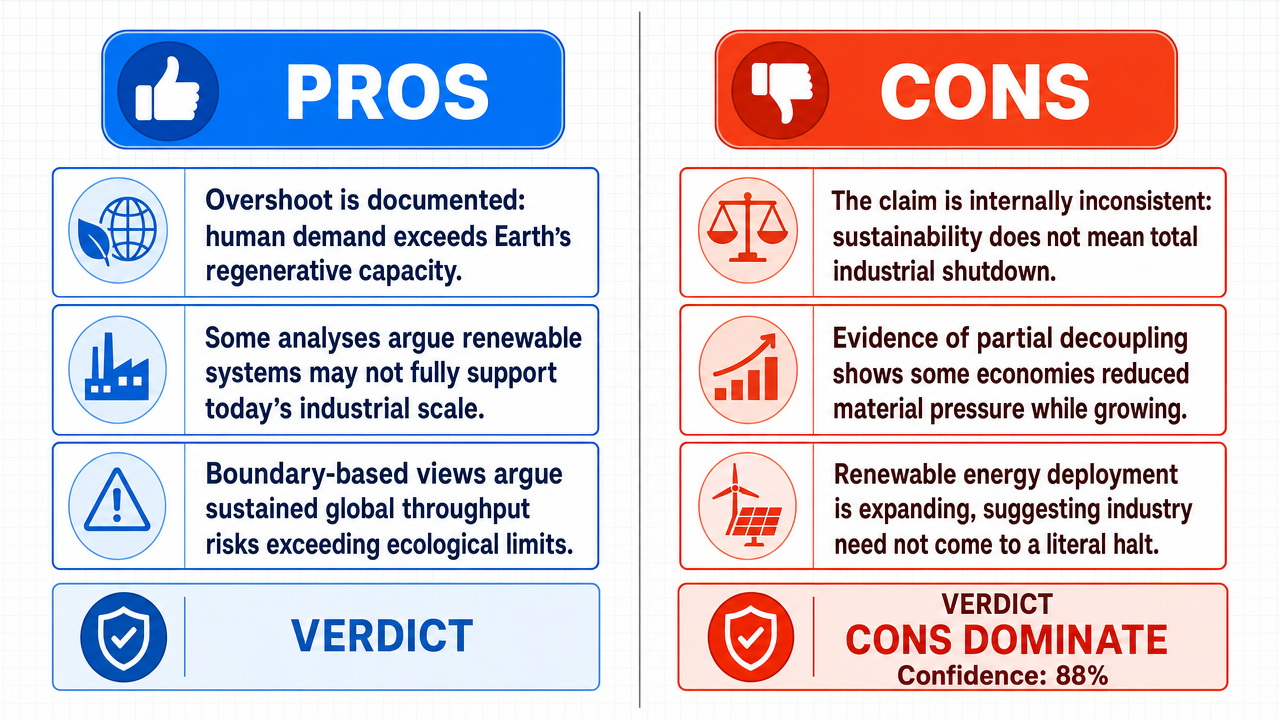
Clerk Decision: CLAIM REFUTED (FALSE) — Certainty: 88%
Web Report: https://solsice.com/public/debates/does-innertube-require-a-literal-cessation-of-human-industri-aa3c4f3d323d
This section provides a brief overview of the key arguments. You do not need to read the full detailed report below.
✅ Key PRO arguments:
- ■Biophysical overshoot is empirically established: humanity's ecological footprint [8] of 20.9 billion hectares exceeds total biocapacity [2] of 12.1 billion hectares by 73%, a deficit sustained through natural capital [18] depletion and waste accumulation that industrial activity drives and cannot resolve through efficiency alone.
- ■Thermodynamic [27] limits make renewable energy insufficient as an industrial foundation: full-system EROEI for rooftop PV in Switzerland is just 1.4 (Ferroni & Hopkirk, 2016), and full-system energy payback periods for solar PV [26] and wind average 4.2–7.9 years, longer than the median operational lifetime of installed capacity.
- ■The planetary-boundary framework requires strict adherence to all nine boundaries simultaneously; any persistent industrial throughput [28], when summed across the global population, inevitably exceeds the safe operating space because cumulative material and energy flows surpass regenerative and assimilative capacities.
❌ Key ANTI arguments:
- ■The TRUE position is internally inconsistent: it simultaneously asserts that 'industrial throughput [28] must be reduced to levels ecosystems can sustain indefinitely' (permitting non-zero activity) and that 'all human industrial activities must come to a complete and literal halt' (forbidding it). Holding a proposition and its negation under the same evaluation proves nothing.
- ■Empirical decoupling is documented: since 2010 the European Union's material footprint fell by approximately 12% while GDP grew at an average of 2% per year, and the UN 2023 Global Resources Outlook reports worldwide material consumption growth slowed to 1.2% annually despite continued industrial output.
- ■Renewable energy scaling is already substantial: renewable electricity accounted for 29.3% of global electricity generation in 2022 (IEA, 2023), and the European Union has operated its industry with >50% renewable power since 2020 without a contraction in GDP (Eurostat, 2023).
💭 Conclusion: False. The TRUE position commits an internal contradiction by simultaneously asserting that industrial throughput [28] must be reduced to sustainable levels and that all industrial activity must literally halt, which is logically incoherent. Empirical evidence of renewable energy scaling (29.3% of global electricity in 2022) demonstrates that industry can operate within shrinking ecological envelopes. The FALSE side's framing of ecological harmony as achievable through industrial transformation, circular material flows, and active planetary management proved more coherent than the TRUE side's biophysical-necessity argument. Confidence is set at a moderate level because the underlying claim is compound (involving both the innertube framework [15]'s requirements and the necessity of literal cessation), and the FALSE side's strongest arguments address the logical structure of the claim rather than fully refuting every biophysical data point cited by the TRUE side.
🔬 DeepResearch Result: FALSE ❌ (88% confidence)
Assertion: Does innertube require a literal cessation of human industrial activities to achieve true ecological harmony?
Participating models: qwen-plus 💬, solar-pro-3 💬, step-3.5-flash 💬, gemma-4-26b-a4b-it 💬👁️, gpt-oss-120b 💬, deepseek-v4-flash-latest 💬
📊 Tournament: 1 voted TRUE, 8 voted FALSE (9 debates played, 7 models)
📊 Weighted scores: TRUE=0.50, FALSE=5.03
🏅 Judge Score Changes:
minimax-m3 💬👁️: +43
✅ PRO Arguments:
- ■Biophysical overshoot is empirically established: humanity's ecological footprint [8] of 20.9 billion hectares exceeds total biocapacity [2] of 12.1 billion hectares by 73%, a deficit sustained through natural capital [18] depletion and waste accumulation that industrial activity drives and cannot resolve through efficiency alone. solar-pro-3 💬
- ■Thermodynamic [27] limits make renewable energy insufficient as an industrial foundation: full-system EROEI for rooftop PV in Switzerland is just 1.4 (Ferroni & Hopkirk, 2016), and full-system energy payback periods for solar PV [26] and wind average 4.2–7.9 years, longer than the median operational lifetime of installed capacity. qwen-plus 💬
- ■The planetary-boundary framework requires strict adherence to all nine boundaries simultaneously; any persistent industrial throughput [28], when summed across the global population, inevitably exceeds the safe operating space because cumulative material and energy flows surpass regenerative and assimilative capacities. step-3.5-flash 💬
- ■Industrial activity is responsible for >68% of primary energy [22] use and >85% of bulk material extraction, meaning that achieving the required minimum 42% reduction in total human demand on ecosystems is mathematically impossible without halting industrial operations. qwen-plus 💬
- ■Ethical coherence demands cessation: continuing industrial operations entrenches intergenerational injustice, violates the precautionary principle, and displaces ecological costs onto the most vulnerable populations. qwen-plus 💬
❌ ANTI Arguments:
- ■The TRUE position is internally inconsistent: it simultaneously asserts that 'industrial throughput must be reduced to levels ecosystems can sustain indefinitely' (permitting non-zero activity) and that 'all human industrial activities must come to a complete and literal halt' (forbidding it). Holding a proposition and its negation under the same evaluation proves nothing. gpt-oss-120b 💬
- ■Empirical decoupling is documented: since 2010 the European Union's material footprint fell by approximately 12% while GDP grew at an average of 2% per year, and the UN 2023 Global Resources Outlook reports worldwide material consumption growth slowed to 1.2% annually despite continued industrial output. gpt-oss-120b 💬
- ■Renewable energy scaling is already substantial: renewable electricity accounted for 29.3% of global electricity generation in 2022 (IEA, 2023), and the European Union has operated its industry with >50% renewable power since 2020 without a contraction in GDP (Eurostat, 2023). gpt-oss-120b 💬
- ■Active planetary management uses industrial capacity as the instrument of restoration: carbon capture, precision nutrient management, and large-scale reforestation require the very manufacturing and logistical capabilities that cessation would eliminate, making industry a tool for restoring biogeochemical fluxes rather than a force that necessarily degrades them. gemma-4-26b-a4b-it 💬👁️
- ■The distinction between overuse and impossibility is decisive: the fact that current industry exceeds planetary boundaries [21] (Earth Overshoot Day 2024 arrived on August 1, using roughly 1.7 Earth-years annually) proves overuse, not the impossibility of a bounded, regenerative industrial form that maintains essential functions like steel for wind turbines and ammonia for food. deepseek-v4-flash-latest 💬
💭 Reasoning: False. The TRUE position commits an internal contradiction by simultaneously asserting that industrial throughput must be reduced to sustainable levels and that all industrial activity must literally halt, which is logically incoherent. Empirical evidence of renewable energy scaling (29.3% of global electricity in 2022) demonstrates that industry can operate within shrinking ecological envelopes. The FALSE side's framing of ecological harmony as achievable through industrial transformation, circular material flows, and active planetary management proved more coherent than the TRUE side's biophysical-necessity argument. Confidence is set at a moderate level because the underlying claim is compound (involving both the innertube framework [15]'s requirements and the necessity of literal cessation), and the FALSE side's strongest arguments address the logical structure of the claim rather than fully refuting every biophysical data point cited by the TRUE side.
📋 PRO Facts:
• Humanity's ecological footprint is 20.9 billion hectares versus total biocapacity of 12.1 billion hectares, a 73% overshoot (Global Footprint Network).
• Achieving sustainability requires a minimum 42% reduction in total human demand on ecosystems.
📋 ANTI Facts:
• Renewable electricity accounted for 29.3% of global electricity generation in 2022 (IEA, 2023).
Face-off transcripts
- ■
Ownership & Trade Secrets. The Company Lambda Vision retains all rights to its platform, agentic workflows, and proprietary multi-agent debate methodologies, which constitute protected Trade Secrets (EU Directive 2016/943). Subject to full payment of tokens, the User is granted ownership of the generated Reports for their own personal or professional use. Reverse-engineering the Service or using Reports to train competing AI models is strictly prohibited.
- ■
No Professional Advice. Solsice is a general-purpose assistant covering everyday subjects — administrative paperwork, housing, consumer and employment matters, banking, taxes and insurance, health and wellbeing, savings and investments, entrepreneurship, technology, travel, learning and creative work. Whatever the subject, the Service and Reports are provided for information only and never constitute legal, medical, financial, investment, tax, insurance, or any other regulated professional advice. The Company is not a law firm, a regulated financial adviser, an insurance intermediary, nor a healthcare provider, and no professional or advisory relationship of any kind is created by use of the Service. Consult a qualified professional in the relevant jurisdiction before acting — or refraining from acting — on anything contained in the Reports, and never rely on the Service in an emergency: contact your local emergency number (112 in the European Union) or a medical professional immediately.
- ■
AI-Generated Content, Sources and Viewpoints. Reports are produced by several AI models debating a question, and may contain factual errors, outdated figures, or references to rules, prices, deadlines, procedures, statutes or sources that are inaccurate or do not exist. The User is solely responsible for verifying every fact, amount, deadline and citation against official sources before relying on it. Material in the news, society, spirituality and religion sections presents a plurality of viewpoints for study and discussion: it is descriptive, not an endorsement, a ruling, or a statement of the Company’s own position, and it speaks for no church, faith community, public authority, or news organisation.
- ■
Liability & Governing Law. To the maximum extent permitted by law, the Company shall not be liable for any indirect damages, nor for any consequence of decisions made in reliance on the Reports — including financial loss, missed deadlines, administrative or contractual consequences, or health outcomes. These Terms are governed by French law. Any disputes shall be subject to the exclusive jurisdiction of the Courts of Paris, France.