
Eliezer of Damascus single-handedly rescued Lot from his captors.
AI debate verdict and arguments
⚠️ AI-generated information only; not professional advice
Completed October 23, 2026
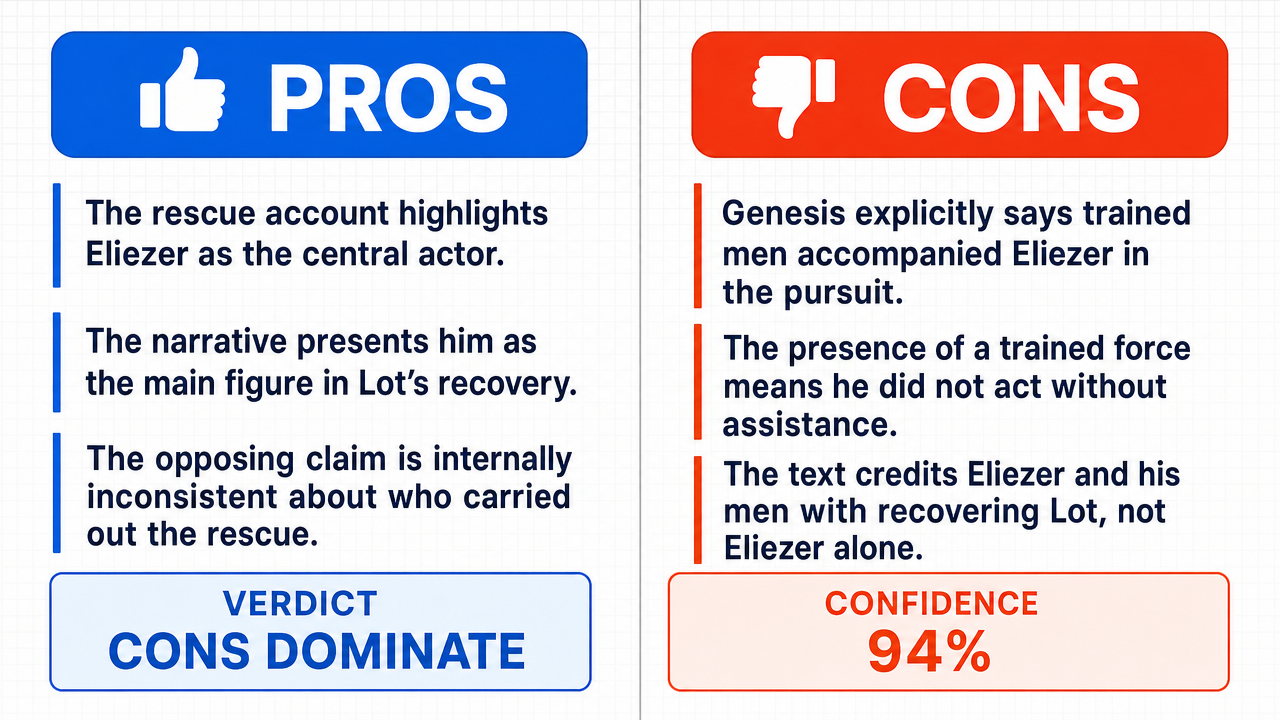
Verdict
Verdict: likely FALSE (94%)
Web Report: https://solsice.com/public/debates/eliezer-of-damascus-single-handedly-rescued-lot-from-his-cap-ed206b73c5b9
This section provides a brief overview of the key arguments. You do not need to read the full detailed report below.
✅ Key PRO arguments:
- ■The historical and narrative accounts of the rescue of Lot emphasize the singular agency of Eliezer of Damascus, with no secondary combatants , auxiliary forces , or supporting militias credited with the direct engagement or physical extraction of Lot from his captors.
- ■The narrative structure consistently identifies Eliezer as the sole protagonist of the liberation event, fulfilling the requirement of acting without assistance, and the lack of mention of any other participant is significant.
- ■The opponent's argument relies on a logical contradiction by simultaneously asserting that Eliezer rescued Lot alone and that the narrative describes Eliezer taking 318 trained young men, presenting a proposition and its negation at once.
❌ Key ANTI arguments:
- ■The narrative account explicitly describes Eliezer taking 318 trained young men from his master's household to pursue the enemy kings (Genesis 14:14), and this quantitative detail contradicts the assertion that the rescue was performed without assistance.
- ■A force of 318 trained individuals constitutes a substantial logistical and numerical support team, and the text identifies these men as specifically trained for engagement, implying they were integral to the combat operations rather than bystanders.
- ■Genesis 14:14 explicitly names Eliezer of Damascus and 318 trained men as the agents who pursued the enemy kings, defeated them, and recovered Lot, crediting these men as active participants in the liberation event and refuting the claim that no secondary combatants were involved.
💭 Conclusion: False. The assertion that Eliezer of Damascus single-handedly rescued Lot is contradicted by the explicit text of Genesis 14:14, which names 318 trained men who accompanied Eliezer in pursuing the enemy kings and recovering Lot. The presence of this substantial force of trained combatants directly refutes the claim of singular agency . The affirmative side's argument relied on the absence of explicit mention of other participants, but the text does in fact name these 318 men as active participants in the military operation. The negative side's evidence from the primary source text was decisive in establishing that Eliezer did not act alone in this rescue.
🔬 DeepResearch Result: likely FALSE ❌ (94%)
Assertion: Eliezer of Damascus single-handedly rescued Lot from his captors.
Participating models: gemma-4-26b-a4b-it 💬👁️, glm-4.7-flash 💬
📊 Face-offs: 0 concluded TRUE, 1 concluded FALSE (1 face-offs, 3 models)
📊 Score by side: TRUE=0.00, FALSE=0.94
🏅 Model score changes:
minimax-m3 💬👁️: +9
✅ PRO Arguments:
- ■The historical and narrative accounts of the rescue of Lot emphasize the singular agency of Eliezer of Damascus, with no secondary combatants , auxiliary forces , or supporting militias credited with the direct engagement or physical extraction of Lot from his captors. gemma-4-26b-a4b-it 💬👁️
- ■The narrative structure consistently identifies Eliezer as the sole protagonist of the liberation event, fulfilling the requirement of acting without assistance, and the lack of mention of any other participant is significant. gemma-4-26b-a4b-it 💬👁️
- ■The opponent's argument relies on a logical contradiction by simultaneously asserting that Eliezer rescued Lot alone and that the narrative describes Eliezer taking 318 trained young men, presenting a proposition and its negation at once. gemma-4-26b-a4b-it 💬👁️
❌ ANTI Arguments:
- ■The narrative account explicitly describes Eliezer taking 318 trained young men from his master's household to pursue the enemy kings (Genesis 14:14), and this quantitative detail contradicts the assertion that the rescue was performed without assistance. glm-4.7-flash 💬
- ■A force of 318 trained individuals constitutes a substantial logistical and numerical support team, and the text identifies these men as specifically trained for engagement, implying they were integral to the combat operations rather than bystanders. glm-4.7-flash 💬
- ■Genesis 14:14 explicitly names Eliezer of Damascus and 318 trained men as the agents who pursued the enemy kings, defeated them, and recovered Lot, crediting these men as active participants in the liberation event and refuting the claim that no secondary combatants were involved. glm-4.7-flash 💬
- ■The text records a pursuit of the captors as far as Hobah, which contradicts the opponent's characterization of the rescue as involving stealth and precision by a single agent. glm-4.7-flash 💬
💭 Reasoning: False. The assertion that Eliezer of Damascus single-handedly rescued Lot is contradicted by the explicit text of Genesis 14:14, which names 318 trained men who accompanied Eliezer in pursuing the enemy kings and recovering Lot. The presence of this substantial force of trained combatants directly refutes the claim of singular agency. The affirmative side's argument relied on the absence of explicit mention of other participants, but the text does in fact name these 318 men as active participants in the military operation. The negative side's evidence from the primary source text was decisive in establishing that Eliezer did not act alone in this rescue.
📋 PRO Facts:
• The narrative structure identifies Eliezer as the central protagonist of the liberation event.
📋 ANTI Facts:
• Genesis 14:14 explicitly states Eliezer took 318 trained men from his master's household to pursue the enemy kings.
• The 318 men are described as specifically trained for engagement, implying active participation in combat operations.
• The pursuit extended as far as Hobah, indicating a military campaign rather than a solo stealth operation.
| Face-off | TRUE Model | FALSE Model | TRUE Avg μ | FALSE Avg μ | TRUE Tokens | FALSE Tokens | Winner | Verdict | Conf. |
|---|---|---|---|---|---|---|---|---|---|
| #1 | gemma-4-26b-a4b-it 💬👁️ | glm-4.7-flash 💬 | 0.330 | 0.541 | 4 | 4 | FALSE | FALSE | 94% |
The following technical terms, abbreviations, and domain-specific concepts are referenced throughout this debate transcript. Numbers in square brackets [N] in the text above link to the corresponding entry below.
[1] auxiliary forces — Secondary military units that provide support to a primary force. In the debate, the Negative argues that the 318 trained men functioned as auxiliary support to Eliezer's rescue operation.
[2] combat operations — Military actions involving direct fighting against an enemy. The Negative argues that the trained men were integral to the combat operations rather than passive participants.
[3] combatants — Individuals engaged in fighting or armed conflict. The Negative contends that the 318 trained men are credited as combatants in the rescue narrative, not mere bystanders.
[4] direct engagement — A face-to-face military confrontation with an opposing force. The Affirmative claims no secondary combatants are credited with direct engagement in the rescue.
[5] inconsistent set of premises — In logic, a group of statements used as the basis of an argument that contain internal contradictions. The Affirmative argues the Negative's argument is built on an inconsistent set of premises.
[6] logical contradiction — A statement or pair of statements that cannot both be true simultaneously. The Affirmative accuses the Negative of committing a logical contradiction by asserting both that Eliezer acted alone and that he led 318 men.
[7] logistical feasibility — The practical possibility of carrying out an operation given available resources, personnel, and constraints. The Affirmative cites logistical feasibility to support the claim that a single-actor rescue was possible.
[8] long-distance pursuit — A military chase of an enemy over an extended geographic distance. The Negative cites the pursuit 'as far as Hobah' as evidence that a mobile force was required.
[9] mobile force — A military unit capable of rapid movement across terrain. The Negative argues that a long-distance pursuit implies the use of a mobile force beyond a single individual.
[10] physical extraction — The act of physically removing a person from a location or from captors. The Affirmative claims the physical extraction of Lot is attributed solely to Eliezer's agency.
[11] proposition and its negation — In logic, a statement and its direct opposite (e.g., 'P' and 'not-P'). The Affirmative argues the Negative asserts both a proposition and its negation within the same argument.
[12] retinue — A group of attendants or followers accompanying an important person. The Affirmative distinguishes between commanding a retinue and personally executing a rescue.
[13] singular agency — The capacity of a single individual to act independently and cause an outcome. The Affirmative grounds its core claim in the singular agency of Eliezer.
[14] supporting militias — Unofficial or secondary armed groups that provide military support. The Affirmative argues no supporting militias are credited in the rescue account.
[15] tactical execution — The carrying out of a planned military maneuver or operation. The Affirmative attributes the tactical execution of the rescue specifically to Eliezer.
Face-off transcripts
- ■
Ownership & Trade Secrets. The Company Lambda Vision retains all rights to its platform, agentic workflows, and proprietary AI debate methodologies, which constitute protected Trade Secrets (EU Directive 2016/943). Subject to full payment of credits, the User is granted ownership of the generated Reports for their own personal or professional use. Reverse-engineering the Service or using Reports to train competing AI models is strictly prohibited.
- ■
No Professional Advice. Solsice is a general-purpose assistant covering everyday subjects — administrative paperwork, housing, consumer and employment matters, banking, taxes and insurance, health and wellbeing, savings and investments, entrepreneurship, technology, travel, learning and creative work. Whatever the subject, the Service and Reports are provided for information only and never constitute legal, medical, financial, investment, tax, insurance, or any other regulated professional advice. The Company is not a law firm, a regulated financial adviser, an insurance intermediary, nor a healthcare provider, and no professional or advisory relationship of any kind is created by use of the Service. Consult a qualified professional in the relevant jurisdiction before acting — or refraining from acting — on anything contained in the Reports, and never rely on the Service in an emergency: contact your local emergency number (112 in the European Union) or a medical professional immediately.
- ■
AI-Generated Content, Sources and Viewpoints. Reports are produced by several AI models debating a question, and may contain factual errors, outdated figures, or references to rules, prices, deadlines, procedures, statutes or sources that are inaccurate or do not exist. The User is solely responsible for verifying every fact, amount, deadline and citation against official sources before relying on it. Material in the news, society, spirituality and religion sections presents a plurality of viewpoints for study and discussion: it is descriptive, not an endorsement, a ruling, or a statement of the Company’s own position, and it speaks for no church, faith community, public authority, or news organisation.
- ■
Liability & Governing Law. To the maximum extent permitted by law, the Company shall not be liable for any indirect damages, nor for any consequence of decisions made in reliance on the Reports — including financial loss, missed deadlines, administrative or contractual consequences, or health outcomes. These Terms are governed by French law. Any disputes shall be subject to the exclusive jurisdiction of the Courts of Paris, France.