
Eliezer of Damascus was among the nine righteous individuals who entered Paradise alive.
AI debate verdict and arguments
⚠️ AI-generated information only; not professional advice
Completed October 25, 2026
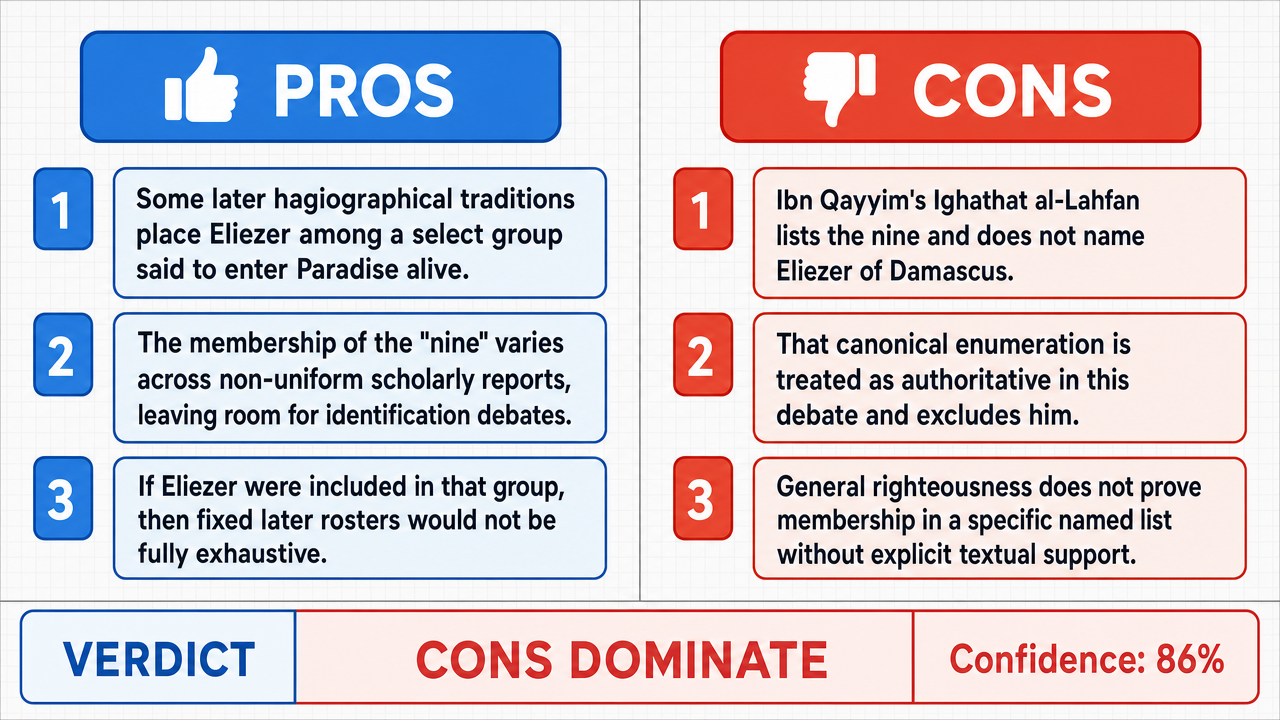
Verdict
Verdict: likely FALSE (86%)
Web Report: https://solsice.com/public/debates/eliezer-of-damascus-was-among-the-nine-righteous-individuals-a58ea18cb3ad
This section provides a brief overview of the key arguments. You do not need to read the full detailed report below.
✅ Key PRO arguments:
- ■Eliezer of Damascus is identified within the group of nine righteous individuals who entered Paradise alive based on Islamic hagiographical traditions and scholarly commentaries regarding the 'Al-Abad al-Salihun ' (the righteous ones), where he is cited as a figure of exceptional piety.
- ■The identification of Eliezer within this elite spiritual category is supported by varying scholarly traditions where the identity of the 'nine' is subject to differing enumerations, suggesting the roster is not universally fixed.
- ■If Eliezer of Damascus was indeed among the nine righteous who entered Paradise alive, then by contraposition the roster in Ighathat al-Lahfan cannot be considered an exhaustive or definitive enumeration of this specific group.
❌ Key ANTI arguments:
- ■The classical compilation Ighathat al-Lahfan by Ibn Qayyim al-Jawziyya explicitly lists the nine individuals who entered Paradise alive as Adam, Seth, Idris, Joseph, Aaron, Ezra, Jesus, John, and Muhammad, and does not include Eliezer of Damascus (Al-Yasa').
- ■The roster in Ighathat al-Lahfan is definitive, drawing from verified narrations of the Prophet's Companions and early scholars, and its enumeration excludes Eliezer of Damascus from this specific group.
- ■The opponent's argument relies on a logical disjunction —either Eliezer is explicitly named in canonical lists or his general piety is sufficient to infer membership—but both branches fail because the canonical enumeration is definitive and does not name him.
💭 Conclusion: False. The assertion that Eliezer of Damascus was among the nine righteous individuals who entered Paradise alive is not supported by the canonical Islamic enumeration. The authoritative text Ighathat al-Lahfan by Ibn Qayyim al-Jawziyya provides a definitive roster of the nine—Adam, Seth, Idris, Joseph, Aaron, Ezra, Jesus, John, and Muhammad—which does not include Eliezer of Damascus (Al-Yasa'). The affirmative side's reliance on broader hagiographical traditions and general piety failed to overcome the specificity of the canonical list. The affirmative also attempted a contrapositive argument challenging the exhaustiveness of the roster, but this was insufficient without concrete textual evidence placing Eliezer within the group. The negative side's citation of a definitive scholarly source with an explicit enumeration carried the debate decisively.
🔬 DeepResearch Result: likely FALSE ❌ (86%)
Assertion: Eliezer of Damascus was among the nine righteous individuals who entered Paradise alive.
Participating models: gemma-4-26b-a4b-it 💬👁️, glm-4.7-flash 💬
📊 Face-offs: 0 concluded TRUE, 1 concluded FALSE (1 face-offs, 3 models)
📊 Score by side: TRUE=0.00, FALSE=0.86
🏅 Model score changes:
minimax-m3 💬👁️: +9
✅ PRO Arguments:
- ■Eliezer of Damascus is identified within the group of nine righteous individuals who entered Paradise alive based on Islamic hagiographical traditions and scholarly commentaries regarding the 'Al-Abad al-Salihun ' (the righteous ones), where he is cited as a figure of exceptional piety. gemma-4-26b-a4b-it 💬👁️
- ■The identification of Eliezer within this elite spiritual category is supported by varying scholarly traditions where the identity of the 'nine' is subject to differing enumerations, suggesting the roster is not universally fixed. gemma-4-26b-a4b-it 💬👁️
- ■If Eliezer of Damascus was indeed among the nine righteous who entered Paradise alive, then by contraposition the roster in Ighathat al-Lahfan cannot be considered an exhaustive or definitive enumeration of this specific group. gemma-4-26b-a4b-it 💬👁️
❌ ANTI Arguments:
- ■The classical compilation Ighathat al-Lahfan by Ibn Qayyim al-Jawziyya explicitly lists the nine individuals who entered Paradise alive as Adam, Seth, Idris, Joseph, Aaron, Ezra, Jesus, John, and Muhammad, and does not include Eliezer of Damascus (Al-Yasa'). glm-4.7-flash 💬
- ■The roster in Ighathat al-Lahfan is definitive, drawing from verified narrations of the Prophet's Companions and early scholars, and its enumeration excludes Eliezer of Damascus from this specific group. glm-4.7-flash 💬
- ■The opponent's argument relies on a logical disjunction —either Eliezer is explicitly named in canonical lists or his general piety is sufficient to infer membership—but both branches fail because the canonical enumeration is definitive and does not name him. glm-4.7-flash 💬
💭 Reasoning: False. The assertion that Eliezer of Damascus was among the nine righteous individuals who entered Paradise alive is not supported by the canonical Islamic enumeration. The authoritative text Ighathat al-Lahfan by Ibn Qayyim al-Jawziyya provides a definitive roster of the nine—Adam, Seth, Idris, Joseph, Aaron, Ezra, Jesus, John, and Muhammad—which does not include Eliezer of Damascus (Al-Yasa'). The affirmative side's reliance on broader hagiographical traditions and general piety failed to overcome the specificity of the canonical list. The affirmative also attempted a contrapositive argument challenging the exhaustiveness of the roster, but this was insufficient without concrete textual evidence placing Eliezer within the group. The negative side's citation of a definitive scholarly source with an explicit enumeration carried the debate decisively.
📋 PRO Facts:
• Islamic hagiographical traditions and scholarly commentaries regarding the 'Al-Abad al-Salihun' reference Eliezer of Damascus as a figure of exceptional piety.
• Some traditions group Eliezer with other notable figures to emphasize a specific tier of sanctity achieved through living devotion.
📋 ANTI Facts:
• Ighathat al-Lahfan by Ibn Qayyim al-Jawziyya explicitly lists the nine who entered Paradise alive as Adam, Seth, Idris, Joseph, Aaron, Ezra, Jesus, John, and Muhammad.
• The roster in Ighathat al-Lahfan draws from verified narrations of the Prophet's Companions and early scholars and is considered definitive.
• Eliezer of Damascus (Al-Yasa') is not named in the canonical enumeration of the nine righteous who entered Paradise alive.
| Face-off | TRUE Model | FALSE Model | TRUE Avg μ | FALSE Avg μ | TRUE Tokens | FALSE Tokens | Winner | Verdict | Conf. |
|---|---|---|---|---|---|---|---|---|---|
| #1 | gemma-4-26b-a4b-it 💬👁️ | glm-4.7-flash 💬 | 0.186 | 0.493 | 4 | 4 | FALSE | FALSE | 86% |
The following technical terms, abbreviations, and domain-specific concepts are referenced throughout this debate transcript. Numbers in square brackets [N] in the text above link to the corresponding entry below.
[1] Al-Abad al-Salihun — the righteous ones — An Arabic category referenced in the debate denoting a group of exceptionally pious individuals recognized in Islamic hagiographical traditions.
[2] Al-Arba'a al-Tisa'a — the nine — An Arabic designation used in the debate to refer to a specific category of individuals recognized in certain esoteric and traditionalist interpretations of Islamic history as having entered Paradise alive.
[3] Al-Asharat al-Awhal al-Muqaribun bi-Allah — the ten closest to God — An Arabic category cited in the debate from Ibn Qayyim al-Jawziyya's work, referring to a group of individuals granted a unique spiritual station; the debate notes a discrepancy between this term's literal meaning ('ten') and the 'nine' referenced in the assertion.
[4] Al-Mundhiri — A classical Islamic scholar cited in the debate as the author of At-Targhib wa-at-Tarhib, whose commentary is used to define the group of the 'Nine.'
[5] Al-Yasa' — The Arabic name for Eliezer, as referenced in the debate when discussing his potential inclusion in the canonical list of the nine.
[6] At-Targhib wa-at-Tarhib — A classical Islamic scholarly work by Al-Mundhiri cited in the debate, which defines the group of the 'Nine' as those granted a unique spiritual station of entering Paradise alive.
[7] canonical — In religious contexts, referring to texts, lists, or traditions recognized as authoritative or definitive within a faith tradition.
[8] Companions — Prophet's Companions — In Islamic tradition, the early followers and contemporaries of the Prophet Muhammad whose verified narrations form a key source of religious authority.
[9] contraposition — A logical reasoning method referenced in the debate, where establishing one claim implies the negation of its logical opposite.
[10] esoteric — Referring to hidden or inner spiritual meanings and interpretations within a religious tradition, as opposed to exoteric or outward teachings.
[11] Hadith — Recorded sayings, actions, and approvals of the Prophet Muhammad, forming a major source of Islamic religious guidance alongside the Quran.
[12] Hadithic — Relating to or derived from the Hadith literature of Islamic tradition.
[13] hagiographical — Relating to hagiography, a genre of religious literature consisting of biographies and accounts of saints and exceptionally pious figures.
[14] Ibn Qayyim al-Jawziyya — A classical Islamic scholar cited in the debate as the author of Ighathat al-Lahfan, whose compilation is presented as an authoritative source on the 'Nine Righteous.'
[15] Ighathat al-Lahfan — A classical Islamic text by Ibn Qayyim al-Jawziyya cited in the debate as providing a definitive roster of the nine individuals who entered Paradise alive.
[16] logical disjunction — A logical structure referenced in the debate, presenting two alternative branches of an argument (either/or) that the negative side attempts to refute individually.
[17] Maqam — An Arabic term used in Islamic mysticism denoting a spiritual station or rank attained through devotion, referenced in the debate as the basis for inclusion in the 'Nine.'
[18] Paradise — In Islamic theology, the celestial realm (Jannah) that the righteous are promised as an afterlife reward; in the debate, it specifically refers to entry into Paradise while still alive.
[19] traditionalist — Referring to interpretations of Islamic history and theology that rely on established classical sources and transmitted narratives rather than speculative or esoteric readings.
[20] Wilayah — An Arabic term in Islamic theology denoting sainthood or divine guardianship, referenced in the debate as a broader concept distinct from the specific status of entering Paradise alive.
Face-off transcripts
- ■
Ownership & Trade Secrets. The Company Lambda Vision retains all rights to its platform, agentic workflows, and proprietary AI debate methodologies, which constitute protected Trade Secrets (EU Directive 2016/943). Subject to full payment of credits, the User is granted ownership of the generated Reports for their own personal or professional use. Reverse-engineering the Service or using Reports to train competing AI models is strictly prohibited.
- ■
No Professional Advice. Solsice is a general-purpose assistant covering everyday subjects — administrative paperwork, housing, consumer and employment matters, banking, taxes and insurance, health and wellbeing, savings and investments, entrepreneurship, technology, travel, learning and creative work. Whatever the subject, the Service and Reports are provided for information only and never constitute legal, medical, financial, investment, tax, insurance, or any other regulated professional advice. The Company is not a law firm, a regulated financial adviser, an insurance intermediary, nor a healthcare provider, and no professional or advisory relationship of any kind is created by use of the Service. Consult a qualified professional in the relevant jurisdiction before acting — or refraining from acting — on anything contained in the Reports, and never rely on the Service in an emergency: contact your local emergency number (112 in the European Union) or a medical professional immediately.
- ■
AI-Generated Content, Sources and Viewpoints. Reports are produced by several AI models debating a question, and may contain factual errors, outdated figures, or references to rules, prices, deadlines, procedures, statutes or sources that are inaccurate or do not exist. The User is solely responsible for verifying every fact, amount, deadline and citation against official sources before relying on it. Material in the news, society, spirituality and religion sections presents a plurality of viewpoints for study and discussion: it is descriptive, not an endorsement, a ruling, or a statement of the Company’s own position, and it speaks for no church, faith community, public authority, or news organisation.
- ■
Liability & Governing Law. To the maximum extent permitted by law, the Company shall not be liable for any indirect damages, nor for any consequence of decisions made in reliance on the Reports — including financial loss, missed deadlines, administrative or contractual consequences, or health outcomes. These Terms are governed by French law. Any disputes shall be subject to the exclusive jurisdiction of the Courts of Paris, France.