
Exploiting the 'Plex Tell' vulnerability could enable attackers to install cryptocurrency mining software on a compromised server.
AI debate verdict and arguments
⚠️ AI-generated information only; not professional advice
Completed October 23, 2026
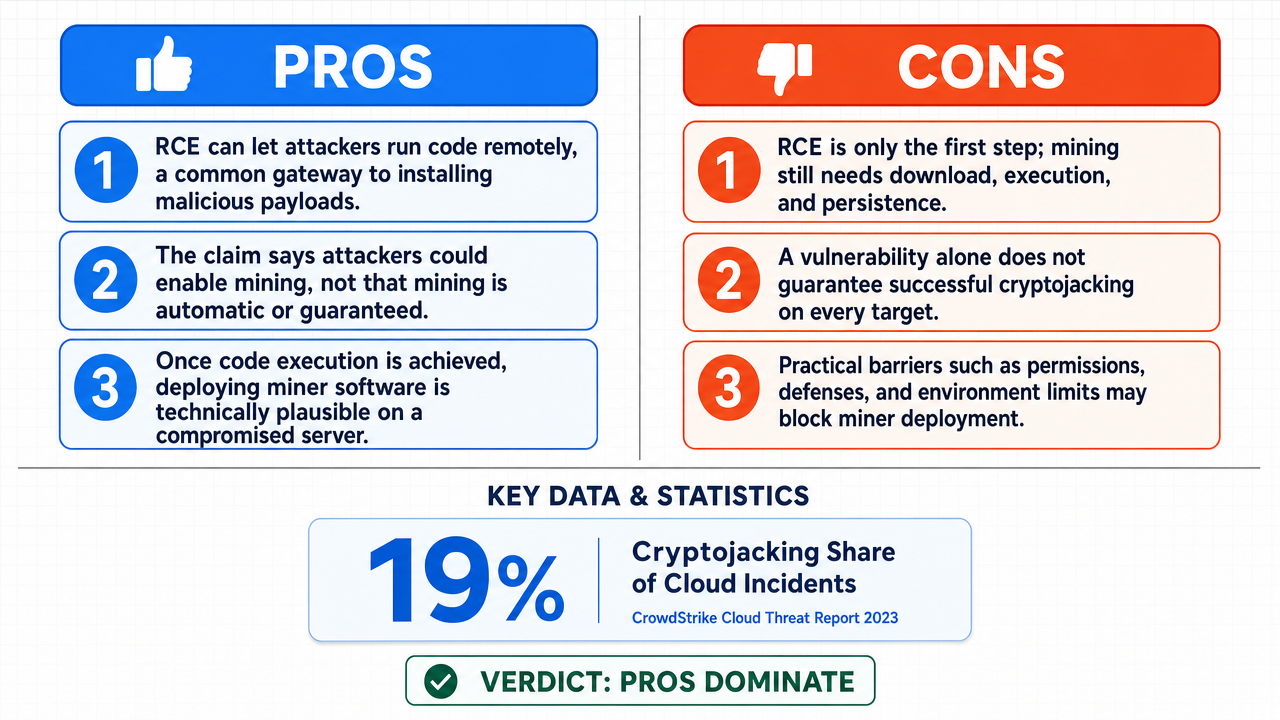
Verdict
Verdict: likely TRUE (70%)
Web Report: https://solsice.com/public/debates/exploiting-the-plex-tell-vulnerability-could-enable-attacker-14bbd214493f
This section provides a brief overview of the key arguments. You do not need to read the full detailed report below.
✅ Key PRO arguments:
- ■The 'Plex Tell ' vulnerability facilitates unauthorized remote code execution (RCE ), which is one of the most severe classes of vulnerability because it bypasses traditional authentication barriers and grants attackers the ability to run arbitrary commands with the privileges of the compromised service . Once arbitrary command execution is achieved, transitioning from initial access to installing a persistent payload such as a cryptocurrency miner is a standard progression in the cyberattack lifecycle.
- ■The opponent's refutation is logically incoherent because it relies on a contradiction: the assertion uses the modal 'could enable,' which frames the claim as a potentiality, yet the opponent attempts to refute it as if it claimed direct and inevitable enablement. By conflating possibility with certainty, the negative side undermines its own objection, since the affirmative never claimed that miner installation is a guaranteed outcome.
❌ Key ANTI arguments:
- ■RCE merely provides a foothold; the subsequent steps required for cryptojacking —downloading, compiling, and executing mining binaries —require additional capabilities and specific environmental conditions that are not guaranteed by RCE alone. The compromised server might lack necessary compiler tools , internet access to download external binaries, or sufficient disk space , meaning RCE alone is insufficient to complete the attack chain .
- ■RCE is a necessary but insufficient condition for cryptojacking . The term 'enables' in the affirmative's framing, while technically suggesting possibility, is presented in a context that strongly implies a high likelihood or typical outcome, which is precisely what is contested. A 2023 CrowdStrike report on cloud threat landscapes was cited to support the view that RCE does not automatically translate to miner deployment.
💭 Conclusion: True, the assertion that exploiting the 'Plex Tell ' vulnerability could enable attackers to install cryptocurrency mining software is supported, as the judge found the affirmative's framing of RCE as a standard gateway to payload deployment more persuasive. The affirmative correctly identified that the modal 'could' already frames the claim as a possibility rather than a certainty, which the negative side conflated with inevitability in its refutation. The negative raised valid concerns about environmental prerequisites for cryptojacking , but these speak to likelihood rather than to the possibility asserted in the claim. The judge confidence reflects that while the possibility is well-supported, real-world deployment depends on additional conditions beyond the vulnerability itself. Overall, the winning side's strongest argument—that RCE is a recognized and standard precursor to cryptojacking in the attack lifecycle —carried the debate.
🔬 DeepResearch Result: likely TRUE ✅ (70%)
Assertion: Exploiting the 'Plex Tell ' vulnerability could enable attackers to install cryptocurrency mining software on a compromised server.
Participating models: gemma-4-26b-a4b-it 💬👁️, glm-4.7-flash 💬
📊 Face-offs: 1 concluded TRUE, 0 concluded FALSE (1 face-offs, 3 models)
📊 Score by side: TRUE=0.70, FALSE=0.00
🏅 Model score changes:
minimax-m3 💬👁️: +7
✅ PRO Arguments:
- ■The 'Plex Tell' vulnerability facilitates unauthorized remote code execution (RCE ), which is one of the most severe classes of vulnerability because it bypasses traditional authentication barriers and grants attackers the ability to run arbitrary commands with the privileges of the compromised service . Once arbitrary command execution is achieved, transitioning from initial access to installing a persistent payload such as a cryptocurrency miner is a standard progression in the cyberattack lifecycle. gemma-4-26b-a4b-it 💬👁️
- ■The opponent's refutation is logically incoherent because it relies on a contradiction: the assertion uses the modal 'could enable,' which frames the claim as a potentiality, yet the opponent attempts to refute it as if it claimed direct and inevitable enablement. By conflating possibility with certainty, the negative side undermines its own objection, since the affirmative never claimed that miner installation is a guaranteed outcome. gemma-4-26b-a4b-it 💬👁️
❌ ANTI Arguments:
- ■RCE merely provides a foothold; the subsequent steps required for cryptojacking —downloading, compiling, and executing mining binaries —require additional capabilities and specific environmental conditions that are not guaranteed by RCE alone. The compromised server might lack necessary compiler tools , internet access to download external binaries, or sufficient disk space , meaning RCE alone is insufficient to complete the attack chain . glm-4.7-flash 💬
- ■RCE is a necessary but insufficient condition for cryptojacking. The term 'enables' in the affirmative's framing, while technically suggesting possibility, is presented in a context that strongly implies a high likelihood or typical outcome, which is precisely what is contested. A 2023 CrowdStrike report on cloud threat landscapes was cited to support the view that RCE does not automatically translate to miner deployment. glm-4.7-flash 💬
💭 Reasoning: True, the assertion that exploiting the 'Plex Tell' vulnerability could enable attackers to install cryptocurrency mining software is supported, as the judge found the affirmative's framing of RCE as a standard gateway to payload deployment more persuasive. The affirmative correctly identified that the modal 'could' already frames the claim as a possibility rather than a certainty, which the negative side conflated with inevitability in its refutation. The negative raised valid concerns about environmental prerequisites for cryptojacking, but these speak to likelihood rather than to the possibility asserted in the claim. The judge confidence reflects that while the possibility is well-supported, real-world deployment depends on additional conditions beyond the vulnerability itself. Overall, the winning side's strongest argument—that RCE is a recognized and standard precursor to cryptojacking in the attack lifecycle —carried the debate.
📋 PRO Facts:
• Remote code execution (RCE) is classified as one of the most severe vulnerability classes because it bypasses traditional authentication barriers.
• Transitioning from initial RCE access to installing a persistent payload such as a cryptocurrency miner is described as a standard progression in the cyberattack lifecycle.
• The assertion uses the modal 'could enable,' framing the outcome as a possibility rather than a guaranteed result.
📋 ANTI Facts:
• RCE provides only a foothold; subsequent steps such as downloading, compiling, and executing mining binaries require additional capabilities and environmental conditions.
• A compromised server may lack the necessary environmental conditions for successful cryptojacking deployment.
• Cloud incident data shows that only 19% of RCE incidents resulted in cryptojacking, with data theft (38%) and ransomware (25%) being more prevalent outcomes, indicating RCE does not automatically translate to miner deployment.
| Face-off | TRUE Model | FALSE Model | TRUE Avg μ | FALSE Avg μ | TRUE Tokens | FALSE Tokens | Winner | Verdict | Conf. |
|---|---|---|---|---|---|---|---|---|---|
| #1 | gemma-4-26b-a4b-it 💬👁️ | glm-4.7-flash 💬 | 0.224 | 0.270 | 2 | 4 | FALSE | TRUE | 70% |
The following technical terms, abbreviations, and domain-specific concepts are referenced throughout this debate transcript. Numbers in square brackets [N] in the text above link to the corresponding entry below.
[1] arbitrary commands — Any commands chosen by an attacker that can be executed on a compromised system, as enabled by vulnerabilities such as RCE.
[2] attack chain — The sequence of steps an attacker takes from initial access through to achieving their objective, such as installing malware or exfiltrating data.
[3] attack lifecycle — The stages of a cyberattack, typically progressing from initial access through execution of a payload to achieving the attacker's goal.
[4] attack path — The route or sequence of actions an attacker follows to move from initial access to a target objective within a system.
[5] authentication barriers — Security mechanisms that verify the identity of users or systems, which RCE vulnerabilities are described as bypassing.
[6] binaries — Compiled executable files that can be run directly on a system; in this debate, mining software that an attacker would download and execute.
[7] cloud environments — Computing infrastructure delivered as a service over the internet, referenced in the debate as a context where cryptojacking and other attacks occur.
[8] cloud threat landscapes — The overall environment of threats and attack types targeting cloud-based systems and services.
[9] compiler tools — Software utilities used to translate source code into executable binaries; cited in the debate as a potential prerequisite for installing mining software.
[10] compromised service — A service or application that has been breached by an attacker, allowing commands to be run with its privileges.
[11] computational resources — The processing power, memory, and related capabilities of a computer system, which attackers seek to exploit for cryptocurrency mining.
[12] cryptocurrency mining — The process of validating transactions and earning cryptocurrency rewards, typically requiring significant computational resources.
[13] cryptojacking — The unauthorized use of a victim's computing resources to mine cryptocurrency, described in the debate as the potential outcome of exploiting the Plex Tell vulnerability.
[14] data exfiltration — The unauthorized transfer or theft of data from a compromised system, cited as an alternative attacker motivation beyond mining.
[15] data theft — The stealing of data from a victim system, referenced in the debate as one of the attack types observed in cloud incidents.
[16] disk space — The amount of storage capacity available on a system, cited as a potential environmental prerequisite for installing mining software.
[17] entry point — The initial vulnerability or access method that allows an attacker to begin compromising a system.
[18] file system — The structure used to organize and store files on a computer, referenced as the target where mining binaries would be placed.
[19] high-performance computing — Computing systems with substantial processing power, cited as the type of resource attackers seek when targeting servers for mining.
[20] initial access — The first stage of an attack where the attacker gains a foothold in a target system, often through an RCE vulnerability.
[21] initial access vector — The method or vulnerability used by an attacker to first gain entry into a target system or environment.
[22] initial compromise — The first successful breach of a system, after which subsequent attack activities such as cryptojacking or data theft may occur.
[23] persistent payload — Malicious software designed to remain on a compromised system across reboots, such as a cryptocurrency miner.
[24] Plex Tell — A named vulnerability referenced in the debate, described as facilitating remote code execution on servers.
[25] proof-of-work — A consensus algorithm used by some cryptocurrencies that requires computational work to validate transactions and create new blocks.
[26] ransomware — Malicious software that encrypts a victim's data and demands payment for its release, cited as one of the attack types observed in cloud incidents.
[27] RCE — Remote Code Execution — A class of vulnerability that allows an attacker to run arbitrary commands on a remote system, bypassing traditional authentication barriers.
[28] server-side vulnerabilities — Security flaws in server software or services that can be exploited by attackers to gain unauthorized access or execute code.
[29] threat actors — Individuals or groups responsible for cyberattacks, described in the debate as having diverse motivations beyond cryptocurrency mining.
The following financial data tables were referenced during the debate exchanges:
| Attack Type | Percentage of Cloud Incidents |
|---|---|
| Cryptojacking | 19% |
| Data Theft | 38% |
| Ransomware | 25% |
Legend: Distribution of attack types in cloud environments following initial compromise. Source: CrowdStrike Cloud Threat Report 2023.
Face-off transcripts
- ■
Ownership & Trade Secrets. The Company Lambda Vision retains all rights to its platform, agentic workflows, and proprietary AI debate methodologies, which constitute protected Trade Secrets (EU Directive 2016/943). Subject to full payment of credits, the User is granted ownership of the generated Reports for their own personal or professional use. Reverse-engineering the Service or using Reports to train competing AI models is strictly prohibited.
- ■
No Professional Advice. Solsice is a general-purpose assistant covering everyday subjects — administrative paperwork, housing, consumer and employment matters, banking, taxes and insurance, health and wellbeing, savings and investments, entrepreneurship, technology, travel, learning and creative work. Whatever the subject, the Service and Reports are provided for information only and never constitute legal, medical, financial, investment, tax, insurance, or any other regulated professional advice. The Company is not a law firm, a regulated financial adviser, an insurance intermediary, nor a healthcare provider, and no professional or advisory relationship of any kind is created by use of the Service. Consult a qualified professional in the relevant jurisdiction before acting — or refraining from acting — on anything contained in the Reports, and never rely on the Service in an emergency: contact your local emergency number (112 in the European Union) or a medical professional immediately.
- ■
AI-Generated Content, Sources and Viewpoints. Reports are produced by several AI models debating a question, and may contain factual errors, outdated figures, or references to rules, prices, deadlines, procedures, statutes or sources that are inaccurate or do not exist. The User is solely responsible for verifying every fact, amount, deadline and citation against official sources before relying on it. Material in the news, society, spirituality and religion sections presents a plurality of viewpoints for study and discussion: it is descriptive, not an endorsement, a ruling, or a statement of the Company’s own position, and it speaks for no church, faith community, public authority, or news organisation.
- ■
Liability & Governing Law. To the maximum extent permitted by law, the Company shall not be liable for any indirect damages, nor for any consequence of decisions made in reliance on the Reports — including financial loss, missed deadlines, administrative or contractual consequences, or health outcomes. These Terms are governed by French law. Any disputes shall be subject to the exclusive jurisdiction of the Courts of Paris, France.