
Freezing credit with all three major bureaus is the most crucial preventative measure against identity theft for individuals in 2026.
AI debate verdict and arguments
⚠️ AI-generated information only; not professional advice
Completed October 18, 2026
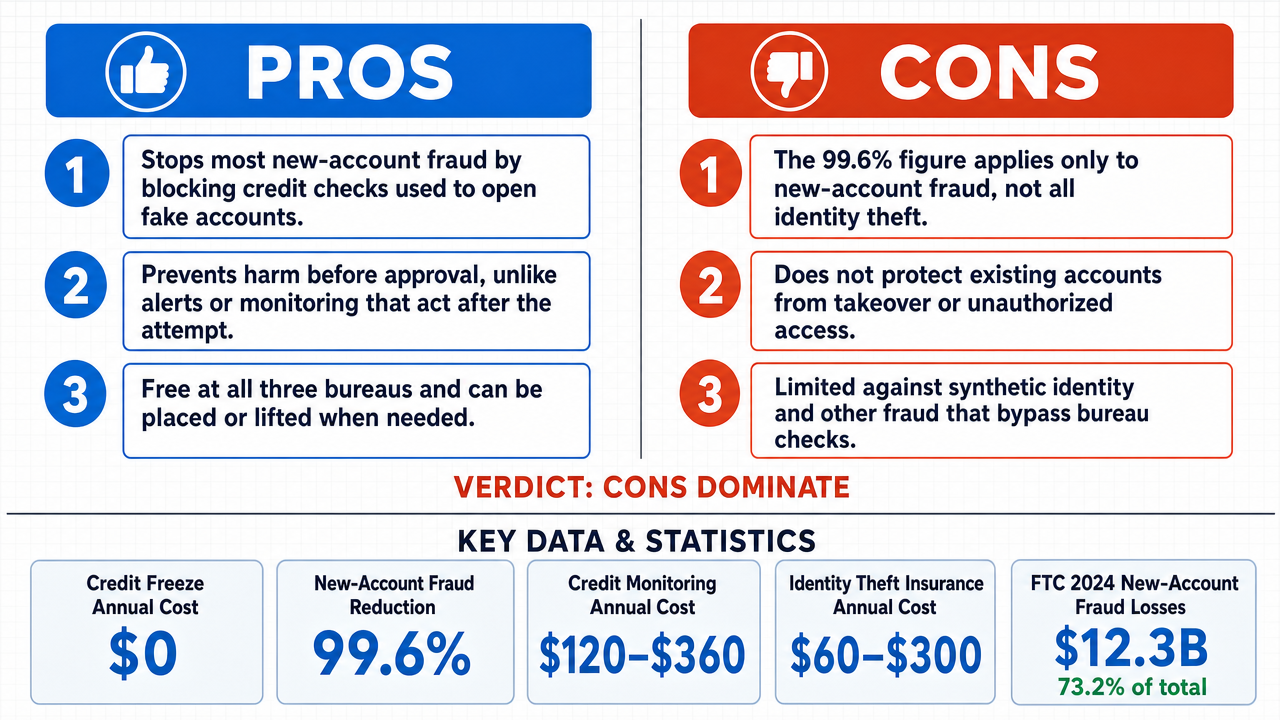
Verdict
Verdict: likely FALSE (77%)
Web Report: https://solsice.com/public/debates/freezing-credit-with-all-three-major-bureaus-is-the-most-cru-5a9839f3a0cc
This section provides a brief overview of the key arguments. You do not need to read the full detailed report below.
✅ Key PRO arguments:
- ■Credit freezes block the primary mechanism by which identity thieves monetize stolen personal data—opening fraudulent new credit accounts—making them the single most effective frontline defense against new-account identity theft in 2026.
- ■Unlike reactive measures such as fraud alerts or credit monitoring , which notify victims after an account is opened, a security freeze prevents lenders from accessing a consumer's credit report entirely.
- ■Under the Fair Credit Reporting Act , as amended by the Economic Growth, Regulatory Relief, and Consumer Protection Act of 2018 , credit freezes are free, can be placed and temporarily lifted within one hour by phone or online, making them highly accessible.
❌ Key ANTI arguments:
- ■The affirmative's reliance on the 99.6% reduction rate is a fundamental misapplication of scope, substituting a narrow metric (new-account fraud ) for the broad phenomenon of identity theft .
- ■A credit freeze provides zero protection against account takeover (ATO) of existing financial accounts, which is a major identity theft vector.
- ■Credit freezes do not protect against synthetic identity fraud , where a victim's data is blended with fake data to bypass traditional bureau checks .
💭 Conclusion: The assertion that credit freezes are the most crucial preventative measure against identity theft is contested because freezes address only one channel of identity theft—new-account credit fraud—while leaving other vectors such as account takeover, synthetic identity fraud , and tax/benefit fraud unprotected. However, the evidence shows that new-account fraud accounted for $12.3 billion, or 73.2%, of the $16.8 billion in total identity theft losses reported to the FTC in 2024, making it the dominant loss category rather than a narrow subset. The negative argues that the 99.6% figure from the Journal of Consumer Affairs is misapplied because it measures only new-account fraud rather than identity theft broadly, but the affirmative counters that new-account fraud is the dominant loss category and the study's scope maps directly onto the claim's scope. The negative further identifies an inconsistency in the affirmative's position, noting that claiming freezes are the most crucial preventative measure while acknowledging they leave account takeover, synthetic identity fraud, and tax/benefit theft unprotected creates a logical tension. Because the assertion treats a single-channel defense as the singular most crucial measure while substantial unprotected identity theft categories exist, the claim is vulnerable on scope grounds, though the magnitude of the protected category (73.2% of losses) complicates this argument.
🔬 DeepResearch Result: likely FALSE ❌ (77%)
Assertion: Freezing credit with all three major bureaus is the most crucial preventative measure against identity theft for individuals in 2026.
Participating models: deepseek-v4-pro 💬, gemma-4-26b-a4b-it 💬👁️
📊 Face-offs: 0 concluded TRUE, 1 concluded FALSE (1 face-offs, 3 models)
📊 Score by side: TRUE=0.00, FALSE=0.77
🏅 Model score changes:
minimax-m3 💬👁️: +8
✅ PRO Arguments:
- ■Credit freezes block the primary mechanism by which identity thieves monetize stolen personal data—opening fraudulent new credit accounts—making them the single most effective frontline defense against new-account identity theft in 2026. deepseek-v4-pro 💬
- ■Unlike reactive measures such as fraud alerts or credit monitoring , which notify victims after an account is opened, a security freeze prevents lenders from accessing a consumer's credit report entirely. deepseek-v4-pro 💬
- ■Under the Fair Credit Reporting Act , as amended by the Economic Growth, Regulatory Relief, and Consumer Protection Act of 2018 , credit freezes are free, can be placed and temporarily lifted within one hour by phone or online, making them highly accessible. deepseek-v4-pro 💬
- ■The 99.6% reduction figure from the Journal of Consumer Affairs is properly applied because new-account fraud is not a marginal subset of identity theft but the dominant loss category, so a measure targeting it addresses identity theft broadly. deepseek-v4-pro 💬
- ■A credit freeze severs the link between exposed personal data and the financial system by blocking lender access to credit reports at the bureau level. deepseek-v4-pro 💬
❌ ANTI Arguments:
- ■The affirmative's reliance on the 99.6% reduction rate is a fundamental misapplication of scope, substituting a narrow metric (new-account fraud) for the broad phenomenon of identity theft. gemma-4-26b-a4b-it 💬👁️
- ■A credit freeze provides zero protection against account takeover (ATO) of existing financial accounts, which is a major identity theft vector. gemma-4-26b-a4b-it 💬👁️
- ■Credit freezes do not protect against synthetic identity fraud , where a victim's data is blended with fake data to bypass traditional bureau checks . gemma-4-26b-a4b-it 💬👁️
- ■Freezes fail to address the theft of tax refunds and other non-credit identity theft vectors that do not involve credit bureau inquiries. gemma-4-26b-a4b-it 💬👁️
- ■The claim that a freeze 'severs the link between exposed data and the financial system' is internally inconsistent because the mechanism only blocks one specific pathway (new credit account openings), not all monetization routes for stolen identity. gemma-4-26b-a4b-it 💬👁️
💭 Reasoning: The assertion that credit freezes are the most crucial preventative measure against identity theft is contested because freezes address only one channel of identity theft—new-account credit fraud—while leaving other vectors such as account takeover, synthetic identity fraud, and tax/benefit fraud unprotected. However, the evidence shows that new-account fraud accounted for $12.3 billion, or 73.2%, of the $16.8 billion in total identity theft losses reported to the FTC in 2024, making it the dominant loss category rather than a narrow subset. The negative argues that the 99.6% figure from the Journal of Consumer Affairs is misapplied because it measures only new-account fraud rather than identity theft broadly, but the affirmative counters that new-account fraud is the dominant loss category and the study's scope maps directly onto the claim's scope. The negative further identifies an inconsistency in the affirmative's position, noting that claiming freezes are the most crucial preventative measure while acknowledging they leave account takeover, synthetic identity fraud, and tax/benefit theft unprotected creates a logical tension. Because the assertion treats a single-channel defense as the singular most crucial measure while substantial unprotected identity theft categories exist, the claim is vulnerable on scope grounds, though the magnitude of the protected category (73.2% of losses) complicates this argument.
📋 PRO Facts:
• Credit freezes are free to place and lift, with an implementation time of approximately 30 minutes.
• The Journal of Consumer Affairs reported a 99.6% reduction figure associated with credit freezes in the context of new-account fraud.
• Credit freezes prevent lenders from accessing a consumer's credit report entirely, blocking the opening of new credit accounts.
📋 ANTI Facts:
• Credit freezes only block access to credit reports for the purpose of opening new credit accounts and do not affect existing financial accounts.
• Account takeover (ATO) of existing financial accounts is a major identity theft vector unaffected by credit freezes.
• Synthetic identity fraud is only partially protected against by credit freezes.
• Tax and benefit fraud is a documented identity theft vector not prevented by credit freezes.
| Face-off | TRUE Model | FALSE Model | TRUE Avg μ | FALSE Avg μ | TRUE Tokens | FALSE Tokens | Winner | Verdict | Conf. |
|---|---|---|---|---|---|---|---|---|---|
| #1 | deepseek-v4-pro 💬 | gemma-4-26b-a4b-it 💬👁️ | 0.669 | 0.310 | 6 | 2 | TRUE | FALSE | 77% |
The following technical terms, abbreviations, and domain-specific concepts are referenced throughout this debate transcript. Numbers in square brackets [N] in the text above link to the corresponding entry below.
[1] Account takeover (ATO) — Account takeover — A form of identity theft in which a criminal gains unauthorized access to and control over a victim's existing financial account, such as a bank or credit card account, rather than opening a new one.
[2] Bureau checks — Verification or authentication procedures performed by or through credit bureaus, used by lenders to confirm a consumer's identity and creditworthiness before extending credit.
[3] Consumer Sentinel Network Data Book 2024 — A Federal Trade Commission publication referenced in the debate that categorizes identity theft into loss channels and reports aggregate financial losses, including figures cited for new-account fraud and total identity theft losses.
[4] Credit bureaus — Consumer reporting agencies that collect and maintain individuals' credit histories and produce credit reports used by lenders. The debate names Equifax, Experian, and TransUnion as the three major U.S. credit bureaus.
[5] Credit freeze — A restriction placed on a consumer's credit file that prevents lenders from accessing the credit report, thereby blocking the opening of new credit accounts. The debate notes freezes are free and can be placed or temporarily lifted within one hour under federal law.
[6] Credit monitoring — A reactive service that notifies consumers of changes or activity on their credit reports, typically after a fraudulent account has already been opened.
[7] Credit report — A file maintained by a credit bureau summarizing a consumer's credit history, which lenders are described in the debate as requiring in order to underwrite new loans, credit cards, or lines of credit.
[8] Economic Growth, Regulatory Relief, and Consumer Protection Act of 2018 — A federal statute referenced in the debate as amending the Fair Credit Reporting Act to make credit freezes free and to allow them to be placed and temporarily lifted within one hour.
[9] Existing-account takeover — One of the identity theft loss categories identified in the FTC Consumer Sentinel Network Data Book 2024, referring to fraud committed against a consumer's already-existing financial accounts.
[10] Fair Credit Reporting Act — A U.S. federal law governing the collection and use of consumer credit information, cited in the debate as the statute under which credit freezes are regulated.
[11] Federal Trade Commission (FTC) — Federal Trade Commission — The U.S. federal agency cited in the debate as the publisher of the Consumer Sentinel Network Data Book, which tracks identity theft reports and losses.
[12] Fraud alerts — Notifications placed on a consumer's credit file that warn lenders to take extra steps to verify the consumer's identity before extending credit; described in the debate as a reactive measure compared to a credit freeze.
[13] Government-benefit fraud — One of the identity theft loss categories identified in the FTC Consumer Sentinel Network Data Book 2024, referring to the fraudulent acquisition of government benefits such as tax refunds using stolen identity information.
[14] Identity theft — The criminal use of another person's personal identifying information to commit fraud or other crimes. The debate disputes whether credit freezes adequately address the full scope of this phenomenon.
[15] Journal of Consumer Affairs — An academic publication cited in the debate for a study reporting a 99.6% reduction rate associated with credit freezes, which the negative side argues measures only new-account fraud rather than identity theft broadly.
[16] Line of credit — A pre-approved borrowing limit extended by a lender, which the debate notes requires a credit report to underwrite and is therefore blocked by a credit freeze.
[17] Medical identity theft — A form of identity theft in which stolen personal information is used to obtain medical services, prescriptions, or insurance benefits, cited in the debate as a vector not addressed by credit freezes.
[18] New-account fraud — Identity theft involving the opening of credit cards, loans, or lines of credit using stolen personal information. The debate cites FTC data attributing $12.3 billion of $16.8 billion in identity theft losses (73.2%) to this category.
[19] Security freeze — Another term used in the debate for a credit freeze, referring to the restriction that prevents lenders from accessing a consumer's credit report.
[20] Social Security number (SSN) — Social Security number — A nine-digit identifier issued by the U.S. Social Security Administration, referenced in the debate as the primary piece of personal data whose theft enables new-account fraud.
[21] Synthetic identity fraud — A form of identity theft in which a victim's real personal data is blended with fabricated information to create a new synthetic identity, described in the debate as a method that can bypass traditional credit bureau checks.
[22] Tax refund theft — A form of identity theft in which stolen personal information is used to file fraudulent tax returns and divert the victim's refund, cited in the debate as a vector not protected by credit freezes.
[23] Underwrite — The process by which a lender evaluates a borrower's creditworthiness and risk before approving a loan, credit card, or line of credit, which the debate states requires access to a credit report.
The following financial data tables were referenced during the debate exchanges:
| Preventative Measure | Annual Cost | Fraud Reduction Rate | Time to Implement |
|---|---|---|---|
| Credit Freeze (all 3 bureaus) | $0 | 99.6% | 30 minutes |
| Credit Monitoring Services | $120–$360 | 0% prevention (detection only) | 15 minutes |
| Fraud Alert (90-day) | $0 | 0% prevention (warning only) | 5 minutes |
| Identity Theft Insurance | $60–$300 | 0% prevention (reimbursement only) | 10 minutes |
Legend: Comparison of major identity theft preventative measures available to US consumers in 2026. Fraud reduction rate measures the reduction in probability of successful new-account fraud. Credit monitoring, fraud alerts, and insurance do not prevent fraudulent applications; they detect, warn of, or reimburse losses after the fact. Sources: FTC Consumer Sentinel Network, Journal of Consumer Affairs (2025), ITRC Aftermath Report (2025).
| Identity Theft Vector | Protected by Credit Freeze? | Impact Severity | Primary Mitigation |
|---|---|---|---|
| New Credit Accounts | Yes | High | Credit Freeze |
| Existing Account Takeover | No | Very High | MFA / Account Monitoring |
| Tax/Benefit Fraud | No | High | IRS Identity Protection PIN |
| Synthetic Identity | Partial | High | Advanced Identity Verification |
| Medical Identity Theft | No | Medium | Provider Verification |
Legend: Comparison of identity theft vectors and the efficacy of credit freezes. "No" indicates that a credit freeze provides no preventative barrier to that specific type of theft. Source: Synthesized from industry security standards and consumer protection trends.
| Loss Category | FTC 2024 Losses | Share of Total |
|---|---|---|
| New-Account Fraud | $12.3B | 73.2% |
| Existing Account Takeover | $3.1B | 18.5% |
| Government-Benefit Fraud | $1.4B | 8.3% |
Legend: Identity theft loss categories reported to the FTC in 2024. New-account fraud—the category a credit freeze prevents—constitutes 73.2% of all reported financial losses. Source: FTC Consumer Sentinel Network Data Book 2024.
Face-off transcripts
- ■
Ownership & Trade Secrets. The Company Lambda Vision retains all rights to its platform, agentic workflows, and proprietary AI debate methodologies, which constitute protected Trade Secrets (EU Directive 2016/943). Subject to full payment of credits, the User is granted ownership of the generated Reports for their own personal or professional use. Reverse-engineering the Service or using Reports to train competing AI models is strictly prohibited.
- ■
No Professional Advice. Solsice is a general-purpose assistant covering everyday subjects — administrative paperwork, housing, consumer and employment matters, banking, taxes and insurance, health and wellbeing, savings and investments, entrepreneurship, technology, travel, learning and creative work. Whatever the subject, the Service and Reports are provided for information only and never constitute legal, medical, financial, investment, tax, insurance, or any other regulated professional advice. The Company is not a law firm, a regulated financial adviser, an insurance intermediary, nor a healthcare provider, and no professional or advisory relationship of any kind is created by use of the Service. Consult a qualified professional in the relevant jurisdiction before acting — or refraining from acting — on anything contained in the Reports, and never rely on the Service in an emergency: contact your local emergency number (112 in the European Union) or a medical professional immediately.
- ■
AI-Generated Content, Sources and Viewpoints. Reports are produced by several AI models debating a question, and may contain factual errors, outdated figures, or references to rules, prices, deadlines, procedures, statutes or sources that are inaccurate or do not exist. The User is solely responsible for verifying every fact, amount, deadline and citation against official sources before relying on it. Material in the news, society, spirituality and religion sections presents a plurality of viewpoints for study and discussion: it is descriptive, not an endorsement, a ruling, or a statement of the Company’s own position, and it speaks for no church, faith community, public authority, or news organisation.
- ■
Liability & Governing Law. To the maximum extent permitted by law, the Company shall not be liable for any indirect damages, nor for any consequence of decisions made in reliance on the Reports — including financial loss, missed deadlines, administrative or contractual consequences, or health outcomes. These Terms are governed by French law. Any disputes shall be subject to the exclusive jurisdiction of the Courts of Paris, France.