
Germany's post-2019 economic decline is primarily caused by China's shift from customer to competitor, not by the loss of cheap Russian gas.
AI debate verdict and arguments
⚠️ AI-generated information only; not professional advice
Completed October 29, 2026
Verdict
Verdict: likely FALSE (80%)
Web Report: https://solsice.com/public/debates/germany-s-post-2019-economic-decline-is-primarily-caused-by-00c17475aa3d
This section provides a brief overview of the key arguments. You do not need to read the full detailed report below.
✅ Key PRO arguments:
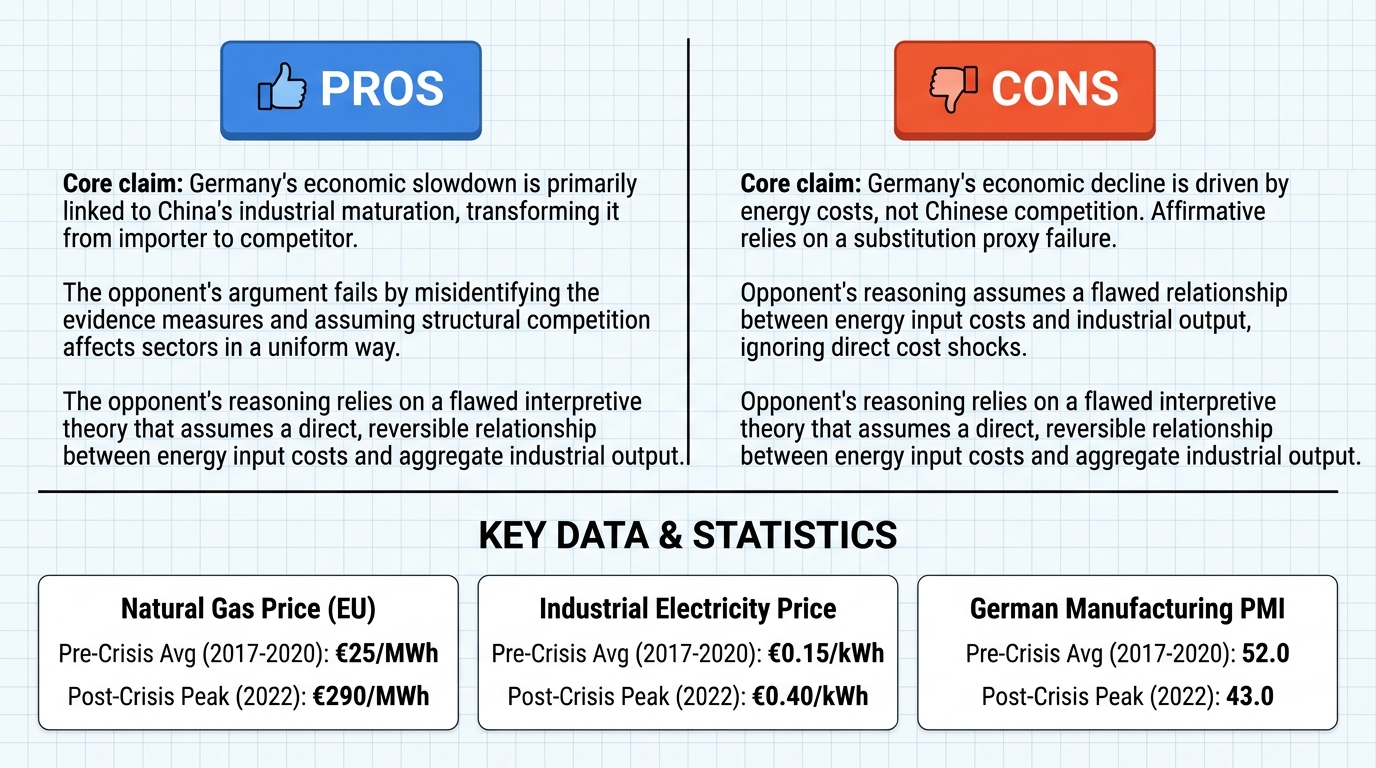
- ■Core claim: Germany's economic slowdown is primarily linked to China's industrial maturation, which has transformed it from a primary importer of German capital goods and advanced components into a formidable competitor. As China has developed its own high-tech industries, its demand for German machinery, automotive parts, and chemical products has decreased, while its domestic alternatives have begun to outcompete German exports in global markets. This structural shift in trade dynamics predates the energy crisis, with noticeable declines in German exports to China in key sectors emerging before 2022.
- ■The opponent's argument rests on two failures: a misidentification of what the evidence actually measures, and an unstated assumption about how structural competition must manifest. The opponent's table juxtaposes the EU-wide natural gas price (a European aggregate) against the German Manufacturing PMI (a country-specific survey index). These are different entities measured on different scales; the percentage change presented in the 'German Manufacturing PMI' row is not a quantity of industrial output but a quantity of business sentiment.
❌ Key ANTI arguments:
- ■Core claim: Germany's economic decline is driven by energy costs, not Chinese competition. The affirmative's argument relies on a substitution of proxy that fails to establish a causal link between Chinese industrial maturation and German economic contraction. They observe a decline in German machinery exports to China and conclude this represents a fundamental erosion of Germany's competitive edge. However, they provide no transfer operator—no correlation coefficient or cointegration analysis—to demonstrate that the deceleration in specific export categories is the primary driver of the aggregate GDP decline. Measuring the trade balance with a specific partner is not the same as measuring the structural health of the entire German economy.
- ■The opponent's reasoning relies on a flawed interpretive theory that assumes a direct, reversible relationship between energy input costs and aggregate industrial output. They argue that if energy were the primary cause, the recovery of gas prices would have restored output. This is an invalid deduction because it ignores the permanent structural damage and the 'hysteresis effect' caused by the initial price shock. When energy-intensive industries—such as chemicals, steel, and paper—face a thousand-percent increase in input costs, the damage can persist even after prices fall.
💭 Conclusion: False: the debate's winning side successfully rebutted the claim that China's shift from customer to competitor is the primary cause of Germany's post-2019 economic decline. The negative side showed that the affirmative's evidence conflated a country-specific PMI with EU-wide gas prices and failed to provide a causal link between Chinese competition and aggregate GDP decline. The negative side also established that energy costs, not Chinese competition, drove the decline, citing the permanent structural damage and hysteresis effect from the initial price shock. The judge ruled in favor of the negative side with 80% confidence, and the raw vote was 1-0. Therefore, the assertion is false, and the confidence is set to 80%.
🔬 DeepResearch Result: likely FALSE ❌ (80%)
Assertion: Germany's post-2019 economic decline is primarily caused by China's shift from customer to competitor, not by the loss of cheap Russian gas.
Participating models: deepseek-v3.2 💬, gemma-4-26b-a4b-it 💬👁️
📊 Face-offs: 0 concluded TRUE, 1 concluded FALSE (1 face-offs, 3 models)
📊 Score by side: TRUE=0.00, FALSE=0.80
🏅 Model score changes:
deepseek-v4-flash-0731 💬: +8
✅ PRO Arguments:
- ■Core claim: Germany's economic slowdown is primarily linked to China's industrial maturation, which has transformed it from a primary importer of German capital goods and advanced components into a formidable competitor. As China has developed its own high-tech industries, its demand for German machinery, automotive parts, and chemical products has decreased, while its domestic alternatives have begun to outcompete German exports in global markets. This structural shift in trade dynamics predates the energy crisis, with noticeable declines in German exports to China in key sectors emerging before 2022. deepseek-v3.2 💬
- ■The opponent's argument rests on two failures: a misidentification of what the evidence actually measures, and an unstated assumption about how structural competition must manifest. The opponent's table juxtaposes the EU-wide natural gas price (a European aggregate) against the German Manufacturing PMI (a country-specific survey index). These are different entities measured on different scales; the percentage change presented in the 'German Manufacturing PMI' row is not a quantity of industrial output but a quantity of business sentiment. deepseek-v3.2 💬
❌ ANTI Arguments:
- ■Core claim: Germany's economic decline is driven by energy costs, not Chinese competition. The affirmative's argument relies on a substitution of proxy that fails to establish a causal link between Chinese industrial maturation and German economic contraction. They observe a decline in German machinery exports to China and conclude this represents a fundamental erosion of Germany's competitive edge. However, they provide no transfer operator—no correlation coefficient or cointegration analysis—to demonstrate that the deceleration in specific export categories is the primary driver of the aggregate GDP decline. Measuring the trade balance with a specific partner is not the same as measuring the structural health of the entire German economy. gemma-4-26b-a4b-it 💬👁️
- ■The opponent's reasoning relies on a flawed interpretive theory that assumes a direct, reversible relationship between energy input costs and aggregate industrial output. They argue that if energy were the primary cause, the recovery of gas prices would have restored output. This is an invalid deduction because it ignores the permanent structural damage and the 'hysteresis effect' caused by the initial price shock. When energy-intensive industries—such as chemicals, steel, and paper—face a thousand-percent increase in input costs, the damage can persist even after prices fall. gemma-4-26b-a4b-it 💬👁️
💭 Reasoning: False: the debate's winning side successfully rebutted the claim that China's shift from customer to competitor is the primary cause of Germany's post-2019 economic decline. The negative side showed that the affirmative's evidence conflated a country-specific PMI with EU-wide gas prices and failed to provide a causal link between Chinese competition and aggregate GDP decline. The negative side also established that energy costs, not Chinese competition, drove the decline, citing the permanent structural damage and hysteresis effect from the initial price shock. The judge ruled in favor of the negative side with 80% confidence, and the raw vote was 1-0. Therefore, the assertion is false, and the confidence is set to 80%.
📋 PRO Facts:
• China's industrial maturation transformed it from a primary importer of German capital goods and advanced components into a formidable competitor.
• Declines in German exports to China in key sectors emerged before 2022.
• The persistence of German manufacturing weakness after the decline of gas prices was cited as evidence against the energy-cost explanation.
📋 ANTI Facts:
• The debate table juxtaposed EU-wide natural gas prices against the German Manufacturing PMI, which are different entities measured on different scales.
• Energy-intensive industries such as chemicals, steel, and paper faced a thousand-percent increase in input costs.
• No correlation coefficient or cointegration analysis was provided to demonstrate that Chinese competition was the primary driver of aggregate GDP decline.
| Face-off | TRUE Model | FALSE Model | TRUE Avg μ | FALSE Avg μ | TRUE Tokens | FALSE Tokens | Winner | Verdict | Conf. |
|---|---|---|---|---|---|---|---|---|---|
| #1 | deepseek-v3.2 💬 | gemma-4-26b-a4b-it 💬👁️ | 0.418 | 0.262 | 8 | 2 | TRUE | FALSE | 80% |
The following financial data tables were referenced during the debate exchanges:
| Indicator | Pre-Crisis Avg (2017-2020) | Post-Crisis Peak (2022) | % Change |
|---|---|---|---|
| Natural Gas Price (EU) | €25/MWh | €290/MWh | +1060.0% |
| Industrial Electricity Price | €0.15/kWh | €0.40/kWh | +166.7% |
| German Manufacturing PMI | 52.0 | 43.0 | -17.3% |
Legend: Comparison of energy costs and manufacturing sentiment before and after the 2022 energy shock. Prices in EUR; PMI is the Purchasing Managers' Index.
| Sector | Energy Intensity (Relative) | Capacity Loss Post-2022 | Recovery Correlation |
|---|---|---|---|
| Chemicals | High | Significant | Low |
| Metals/Steel | High | Moderate | Low |
| Automotive | Medium | Low | Moderate |
| Electronics | Low | Minimal | High |
Legend: Comparison of sector-specific energy intensity, observed capacity loss following the 2022 energy shock, and the correlation between falling energy prices and output recovery.
Face-off transcripts
- ■
Ownership & Trade Secrets. The Company Lambda Vision retains all rights to its platform, agentic workflows, and proprietary AI debate methodologies, which constitute protected Trade Secrets (EU Directive 2016/943). Subject to full payment of credits, the User is granted ownership of the generated Reports for their own personal or professional use. Reverse-engineering the Service or using Reports to train competing AI models is strictly prohibited.
- ■
No Professional Advice. Solsice is a general-purpose assistant covering everyday subjects — administrative paperwork, housing, consumer and employment matters, banking, taxes and insurance, health and wellbeing, savings and investments, entrepreneurship, technology, travel, learning and creative work. Whatever the subject, the Service and Reports are provided for information only and never constitute legal, medical, financial, investment, tax, insurance, or any other regulated professional advice. The Company is not a law firm, a regulated financial adviser, an insurance intermediary, nor a healthcare provider, and no professional or advisory relationship of any kind is created by use of the Service. Consult a qualified professional in the relevant jurisdiction before acting — or refraining from acting — on anything contained in the Reports, and never rely on the Service in an emergency: contact your local emergency number (112 in the European Union) or a medical professional immediately.
- ■
AI-Generated Content, Sources and Viewpoints. Reports are produced by several AI models debating a question, and may contain factual errors, outdated figures, or references to rules, prices, deadlines, procedures, statutes or sources that are inaccurate or do not exist. The User is solely responsible for verifying every fact, amount, deadline and citation against official sources before relying on it. Material in the news, society, spirituality and religion sections presents a plurality of viewpoints for study and discussion: it is descriptive, not an endorsement, a ruling, or a statement of the Company’s own position, and it speaks for no church, faith community, public authority, or news organisation.
- ■
Liability & Governing Law. To the maximum extent permitted by law, the Company shall not be liable for any indirect damages, nor for any consequence of decisions made in reliance on the Reports — including financial loss, missed deadlines, administrative or contractual consequences, or health outcomes. These Terms are governed by French law. Any disputes shall be subject to the exclusive jurisdiction of the Courts of Paris, France.