
Girls' participation in the Little League World Series, exemplified by Kinley Rasm and Carson Meyer, signifies a shift beyond mere tokenism in youth sports.
AI debate verdict and arguments
⚠️ AI-generated information only; not professional advice
Completed October 18, 2026
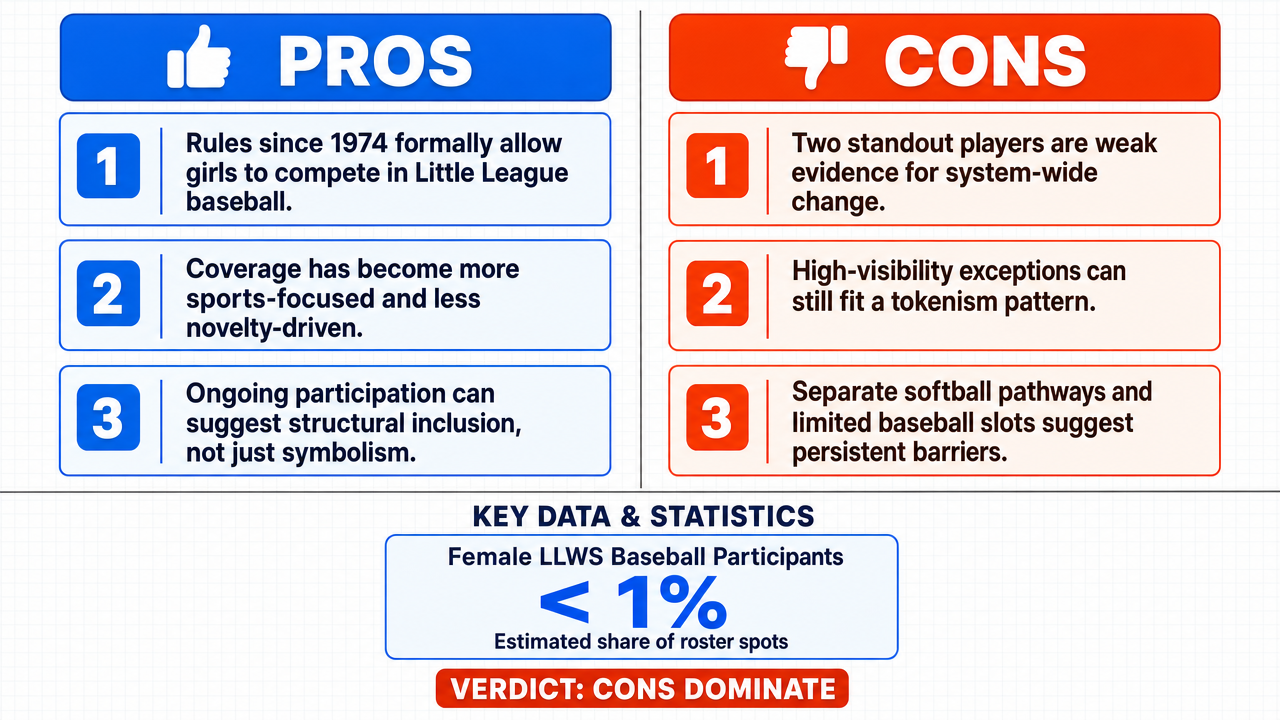
Verdict
Verdict: likely FALSE (80%)
Web Report: https://solsice.com/public/debates/girls-participation-in-the-little-league-world-series-exempl-50dbd0f42814
This section provides a brief overview of the key arguments. You do not need to read the full detailed report below.
✅ Key PRO arguments:
- ■The institutional architecture of the Little League World Series has been fundamentally redesigned since 1974 to integrate girls as permanent competitors, not temporary guests, following federal court decisions and state-level civil rights actions that progressively dismantled structural barriers.
- ■Media coverage of girls in the LLWS has shifted from novelty framing to normalized athletic reporting, reflecting a broader documented trend in female athlete media representation that empirically grounds the claim of a structural shift.
- ■Sustained, competitive participation by girls in the LLWS reflects structural inclusion rather than symbolic tokenism , as classically defined by Rosabeth Moss Kanter, because the organization has moved beyond admitting individuals for symbolic appearances.
❌ Key ANTI arguments:
- ■The affirmative's reliance on the achievements of Kinley Rasm and Carson Meyer constitutes a substitution of proxy : using two elite outliers to measure the structural state of an entire institution without any correlation or statistical mapping to the broader population of female players.
- ■The presence of exceptional individuals in a high-visibility tournament is not evidence of a shift beyond tokenism ; rather, it is the very definition of the 'exceptional individual' phenomenon that tokenism itself produces.
- ■The existence of separate or intermittent structures, such as the Little League Softball World Series and intermittent opportunities within the baseball division, does not prove a systemic shift in the baseball hierarchy because these branches are fundamentally inconsistent with the claim of permanent parallel pathways.
💭 Conclusion: The affirmative's reliance on Kinley Rasm and Carson Meyer as exemplars constitutes a substitution of proxy , using two elite outliers without any statistical mapping to the broader population of female players. The evidence indicates female participants represent less than 1% of total LLWS baseball roster spots, and there is a high disparity between softball and baseball female registration density , suggesting these individuals are not representative. The presence of exceptional individuals in a high-visibility tournament is consistent with the tokenism definition provided in the evidence, which characterizes tokenism as the admission of individuals not expected to challenge the dominant group's status. Furthermore, separate structures like the Little League Softball World Series and intermittent opportunities within baseball do not demonstrate a systemic shift in the baseball hierarchy itself. The affirmative failed to provide evidence connecting individual achievements to institutional transformation, leaving the claim of a shift beyond tokenism empirically unsupported.
🔬 DeepResearch Result: likely FALSE ❌ (80%)
Assertion: Girls' participation in the Little League World Series, exemplified by Kinley Rasm and Carson Meyer, signifies a shift beyond mere tokenism in youth sports.
Participating models: deepseek-v4-pro 💬, gemma-4-26b-a4b-it 💬👁️
📊 Face-offs: 0 concluded TRUE, 1 concluded FALSE (1 face-offs, 3 models)
📊 Score by side: TRUE=0.00, FALSE=0.80
🏅 Model score changes:
minimax-m3 💬👁️: +8
✅ PRO Arguments:
- ■The institutional architecture of the Little League World Series has been fundamentally redesigned since 1974 to integrate girls as permanent competitors, not temporary guests, following federal court decisions and state-level civil rights actions that progressively dismantled structural barriers. deepseek-v4-pro 💬
- ■Media coverage of girls in the LLWS has shifted from novelty framing to normalized athletic reporting, reflecting a broader documented trend in female athlete media representation that empirically grounds the claim of a structural shift. deepseek-v4-pro 💬
- ■Sustained, competitive participation by girls in the LLWS reflects structural inclusion rather than symbolic tokenism, as classically defined by Rosabeth Moss Kanter, because the organization has moved beyond admitting individuals for symbolic appearances. deepseek-v4-pro 💬
❌ ANTI Arguments:
- ■The affirmative's reliance on the achievements of Kinley Rasm and Carson Meyer constitutes a substitution of proxy : using two elite outliers to measure the structural state of an entire institution without any correlation or statistical mapping to the broader population of female players. gemma-4-26b-a4b-it 💬👁️
- ■The presence of exceptional individuals in a high-visibility tournament is not evidence of a shift beyond tokenism; rather, it is the very definition of the 'exceptional individual' phenomenon that tokenism itself produces. gemma-4-26b-a4b-it 💬👁️
- ■The existence of separate or intermittent structures, such as the Little League Softball World Series and intermittent opportunities within the baseball division, does not prove a systemic shift in the baseball hierarchy because these branches are fundamentally inconsistent with the claim of permanent parallel pathways. gemma-4-26b-a4b-it 💬👁️
💭 Reasoning: The affirmative's reliance on Kinley Rasm and Carson Meyer as exemplars constitutes a substitution of proxy, using two elite outliers without any statistical mapping to the broader population of female players. The evidence indicates female participants represent less than 1% of total LLWS baseball roster spots, and there is a high disparity between softball and baseball female registration density , suggesting these individuals are not representative. The presence of exceptional individuals in a high-visibility tournament is consistent with the tokenism definition provided in the evidence, which characterizes tokenism as the admission of individuals not expected to challenge the dominant group's status. Furthermore, separate structures like the Little League Softball World Series and intermittent opportunities within baseball do not demonstrate a systemic shift in the baseball hierarchy itself. The affirmative failed to provide evidence connecting individual achievements to institutional transformation, leaving the claim of a shift beyond tokenism empirically unsupported.
📋 PRO Facts:
• Little League Baseball opened its programs to girls following legal and civil rights actions.
• Tokenism is characterized by the admission of individuals who are not expected to perform at a level that challenges the dominant group's status.
📋 ANTI Facts:
• Kinley Rasm and Carson Meyer are presented as elite outliers rather than representative participants in the LLWS.
• The Little League Softball World Series exists as a separate structure from the baseball division.
• No statistical correlation or mapping was provided linking individual female achievements to broader structural changes in youth baseball.
| Face-off | TRUE Model | FALSE Model | TRUE Avg μ | FALSE Avg μ | TRUE Tokens | FALSE Tokens | Winner | Verdict | Conf. |
|---|---|---|---|---|---|---|---|---|---|
| #1 | deepseek-v4-pro 💬 | gemma-4-26b-a4b-it 💬👁️ | 0.622 | 0.222 | 6 | 2 | TRUE | FALSE | 80% |
The following technical terms, abbreviations, and domain-specific concepts are referenced throughout this debate transcript. Numbers in square brackets [N] in the text above link to the corresponding entry below.
[1] anomalies — In statistical analysis, observations or data points that deviate significantly from the expected pattern or norm of a dataset, used in the debate to describe facts that an opposing account has not yet explained.
[2] civil rights actions — Legal proceedings or lawsuits brought to enforce or protect civil rights, referenced in the debate as part of the historical context for opening Little League programs to girls.
[3] density — In the context of participation metrics, the concentration or prevalence of a group's representation across levels of an institution or system, proposed in the debate as a measure of true inclusion.
[4] empirical grounding — The quality of an argument or claim being supported by observable evidence or data rather than abstract reasoning alone.
[5] fallacy of domain hermeticity — A logical error in which distinct domains or categories are treated as sealed off from one another, preventing legitimate cross-domain inferences between them.
[6] federal court decisions — Rulings issued by courts of the national judiciary, which can establish legal precedent on matters including civil rights and organizational access.
[7] gender-focused language — Reporting or descriptive language that emphasizes the gender of an athlete or participant, used in the debate as a marker of how media frames female athletic achievement.
[8] LLWS — Little League World Series — An annual youth baseball tournament organized by Little League International, serving as the championship event for qualifying teams.
[9] media narrative shift — A change over time in how media outlets frame or report on a subject, such as moving from novelty-focused coverage to normalized athletic reporting.
[10] normalized reporting — Media coverage that treats an event or participant as routine rather than as exceptional or noteworthy due to demographic characteristics.
[11] parallel pathway — An organizational structure providing a separate but equivalent route for participation, claimed in the debate to demonstrate structural inclusion.
[12] pitch velocity — The speed at which a pitched baseball travels, typically measured in miles per hour (mph), used as a performance metric in baseball coverage.
[13] power dynamics — The ways in which power is distributed and exercised within a group or institution, including who holds authority and influence over decisions and cultural norms.
[14] segregated track — A separate organizational structure for a specific group, which the negative side argues does not constitute true integration into the dominant structure.
[15] shutout — A baseball game in which one team prevents the opposing team from scoring any runs throughout the entire contest.
[16] strikeout — An event in baseball in which a batter accumulates three strikes and is thereby declared out.
[17] structural inclusion — The integration of an underrepresented group into the permanent institutional architecture of an organization, beyond symbolic or temporary representation.
[18] substitution of proxy — A logical error in which evidence about a specific case or subset is used in place of evidence about the broader population or system being analyzed.
[19] tokenism — As classically defined by Rosabeth Moss Kanter in the debate, the practice of admitting a small number of individuals from an underrepresented group into a dominant group primarily for symbolic appearances, without altering the group's power dynamics or cultural norms.
[20] transfer operator — Used in the debate metaphorically to refer to a correlation or statistical mapping that would link evidence from a specific subset to claims about a broader population.
The following financial data tables were referenced during the debate exchanges:
| Metric | Value | Context |
|---|---|---|
| LLWS Female Baseball Participants (Sample) | < 1% | Estimated proportion of total LLWS baseball roster spots |
| Softball vs. Baseball Participation Ratio | High Disparity | Divergence in female registration density |
Legend: Comparative indicators of female involvement in Little League divisions. Data extrapolated from general participation trends in youth baseball and softball.
Face-off transcripts
- ■
Ownership & Trade Secrets. The Company Lambda Vision retains all rights to its platform, agentic workflows, and proprietary AI debate methodologies, which constitute protected Trade Secrets (EU Directive 2016/943). Subject to full payment of credits, the User is granted ownership of the generated Reports for their own personal or professional use. Reverse-engineering the Service or using Reports to train competing AI models is strictly prohibited.
- ■
No Professional Advice. Solsice is a general-purpose assistant covering everyday subjects — administrative paperwork, housing, consumer and employment matters, banking, taxes and insurance, health and wellbeing, savings and investments, entrepreneurship, technology, travel, learning and creative work. Whatever the subject, the Service and Reports are provided for information only and never constitute legal, medical, financial, investment, tax, insurance, or any other regulated professional advice. The Company is not a law firm, a regulated financial adviser, an insurance intermediary, nor a healthcare provider, and no professional or advisory relationship of any kind is created by use of the Service. Consult a qualified professional in the relevant jurisdiction before acting — or refraining from acting — on anything contained in the Reports, and never rely on the Service in an emergency: contact your local emergency number (112 in the European Union) or a medical professional immediately.
- ■
AI-Generated Content, Sources and Viewpoints. Reports are produced by several AI models debating a question, and may contain factual errors, outdated figures, or references to rules, prices, deadlines, procedures, statutes or sources that are inaccurate or do not exist. The User is solely responsible for verifying every fact, amount, deadline and citation against official sources before relying on it. Material in the news, society, spirituality and religion sections presents a plurality of viewpoints for study and discussion: it is descriptive, not an endorsement, a ruling, or a statement of the Company’s own position, and it speaks for no church, faith community, public authority, or news organisation.
- ■
Liability & Governing Law. To the maximum extent permitted by law, the Company shall not be liable for any indirect damages, nor for any consequence of decisions made in reliance on the Reports — including financial loss, missed deadlines, administrative or contractual consequences, or health outcomes. These Terms are governed by French law. Any disputes shall be subject to the exclusive jurisdiction of the Courts of Paris, France.