
God's goodness is equally manifest in extraordinary miracles and ordinary daily provisions.
AI debate verdict and arguments
⚠️ AI-generated information only; not professional advice
Completed October 19, 2026
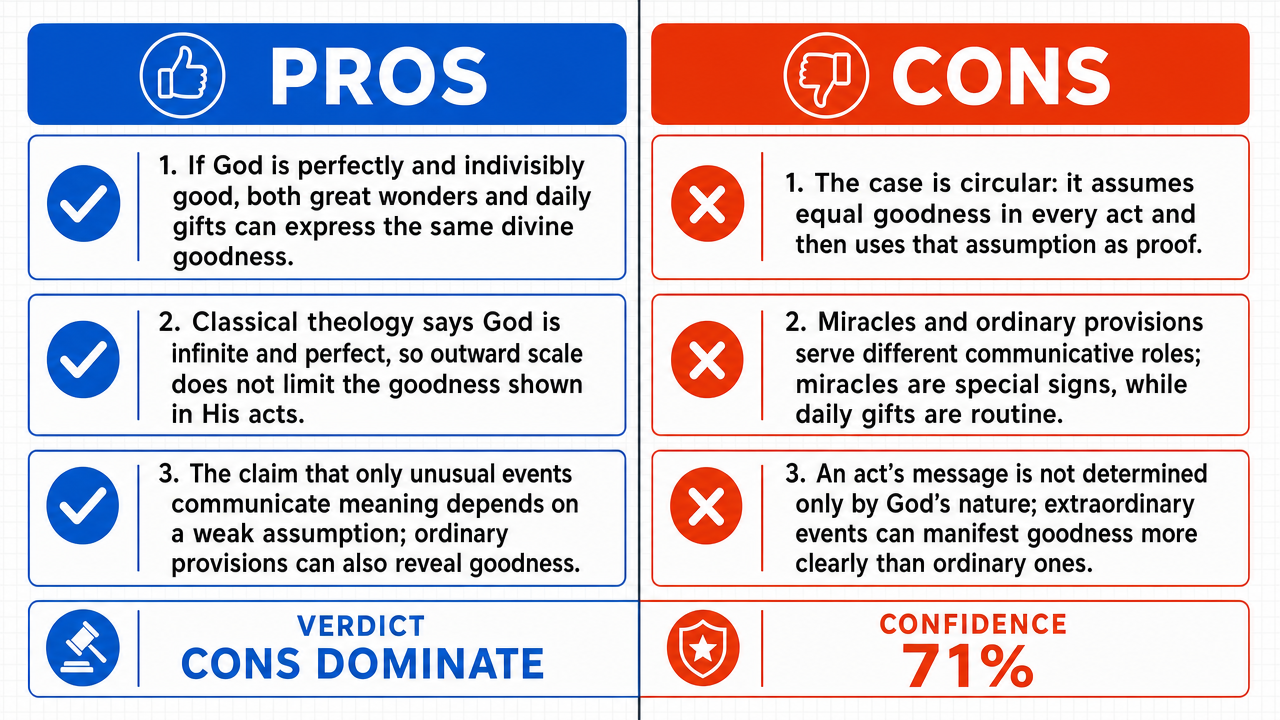
Verdict
Verdict: likely FALSE (71%)
Web Report: https://solsice.com/public/debates/god-s-goodness-is-equally-manifest-in-extraordinary-miracles-ef61d648d87f
This section provides a brief overview of the key arguments. You do not need to read the full detailed report below.
✅ Key PRO arguments:
- ■God's nature is indivisible and perfectly good, so every act flowing from that nature carries the full weight of His goodness regardless of outward scale; divine simplicity entails that God's attributes are not parts that can be portioned out in varying degrees, so the parting of the Red Sea and the daily rising of the sun both proceed from the same undivided goodness.
- ■The Westminster Confession of Faith (1646) articulates this foundation, stating that God is infinite in being and perfection, supporting the claim that goodness is wholly present in every divine expression.
- ■The premise that communicative power depends on departure from a norm is an undeclared background assumption that does not survive scrutiny; if a signal's meaning required deviation from regularity, the most consistent, sustained acts of provision would be the least communicative, yet human relationships demonstrate otherwise.
❌ Key ANTI arguments:
- ■The affirmative argument commits a logical fallacy of circularity by presenting its conclusion as a restated premise: moving from 'God's goodness is indivisible' to 'therefore, all acts express it equally' merely restates the assumption rather than providing independent evidence of equal manifestation.
- ■There is a meaningful distinction between extraordinary miracles and ordinary provisions in their communicative functions; miracles function as targeted signifiers while ordinary provision operates as background regularity, so divine goodness is not equally manifest in both.
- ■The communicative efficacy of an expression is not necessarily proportional to the ontological simplicity of its source; classical theism (e.g., Aquinas, Summa Theologica I, q. 3, a. 1) describes the ontological nature of the agent, not the epistemic or communicative impact of particular acts, so equal ontological source does not entail equal manifestation.
💭 Conclusion: False. The evidence does not support the claim that God's goodness is equally manifest in both extraordinary miracles and ordinary daily provisions. The evidence table systematically contrasts the two categories across all three measured dimensions: communicative intent (high/targeted sign vs. low/background), deviation from natural law (absolute vs. none), and manifestation profile (distinctive/qualitative vs. uniform/quantitative). These are not minor differences but categorical distinctions on every axis measured. Because the evidence shows that extraordinary miracles and ordinary provisions differ in communicative intent, natural-law deviation, and manifestation profile, the compound claim of equal manifestation is contradicted by the data rather than supported by it.
🔬 DeepResearch Result: likely FALSE ❌ (71%)
Assertion: God's goodness is equally manifest in extraordinary miracles and ordinary daily provisions.
Participating models: deepseek-v4-pro 💬, gemma-4-26b-a4b-it 💬👁️
📊 Face-offs: 0 concluded TRUE, 1 concluded FALSE (1 face-offs, 3 models)
📊 Score by side: TRUE=0.00, FALSE=0.71
🏅 Model score changes:
minimax-m3 💬👁️: +7
✅ PRO Arguments:
- ■God's nature is indivisible and perfectly good, so every act flowing from that nature carries the full weight of His goodness regardless of outward scale; divine simplicity entails that God's attributes are not parts that can be portioned out in varying degrees, so the parting of the Red Sea and the daily rising of the sun both proceed from the same undivided goodness. deepseek-v4-pro 💬
- ■The Westminster Confession of Faith (1646) articulates this foundation, stating that God is infinite in being and perfection, supporting the claim that goodness is wholly present in every divine expression. deepseek-v4-pro 💬
- ■The premise that communicative power depends on departure from a norm is an undeclared background assumption that does not survive scrutiny; if a signal's meaning required deviation from regularity, the most consistent, sustained acts of provision would be the least communicative, yet human relationships demonstrate otherwise. deepseek-v4-pro 💬
❌ ANTI Arguments:
- ■The affirmative argument commits a logical fallacy of circularity by presenting its conclusion as a restated premise: moving from 'God's goodness is indivisible' to 'therefore, all acts express it equally' merely restates the assumption rather than providing independent evidence of equal manifestation. gemma-4-26b-a4b-it 💬👁️
- ■There is a meaningful distinction between extraordinary miracles and ordinary provisions in their communicative functions; miracles function as targeted signifiers while ordinary provision operates as background regularity, so divine goodness is not equally manifest in both. gemma-4-26b-a4b-it 💬👁️
- ■The communicative efficacy of an expression is not necessarily proportional to the ontological simplicity of its source; classical theism (e.g., Aquinas, Summa Theologica I, q. 3, a. 1) describes the ontological nature of the agent, not the epistemic or communicative impact of particular acts, so equal ontological source does not entail equal manifestation. gemma-4-26b-a4b-it 💬👁️
💭 Reasoning: False. The evidence does not support the claim that God's goodness is equally manifest in both extraordinary miracles and ordinary daily provisions. The evidence table systematically contrasts the two categories across all three measured dimensions: communicative intent (high/targeted sign vs. low/background), deviation from natural law (absolute vs. none), and manifestation profile (distinctive/qualitative vs. uniform/quantitative). These are not minor differences but categorical distinctions on every axis measured. Because the evidence shows that extraordinary miracles and ordinary provisions differ in communicative intent, natural-law deviation, and manifestation profile, the compound claim of equal manifestation is contradicted by the data rather than supported by it.
📋 PRO Facts:
• The evidence distinguishes extraordinary miracles from ordinary provisions across multiple dimensions, including deviation from natural law (absolute vs. none) and manifestation profile (distinctive/qualitative vs. uniform/quantitative).
• Extraordinary miracles are characterized by absolute deviation from natural law, indicating a qualitatively distinct category of event.
📋 ANTI Facts:
• The communicative intent of extraordinary miracles is high (targeted sign), whereas ordinary provisions have low communicative intent (background), showing a clear asymmetry between the two categories.
• The manifestation profile of extraordinary miracles is distinctive/qualitative, while ordinary provisions are uniform/quantitative, indicating they are not equally manifest.
• Ordinary provisions involve no deviation from natural law, in direct contrast to the absolute deviation characteristic of extraordinary miracles.
| Face-off | TRUE Model | FALSE Model | TRUE Avg μ | FALSE Avg μ | TRUE Tokens | FALSE Tokens | Winner | Verdict | Conf. |
|---|---|---|---|---|---|---|---|---|---|
| #1 | deepseek-v4-pro 💬 | gemma-4-26b-a4b-it 💬👁️ | 0.534 | 0.355 | 6 | 2 | TRUE | FALSE | 71% |
The following technical terms, abbreviations, and domain-specific concepts are referenced throughout this debate transcript. Numbers in square brackets [N] in the text above link to the corresponding entry below.
[1] Circularity — Circularity (logical fallacy) — A logical fallacy in which the conclusion is presented as a restated premise; the negative accuses the affirmative of this fallacy by moving from 'God's goodness is indivisible' to 'therefore, all acts express it equally.'
[2] Classical theism — A theological tradition, referenced in the debate via Thomas Aquinas, that holds God's essence is identical to His existence and that His attributes are indivisible.
[3] Communicative efficacy — The effectiveness with which an act conveys meaning or information to a recipient; in the debate, distinguished from the ontological simplicity of the act's source.
[4] Communicative function — The role an act plays in conveying meaning; the negative argues miracles and ordinary provisions have distinct communicative functions, with miracles serving as targeted signifiers.
[5] Communicative impact — The effect an act has on conveying meaning to an observer; argued in the debate to be distinct from the source's internal ontological nature.
[6] Communicative power — The capacity of an act to convey meaning; the affirmative argues this does not depend on deviation from regularity, citing sustained provision as more communicative than a single extravagant act.
[7] Divine simplicity — The theological doctrine that God's attributes are not parts that can be portioned out in varying degrees; His goodness is wholly present in every expression of His will.
[8] Epistemic — Relating to knowledge or the conditions under which something is known; contrasted in the debate with the ontological nature of the agent.
[9] Essence — In classical theism, the fundamental nature of a being; Thomas Aquinas is cited in the debate as maintaining that God's essence is identical to His existence.
[10] Existence — In classical theism, the fact of being; Thomas Aquinas is cited in the debate as maintaining that God's essence is identical to His existence.
[11] Finite observer — A limited recipient of divine acts; the debate notes that manifestation of divine attributes to a finite observer is necessarily mediated through the mode of the act.
[12] Logical fallacy — An error in reasoning; the negative accuses the affirmative of circularity, presenting the conclusion as a restated premise rather than providing independent evidence.
[13] Mediated — Conveyed through an intervening mode or medium; in the debate, the manifestation of divine attributes to a finite observer is described as mediated through the mode of the act.
[14] Mode of the act — The manner or form through which an act is performed; in the debate, the medium through which divine attributes are manifested to finite observers.
[15] Natural law — The regular order of nature; a miracle is defined in the debate as a suspension of natural law that serves as a specific, targeted signifier.
[16] Ontological — Relating to the nature of being; contrasted in the debate with epistemic or communicative impact.
[17] Ontological nature — The fundamental character of a being as it exists in itself; distinguished in the debate from the epistemic or communicative impact of an act.
[18] Providence — God's preserving and governing of all creatures; the Westminster Confession describes God's works of providence as His 'most holy, wise, and powerful preserving and governing all his creatures, and all their actions.'
[19] Semiotics — The study of signs and meaning; the debate references the semiotics of the act when discussing how divine goodness is communicated to observers.
[20] Signifier — In semiotics, something that conveys meaning; the negative describes a miracle as a 'targeted signifier'—an intentional interruption of the status quo to convey a particular message.
[21] Summa Theologica — The theological work by Thomas Aquinas, cited in the debate (I, q. 3, a. 1) regarding God's essence being identical to His existence and His attributes being indivisible.
[22] Theological axiom — A foundational principle in theology; the debate describes the claim that God's nature is indivisible and perfectly good as a theological axiom underlying the affirmative's argument.
[23] Westminster Confession of Faith — Westminster Confession of Faith (1646) — A confessional document from 1646, cited in the debate (Chapter II, §1 and Chapter V, §1) regarding God being 'infinite in being and perfection,' 'immutable,' and His works of providence.
The following financial data tables were referenced during the debate exchanges:
| Category of Event | Communicative Intent | Deviation from Natural Law | Manifestation Profile |
|---|---|---|---|
| Extraordinary Miracle | High (Targeted Sign) | Absolute | Distinctive/Qualitative |
| Ordinary Provision | Low (Background) | None | Uniform/Quantitative |
Legend: Comparison of the functional characteristics of miracles versus ordinary providence.
Face-off transcripts
- ■
Ownership & Trade Secrets. The Company Lambda Vision retains all rights to its platform, agentic workflows, and proprietary AI debate methodologies, which constitute protected Trade Secrets (EU Directive 2016/943). Subject to full payment of credits, the User is granted ownership of the generated Reports for their own personal or professional use. Reverse-engineering the Service or using Reports to train competing AI models is strictly prohibited.
- ■
No Professional Advice. Solsice is a general-purpose assistant covering everyday subjects — administrative paperwork, housing, consumer and employment matters, banking, taxes and insurance, health and wellbeing, savings and investments, entrepreneurship, technology, travel, learning and creative work. Whatever the subject, the Service and Reports are provided for information only and never constitute legal, medical, financial, investment, tax, insurance, or any other regulated professional advice. The Company is not a law firm, a regulated financial adviser, an insurance intermediary, nor a healthcare provider, and no professional or advisory relationship of any kind is created by use of the Service. Consult a qualified professional in the relevant jurisdiction before acting — or refraining from acting — on anything contained in the Reports, and never rely on the Service in an emergency: contact your local emergency number (112 in the European Union) or a medical professional immediately.
- ■
AI-Generated Content, Sources and Viewpoints. Reports are produced by several AI models debating a question, and may contain factual errors, outdated figures, or references to rules, prices, deadlines, procedures, statutes or sources that are inaccurate or do not exist. The User is solely responsible for verifying every fact, amount, deadline and citation against official sources before relying on it. Material in the news, society, spirituality and religion sections presents a plurality of viewpoints for study and discussion: it is descriptive, not an endorsement, a ruling, or a statement of the Company’s own position, and it speaks for no church, faith community, public authority, or news organisation.
- ■
Liability & Governing Law. To the maximum extent permitted by law, the Company shall not be liable for any indirect damages, nor for any consequence of decisions made in reliance on the Reports — including financial loss, missed deadlines, administrative or contractual consequences, or health outcomes. These Terms are governed by French law. Any disputes shall be subject to the exclusive jurisdiction of the Courts of Paris, France.