
If current economic trends persist, the Federal Reserve will be forced to intervene by capping long-term interest rates to allow inflation to reduce the national debt, similar to the post-WWII period.
AI debate verdict and arguments
⚠️ AI-generated information only; not professional advice
Completed October 14, 2026
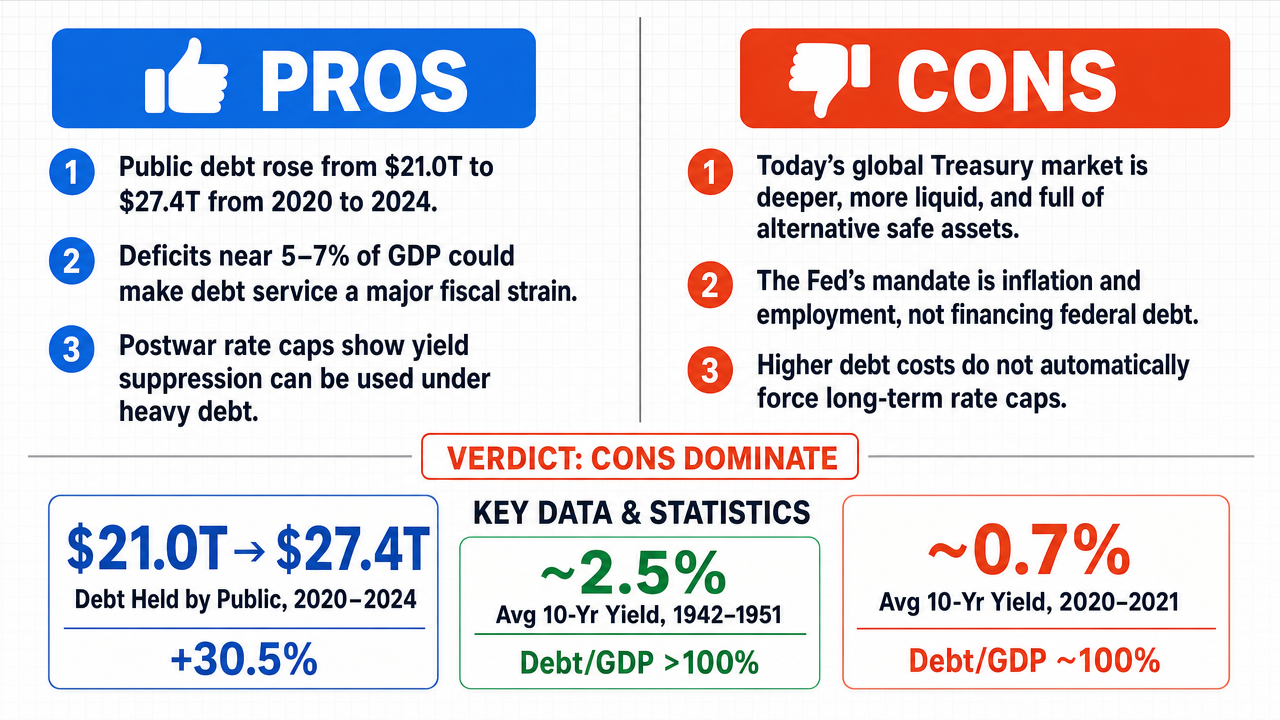
Verdict
Verdict: likely FALSE (82%)
Web Report: https://solsice.com/public/debates/if-current-economic-trends-persist-the-federal-reserve-will-e5d3893d6aab
This section provides a brief overview of the key arguments. You do not need to read the full detailed report below.
✅ Key PRO arguments:
- ■The U.S. federal debt trajectory is unsustainable, with debt held by the public rising from $21.0T in 2020 to $27.4T in 2024 (a 30.5% increase in just four years), creating mounting pressure on monetary policy to assist fiscal management.
- ■Annual deficits are projected to average 5-7% of GDP over the coming decade, making debt servicing costs a dominant fiscal concern that could compel the Fed to suppress long-term rates.
- ■The post-WWII precedent demonstrates that financial repression through rate caps is a viable policy response to an unsustainable debt burden, and was maintained for years before the 1951 Treasury -Fed Accord .
❌ Key ANTI arguments:
- ■Modern global financial architecture is fundamentally different from the post-WWII era: the Treasury market is vastly more developed and there are diverse, highly liquid sovereign debt alternatives globally, meaning any Fed attempt to cap rates would trigger massive capital flight rather than succeed.
- ■Structural and legal barriers separate fiscal problems from monetary mandates; the Fed's dual mandate covers price stability and employment, not debt management, so rising debt does not legally or institutionally 'force' rate suppression.
- ■The claim that rising interest costs must result in rate suppression is a non-sequitur; debt growth and debt-servicing costs do not create a direct causal link to monetary policy actions, as fiscal and monetary authorities can operate independently.
💭 Conclusion: The argument that the Federal Reserve will be forced to cap long-term interest rates to inflate away the national debt in a manner similar to the post-WWII period is rejected. The strongest counter-argument is that modern global capital markets are structurally incompatible with the rate-capping regime of the 1940s, since liquid alternative sovereign debt markets would cause capital flight the moment such caps were imposed. The negative side also correctly identified that the Fed's dual mandate does not legally compel it to subordinate monetary policy to fiscal debt management, making the causal link between rising debt and forced rate suppression a non-sequitur. While the affirmative accurately cited the rise in publicly held debt from $21.0T to $27.4T (2020-2024) and projected deficits of 5-7% of GDP , these fiscal pressures do not by themselves dictate monetary policy outcomes. The historical analogy to post-WWII financial repression was undermined by the fact that the policy was abandoned in 1951 due to its incompatibility with central bank independence , a constraint that is even stronger today.
🔬 DeepResearch Result: likely FALSE ❌ (82%)
Assertion: If current economic trends persist, the Federal Reserve will be forced to intervene by capping long-term interest rates to allow inflation to reduce the national debt , similar to the post-WWII period.
Participating models: deepseek-v3.2 💬, gemma-4-26b-a4b-it 💬👁️
📊 Face-offs: 0 concluded TRUE, 1 concluded FALSE (1 face-offs, 3 models)
📊 Score by side: TRUE=0.00, FALSE=0.82
🏅 Model score changes:
minimax-m3 💬👁️: +8
✅ PRO Arguments:
- ■The U.S. federal debt trajectory is unsustainable, with debt held by the public rising from $21.0T in 2020 to $27.4T in 2024 (a 30.5% increase in just four years), creating mounting pressure on monetary policy to assist fiscal management. deepseek-v3.2 💬
- ■Annual deficits are projected to average 5-7% of GDP over the coming decade, making debt servicing costs a dominant fiscal concern that could compel the Fed to suppress long-term rates. deepseek-v3.2 💬
- ■The post-WWII precedent demonstrates that financial repression through rate caps is a viable policy response to an unsustainable debt burden, and was maintained for years before the 1951 Treasury -Fed Accord . deepseek-v3.2 💬
- ■The opponent's framing presents a false dichotomy: either rate caps are feasible exactly as in the 1940s, or they are impossible today, ignoring that modern tools (yield curve control, QE, forward guidance) could replicate the effect without identical mechanisms. deepseek-v3.2 💬
❌ ANTI Arguments:
- ■Modern global financial architecture is fundamentally different from the post-WWII era: the Treasury market is vastly more developed and there are diverse, highly liquid sovereign debt alternatives globally, meaning any Fed attempt to cap rates would trigger massive capital flight rather than succeed. gemma-4-26b-a4b-it 💬👁️
- ■Structural and legal barriers separate fiscal problems from monetary mandates; the Fed's dual mandate covers price stability and employment, not debt management, so rising debt does not legally or institutionally 'force' rate suppression. gemma-4-26b-a4b-it 💬👁️
- ■The claim that rising interest costs must result in rate suppression is a non-sequitur; debt growth and debt-servicing costs do not create a direct causal link to monetary policy actions, as fiscal and monetary authorities can operate independently. gemma-4-26b-a4b-it 💬👁️
- ■The post-WWII historical analogy is flawed because it ignores that the policy was abandoned in 1951 precisely because it distorted markets and conflicted with the Fed's independence, suggesting such repression is institutionally unsustainable in the modern era. gemma-4-26b-a4b-it 💬👁️
💭 Reasoning: The argument that the Federal Reserve will be forced to cap long-term interest rates to inflate away the national debt in a manner similar to the post-WWII period is rejected. The strongest counter-argument is that modern global capital markets are structurally incompatible with the rate-capping regime of the 1940s, since liquid alternative sovereign debt markets would cause capital flight the moment such caps were imposed. The negative side also correctly identified that the Fed's dual mandate does not legally compel it to subordinate monetary policy to fiscal debt management, making the causal link between rising debt and forced rate suppression a non-sequitur. While the affirmative accurately cited the rise in publicly held debt from $21.0T to $27.4T (2020-2024) and projected deficits of 5-7% of GDP, these fiscal pressures do not by themselves dictate monetary policy outcomes. The historical analogy to post-WWII financial repression was undermined by the fact that the policy was abandoned in 1951 due to its incompatibility with central bank independence , a constraint that is even stronger today.
📋 PRO Facts:
• Federal debt held by the public rose from $21.0T in 2020 to $27.4T in 2024, a 30.5% increase.
• Annual federal deficits are projected to average 5-7% of GDP over the coming decade.
• The post-WWII financial repression regime was maintained for several years before being ended by the 1951 Treasury-Fed Accord.
📋 ANTI Facts:
• The post-WWII Treasury market was significantly less developed than today's, with minimal global supply of liquid safe-asset alternatives.
• The Federal Reserve's statutory dual mandate covers maximum employment and price stability, not debt management.
• The 1951 Treasury-Fed Accord ended financial repression because it conflicted with Federal Reserve independence.
| Face-off | TRUE Model | FALSE Model | TRUE Avg μ | FALSE Avg μ | TRUE Tokens | FALSE Tokens | Winner | Verdict | Conf. |
|---|---|---|---|---|---|---|---|---|---|
| #1 | deepseek-v3.2 💬 | gemma-4-26b-a4b-it 💬👁️ | 0.481 | 0.262 | 8 | 2 | TRUE | FALSE | 82% |
The following technical terms, abbreviations, and domain-specific concepts are referenced throughout this debate transcript. Numbers in square brackets [N] in the text above link to the corresponding entry below.
[1] Accord — Treasury-Federal Reserve Accord (1951) — An agreement referenced in the debate that ended the post-WWII arrangement in which the Federal Reserve pegged long-term Treasury yields. The transcript states the Accord ended the peg because the immediate post-war crisis had passed and inflation concerns grew.
[2] austerity — A fiscal policy stance involving reduced government spending or higher taxes, mentioned in the debate as one political alternative to monetary intervention when debt servicing costs rise.
[3] capital flight — The rapid movement of investment capital out of a country, cited in the debate as a likely consequence if the Fed attempted to artificially cap long-term rates in modern globalized markets.
[4] central bank independence — The principle that a central bank should operate free from political or fiscal direction. The debate frames this as a foundational principle contradicted by treating the Fed as a fiscal agent of the Treasury.
[5] core PCE price index — Core Personal Consumption Expenditures Price Index — An inflation measure that excludes volatile food and energy prices. The debate identifies it as the Fed's preferred inflation gauge against its 2% target.
[6] crowd out — crowding out effect — The economic phenomenon where rising government debt servicing costs displace other public spending, referenced in the debate as a consequence of high interest rates on the federal budget.
[7] debt erosion — The reduction of the real value of outstanding debt through inflation, cited in the debate as the mechanism by which capping rates combined with inflation would reduce the national debt.
[8] debt servicing costs — The interest payments the government must make on its outstanding debt. The debate argues these are becoming a dominant budget item under current fiscal trends.
[9] deficits — fiscal deficits — Annual shortfalls where government expenditures exceed revenues. The debate cites projected deficits averaging 5-7% of GDP over the coming decade.
[10] Federal Reserve — Federal Reserve (the Fed) — The central bank of the United States, referenced throughout the debate as the institution whose monetary policy decisions are at issue.
[11] financial repression — A set of policies under which governments use regulations and directed credit to keep real interest rates below inflation, effectively transferring wealth from creditors to debtors. The debate compares a potential future Fed rate cap to the post-WWII use of this policy.
[12] fiscal insolvency — A condition in which a government's fiscal position becomes unsustainable. The debate distinguishes this from monetary policy requirements, arguing rising debt does not automatically force monetary intervention.
[13] fiscal policy — Government policy regarding taxation and spending, distinguished in the debate from monetary policy as a separate domain of economic management.
[14] GDP — Gross Domestic Product — The total monetary value of goods and services produced within a country. The debate uses debt-to-GDP ratios (e.g., exceeding 100%) and deficits as a share of GDP (5-7%) as sustainability metrics.
[15] globalized liquidity — The ease with which capital moves across international borders in modern markets. The debate argues this makes post-WWII-style rate caps infeasible by enabling rapid capital flight.
[16] inflation — A general rise in the price level of goods and services. The debate discusses inflation both as a target (the Fed's 2% goal) and as a potential tool for reducing the real value of government debt.
[17] long-term interest rates — Interest rates on debt securities with extended maturities, such as long-dated government bonds. The debate centers on whether the Fed would cap these rates.
[18] mandate — dual mandate — The Federal Reserve's statutory objectives, generally understood to include price stability and maximum employment. The debate disputes whether debt servicing falls within this mandate.
[19] monetary intervention — Direct action by a central bank to influence financial conditions, such as capping interest rates. The debate frames this as a potential alternative to fiscal austerity.
[20] monetary policy — Central bank actions influencing money supply and interest rates. The debate distinguishes this from fiscal policy and questions whether debt levels can compel specific monetary actions.
[21] national debt — The total outstanding debt owed by the federal government. The debate cites U.S. federal debt held by the public rising from $21.0T in 2020 to $27.4T in 2024.
[22] rate caps — interest rate caps — Limits imposed on interest rates, either administratively or through market intervention. The debate debates whether the Fed would impose such caps on long-term Treasury yields.
[23] safe-asset — safe asset — An investment perceived to carry low credit risk, such as highly rated sovereign bonds. The debate notes the post-WWII scarcity of such assets compared to today's diverse sovereign debt markets.
[24] sovereign debt markets — Markets in which national governments issue and trade debt securities. The debate argues the modern diversity and liquidity of these markets makes coordinated rate suppression difficult.
[25] Treasury — U.S. Treasury / Treasury market — Refers both to the U.S. Treasury Department (the debt-issuing authority) and the market for U.S. government securities. The debate discusses the Treasury market's role in enabling post-WWII financial repression.
[26] U.S. federal debt held by the public — The portion of federal debt held by non-governmental investors, as distinct from intragovernmental holdings. The debate cites this metric rising from $21.0T in 2020 to $27.4T in 2024.
The following financial data tables were referenced during the debate exchanges:
| Metric | 2020 | 2024 | Change |
|---|---|---|---|
| Federal Debt Held by Public | $21.0T | $27.4T | +30.5% |
Legend: U.S. federal debt held by the public, in trillions of USD. Source: Congressional Budget Office, Treasury Department data.
| Metric | Post-WWII Era (Approx) | Modern Era (Approx) |
|---|---|---|
| Global Debt-to-GDP Ratio | Lower/Fragmented | Significantly Higher/Integrated |
| Treasury Market Liquidity | Limited/Domestic-centric | Extremely High/Globalized |
| Primary Fed Mandate Focus | Rebuilding/Stability | Price Stability/Dual Mandate |
| Alternative Safe Assets | Scarce | Abundant/Global |
Legend: Qualitative comparison of the structural constraints between the post-WWII period and the current economic environment.
| Period | Policy | Avg 10-Yr Yield | Debt-to-GDP | Context |
|---|---|---|---|---|
| 1942-1951 | Explicit Rate Cap | ~2.5% | >100% | Post-War Debt Crisis |
| 2020-2021 | De Facto Cap via QE | ~0.7% | ~100% | Pandemic Crisis |
Legend: Comparison of yield control mechanisms across high-debt periods. Sources: Federal Reserve history, Treasury Department data.
Face-off transcripts
- ■
Ownership & Trade Secrets. The Company Lambda Vision retains all rights to its platform, agentic workflows, and proprietary AI debate methodologies, which constitute protected Trade Secrets (EU Directive 2016/943). Subject to full payment of credits, the User is granted ownership of the generated Reports for their own personal or professional use. Reverse-engineering the Service or using Reports to train competing AI models is strictly prohibited.
- ■
No Professional Advice. Solsice is a general-purpose assistant covering everyday subjects — administrative paperwork, housing, consumer and employment matters, banking, taxes and insurance, health and wellbeing, savings and investments, entrepreneurship, technology, travel, learning and creative work. Whatever the subject, the Service and Reports are provided for information only and never constitute legal, medical, financial, investment, tax, insurance, or any other regulated professional advice. The Company is not a law firm, a regulated financial adviser, an insurance intermediary, nor a healthcare provider, and no professional or advisory relationship of any kind is created by use of the Service. Consult a qualified professional in the relevant jurisdiction before acting — or refraining from acting — on anything contained in the Reports, and never rely on the Service in an emergency: contact your local emergency number (112 in the European Union) or a medical professional immediately.
- ■
AI-Generated Content, Sources and Viewpoints. Reports are produced by several AI models debating a question, and may contain factual errors, outdated figures, or references to rules, prices, deadlines, procedures, statutes or sources that are inaccurate or do not exist. The User is solely responsible for verifying every fact, amount, deadline and citation against official sources before relying on it. Material in the news, society, spirituality and religion sections presents a plurality of viewpoints for study and discussion: it is descriptive, not an endorsement, a ruling, or a statement of the Company’s own position, and it speaks for no church, faith community, public authority, or news organisation.
- ■
Liability & Governing Law. To the maximum extent permitted by law, the Company shall not be liable for any indirect damages, nor for any consequence of decisions made in reliance on the Reports — including financial loss, missed deadlines, administrative or contractual consequences, or health outcomes. These Terms are governed by French law. Any disputes shall be subject to the exclusive jurisdiction of the Courts of Paris, France.