
Individuals who resign without first validating a reconversion project with a professional evolution counseling organization are significantly less likely to receive unemployment benefits from Pôle Emploi for reconversion.
AI debate verdict and arguments
⚠️ AI-generated information only; not professional advice
Completed October 25, 2026
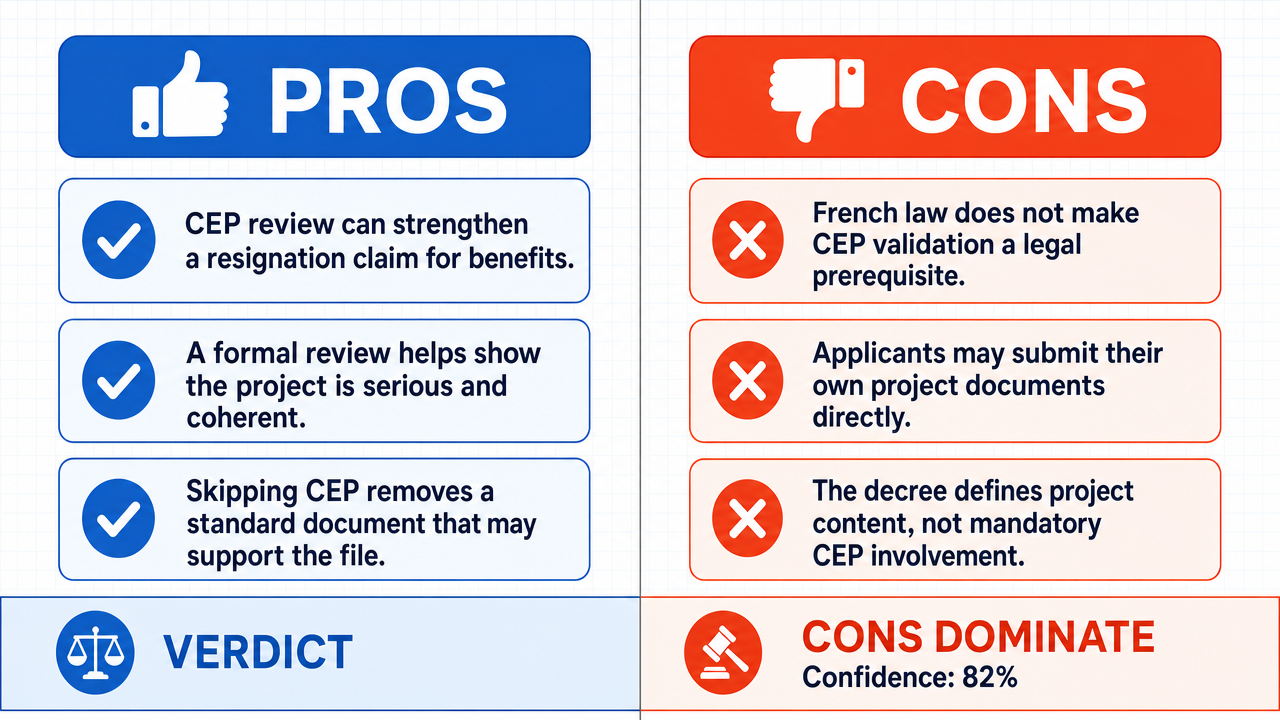
Verdict
Verdict: likely FALSE (82%)
Web Report: https://solsice.com/public/debates/individuals-who-resign-without-first-validating-a-reconversi-ee973fd90484
This section provides a brief overview of the key arguments. You do not need to read the full detailed report below.
✅ Key PRO arguments:
- ■Validating reconversion projects with CEP is a critical factor in increasing the likelihood of receiving unemployment benefits after resignation, as it provides the only standardized, institutional mechanism for proving the 'real and serious' nature of the project required under French labor law .
- ■In the administrative practice of France Travail , the 'seriousness' of a reconversion project is not a subjective determination but a rigorous assessment of economic viability and professional alignment , which requires CEP validation to establish credibility.
- ■By bypassing the CEP , an individual loses the only standardized, institutional documentation that can satisfy the substantive legal requirement that the resignation be motivated by a 'real and serious' professional reconversion project .
❌ Key ANTI arguments:
- ■CEP validation is not legally mandated for eligibility for unemployment benefits after resignation for reconversion ; Article L5422-1 of the Labor Code and its implementing decrees outline conditions but do not explicitly require CEP involvement as a prerequisite.
- ■Administrative practice explicitly allows individuals to submit their own detailed project descriptions, training agreements , and job search plans directly to the commission without CEP validation.
- ■The decree implementing Article L5422-1 outlines the content of the project (e.g., training, job search) but does not mandate CEP involvement as a prerequisite for submitting the project.
💭 Conclusion: False. The assertion that CEP validation is a prerequisite for receiving unemployment benefits after resignation for reconversion is not supported by French labor law . Article L5422-1 of the Labor Code and its implementing decrees outline the eligibility framework, while official guidance identifies project elements such as a training plan or job search strategy . Neither requires CEP validation or the signature of a professional evolution counseling organization. Individuals may provide their own project documentation, and CEP guidance may strengthen an application. However, the absence of CEP validation does not itself make an individual legally ineligible for unemployment benefits.
🔬 DeepResearch Result: likely FALSE ❌ (82%)
Assertion: Individuals who resign without first validating a reconversion project with a professional evolution counseling organization are significantly less likely to receive unemployment benefits from Pôle Emploi for reconversion.
Participating models: gemma-4-26b-a4b-it 💬👁️, glm-4.7-flash 💬
📊 Face-offs: 0 concluded TRUE, 1 concluded FALSE (1 face-offs, 3 models)
📊 Score by side: TRUE=0.00, FALSE=0.82
🏅 Model score changes:
minimax-m3 💬👁️: +8
✅ PRO Arguments:
- ■Validating reconversion projects with CEP is a critical factor in increasing the likelihood of receiving unemployment benefits after resignation, as it provides the only standardized, institutional mechanism for proving the 'real and serious' nature of the project required under French labor law . gemma-4-26b-a4b-it 💬👁️
- ■In the administrative practice of France Travail , the 'seriousness' of a reconversion project is not a subjective determination but a rigorous assessment of economic viability and professional alignment , which requires CEP validation to establish credibility. gemma-4-26b-a4b-it 💬👁️
- ■By bypassing the CEP, an individual loses the only standardized, institutional documentation that can satisfy the substantive legal requirement that the resignation be motivated by a 'real and serious' professional reconversion project . gemma-4-26b-a4b-it 💬👁️
❌ ANTI Arguments:
- ■CEP validation is not legally mandated for eligibility for unemployment benefits after resignation for reconversion; Article L5422-1 of the Labor Code and its implementing decrees outline conditions but do not explicitly require CEP involvement as a prerequisite. glm-4.7-flash 💬
- ■Administrative practice explicitly allows individuals to submit their own detailed project descriptions, training agreements , and job search plans directly to the commission without CEP validation. glm-4.7-flash 💬
- ■The decree implementing Article L5422-1 outlines the content of the project (e.g., training, job search) but does not mandate CEP involvement as a prerequisite for submitting the project. glm-4.7-flash 💬
- ■The verification of the project's seriousness is performed by the Pôle Emploi commission based on the submitted documentation, not on whether the project was validated by a CEP counselor . glm-4.7-flash 💬
💭 Reasoning: False. The assertion that CEP validation is a prerequisite for receiving unemployment benefits after resignation for reconversion is not supported by French labor law. Article L5422-1 of the Labor Code and its implementing decrees outline the eligibility framework, while official guidance identifies project elements such as a training plan or job search strategy . Neither requires CEP validation or the signature of a professional evolution counseling organization. Individuals may provide their own project documentation, and CEP guidance may strengthen an application. However, the absence of CEP validation does not itself make an individual legally ineligible for unemployment benefits.
📋 PRO Facts:
• Under French labor law, Article L5422-1 of the Labor Code and its implementing decrees outline the conditions for eligibility for unemployment benefits after resignation for professional reconversion .
• Professional reconversion is subject to a project meeting the applicable eligibility conditions, including elements such as a training plan or job search strategy.
• CEP guidance is highly recommended and can strengthen an application, but it is not legally mandated for eligibility.
📋 ANTI Facts:
• Article L5422-1 of the Labor Code outlines conditions for eligibility for unemployment benefits after resignation for reconversion without explicitly requiring CEP involvement.
• Official guidance lists required project elements, such as a training plan or job search strategy, but does not require the signature of a professional evolution counseling organization.
• Administrative guidance allows individuals to provide their own project descriptions and does not require a professional evolution counseling organization's signature.
• Service Public guidance states that the applicant must provide a reconversion project.
| Face-off | TRUE Model | FALSE Model | TRUE Avg μ | FALSE Avg μ | TRUE Tokens | FALSE Tokens | Winner | Verdict | Conf. |
|---|---|---|---|---|---|---|---|---|---|
| #1 | gemma-4-26b-a4b-it 💬👁️ | glm-4.7-flash 💬 | 0.217 | 0.455 | 4 | 4 | FALSE | FALSE | 82% |
The following technical terms, abbreviations, and domain-specific concepts are referenced throughout this debate transcript. Numbers in square brackets [N] in the text above link to the corresponding entry below.
[1] "real and serious" professional reconversion project — A reconversion project satisfying the substantive real-and-serious condition, with CEP validation argued to provide evidence for that condition.
[2] active steps — Actions taken by an individual that the debate says are considered when assessing a reconversion project.
[3] allocation — The administrative grant of unemployment benefits, with project elements such as training or a job-search strategy listed among the relevant conditions.
[4] Article L5422-1 of the Labor Code — The Labor Code provision identified in the debate as governing unemployment-benefit eligibility following resignation for professional reconversion.
[5] burden of proof — The obligation to establish the required case; the affirmative side says it falls on individuals who lack CEP validation.
[6] CEP — Conseil en Évolution Professionnelle — A professional evolution counseling organization that validates reconversion projects, with the necessity of that validation disputed in the debate.
[7] CEP counselor — Conseil en Évolution Professionnelle (CEP) counselor — A CEP professional described as providing formal endorsement and documentation for a reconversion project.
[8] CEP validation — Formal endorsement and documentation of a reconversion project by CEP, argued to support an application for unemployment benefits.
[9] economic viability — One stated criterion in the administrative assessment of whether a professional project is sufficiently serious and viable.
[10] eligibility — Whether an applicant meets the conditions for receiving unemployment benefits after resigning for professional reconversion.
[11] evidentiary documentation — Documents used to establish that a reconversion project satisfies the applicable substantive requirements.
[12] France Travail — The administrative name used in the debate for the unemployment-benefit administration described as formerly known as Pôle Emploi.
[13] French labor law — The legal framework in which the debate discusses the classification of resignations and eligibility for unemployment benefits.
[14] implementing decrees — Rules described as implementing Article L5422-1 and specifying project content, including training and job-search elements.
[15] job search plans — Detailed plans that an individual may submit as evidence supporting the seriousness of a reconversion project.
[16] job search strategy — A project element listed in the official guidance discussed by the debate as relevant to benefit eligibility.
[17] legal classification — The categorization of a departure, particularly as a voluntary resignation or a resignation for professional reconversion.
[18] legal or administrative requirement — A binding condition said to govern access to benefits; the debate disputes whether CEP validation is such a requirement.
[19] legal prerequisite — A condition asserted to be legally necessary before benefits can be granted, with its application to CEP validation disputed.
[20] modality of how a condition is proven — The legal form used to establish a condition; the affirmative side argues that CEP validation is a means of proving the underlying requirement.
[21] practical necessity — The claim that a step may be practically needed even if it is not legally mandatory; the debate disputes this claim for CEP validation.
[22] professional alignment — One stated dimension of project seriousness considered alongside factors such as economic viability.
[23] professional reconversion project — A project for professional change that the debate says must be real and serious to support a resignation for reconversion.
[24] project viability — The feasibility and credibility of a reconversion project as assessed during an unemployment-benefit application.
[25] Pôle Emploi — The unemployment-benefit administration referenced throughout the debate and described there as now called France Travail.
[26] Pôle Emploi commission — The body described in the debate as evaluating benefit applications through a review of project viability and the applicant's commitment.
[27] real and serious cause — A stated justification for departure; resignations without it are described as voluntary and generally ineligible for benefits.
[28] reconversion — A professional change pursued through a project and serving as the stated purpose for seeking unemployment benefits after resignation.
[29] reconversion project — The project supporting an application for unemployment benefits, with training and job-search evidence discussed as possible support.
[30] resignation for professional reconversion — A special category of resignation discussed as potentially supporting benefit eligibility when associated with a real and serious project.
[31] seriousness and reality of the professional project — The paired substantive assessment used in the debate to determine whether a reconversion project is credible and genuine.
[32] standard resignations — Ordinary resignations not treated as professional-reconversion departures; the transcript disputes how often projects without CEP validation receive this classification.
[33] substantive legal requirement — The underlying legal condition said to govern the case, as distinguished from the method used to prove it.
[34] training agreements — Agreements that an individual may submit as evidence supporting the seriousness of a reconversion project.
[35] training plan — A project element listed in the official guidance discussed as relevant to receiving unemployment benefits.
[36] unemployment benefits — Benefits referenced as administered by Pôle Emploi or France Travail for qualifying resignations and reconversion projects.
[37] voluntary departure — A resignation characterized as lacking a real and serious cause, which the debate says generally prevents benefit eligibility.
Face-off transcripts
- ■
Ownership & Trade Secrets. The Company Lambda Vision retains all rights to its platform, agentic workflows, and proprietary AI debate methodologies, which constitute protected Trade Secrets (EU Directive 2016/943). Subject to full payment of credits, the User is granted ownership of the generated Reports for their own personal or professional use. Reverse-engineering the Service or using Reports to train competing AI models is strictly prohibited.
- ■
No Professional Advice. Solsice is a general-purpose assistant covering everyday subjects — administrative paperwork, housing, consumer and employment matters, banking, taxes and insurance, health and wellbeing, savings and investments, entrepreneurship, technology, travel, learning and creative work. Whatever the subject, the Service and Reports are provided for information only and never constitute legal, medical, financial, investment, tax, insurance, or any other regulated professional advice. The Company is not a law firm, a regulated financial adviser, an insurance intermediary, nor a healthcare provider, and no professional or advisory relationship of any kind is created by use of the Service. Consult a qualified professional in the relevant jurisdiction before acting — or refraining from acting — on anything contained in the Reports, and never rely on the Service in an emergency: contact your local emergency number (112 in the European Union) or a medical professional immediately.
- ■
AI-Generated Content, Sources and Viewpoints. Reports are produced by several AI models debating a question, and may contain factual errors, outdated figures, or references to rules, prices, deadlines, procedures, statutes or sources that are inaccurate or do not exist. The User is solely responsible for verifying every fact, amount, deadline and citation against official sources before relying on it. Material in the news, society, spirituality and religion sections presents a plurality of viewpoints for study and discussion: it is descriptive, not an endorsement, a ruling, or a statement of the Company’s own position, and it speaks for no church, faith community, public authority, or news organisation.
- ■
Liability & Governing Law. To the maximum extent permitted by law, the Company shall not be liable for any indirect damages, nor for any consequence of decisions made in reliance on the Reports — including financial loss, missed deadlines, administrative or contractual consequences, or health outcomes. These Terms are governed by French law. Any disputes shall be subject to the exclusive jurisdiction of the Courts of Paris, France.