
International recognition of sovereignty for states with minimal territorial control has primarily hindered the development of strong institutions in Africa.
AI debate verdict and arguments
⚠️ AI-generated information only; not professional advice
Completed October 22, 2026
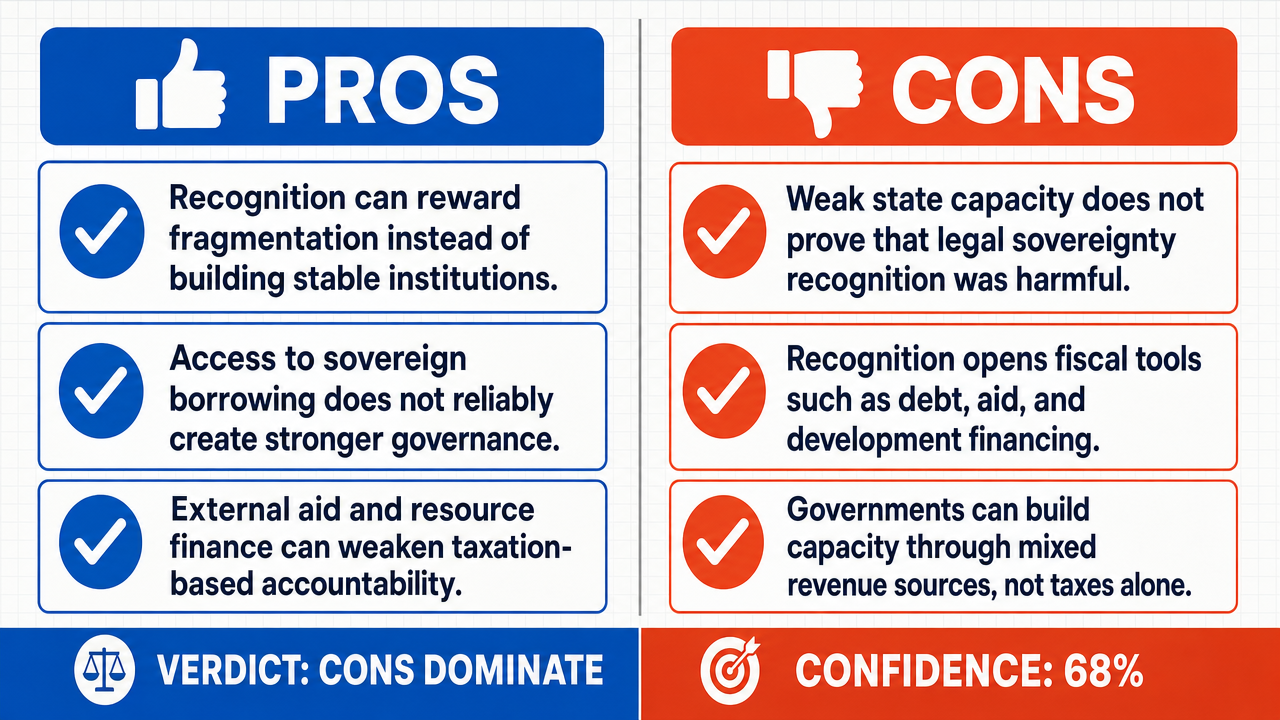
Verdict
Verdict: likely FALSE (68%)
Web Report: https://solsice.com/public/debates/international-recognition-of-sovereignty-for-states-with-min-ccb9f699c6b9
This section provides a brief overview of the key arguments. You do not need to read the full detailed report below.
✅ Key PRO arguments:
- ■Premature sovereignty recognition created a perverse incentive structure that rewarded factional fragmentation rather than institutional consolidation , as the OAU's 1964 adoption of uti possidetis juris allowed any group controlling even a sliver of territory to secure international legal personality without first building administrative, fiscal, or coercive capacity .
- ■The claim that sovereign debt access drives institution-building is undermined by the fact that states with the longest histories of sovereign borrowing have the weakest institutions, citing Ghana as a prolific Eurobond issuer since 2007 with persistently weak institutional outcomes.
- ■External rents from foreign aid and commodity-backed financing substituted for domestic taxation , preventing the development of a reciprocal social contract between rulers and citizens that is foundational to strong institutions.
❌ Key ANTI arguments:
- ■The affirmative commits a logical error by substituting a proxy (administrative reach and tax revenue) for the legal status of sovereignty itself; the absence of effective territorial control does not mean sovereignty is a 'fiction' that hinders institutions.
- ■Sovereign recognition unlocks essential fiscal tools —access to capital markets, sovereign debt instruments, and multilateral development assistance —which in turn build the bureaucratic infrastructure of the state.
- ■The opponent's argument rests on a false dichotomy assuming the only two possible sources of government revenue are domestic taxation and external rents , and that the latter necessarily prevents the former.
💭 Conclusion: False. The debate verdict rejects the assertion that international recognition of sovereignty has primarily hindered institutional development in Africa. The winning side successfully argued that the affirmative confused a proxy (administrative reach and tax revenue) with the legal status of sovereignty itself, committing a logical error of substitution. The negative demonstrated that sovereign recognition unlocks essential fiscal tools —capital markets, sovereign debt instruments, and multilateral development assistance —that enable bureaucratic infrastructure building. Furthermore, the negative exposed a false dichotomy in the affirmative's argument, which assumed government revenue must come exclusively from either domestic taxation or external rents . The affirmative's case, while raising legitimate concerns about external rents substituting for domestic taxation, failed to establish a clear causal mechanism showing how the legal act of recognition itself directly hinders institutional development, rather than merely correlating with weak institutional outcomes.
🔬 DeepResearch Result: likely FALSE ❌ (68%)
Assertion: International recognition of sovereignty for states with minimal territorial control has primarily hindered the development of strong institutions in Africa.
Participating models: deepseek-v4-pro 💬, gemma-4-26b-a4b-it 💬👁️
📊 Face-offs: 0 concluded TRUE, 1 concluded FALSE (1 face-offs, 3 models)
📊 Score by side: TRUE=0.00, FALSE=0.68
🏅 Model score changes:
minimax-m3 💬👁️: +7
✅ PRO Arguments:
- ■Premature sovereignty recognition created a perverse incentive structure that rewarded factional fragmentation rather than institutional consolidation , as the OAU's 1964 adoption of uti possidetis juris allowed any group controlling even a sliver of territory to secure international legal personality without first building administrative, fiscal, or coercive capacity . deepseek-v4-pro 💬
- ■The claim that sovereign debt access drives institution-building is undermined by the fact that states with the longest histories of sovereign borrowing have the weakest institutions, citing Ghana as a prolific Eurobond issuer since 2007 with persistently weak institutional outcomes. deepseek-v4-pro 💬
- ■External rents from foreign aid and commodity-backed financing substituted for domestic taxation , preventing the development of a reciprocal social contract between rulers and citizens that is foundational to strong institutions. deepseek-v4-pro 💬
- ■Recognition froze colonial borders regardless of on-the-ground realities, guaranteeing that weak entities could secure legal personality without first demonstrating the administrative capacity that defines a functional state. deepseek-v4-pro 💬
❌ ANTI Arguments:
- ■The affirmative commits a logical error by substituting a proxy (administrative reach and tax revenue) for the legal status of sovereignty itself; the absence of effective territorial control does not mean sovereignty is a 'fiction' that hinders institutions. gemma-4-26b-a4b-it 💬👁️
- ■Sovereign recognition unlocks essential fiscal tools —access to capital markets, sovereign debt instruments , and multilateral development assistance —which in turn build the bureaucratic infrastructure of the state. gemma-4-26b-a4b-it 💬👁️
- ■The opponent's argument rests on a false dichotomy assuming the only two possible sources of government revenue are domestic taxation and external rents, and that the latter necessarily prevents the former. gemma-4-26b-a4b-it 💬👁️
- ■Sovereignty recognition provides the essential legal framework for institutional building and stability, enabling states to engage in international agreements, attract investment, and access development assistance. gemma-4-26b-a4b-it 💬👁️
💭 Reasoning: False. The debate verdict rejects the assertion that international recognition of sovereignty has primarily hindered institutional development in Africa. The winning side successfully argued that the affirmative confused a proxy (administrative reach and tax revenue) with the legal status of sovereignty itself, committing a logical error of substitution. The negative demonstrated that sovereign recognition unlocks essential fiscal tools—capital markets, sovereign debt instruments, and multilateral development assistance—that enable bureaucratic infrastructure building. Furthermore, the negative exposed a false dichotomy in the affirmative's argument, which assumed government revenue must come exclusively from either domestic taxation or external rents. The affirmative's case, while raising legitimate concerns about external rents substituting for domestic taxation, failed to establish a clear causal mechanism showing how the legal act of recognition itself directly hinders institutional development, rather than merely correlating with weak institutional outcomes.
📋 PRO Facts:
• The Organisation of African Unity adopted the principle of uti possidetis juris in 1964, freezing colonial borders regardless of on-the-ground realities.
• Ghana issued its first Eurobond in 2007 and has since become one of Africa's most prolific sovereign borrowers .
📋 ANTI Facts:
• Sovereign recognition provides access to capital markets, sovereign debt instruments, and multilateral development assistance.
• The Central African Republic is cited as an example of a state with low effective territorial control and low domestic tax ratios.
• Government revenue can be generated through multiple streams beyond the dichotomy of domestic taxation and external rents.
| Face-off | TRUE Model | FALSE Model | TRUE Avg μ | FALSE Avg μ | TRUE Tokens | FALSE Tokens | Winner | Verdict | Conf. |
|---|---|---|---|---|---|---|---|---|---|
| #1 | deepseek-v4-pro 💬 | gemma-4-26b-a4b-it 💬👁️ | 0.611 | 0.383 | 6 | 2 | TRUE | FALSE | 68% |
The following technical terms, abbreviations, and domain-specific concepts are referenced throughout this debate transcript. Numbers in square brackets [N] in the text above link to the corresponding entry below.
[1] administrative reach — The extent to which a state's governing apparatus can project authority and deliver services across its territory and population.
[2] bureaucratic infrastructure — The organized administrative apparatus and civil service systems through which a state implements policy and exercises governance.
[3] causal mechanism — The specific pathway or process through which a cause produces an effect, as opposed to mere correlation between variables.
[4] causal sequence — The ordered chain of cause-and-effect relationships linking an initial cause to a final outcome.
[5] coercive capacity — A state's ability to compel compliance and maintain order through the legitimate use or threat of force.
[6] commodity-backed financing — Financial arrangements in which loans or credit are secured by or tied to the export revenues of specific commodities.
[7] Control of Corruption score — A World Bank Worldwide Governance Indicators metric measuring perceptions of the extent to which public power is exercised for private gain, including both petty and grand forms of corruption.
[8] domestic taxation — Revenue raised by a government through taxes levied on economic activity and persons within its own borders, as distinct from external sources of revenue.
[9] Eurobond — A bond issued by a borrower in a currency other than that of the country where the bond is issued, typically denominated in a major reserve currency.
[10] external rents — Government revenue derived from sources outside the domestic economy, such as foreign aid, commodity exports, or external borrowing, rather than from taxing domestic economic activity.
[11] false dichotomy — A logical fallacy that presents two options as the only possible alternatives when in fact other possibilities exist.
[12] fiscal capacity — The ability of a state to raise and manage public revenue through taxation and other financial instruments.
[13] fiscal tools — Government instruments used to manage revenue, expenditure, and borrowing, including taxation, debt issuance, and development assistance.
[14] foreign aid — International transfers of resources from donor governments or institutions to recipient countries, typically for development or humanitarian purposes.
[15] Government Effectiveness indicator — A World Bank Worldwide Governance Indicators metric measuring perceptions of the quality of public services, the civil service's independence from political pressures, and the quality of policy formulation and implementation.
[16] institution-building — The deliberate process of developing effective administrative, fiscal, legal, and coercive structures of governance.
[17] institutional atrophy — The progressive weakening, decay, or loss of capacity of state institutions over time.
[18] institutional capacity — The ability of state institutions to effectively perform their core functions, including administration, service delivery, and rule enforcement.
[19] institutional consolidation — The process by which state institutions become established, stabilized, and capable of exercising durable authority.
[20] juridical sovereignty — The legal recognition of a state's status under international law, as distinct from its actual exercise of authority on the ground.
[21] legal personality — The capacity of an entity to hold rights and bear duties under international or domestic law, enabling it to act as a legal person.
[22] monopoly on legitimate violence — Max Weber's definition of the state as the entity that successfully claims the exclusive right to use physical force within a given territory.
[23] multilateral development assistance — Development aid channeled through international institutions involving multiple donor and recipient countries, such as the World Bank or United Nations agencies.
[24] perverse incentive structure — A system of rewards and penalties that produces outcomes contrary to the intended or stated objectives of the policy or arrangement.
[25] reciprocal social contract — A political arrangement in which the state provides public goods and services in exchange for citizens' compliance, including the payment of taxes.
[26] secessionist movements — Organized political efforts by a group within a state to withdraw formally from that state and establish an independent political entity.
[27] social contract — A conceptual framework in political philosophy describing the implicit or explicit agreement between a state and its citizens regarding rights, duties, and the basis of legitimate authority.
[28] sovereign borrowers — National governments that issue debt instruments to raise funds in domestic or international capital markets.
[29] sovereign debt — Debt obligations issued or guaranteed by a national government, repayable in the issuing state's currency or a foreign currency.
[30] sovereign debt instruments — Financial securities, such as bonds, issued by a national government to borrow from investors or other states.
[31] substitution of proxy — A logical error in which a proxy or indirect measure is treated as if it were the underlying concept itself, rather than a stand-in for it.
[32] transfer operator — In causal analysis, the mechanism or function that transmits the effect of a cause to an outcome, specifying how the causal influence is conveyed.
[33] uti possidetis juris — A legal principle, applied in Africa by the Organisation of African Unity in 1964, that freezes colonial-era administrative boundaries as the borders of newly independent states, regardless of subsequent territorial changes.
[34] warlord-controlled enclaves — Territorial areas governed by armed non-state actors who exercise personal military and political control over a local population and resources.
[35] Weberian — Relating to the political theory of Max Weber, particularly his definition of the state as the entity holding a monopoly on the legitimate use of physical force within a territory.
[36] Worldwide Governance Indicators (WGI) — A World Bank dataset that compiles aggregate and individual governance indicators, including Government Effectiveness and Control of Corruption, across countries over time.
The following financial data tables were referenced during the debate exchanges:
| Country | Recognized Sovereignty Year | Effective Territorial Control at Recognition (%) | Years to Achieve >80% Control |
|---|---|---|---|
| Somalia | 1960 | <15% | Never achieved |
| DR Congo | 1960 | <20% | >40 years |
| Chad | 1960 | <25% | >30 years |
| Central African Republic | 1960 | <30% | Never achieved |
Legend: Territorial control estimates at the date of internationally recognized sovereignty for selected African states, alongside the duration required to establish effective administrative control. Source: Herbst (2000), States and Power in Africa; Englebert (2009), Africa: Unity, Sovereignty, and Sorrow.
| Country | IMF/World Bank Development Assistance (% of GDP) | Sovereign Debt Access (Access to International Markets) | Institutional Growth Trend (Post-Conflict) |
|---|---|---|---|
| Rwanda | 12.5% | High | Strong |
| Ghana | 4.2% | High | Moderate |
| Ethiopia | 6.8% | Moderate | Moderate |
| Sierra Leone | 15.1% | Low | Recovering |
Legend: Estimates of development assistance and market access levels for selected African economies (2015–2022). Institutional growth trends are qualitative assessments based on World Bank Governance Indicators.
| Country | First Eurobond Year | Gov't Effectiveness (Percentile, 2007) | Gov't Effectiveness (Percentile, 2022) | Change |
|---|---|---|---|---|
| Ghana | 2007 | 57.2 | 46.2 | -11.0 |
| Zambia | 2012 | 35.1 | 22.6 | -12.5 |
| Gabon | 2007 | 30.3 | 24.5 | -5.8 |
| Senegal | 2009 | 43.8 | 48.1 | +4.3 |
Legend: Government Effectiveness percentile ranks (higher = better) for selected African sovereign bond issuers, comparing the year of first Eurobond issuance to 2022. Source: Worldwide Governance Indicators, World Bank (2023). Percentile ranks are global; 50th = world median.
Face-off transcripts
- ■
Ownership & Trade Secrets. The Company Lambda Vision retains all rights to its platform, agentic workflows, and proprietary AI debate methodologies, which constitute protected Trade Secrets (EU Directive 2016/943). Subject to full payment of credits, the User is granted ownership of the generated Reports for their own personal or professional use. Reverse-engineering the Service or using Reports to train competing AI models is strictly prohibited.
- ■
No Professional Advice. Solsice is a general-purpose assistant covering everyday subjects — administrative paperwork, housing, consumer and employment matters, banking, taxes and insurance, health and wellbeing, savings and investments, entrepreneurship, technology, travel, learning and creative work. Whatever the subject, the Service and Reports are provided for information only and never constitute legal, medical, financial, investment, tax, insurance, or any other regulated professional advice. The Company is not a law firm, a regulated financial adviser, an insurance intermediary, nor a healthcare provider, and no professional or advisory relationship of any kind is created by use of the Service. Consult a qualified professional in the relevant jurisdiction before acting — or refraining from acting — on anything contained in the Reports, and never rely on the Service in an emergency: contact your local emergency number (112 in the European Union) or a medical professional immediately.
- ■
AI-Generated Content, Sources and Viewpoints. Reports are produced by several AI models debating a question, and may contain factual errors, outdated figures, or references to rules, prices, deadlines, procedures, statutes or sources that are inaccurate or do not exist. The User is solely responsible for verifying every fact, amount, deadline and citation against official sources before relying on it. Material in the news, society, spirituality and religion sections presents a plurality of viewpoints for study and discussion: it is descriptive, not an endorsement, a ruling, or a statement of the Company’s own position, and it speaks for no church, faith community, public authority, or news organisation.
- ■
Liability & Governing Law. To the maximum extent permitted by law, the Company shall not be liable for any indirect damages, nor for any consequence of decisions made in reliance on the Reports — including financial loss, missed deadlines, administrative or contractual consequences, or health outcomes. These Terms are governed by French law. Any disputes shall be subject to the exclusive jurisdiction of the Courts of Paris, France.